Overview

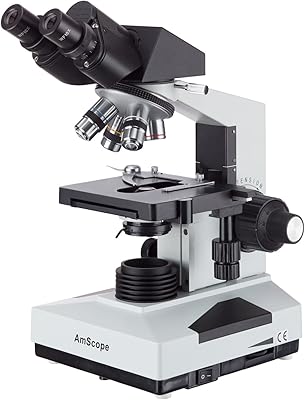
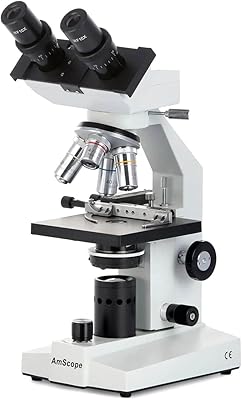
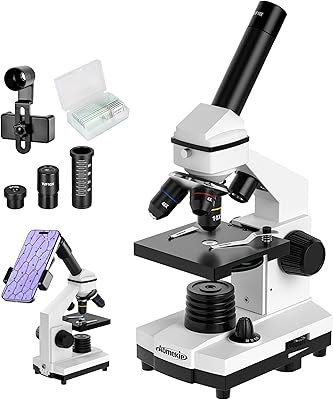
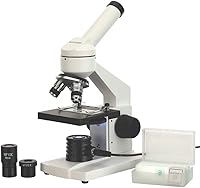
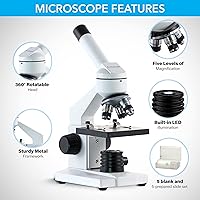
The AmScope M102C Biological Compound Microscope is a solid entry-level scope built for students, homeschoolers, and anyone just starting to explore the microscopic world. What separates it from cheap plastic kits is its all-metal frame and genuine optical glass lenses — you can feel the difference the moment you pick it up. It ships with five prepared slides and five blank ones, so there is no waiting around before the first real experiment. The wall-powered LED light means no scrambling for batteries mid-session, and the single eyepiece keeps setup straightforward enough for a curious ten-year-old to handle without much adult supervision.
Features & Benefits

This beginner compound scope covers five magnification levels — 40X, 100X, 200X, 400X, and 1000X — giving students enough range to study everything from large insect parts down to individual cells. The disc diaphragm on the condenser is a small but useful touch; adjusting it changes how much light hits the slide, which genuinely improves contrast when switching between specimens. Optical glass lenses make a real difference at 400X and below, where images stay sharp and well-defined. The body is compact and sturdy, measuring roughly 7.7 by 5.5 by 15 inches and weighing just under 3.5 pounds — light enough for a kid to move, yet stable enough not to wobble during focused observation.

Best For

This student microscope is a natural fit for middle and high school students working through biology units or preparing a science fair project. It also suits homeschooling families who want a proper optical tool — not a toy — for life science lessons. Kids aged roughly 8 and up can use it with minimal adult help once they get the hang of focusing. Hobbyists curious about pond water samples or plant cell structures will find the lower magnification range especially satisfying. For anyone taking their first real look at the microscopic world, this beginner compound scope strikes a strong balance between quality and accessibility.

User Feedback

Owner reviews are largely positive, with many buyers highlighting the image clarity at 400X as better than expected for an entry-level price tier. Build quality also earns consistent praise, particularly from parents who watched their kids handle it less than gently. That said, a few issues surface repeatedly. The coarse focus knob can feel stiff right out of the box, which younger users find frustrating at first. The 1000X setting sounds impressive but requires immersion oil to be genuinely useful — something the listing never mentions. And a critical note for North American buyers: this scope runs on 220 volts, so a step-down converter is necessary before plugging it into a standard U.S. outlet.

Pros

  • Optical glass lenses deliver noticeably sharper images than plastic-lens competitors at a similar price point.
  • The all-metal frame feels durable and sturdy — it can handle the occasional knock from younger users.
  • Wall-powered LED illumination keeps the light consistent and eliminates the need for replacement batteries.
  • Five prepared slides are included, so kids can start exploring real specimens on day one.
  • The monocular design is easy for beginners to learn on without feeling overwhelmed by controls.
  • Image clarity at 40X through 400X genuinely impresses most first-time users and parents alike.
  • The compact footprint fits comfortably on a standard desk or a child's homework table.
  • The disc diaphragm lets users tweak light contrast, which makes a practical difference when switching specimen types.
  • At roughly 3.5 pounds, it is light enough for a child to reposition without help.
  • Ranked among the top 50 lab compound monocular microscopes, it has a proven track record since 2015.

Cons

  • Runs on 220 volts — North American buyers must purchase a separate step-down converter before use.
  • The 1000X setting requires immersion oil to produce usable images, and none is included or mentioned.
  • The coarse focus knob can feel stiff straight out of the box, which frustrates younger users.
  • Only five prepared slides are included; kids often exhaust their curiosity with these within the first week.
  • The monocular eyepiece causes noticeable eye fatigue during longer viewing sessions compared to binocular models.
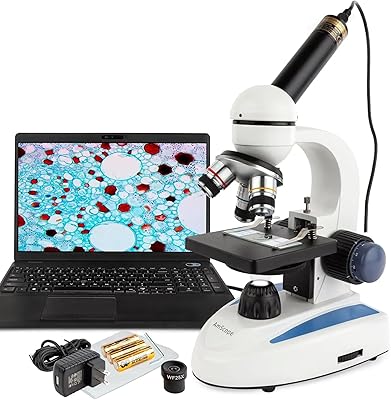
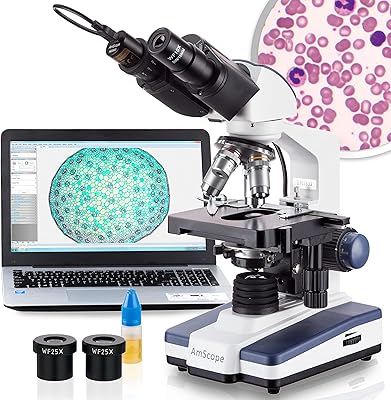
  • No camera port means capturing or sharing images requires a separate adapter setup that is not straightforward.
  • Blank slides require a basic slide preparation technique that beginners may struggle with initially.
  • The disc diaphragm is functional but less precise than an iris diaphragm found on higher-tier scopes.

Ratings

Our AI scoring system analyzed verified global user reviews for the AmScope M102C Biological Compound Microscope, actively filtering out incentivized, bot-generated, and duplicate submissions to surface what real buyers actually experienced. The scores below reflect a transparent picture — consistent strengths and genuine frustrations alike — drawn from thousands of documented ownership experiences across student, homeschool, and hobbyist contexts.

Optical Image Quality
83%
At 40X through 400X, reviewers consistently describe crisp, well-defined images that genuinely surprised them given the price tier. The optical glass lenses make a tangible difference when examining plant cells or pond microorganisms — details that plastic-lens alternatives simply blur over.
Image quality drops off sharply at 1000X without immersion oil, which is not included or flagged in the listing. Users who bought this scope expecting to view bacteria or blood cells at full power were frequently disappointed by the blurry, unusable results.
Build Quality
88%
The all-metal frame earns consistent praise from parents and teachers who watched students handle it roughly during lab sessions. Compared to plastic-body competitors in the same price bracket, this beginner compound scope feels noticeably more solid and professional.
The coarse focus knob is a recurring weak point — several buyers found it stiff right out of the box, which frustrated younger users trying to dial in a clear image. The mechanism improves with use, but it creates a poor first impression during the initial unboxing session.
Value for Money
86%
For an entry-level scope that ships with optical glass lenses, a metal frame, and a starter slide kit, most buyers felt they received more than their money's worth. Hobbyists and parents setting up a home science corner regularly cited it as the best balance of quality and affordability they found.
The mandatory purchase of a step-down voltage converter for North American buyers adds unexpected cost and hassle. When you factor in the converter and the immersion oil needed for the top magnification setting, the effective out-of-pocket cost is higher than the listing price suggests.
Ease of Setup
81%
19%
Most buyers reported getting the scope up and running within 15 to 20 minutes of unboxing, with no tools required. The included prepared slides let kids start viewing real specimens almost immediately, which makes the first-use experience rewarding rather than frustrating.
The 220V power requirement catches North American buyers completely off guard, since the listing does not clearly flag it. Discovering you need a voltage converter only after unboxing the unit is a genuine friction point that delays first use and irritates gift-givers especially.
Ease of Use
79%
21%
The monocular eyepiece and straightforward focus knobs make this student microscope approachable for children and first-timers who have never used optical equipment before. Most kids aged 10 and up can learn the basics independently within one short session.
Transitioning to higher magnification levels requires more technique than beginners expect — proper slide centering, condenser adjustment, and focus discipline all matter more at 400X and above. Younger users often get frustrated before developing the patience these steps require.
Illumination
84%
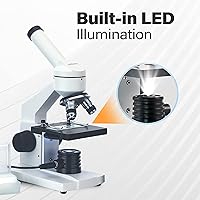
The wall-powered LED provides steady, cool light that stays consistent throughout long homework or lab sessions without flickering or dimming. Unlike older halogen setups, the LED does not heat up specimens, which is genuinely useful when examining delicate biological samples.
Brightness is not adjustable beyond the disc diaphragm, which limits fine-tuned lighting control compared to scopes with a variable rheostat. A few users also noted that the 220V requirement means the illumination system is effectively unusable without a converter in 110V countries.
Magnification Range
74%
26%
Five distinct magnification steps give students and hobbyists enough flexibility to observe large structures at 40X and work progressively down to cellular detail at 400X. For school-level biology and casual science exploration, the practical range covers virtually every common use case.
The headline 1000X figure is misleading without context — achieving a sharp, usable image at that level demands immersion oil technique that beginners rarely have. Many users felt the true working range tops out at 400X, making the 1000X spec feel more like a marketing number than a real capability.
Included Accessories
71%
29%
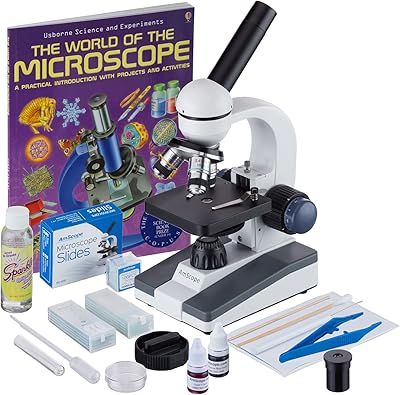
Shipping with 10 slides total — five prepared and five blank — gives beginners a meaningful starting point that most competing kits at this tier do not match. Kids can start with the prepared specimens and graduate to making their own preparations using the blank slides within the same session.
The slide variety runs thin quickly, especially for curious children who burn through the prepared set within the first week. No immersion oil, no lens cleaning kit, and no additional objective lenses are included, so expansion costs start adding up faster than buyers typically anticipate.
Durability
85%
The metal construction has proven its longevity across years of ownership reports — several reviewers noted their unit was still performing well after two or three years of regular student use. It holds up to the bumps and careless handling that are inevitable in a kid-friendly environment.
The focus mechanism is the component most likely to show wear over time, particularly if the initial stiffness leads users to force the knob rather than work it gently. Long-term optical alignment can also drift if the scope is frequently transported without its original packaging.
Portability
76%
24%
At 3.43 pounds and with a compact 7.7 by 5.5 footprint, the AmScope M102C is easy to move between a bedroom desk and a classroom table without strain. Its size makes storage in a closet or on a shelf practical even in smaller living spaces.
The wall-power dependency makes true portability limited — there is no battery option, so the scope is always tethered to an outlet and a converter. Taking it to a science fair or outdoor educational event requires planning around power access.
Optics Clarity at Low Mag
91%
At 40X and 100X, the glass lenses produce bright, wide, and sharp fields of view that genuinely impress first-time users. Pond water samples, onion skin cells, and fabric fibers all resolve with satisfying clarity that reinforces a child's excitement about science.
Even at low magnification, achieving the best image requires proper condenser and diaphragm adjustment, which is not explained in enough detail in the included documentation. Beginners who skip this step often blame the optics when the real issue is light setup.
Focus Mechanism
63%
37%
The dual coarse and fine focus system is a step above the single-knob designs found on cheaper toy microscopes, giving users meaningful control once they learn the workflow. Fine focus in particular is appreciated by older students doing more careful specimen observation.
Stiffness in the coarse focus knob is the single most common mechanical complaint across user reviews, and it disproportionately affects younger children who lack the hand strength to overcome it. This is a quality-control inconsistency rather than a design flaw, but it affects enough units to be a real concern.
Documentation & Instructions
58%
42%
The basic instruction sheet covers the fundamental assembly steps and magnification combinations clearly enough for an adult to follow without confusion. Most users get the scope assembled and focused within their first sitting using the included guide.
Critical operational details are absent — there is no mention of immersion oil requirements for 1000X, no voltage warning for 110V buyers, and no slide preparation guidance for beginners. These omissions lead directly to the most common negative reviews and buyer frustration.
Lens Durability
80%
20%
The optical glass lenses hold up well under regular cleaning and student handling, with very few reports of scratching or coating degradation over extended use periods. The glass construction is meaningfully more resilient than acrylic alternatives found on lower-cost scopes.
Without a dedicated lens cleaning kit in the box, some users resort to improper materials like paper towels, which can cause micro-scratches over time. The lack of a dust cover in the package is also a small but genuine oversight for long-term lens protection.

Suitable for:

The AmScope M102C Biological Compound Microscope is a strong match for students in middle or high school who need a reliable tool for biology class, lab reports, or science fair work. It also makes a lot of sense for homeschooling families who want something with real optical quality rather than a toy-grade alternative that frustrates kids within an hour. Parents setting up a home science space for curious children aged 8 and up will appreciate that it arrives ready to use, with prepared slides already in the box. Hobbyists who want to casually explore pond water samples, leaf cross-sections, or insect parts will get plenty of mileage from the 40X to 400X range. Budget-conscious buyers who refuse to sacrifice optical glass lenses for the sake of saving a few dollars will find this beginner compound scope hits a genuinely satisfying middle ground.
Not suitable for:

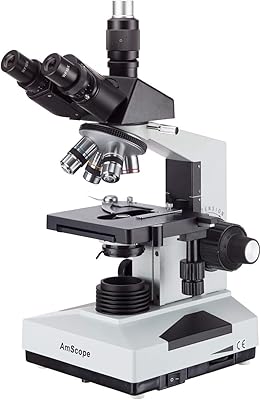
Anyone expecting the AmScope M102C Biological Compound Microscope to function as a serious research or clinical tool will quickly hit its ceiling. The 1000X magnification setting, while technically available, is largely impractical without immersion oil, which is sold separately and never mentioned in the product listing — a meaningful omission for buyers counting on that top-end power. North American users plugging into a standard 110V outlet are in for a surprise: this scope runs on 220 volts and requires a step-down converter, adding cost and inconvenience that the listing buries. Advanced hobbyists or adult enthusiasts who plan to spend hours at the eyepiece doing detailed specimen documentation would be better served by a binocular or trinocular model with a camera port. If the buyer needs digital image capture, lab-grade optics, or a wide-field eyepiece for extended viewing comfort, this entry-level scope is the wrong tool.

Specifications

  • Brand: Manufactured by AmScope, a company focused on optical instruments for education and professional use.
  • Model Number: The exact model designation is M102C-PB10, where PB10 indicates the included prepared and blank slide bundle.
  • Magnification: Offers five magnification levels — 40X, 100X, 200X, 400X, and 1000X — achieved through combinations of the eyepiece and objective lenses.
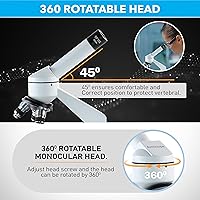
  • Eyepiece Type: Single monocular eyepiece design, which is standard for entry-level biological microscopes and keeps operation straightforward for new users.
  • Lens Material: All optical lenses, both eyepiece and objectives, are made from optical glass rather than acrylic or plastic.
  • Frame Material: The body and arm are constructed entirely from metal, providing a more durable and stable foundation than plastic-frame alternatives.
  • Illumination: Uses a built-in LED light source positioned below the stage, powered directly from a wall outlet for consistent brightness during use.
  • Voltage: Rated at 220 volts, which means buyers in 110V regions such as the United States and Canada must use a separate step-down voltage converter.
  • Condenser: Equipped with a single-lens condenser and a disc diaphragm that allows manual adjustment of light aperture for improved specimen contrast.
  • Dimensions: The unit measures 7.68″ in length, 5.51″ in width, and 15.16″ in height, fitting comfortably on a standard desk or study table.
  • Weight: Weighs 3.43 pounds, making it light enough for a child to handle and reposition without assistance.
  • Color: Available in white with standard black objective turret and stage components.
  • Included Slides: Ships with 5 factory-prepared biological slides and 5 blank glass slides for preparing custom specimens.
  • Focus Mechanism: Features both coarse and fine focus adjustment knobs located on the arm, allowing progressive focusing from low to high magnification.
  • Objective Lenses: Comes with a rotating turret holding multiple objective lenses covering the full magnification range from 4X to 100X objectives.
  • First Available: This model has been available for purchase since April 2015, giving it a long track record of real-world user feedback.
  • Best Sellers Rank: Ranked #50 in Lab Compound Monocular Microscopes on Amazon, indicating consistent and sustained sales performance in its category.

Related Reviews

AmScope M158 USB Compound Microscope
74%
88%
Build Quality
79%
Optical Clarity
51%
Camera Quality
91%
Ease of Setup
62%
Software Experience
More
AmScope B490B Compound Binocular Microscope
85%
94%
Optical Clarity
90%
Build Quality
85%
Ease of Use
92%
Value for Money
93%
Magnification Range
More
AmScope M150C Student Compound Microscope
82%
89%
Value for Money
85%
Build Quality
88%
Ease of Use
82%
Performance at High Magnification
86%
Image Clarity
More
AmScope T490B Compound Trinocular Microscope
74%
88%
Optical Clarity
91%
Trinocular Head
78%
Camera Integration
86%
Mechanical Stage
89%
Build Quality
More
AmScope B100B-MS Compound Binocular Microscope
69%
83%
Build Quality
74%
Optical Clarity
61%
Illumination
69%
Magnification Range
71%
Mechanical Stage
More
Aomekie AO1003 64X-160X-640X Biological Compound Microscope
83%
84%
Magnification Performance
90%
Ease of Use
88%
Build Quality & Durability
86%
Illumination Options
75%
Focusing Precision
More
AmScope B120C-E5 Binocular Compound Microscope
78%
88%
Optical Clarity
76%
Build Quality
91%
Illumination Quality
84%
Ergonomics & Comfort
67%
USB Camera Quality
More
OMAX M83ES 40X-2000X Lab Trinocular Biological Compound LED Microscope
84%
91%
Magnification Performance
89%
LED Illumination Quality
87%
Build Quality & Durability
93%
Ease of Setup
85%
Focus Mechanism
More
SVBONY SV605 Binocular Compound Microscope
85%
90%
Value for Money
88%
Ease of Setup
85%
Build Quality
89%
Optical Performance
91%
Illumination System
More
Herwicm RM Binocular Compound Microscope
73%
78%
Optical Clarity
74%
Build Quality
86%
Ease of Setup
76%
Focusing Mechanism
81%
Lighting System
More

FAQ

Not directly. The AmScope M102C Biological Compound Microscope is rated for 220 volts, while standard U.S. and Canadian outlets supply 110 volts. You will need a step-down voltage converter before plugging it in — this is one of the most commonly missed details, so do not skip it or you risk damaging the unit.
Honestly, not without extra preparation. Getting a clear, stable image at 1000X requires immersion oil applied directly to the slide and objective lens — a technique that takes practice, and the oil itself is not included. Most beginners get their best results between 40X and 400X, where the optics really shine.

Most parents find it works well for kids aged 8 and up with light supervision, and independently for children around 10 to 12 once they learn to focus properly. The controls are not complicated, but younger kids may struggle with the coarse focus knob if it feels stiff out of the box.

A stiff coarse focus knob is a known quirk that some users report on first use. In many cases it loosens up with regular use over a few sessions. If it remains uncomfortably tight, a tiny amount of silicone-based lubricant applied to the rack mechanism can help without damaging optics.

The five prepared slides typically cover basic biological subjects like plant cells, insect parts, and simple organisms — a solid sampler for getting started. The five blank slides let you make your own preparations from things like pond water, onion skin, or cheek cells using basic slide-prep techniques.

There is no dedicated camera port on this beginner compound scope, so direct digital attachment is not straightforward. Some users manage to hold a smartphone camera up to the eyepiece for casual shots, but image quality varies. If photography is a priority, look for a model with a dedicated trinocular port.

The LED is a genuine advantage here. It produces steady, cool light that does not heat up your slides or drain batteries, and brightness stays consistent throughout a session. Older halogen bulbs generate heat that can affect delicate specimens, and mirror-based scopes depend entirely on ambient light conditions.

That depends on how deep their interest goes. For school projects and general curiosity, this student microscope has plenty of range to stay useful through middle and high school. A budding scientist who wants to do advanced cell staining, microbiology experiments, or high-magnification research will likely want an upgrade within a year or two.

Yes. AmScope has a broad accessory ecosystem, and compatible prepared slide sets, blank slides, and spare objectives are widely available from their catalog and on major retail platforms. The standard objective thread size also means some third-party accessories are compatible.

Use only lens tissue or a soft, lint-free microfiber cloth — never regular paper towels or facial tissue, which can scratch optical glass. For stubborn smudges, a drop of lens-cleaning solution applied to the cloth works well. Avoid touching the glass directly with fingers, as skin oils are surprisingly hard to remove cleanly.