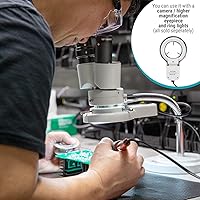
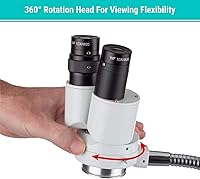
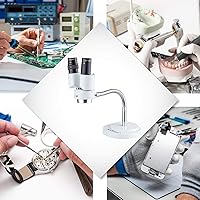
Overview

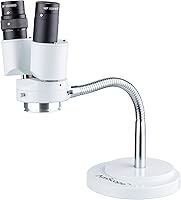
The AmScope SE508 Binocular Stereo Microscope sits comfortably in the mid-range of the stereo microscope market, designed for technicians, hobbyists, and light professional work rather than formal laboratory research. Its fixed 8X magnification is intentional — not a compromise. For surface-level inspection tasks like examining solder joints, dental restorations, or small mechanical parts, 8X hits a practical sweet spot where you see enough detail without losing spatial orientation. The 360° rotating head and gooseneck LED illuminator are the two physical features that immediately set it apart from cheaper fixed-arm alternatives. If you need reliable bench-level magnification for daily shop use, this stereo microscope is worth a serious look.

Features & Benefits

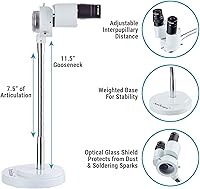
The 95mm working distance is one of the SE508's most practical advantages — it leaves enough clearance between the lens and your workpiece to comfortably maneuver a soldering iron, dental pick, or pair of tweezers underneath. The 25mm field of view means you can take in a reasonable area at once, reducing the constant repositioning that frustrates people using cheaper, narrower-field optics. Interpupillary adjustment is easy to dial in and makes a real difference during extended sessions. The 12-inch gooseneck arm positions the LED right where you need it, cutting down on shadows. And the weighted metal base stays planted — no rocking, no drift.

Best For

This stereo microscope earns its place on the bench for a specific type of user. Electronics repair technicians and PCB solderers will get the most out of it — the working distance and steady optics are well-matched to that workflow. Jewelry makers, fly tyers, and model builders also fit the profile well. Dental lab technicians doing bench-level restoration work will find the combination of rotation and illumination especially useful. Small shop owners who need quick visual inspection of components or machined parts will appreciate the no-fuss setup. It also works well in educational settings where durability matters more than advanced optical features. This is not the scope for high-magnification biological work.

User Feedback

Buyers consistently point to build quality and stability as the highlights — the all-metal construction and weighted base inspire confidence in a way that plastic-bodied alternatives simply don't. Image clarity gets solid marks too, with most users reporting clean, sharp edges for surface inspection tasks. That said, the most common frustration is the fixed magnification. Users who later want more flexibility — say, zooming in on smaller components — find themselves outgrowing the SE508 fairly quickly and wishing they had invested in a zoom model. A few buyers have also noted that the LED brightness can feel uneven across the field over time, and the gooseneck can lose some rigidity with heavy use. Overall, the value perception is strong for its intended use case.

Pros

  • All-metal construction and a weighted base give this stereo microscope a planted, professional feel on the bench.
  • The 95mm working distance is genuinely practical — plenty of room for soldering irons, picks, and tweezers underneath.
  • A 360-degree rotating head lets you reposition the viewing angle without shifting your workpiece or base.
  • The adjustable interpupillary distance makes binocular viewing comfortable across a wide range of users.
  • The flexible 12-inch gooseneck LED arm positions light exactly where you need it, reducing shadows on detailed work.
  • Setup is straightforward — most buyers report being up and running within minutes of unboxing.
  • Image clarity and edge sharpness at 8X receive consistently positive marks from real-world users.
  • The 25mm field of view reduces constant repositioning, which adds up to meaningful time savings during longer sessions.
  • Battery-powered operation means no cord management headaches on a busy workbench.
  • For its price tier, the SE508 offers a level of build durability that outpunches most plastic-bodied competitors.

Cons

  • Fixed 8X magnification offers zero flexibility — users whose needs evolve will likely outgrow it faster than expected.
  • No zoom capability means this bench-top magnifier cannot adapt to finer or broader inspection tasks without replacing the unit.
  • Several buyers report the gooseneck arm can gradually lose rigidity with repeated repositioning over months of use.
  • LED brightness has been noted as occasionally uneven across the field, which can be distracting on reflective surfaces.
  • At 9 pounds, it is not particularly portable and commits firmly to a dedicated bench position.
  • The battery-powered LED, while convenient, means periodic battery changes during heavy use — no corded option is available.
  • No accessory mounting options or camera attachment support limits its usefulness for documentation or remote viewing.
  • The single fixed magnification makes it a poor fit for shops where different operators need different levels of detail.
  • Replacement parts and eyepiece upgrades are not widely available, reducing long-term serviceability.
  • Buyers coming from zoom stereo models may find the transition to fixed magnification frustrating and restrictive.

Ratings

The scores below reflect AI-synthesized analysis of verified global buyer reviews for the AmScope SE508 Binocular Stereo Microscope, with spam, bot-generated, and incentivized feedback actively filtered out before scoring. Each category captures the full picture — what real users praised after weeks or months of hands-on use, and where they ran into genuine frustration. Nothing has been softened to favor the product.

Build Quality
91%
The all-metal construction earns consistent praise from buyers who have used plastic-bodied alternatives at similar price points. Technicians running the SE508 through daily shop use report that it holds up without developing looseness or wobble in the head or arm joints over time.
A smaller subset of users note that certain external finishing details — like paint on the base edges — show wear with heavy use faster than the core structure does. It is a cosmetic issue rather than a functional one, but worth noting for buyers who care about long-term appearance.
Optical Clarity
83%
For surface-level inspection work, the image through the eyepieces is described as clean and sharp in the central field, which is where soldering joints, dental restorations, and fine craft details actually sit during use. The achromatic lens does a solid job controlling color fringing at 8X.
Edge sharpness falls off noticeably, which bothers users who want to assess larger parts in a single glance. A handful of buyers also mention that out-of-box optical alignment occasionally needs minor adjustment before the binocular image merges cleanly.
Working Distance
93%
The 95mm clearance between the objective and the work surface is one of the most consistently praised features among electronics repair users and dental lab technicians. Having that room to freely maneuver a soldering iron or dental pick without pulling back from the eyepieces makes a real, felt difference during longer work sessions.
For users coming from lower-magnification loupes or head-mounted magnifiers, the fixed working distance can feel constraining when dealing with taller three-dimensional objects that encroach on the clearance zone. There is no way to extend it without changing the optical configuration.
Magnification Flexibility
52%
48%
At 8X, the fixed magnification hits a genuinely useful middle ground for most surface inspection tasks — detailed enough to read fine solder joints or set small stones, yet wide enough to maintain spatial awareness of the overall workpiece. Users with defined, repetitive tasks rarely feel limited.
Fixed magnification is the most common source of buyer regret in this category. Users who later need to inspect finer details — hairline PCB cracks, micro text, or intricate mechanical tolerances — find themselves blocked with no upgrade path on this bench-top magnifier. Zoom stereo alternatives cost more upfront but avoid this ceiling entirely.
Illumination Quality
74%
26%
The 12-inch gooseneck LED arm gives users real control over light direction, which matters considerably when working on reflective surfaces like solder pads or polished metal. Buyers appreciate being able to angle the light to eliminate shadow in tight corners of a workpiece.
Brightness consistency is a recurring complaint — some units produce noticeably uneven illumination across the field, with one side appearing slightly brighter than the other. A few long-term users also report gradual LED dimming after extended daily use, which is difficult to address given the integrated design.
Base Stability
89%
The weighted base is one of the quieter strengths of this stereo microscope — it simply stays put. Users doing fine-detail work with both hands underneath the optics report no image drift or vibration transmission from adjacent bench activity, which is exactly what this type of work demands.
The trade-off for that stability is weight. At 9.1 pounds, repositioning the unit within a crowded workspace is a minor chore, and it is not something most users would want to move between benches or rooms on a regular basis.
Gooseneck Durability
61%
39%
Out of the box, the gooseneck arm holds its position well and offers a wide range of positioning angles that users take advantage of for different illumination setups. Early-use experience with the arm is generally positive.
Over months of repeated repositioning, a meaningful number of buyers report that the gooseneck gradually loses tension and begins to droop rather than hold a fixed angle. This is a known wear pattern for gooseneck designs in this price tier and is the most frequently mentioned long-term durability concern.
Ease of Setup
92%
Almost universally described as simple and fast, with most buyers reporting a fully operational unit within ten to fifteen minutes of unboxing. There are no confusing calibration steps or tricky assembly sequences, which makes it accessible for non-technical hobbyists and students as well as professionals.
The documentation included with the unit is minimal, and a small number of buyers with no prior stereo microscope experience found the interpupillary adjustment and binocular image merging process slightly trial-and-error without clearer written guidance.
Ergonomics
78%
22%
The 45-degree angle of view and adjustable interpupillary spacing create a comfortable sitting posture for most users during moderate work sessions. Multiple users in shared shop environments note that switching between operators with different face geometries takes only a few seconds.
During sessions longer than a couple of hours, some users report neck and posture fatigue that they attribute to the fixed eyepiece height with no vertical adjustment on the body itself. A riser block or adjustable-height bench helps, but neither is included.
360° Head Rotation
86%
The rotating head is a practical, well-executed feature that users working on irregularly shaped objects — jewelry pieces, dental prosthetics, or assembled circuit boards — genuinely rely on. Being able to shift the viewing angle without touching the workpiece reduces handling errors significantly.
The rotation mechanism can develop slight play over extended use, introducing minor wobble at extreme angles. It does not affect the core use case in most positions, but users who frequently rotate to near-horizontal angles notice it more than those who work in a standard top-down orientation.
Value for Money
81%
19%
Buyers with a clear, defined use case — electronics repair, dental lab work, hobbyist crafting — consistently feel the pricing is fair for the build quality and optical performance on offer. The metal construction in particular is cited as justifying the cost compared to cheaper plastic-bodied competitors.
Users who purchased this hoping it would grow with their needs and discovered the fixed magnification limitation feel the value proposition weakens considerably. For buyers who ultimately upgraded to a zoom model within a year, the SE508 felt like an expensive detour rather than a stepping stone.
Battery Performance
69%
31%
The LED is efficient enough that casual and moderate users get a reasonable run before needing to replace batteries, and the cordless design is a genuine quality-of-life improvement for users with cluttered workbenches where cable management is already a challenge.
Heavy daily users — those running the scope for four or more hours continuously — find themselves replacing batteries more frequently than expected, which adds a small but persistent operational cost. The lack of a corded power option is a gap that frustrates professional-environment buyers specifically.
Footprint & Portability
58%
42%
The relatively compact base dimensions mean this bench-top magnifier does not dominate a standard workbench, and for users who assign it a dedicated spot, the footprint is a non-issue. It occupies space no differently than a typical desk lamp combined with a stand.
At 9.1 pounds with no carry handle or protective case included, portability is essentially nonexistent as a practical consideration. Users who hoped to move it between workspaces or take it to job sites found the weight and lack of carrying solution genuinely inconvenient.

Suitable for:

The AmScope SE508 Binocular Stereo Microscope is a strong match for anyone who spends real time doing hands-on bench work at a surface-inspection level. Electronics repair technicians and hobbyist solderers will find the 95mm working distance genuinely freeing — there is enough clearance to maneuver tools underneath without constantly pulling back from the eyepieces. Dental lab technicians working on prosthetics or restorations, jewelry makers setting stones, fly tyers wrapping tiny hooks, and model builders painting fine detail all fall squarely into the ideal user profile. Small shop owners who need a reliable, no-fuss optical inspection tool for parts or assemblies will also get consistent daily value from this bench-top magnifier. If your work is fundamentally about seeing surface detail clearly and working with your hands underneath the optics, the SE508 is built around exactly that workflow.

Not suitable for:

The AmScope SE508 Binocular Stereo Microscope is not the right choice for users who need variable magnification — and that group is larger than many buyers initially realize. If you anticipate wanting to zoom in further on very fine features, such as hairline PCB cracks or microscopic surface defects, the fixed 8X will eventually feel limiting and you will likely want a zoom stereo model instead. This scope is also entirely unsuitable for biological or cellular microscopy; it has no transmitted light source and the magnification range simply does not support that type of work. Researchers, pathologists, or advanced science students expecting laboratory-grade optics will be disappointed. Buyers who work in very confined spaces may also find the footprint and 9-pound weight less convenient than a smaller, lighter alternative. If your needs are likely to grow or diversify quickly, it is worth investing in a more versatile platform from the outset.

Specifications

  • Magnification: Fixed 8X magnification provides consistent optical power suited to surface-level inspection and hands-on bench tasks.
  • Working Distance: The working distance measures 95mm (3 3/4 inches), leaving ample clearance to operate tools beneath the optics.
  • Field of View: A 25mm field of view allows users to observe a broad surface area without constantly repositioning the specimen.
  • Head Rotation: The binocular head rotates a full 360 degrees, enabling viewing from multiple angles without disturbing the workpiece.
  • Illuminator: A 12-inch flexible LED gooseneck arm is integrated into the unit, delivering adjustable, directional illumination across the work surface.
  • Interpupillary: The distance between the eyepieces is fully adjustable to accommodate different users and ensure comfortable binocular alignment.
  • Objective Lens: The achromatic objective lens minimizes chromatic aberration, producing cleaner and more color-accurate imagery at the working magnification.
  • Angle of View: The real angle of view is 45 degrees, offering a natural, ergonomic sightline during extended bench sessions.
  • Body Material: The optical body and structural frame are constructed entirely from metal, contributing to long-term durability and vibration resistance.
  • Base: The weighted metal base keeps the unit firmly planted on the workbench, resisting movement during precision handling.
  • Power Source: The LED illuminator is battery powered, eliminating the need for a direct power outlet and reducing cord clutter on the bench.
  • Weight: The complete unit weighs 9.1 pounds, reflecting its robust all-metal build rather than lightweight portability.
  • Dimensions: Overall product dimensions measure 8.07 x 8.07 x 17.72 inches, sized for a dedicated footprint on a standard workbench.
  • Voltage Rating: The unit carries a 240-volt rating, consistent with standard international electrical specifications for its LED system.

Related Reviews
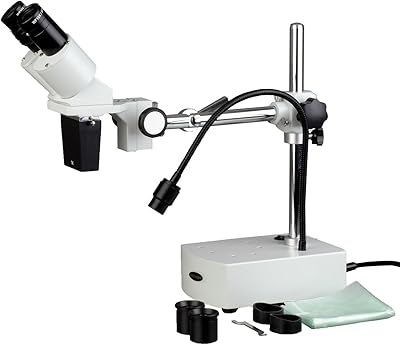
AmScope SE400-Z Binocular Stereo Microscope
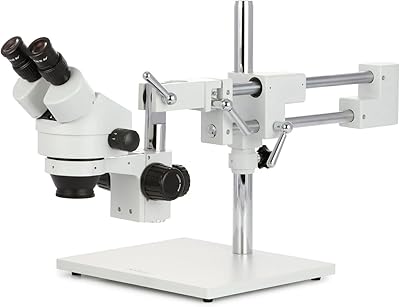
77%
88%
Build Quality
79%
Optical Clarity
93%
Working Distance & Clearance
86%
Boom Arm Flexibility
81%
Eyepiece Comfort & Ergonomics
More
AmScope SM-4B Stereo Zoom Microscope Boom Stand
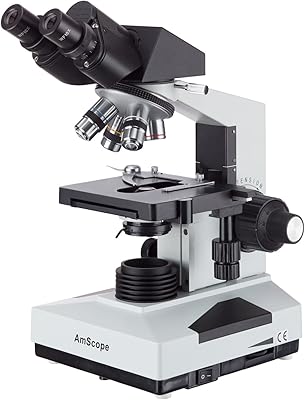
76%
93%
Build Quality
88%
Optical Clarity
91%
Boom Stand Versatility
41%
Illumination
82%
Ergonomics
More
AmScope B490B Compound Binocular Microscope
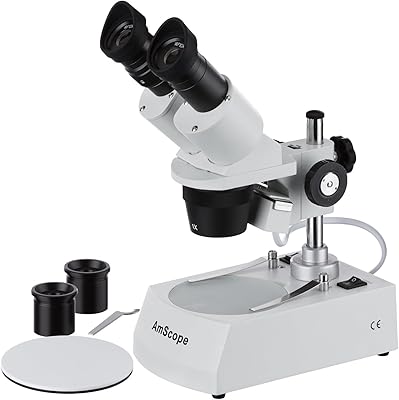
77%
86%
Optical Clarity
91%
Build Quality
63%
Illumination System
88%
Stage Precision
54%
High Magnification Performance
More
AmScope SM-3B Binocular Zoom Stereo Microscope
73%
88%
Optical Clarity
91%
Zoom Range & Versatility
83%
Boom Stand Design
86%
LED Ring Light
84%
Build Quality & Durability
More
AmScope SE305R-PZ Stereo Microscope
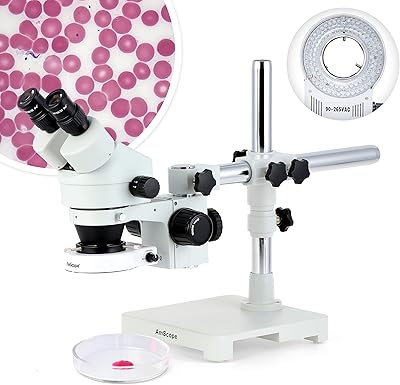
75%
86%
Build Quality
78%
Optical Clarity
71%
Lighting System
91%
Ease of Setup
82%
Ergonomics & Comfort
More
AmScope SE306R-PZ-LED Binocular Stereo Microscope
77%
84%
Build Quality & Materials
82%
Low-Magnification Clarity
58%
High-Magnification Clarity (80x)
81%
LED Illumination System
76%
Value for Money
More
AmScope SW-3T24Z Trinocular Stereo Microscope
87%
92%
Magnification Quality
88%
Ergonomics & Comfort
84%
Boom Stand Adjustability
91%
Image Clarity
85%
Build Quality & Durability
More
AmScope B100B-MS Compound Binocular Microscope
69%
83%
Build Quality
74%
Optical Clarity
61%
Illumination
69%
Magnification Range
71%
Mechanical Stage
More
Swift S306S Binocular Stereo Microscope
79%
83%
Optical Clarity
79%
Build Quality
88%
Illumination System
71%
Magnification Range
91%
Head Design & Ergonomics
More
AmScope B120C-E5 Binocular Compound Microscope
78%
88%
Optical Clarity
76%
Build Quality
91%
Illumination Quality
84%
Ergonomics & Comfort
67%
USB Camera Quality
More

FAQ

Yes, it is one of the more practical options at this price point for exactly that kind of work. The 95mm working distance is the key detail here — it gives you enough room to hold a soldering iron or tweezers comfortably underneath the optics without bumping into the lens housing. The stable base also means the image does not bounce around when you move your hands nearby.

No, the SE508 is fixed at 8X and cannot be adjusted. This is the most important thing to understand before buying. If you think you will regularly need to zoom in tighter on very fine details — like hairline traces on a circuit board or micro-engraving — you should look at a zoom stereo microscope instead. For most surface inspection tasks, 8X is genuinely useful, but it does have a ceiling.

Setup is straightforward. Most users report having the unit assembled and ready to use within ten to fifteen minutes, with no special tools or technical knowledge required. The gooseneck arm and rotating head click into position intuitively, and adjusting the interpupillary spacing takes only a moment once you sit down at the eyepieces.

The AmScope SE508 Binocular Stereo Microscope does not include a dedicated camera port or trinocular head, so standard camera attachment is not straightforward. If documentation or remote viewing is important to your workflow, you would need a trinocular stereo model with an appropriate camera adapter instead.

No, and this is an important distinction. This bench-top magnifier is a stereo surface-inspection scope — it is designed to look at the tops of objects in three dimensions, not through thin specimens on slides. It has no transmitted light base and its magnification range does not come close to what biological work requires. For that, you would need a compound microscope with a transmitted illumination source.

It works well initially and gives you a lot of flexibility for directing light exactly where you need it. However, a number of long-term users have noted that the gooseneck can gradually lose rigidity after months of repeated bending and repositioning, eventually settling in a slightly drooped position. It is not a dealbreaker, but it is worth being aware of if you plan to reposition the light frequently throughout the day.

Battery life will depend heavily on how long you run the LED each session. The LED is relatively efficient, so casual users tend to get a reasonable run before needing a replacement. That said, if you are using this scope for several hours daily in a professional setting, keeping a spare set of batteries on hand is a practical habit. Consult the included documentation for the specific battery type required.

The adjustable interpupillary distance makes it reasonably accommodating for different users. Each person can dial in their preferred eyepiece spacing, so switching between operators in a shared shop or classroom setting is not a hassle. It is not quite as instant as a quick-swap system, but it only takes a few seconds to readjust.

The achromatic objective lens does a solid job of keeping center-field imagery clean and sharp, which is where most users are focused during detail work. Some softening at the extreme edges of the field is normal for optics in this category and price range. For the core inspection area that matters in daily use, the clarity is well-regarded by experienced buyers.

It is a genuinely good fit for that kind of work. Jewelry makers setting small stones, examining hallmarks, or inspecting prong settings benefit from the comfortable working distance and the stable, vibration-resistant base. The rotating head is also a practical advantage when you need to view a ring or pendant from a different angle without picking it up and turning it yourself.