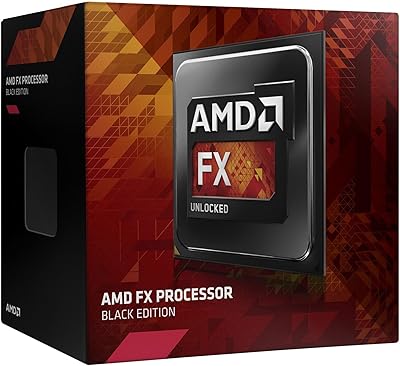
Overview

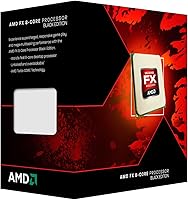
The AMD FX-8300 8-Core Desktop Processor occupies an interesting spot in the CPU market — it's not a modern powerhouse, but for anyone still running an AM3+ platform, it makes a compelling case as an affordable upgrade. Built on AMD's Vishera architecture at 32nm, this eight-core FX chip sits comfortably above entry-level quad-core options without demanding the premium of the higher-end FX-9000 series. If you're refreshing an older desktop rather than building from scratch, the value proposition here is hard to dismiss. It's a chip that knows its lane and fills it well.
Features & Benefits

The FX-8300 runs its eight cores at a base of 3.3GHz, with Turbo Core boost pushing select cores up to 4.2GHz under load. At 95W TDP, heat output is reasonable — most standard mid-tower coolers handle it without drama, and the included stock cooler gets the job done for everyday use. The cache setup, 8MB of L3 paired with 4x2MB of L2, helps keep multi-threaded tasks moving efficiently. DDR3 support slots naturally into existing AM3+ builds, and the unlocked multiplier means confident overclockers have real room to push things further without needing exotic tools.

Best For

This AMD desktop processor makes the most sense for a specific kind of builder: someone with a working AM3+ motherboard who wants more cores without replacing the entire platform. Light video editing and 3D rendering workflows will benefit from the eight-core headroom, even if render times won't rival modern Ryzen builds. It also fits well in a secondary workstation or home office machine where the workload is real but the budget is tight. Pair it with a decent dedicated GPU, and it handles older gaming titles without missing a beat. Cost efficiency is the core appeal here — full stop.

User Feedback

Across more than 670 ratings, the FX-8300 holds a 4.2 out of 5 average, reflecting a user base that largely got what it came for. The most consistent praise centers on multi-core value — buyers upgrading aging systems report a noticeable improvement over older quad-core chips. That said, honest reviewers acknowledge the single-core performance gap; this chip won't compete with modern alternatives in tasks relying on raw clock-for-clock speed. Overclocking experiences lean positive, though better cooling clearly helps. One practical note appearing frequently: always verify your BIOS compatibility before purchasing, as some older AM3+ boards require a firmware update to recognize this processor.

Pros

  • Eight cores at this price point makes it one of the best-value AM3+ upgrade options available.
  • Turbo Core boost pushes clock speeds up to 4.2GHz, helping in lightly threaded bursts.
  • A 95W TDP means it runs cool enough for most standard mid-tower setups without exotic cooling.
  • The unlocked multiplier makes overclocking approachable for intermediate builders.
  • Bundled stock cooler means you can get up and running immediately without extra purchases.
  • Strong multi-threaded throughput handles simultaneous workloads like encoding and browsing without stuttering.
  • DDR3 compatibility slots right into existing AM3+ boards, keeping upgrade costs low.
  • Holds a 4.2 out of 5 average across hundreds of real buyer reviews — not a fluke rating.
  • A practical choice for secondary workstations or home lab machines where budget is the priority.

Cons

  • Single-core performance trails modern Ryzen and Intel processors by a significant margin.
  • The AM3+ platform is a dead end — no meaningful upgrade path exists beyond the FX chip lineup.
  • Some older AM3+ motherboards require a BIOS update before the FX-8300 is even recognized.
  • DDR3 memory support means you cannot take advantage of faster DDR4 or DDR5 speeds.
  • Real-world gaming frame rates suffer in CPU-bound scenarios compared to current-generation chips.
  • The 32nm Vishera architecture is aging, and efficiency per watt lags behind modern process nodes.
  • Not well-suited for demanding creative workloads like 4K video editing or large 3D renders.
  • Stock cooler, while functional, runs audibly louder under sustained load compared to aftermarket options.
  • Resale and long-term value are limited given how far the platform has fallen behind current standards.

Ratings

Our AI rating system analyzed verified global buyer reviews for the AMD FX-8300 8-Core Desktop Processor, actively filtering out incentivized, bot-generated, and outlier feedback to reflect what real builders and upgraders actually experienced. The scores below capture both where this chip earns its reputation and where it falls short — nothing is glossed over. Whether you are weighing a platform upgrade or comparing it against modern alternatives, these ratings give you an honest, data-grounded starting point.

Multi-Core Performance
82%
18%
Users running multi-threaded workloads like video encoding, batch rendering, and running several applications in parallel consistently praised the chip's ability to keep up without breaking the bank. For anyone upgrading from a quad-core FX chip, the jump to eight cores felt genuinely substantial in day-to-day use.
The eight-core advantage narrows quickly in workloads that don't scale well across cores, and reviewers noted that software increasingly optimized for modern architectures doesn't extract the same efficiency it would from a Ryzen chip at a similar price point today.
Single-Core Speed
47%
53%
Turbo Core does nudge active cores up to 4.2GHz, which provides a modest boost during lightly threaded tasks and helps the chip feel more responsive than its base clock alone would suggest. For casual browsing, document work, and older software, the experience is acceptable.
This is the FX-8300's most documented weakness. Buyers who came from Intel Core i5 setups or later moved to Ryzen noted a clear and frustrating gap in single-threaded responsiveness — app launch times, web rendering, and game logic updates all expose the architectural ceiling of the Vishera design.
Gaming Performance
58%
42%
Paired with a capable dedicated GPU, the FX-8300 handles older game titles and less CPU-demanding genres — strategy games, older open-world titles, and indie games — without producing significant bottlenecks. Users building budget retro gaming rigs reported solid, enjoyable experiences at 1080p.
Modern AAA titles that push CPU scheduling hard exposed the chip's single-threaded limitations noticeably, with some users reporting stuttering and frame pacing issues that a GPU upgrade alone couldn't fix. Competitive multiplayer gaming, where frame timing consistency matters, is not this chip's strong suit.
Value for Money
83%
For buyers with an existing AM3+ motherboard, the cost-to-core-count ratio is one of the strongest arguments for this chip. Reviewers who framed the purchase as a platform upgrade rather than a new build consistently described it as one of the smartest low-investment improvements they could make to an aging desktop.
The value equation shifts if you factor in the cost of a new AM3+ board for a fresh build — at that point, the total platform spend starts competing with budget Ryzen options that offer a far better upgrade path and better long-term efficiency.
Thermal Management
74%
26%
At 95W TDP, the FX-8300 sits at a reasonable thermal envelope for an eight-core chip of its generation. Users in standard mid-tower cases with decent airflow reported stable temperatures during moderate workloads without needing anything beyond the included cooler.
During sustained heavy loads — long renders, extended encoding sessions, or overclocked operation — temperatures climb noticeably and the stock cooler becomes audibly strained. A handful of reviewers reported thermal throttling in poorly ventilated cases, particularly compact mid-towers with restricted airflow.
Overclocking Headroom
77%
23%
The unlocked multiplier makes the overclocking process refreshingly accessible — users report clean, stable overclocks through BIOS adjustments without needing specialized software or advanced knowledge. Paired with a mid-range aftermarket cooler, many builders pushed the chip meaningfully beyond stock speeds.
The gains from overclocking this AMD desktop processor are real but bounded — the architectural efficiency ceiling limits how far raw clock speed increases can translate into better real-world performance, and pushing voltages higher increases power draw and heat faster than it improves output.
Platform Compatibility
61%
39%
Drop-in compatibility with the broad ecosystem of AM3+ motherboards makes the FX-8300 a convenient upgrade for existing builds. For users already on compatible boards with up-to-date BIOS, installation is clean and immediate with no additional configuration needed.
Compatibility is not universal, and this is the most frequently raised pain point in buyer reviews. Older AM3+ boards often require a BIOS update to recognize the chip, and performing that update requires a compatible older processor already installed — a genuine logistical hurdle for some buyers.
Stock Cooler Quality
62%
38%
Including a stock cooler in the retail box means builders can get the system up and running without an extra purchase, which reviewers appreciated for budget-constrained builds. For typical office and multimedia workloads running at stock speeds, the bundled cooler is fully functional.
Under sustained computational load, the stock cooler runs noticeably loud and struggles to maintain ideal temperatures. Users who planned to run the chip at full utilization for extended periods — encoding, rendering, gaming sessions — almost universally recommended replacing it with an aftermarket unit.
Power Efficiency
53%
47%
Compared to higher-end FX chips in the 125W to 220W range, the 95W TDP of the FX-8300 represents a relatively conservative power draw for an eight-core chip, and users running modest home desktops did not report unusually high electricity consumption.
Against modern standards — particularly AMD's own Ryzen lineup — the performance-per-watt ratio is poor. Reviewers who later upgraded to Ryzen noted that their new systems consumed less power while delivering significantly better output, highlighting how far efficiency has advanced since the Vishera era.
Installation Experience
79%
21%
The physical installation process follows the standard AM3+ mounting procedure, and users of all experience levels described it as straightforward. The chip seats cleanly, thermal paste application with the stock cooler is simple, and the system typically posts without any unusual configuration steps on compatible boards.
The pre-installation research burden is higher than average — buyers must confirm board compatibility, check BIOS revision support, and in some cases plan for a temporary CPU swap to perform a firmware update before the FX-8300 is even recognized. That friction catches unprepared buyers off guard.
Memory Performance
66%
34%
DDR3 support integrates smoothly with the existing AM3+ ecosystem, and users already owning DDR3 kits reported no compatibility issues. Running dual-channel DDR3 at 1866MHz delivers adequate bandwidth for the workloads this chip is typically used for.
The DDR3 limitation is a hard ceiling — there is no path to faster DDR4 or DDR5 memory on this platform, and that bandwidth gap becomes apparent in memory-intensive workloads like large dataset processing or high-resolution texture streaming in modern games.
Longevity and Upgrade Path
39%
61%
Within the AM3+ ecosystem, the FX-8300 sits near the top of a practical upgrade hierarchy, meaning buyers who choose it are getting close to the ceiling of what the platform can offer without overspending on the FX-9000 series.
The AM3+ platform is functionally a dead end — no new processors, no DDR4 support, and no meaningful performance roadmap ahead. Buyers who purchased this chip as a stopgap have been satisfied, but those who expected it to anchor a system for many years found the upgrade ceiling arrived faster than anticipated.
Workstation Multitasking
76%
24%
Home office users juggling spreadsheets, browser tabs, background downloads, and light creative applications reported that the eight-core configuration handled simultaneous tasks comfortably. The chip rarely became the bottleneck in typical productivity scenarios, which is exactly what this segment of buyers needed.
When multitasking tips into heavier territory — running a VM alongside a media export, for example — the limits of Vishera's inter-module communication architecture surface as inconsistent responsiveness, something users moving from modern chips noticed clearly.
Noise Levels
59%
41%
At idle and during light tasks, the FX-8300 with its stock cooler runs quietly enough for a shared office or living space environment. Casual users who keep loads light reported no meaningful noise complaints in day-to-day operation.
Under any sustained load, the stock cooler fan ramps aggressively and produces a consistent mid-pitch whine that several reviewers described as distracting during long work or gaming sessions. Quiet computing is not achievable with this chip's bundled cooling solution without an aftermarket replacement.

Suitable for:

The AMD FX-8300 8-Core Desktop Processor is a genuinely smart pick for anyone already invested in the AM3+ platform who wants a meaningful performance bump without the cost of a full system rebuild. If you have a compatible motherboard sitting in a mid-tower from the early-to-mid 2010s, dropping this chip in is one of the most cost-efficient upgrades you can make. It shines in multi-threaded workloads like light video editing, batch file processing, and 3D rendering on a budget — tasks where having eight cores available matters more than raw single-core speed. Home office users who run several applications simultaneously will notice a real difference compared to older quad-core predecessors. It also suits retro gaming builds and secondary workstations where the goal is functional reliability at a low entry cost, especially when paired with a dedicated GPU to handle the graphics-heavy lifting.

Not suitable for:

Anyone building a brand-new desktop from scratch in the current market should look elsewhere — the AMD FX-8300 8-Core Desktop Processor is a legacy platform chip, and investing in AM3+ today means committing to a dead-end ecosystem with no upgrade path beyond the FX series itself. Competitive gamers who rely on strong single-threaded performance will find this chip frustrating, as modern Intel Core and AMD Ryzen processors pull significantly ahead in the workloads that most games actually prioritize. Content creators working with 4K footage, complex motion graphics, or large Blender scenes will hit a ceiling faster than they'd like. If your workload demands fast compile times, heavy virtualization, or any task that scales on per-core efficiency rather than core count alone, the FX-8300 simply doesn't keep pace with what modern silicon delivers at comparable or even lower price points today.

Specifications

  • Architecture: Built on AMD's Vishera architecture using a 32nm manufacturing process.
  • Core Count: Features 8 physical cores for handling multi-threaded workloads simultaneously.
  • Base Clock: Operates at a base frequency of 3.3GHz under standard sustained load conditions.
  • Boost Clock: AMD Turbo Core technology can boost active cores up to 4.2GHz when thermal headroom allows.
  • TDP: Rated at 95W thermal design power, making it manageable for most standard mid-tower cooling solutions.
  • L3 Cache: Equipped with 8MB of shared L3 cache to reduce memory latency across all cores.
  • L2 Cache: Includes 4 dedicated L2 cache modules of 2MB each, totaling 8MB of L2 across the processor.
  • CPU Socket: Designed exclusively for AMD's AM3+ socket, requiring a compatible AM3+ motherboard.
  • Memory Support: Supports DDR3 SDRAM memory types, compatible with the standard AM3+ platform memory specification.
  • Processor Series: Part of the AMD FX Black Edition lineup, which denotes an unlocked multiplier for overclocking.
  • Model Number: Official AMD retail model number is FD8300WMHKBOX, which includes the bundled stock cooler.
  • Included Cooler: Ships with an AMD stock cooling solution in the retail box for immediate out-of-box installation.
  • Overclocking: The unlocked CPU multiplier allows users to increase clock speeds beyond stock settings via BIOS.
  • Dimensions: Physical chip dimensions measure approximately 0.79 x 1.97 x 0.02 inches as listed by the manufacturer.
  • Item Weight: The retail package weighs approximately 1.76 ounces including the processor and bundled cooler.
  • Platform: Targets the AM3+ desktop platform, which also supports DDR3 memory and existing AM3+ chipset motherboards.
  • Availability: First made available in February 2015 and listed as not discontinued by the manufacturer.
  • Buyer Rating: Holds an average rating of 4.2 out of 5 based on 673 customer ratings on Amazon.
  • Market Rank: Ranked #165 in Amazon's Computer CPU Processors category at time of listing.

Related Reviews
Intel Core i9-11900K Desktop Processor
70%
91%
Gaming Performance
93%
Single-Core Speed
67%
Multi-Threaded Performance
54%
Thermal Performance
84%
Overclocking Capability
More
AMD Ryzen 7 3800X Desktop Processor
83%
93%
Multi-Threaded Performance
86%
Gaming Performance
74%
Value for Money
71%
Thermal Performance
82%
Bundled Cooler Quality
More
AMD Ryzen 7 9700X
AMD Ryzen 7 9700X
84%
94%
Gaming Performance
88%
Multitasking & Productivity
62%
Thermal Management
91%
Platform Longevity
74%
Value for Money
More
AMD FX-8370 Black Edition Desktop Processor
73%
83%
Multi-Threaded Performance
86%
Clock Speed & Turbo Performance
88%
Overclocking Capability
54%
Thermal Management
89%
Platform Compatibility
More
AMD Ryzen 7 5700X
AMD Ryzen 7 5700X
80%
93%
Value for Money
88%
Gaming Performance
84%
Multi-Threaded Performance
91%
Single-Core Speed
86%
Installation & Compatibility
More
AMD Ryzen 7 7700 Desktop Processor
80%
88%
Gaming Performance
83%
Multi-Threaded Performance
91%
Single-Core Speed
74%
Value for Money
86%
Platform Longevity
More
Intel Core i5-13400F 2.5GHz 10-Core Desktop Processor
87%
88%
Performance
92%
Value for Money
84%
Gaming Performance
89%
Multi-core Efficiency
91%
Ease of Installation
More
Intel Core i7-9700K Octa-Core Desktop Processor
73%
91%
Gaming Performance
89%
Single-Core Speed
88%
Overclocking Potential
86%
Build Quality & Longevity
74%
Value for Money
More
Intel Core i5-9500 Desktop Processor
72%
88%
Everyday Performance
81%
Gaming Capability
91%
Thermal Management
58%
Multi-threaded Workloads
83%
Platform Compatibility
More
Intel Core i5-8600 Desktop Processor
71%
83%
Single-Core Performance
61%
Multithreaded Performance
74%
Gaming Performance
71%
Value for Money
88%
Thermal Efficiency
More

FAQ

The FX-8300 is designed for AM3+ sockets, but many AM3 motherboards are physically compatible since the socket is backward-compatible in most cases. That said, support depends heavily on your specific board and its BIOS version, so check your motherboard manufacturer's CPU compatibility list before purchasing — this is the single most important step to get right.

Quite possibly, yes. A number of AM3+ boards — especially older ones — require a BIOS update to recognize newer FX processors like this one. The tricky part is that you may need an older compatible CPU installed first just to perform the update. Check your board's support page for the minimum BIOS version that lists the FX-8300 as supported.

It depends on your expectations. For older titles, casual gaming, or games that lean on GPU performance rather than CPU throughput, it holds up reasonably well when paired with a decent graphics card. However, modern CPU-intensive titles that rely on strong single-core performance will show its age, as newer Ryzen and Intel chips pull ahead noticeably in those workloads.

The retail box includes an AMD stock cooler, so you can install and run the chip right away without buying anything extra. For everyday computing and moderate workloads, the bundled cooler is sufficient. If you plan to overclock, investing in a quality aftermarket cooler will give you better thermal headroom and quieter operation.

Realistically, even entry-level Ryzen chips from the Ryzen 3 and Ryzen 5 lineup outperform the FX-8300 in most everyday tasks, particularly anything single-threaded. The FX-8300 remains competitive in heavily multi-threaded scenarios at its price point, but if you're starting fresh without an existing AM3+ board, a Ryzen build will serve you better in the long run.

Yes — the unlocked multiplier makes overclocking fairly straightforward through your motherboard's BIOS settings. Most users with mid-range AM3+ boards and a decent aftermarket cooler report stable overclocks without much difficulty. Just make sure your power delivery and cooling are adequate, as pushing the chip harder increases both heat and power draw.

The FX-8300 supports DDR3 SDRAM, which is standard for the AM3+ platform. It does not support DDR4 or DDR5, so if you're looking to use faster modern memory, this platform isn't compatible. For AM3+ users already owning DDR3 sticks, this is a non-issue — your existing RAM will work fine.

For light to moderate video editing — think 1080p timelines, basic color grading, and standard exports — this eight-core FX chip performs reasonably well given its core count. Where it struggles is with 4K footage, complex effects, or demanding render pipelines where modern processors with better per-core efficiency finish the job significantly faster. It's a workable option on a tight budget, not a production workhorse.

Under sustained load, the bundled AMD stock cooler is audible — not painfully loud, but noticeable in a quiet room. For a home office or secondary machine where fan noise isn't a priority, it's perfectly acceptable. If you're building a quiet workstation, an aftermarket cooler with larger heatsink fins and a slower-spinning fan is worth the investment.

If you're currently running something like an FX-4300 or FX-6300, upgrading to the FX-8300 is a straightforward and cost-effective way to add more cores to your existing build. You'll notice the difference in multi-threaded tasks like video exports, running multiple applications, and anything that actually takes advantage of the additional cores. It's one of the more logical upgrade steps within the AM3+ ecosystem.

Where to Buy