Overview

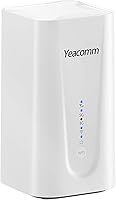
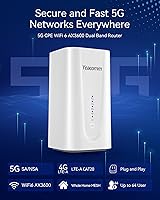
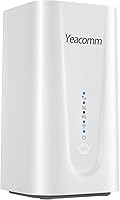
The Yeacomm NR330 AX3600 5G WiFi 6 Router is a mid-to-high-tier cellular gateway built for people who want to ditch their cable or fiber ISP entirely and run their home or office internet off a SIM card. It supports both SA and NSA 5G modes, falls back gracefully to LTE Cat20 or 3G when 5G is not available, and covers the frequency bands used by AT&T and T-Mobile. The compact tower design houses six built-in cellular antennas and an active cooling fan — a detail worth noting if you plan to run it around the clock. Think of this less as a router and more as a full ISP replacement that happens to fit on a desk.

Features & Benefits

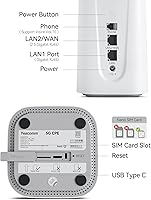
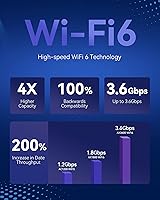
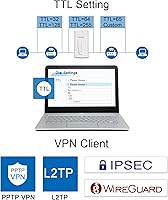
The NR330 packs a wide feature set for its form factor. Wi-Fi 6 with OFDMA and MU-MIMO keeps traffic moving when many devices are connected — up to 64 at once — by reducing the bottlenecks older routers struggle with in busy households. Wired connectivity is not an afterthought either: a 2.5G LAN port handles fast connections to a desktop or NAS, while a standard gigabit port covers everything else. There is also an RJ11 jack for VoLTE voice calls, which is handy if you want to keep a desk phone running over cellular. Power users will appreciate band locking controls and WireGuard support alongside older VPN protocols like IPSec and L2TP.

Best For

This SIM-based WiFi 6 gateway makes the most sense for people who either cannot get reliable fixed broadband or simply do not want to deal with a cable company. Rural and suburban households with solid 5G or LTE coverage from AT&T or T-Mobile are the clearest fit. It also works well for RV owners and vacation rental hosts who need internet that travels with them or just works without a technician visit. Small offices and remote workers who want a cellular backup line will find the advanced networking options worth the investment. If you are a Verizon customer, verify band compatibility carefully before buying, as support for that carrier is not clearly documented.

User Feedback

Buyers generally respond well to how straightforward the setup process is — insert SIM, power on, and this 5G cellular router handles the rest without much configuration. Real-world speeds land well below the theoretical ceiling, which is expected; what users actually report reflects typical mid-band 5G or strong LTE-Advanced performance depending on location and carrier plan. The cooling fan does its job but runs audibly enough that a few users in quiet rooms take notice. Verizon compatibility is a recurring question in reviews and remains unclear, so treat that as a known risk. On the support side, Yeacomm earns generally solid marks for responsiveness, which is reassuring for a less mainstream brand.

Pros

  • Plug-and-play SIM setup means most users are online within minutes, no ISP technician required.
  • Supports both SA and NSA 5G modes, future-proofing the device as carrier networks continue to mature.
  • Wi-Fi 6 with OFDMA handles crowded device environments far better than older router generations.
  • The 2.5G wired port is a genuine bonus for users connecting a NAS, desktop, or unmanaged switch.
  • VoLTE via the RJ11 port lets you run a desk phone over cellular — a rare feature at this price tier.
  • WireGuard VPN support is a modern, practical addition that many competing cellular gateways still lack.
  • Band locking gives AT&T and T-Mobile users real control over which towers and frequencies they connect to.
  • LTE Cat20 fallback ensures you stay connected even when 5G coverage dips or is temporarily unavailable.
  • Yeacomm reportedly responds to support requests within a day, which matters for a less mainstream brand.
  • The compact tower footprint makes placement flexible — shelf, desk, or windowsill all work reasonably well.

Cons

  • Real-world download speeds fall well short of the theoretical ceiling, as they do with virtually all 5G devices, but the gap can still surprise first-time buyers.
  • Verizon compatibility is unconfirmed, making this a risky purchase for customers on that carrier.
  • The active cooling fan runs audibly enough to be noticeable in quiet rooms during sustained high-throughput sessions.
  • No external antenna ports mean users in marginal signal areas cannot upgrade reception with aftermarket antennas.
  • The NR330 carries a premium price that is harder to justify if cellular internet is only needed as an occasional backup.
  • Mesh networking is listed as a feature but documentation on how to configure it is thin and inconsistent.
  • Setup for advanced features like VPN tunnels and band locking assumes a level of networking knowledge casual users may not have.
  • Long-term firmware update cadence from Yeacomm is unclear, which is a valid concern for security-minded buyers.
  • No internal battery means this is a fixed-location device only — not suitable as a portable hotspot solution.

Ratings

The scores below reflect an AI-driven analysis of verified global user reviews for the Yeacomm NR330 AX3600 5G WiFi 6 Router, with spam, bot activity, and incentivized feedback actively filtered out before any scoring was applied. Each category captures both what buyers genuinely praised and where real frustrations surfaced — nothing has been smoothed over to make the product look better than it is. The result is a balanced picture of where this SIM-based WiFi 6 gateway earns its place and where it still has room to improve.

Ease of Setup
83%
Most buyers report getting online within minutes of inserting their SIM card, with no manual APN configuration required on AT&T and T-Mobile plans. For a device aimed partly at rural households and RV users who may not have IT support nearby, that out-of-box experience is a meaningful advantage.
A meaningful minority of users hit snags when their carrier required a custom APN or when the web admin interface was not immediately intuitive to navigate. First-time cellular router buyers occasionally needed to consult support before getting fully online.
Real-World Speeds
71%
29%
On strong mid-band 5G coverage from T-Mobile or AT&T, users regularly report download speeds that comfortably replace a cable connection for video streaming, remote work, and light gaming. The LTE Cat20 fallback also holds up well enough that most buyers never feel stranded when 5G signal dips.
The gap between the advertised peak throughput and what buyers actually experience day-to-day is significant, and some users felt misled by the headline numbers. Performance is heavily dependent on local tower load and carrier plan, meaning two buyers in different zip codes can have dramatically different experiences with identical hardware.
Carrier Compatibility
62%
38%
AT&T and T-Mobile users generally find band coverage solid, with the router latching onto the right frequencies without manual intervention in most urban and suburban markets. The broad LTE band list also helps in areas where 5G has not fully rolled out yet.
Verizon compatibility is a persistent question mark that the manufacturer has never clearly addressed, leading to frustrated returns from customers who assumed it would work. Buyers on regional or MVNO carriers report a more hit-or-miss experience depending on which underlying network their plan rides.
WiFi Performance
78%
22%
The Wi-Fi 6 radio handles busy households well — users with a dozen or more connected devices notice less congestion compared to older routers, particularly during evening peak hours when multiple streams run simultaneously. The dual-band coverage holds up reasonably across a medium-sized home.
The built-in antennas limit range in larger homes or multi-floor layouts, and a few users noted weaker signal penetration through walls compared to routers with external antenna options. There is no Wi-Fi 6E support, which will matter more as that band becomes mainstream.
Build Quality
74%
26%
The compact tower feels solid in hand, with a clean industrial finish that does not look out of place on a desk or bookshelf. The active cooling fan is well-integrated and does its job keeping temperatures stable during extended high-load sessions.
The plastic casing feels functional rather than premium, and a few buyers noted the fan grille collects dust quickly in dusty environments. There are no external antenna ports, which limits upgrade paths for users in weak signal areas.
Fan Noise
58%
42%
For most placements — a living room shelf, a home office corner, or inside an RV cabinet — the fan noise goes largely unnoticed against ambient background sound. The thermal management itself works effectively, with no reported overheating issues even during prolonged heavy use.
In genuinely quiet environments like bedrooms or recording spaces, the fan is noticeably audible and several users specifically flagged it as a dealbreaker for their setup. Unlike passively cooled routers, there is no silent mode or fan speed control available in the firmware.
VPN & Advanced Features
81%
19%
The inclusion of WireGuard alongside legacy protocols like IPSec and L2TP is a standout detail that remote workers and privacy-focused users genuinely appreciate. Band locking and TTL customization give technically inclined buyers real leverage to optimize their carrier connection in ways most competitors do not offer at this price tier.
The firmware interface for configuring VPN tunnels and band locking is functional but not particularly polished, and documentation is sparse. Buyers without prior networking experience will likely find these features inaccessible without external guides or support assistance.
VoLTE Phone Support
76%
24%
The RJ11 port works as advertised for users who want to run a desk phone over their cellular connection, a feature that is genuinely rare at this form factor and appeals strongly to small business owners and older households replacing a landline. Call quality feedback is largely positive on compatible carrier plans.
VoLTE functionality is carrier-dependent and does not work on all plans, which some buyers only discover after purchase. There is limited documentation from Yeacomm clarifying which carriers and plan types fully support this feature.
Value for Money
67%
33%
For buyers who need a full ISP replacement with Wi-Fi 6, 5G, VoLTE, and VPN all in one box, the pricing reflects a genuinely capable device that would otherwise require multiple separate pieces of hardware. RV users and rural households who have no fixed broadband alternative find the cost much easier to rationalize.
For anyone who already has a working cable or fiber connection, this is a hard sell at its price point compared to a standalone Wi-Fi 6 router. Buyers in areas with marginal 5G coverage may end up with a device that never delivers on its speed promise, making the investment feel poorly calibrated.
Customer Support
72%
28%
Yeacomm responds to inquiries faster than most buyers expect from a smaller brand, and multiple users mention receiving helpful troubleshooting guidance within a day of reaching out. For carrier-specific configuration questions in particular, the support team appears to have genuine technical depth.
Complex issues sometimes require multiple back-and-forth exchanges before reaching a resolution, and English-language support quality is occasionally inconsistent. The knowledge base and public documentation are thin, meaning buyers who prefer self-service troubleshooting have fewer resources to rely on.
Firmware & Updates
59%
41%
The firmware is stable for everyday use and does not require frequent reboots or manual interventions once configured, which matters for users running this as a primary connection. Auto-repair features for network drops work reliably enough that most users never need to manually restart the device.
The update cadence from Yeacomm is irregular and not publicly communicated, leaving security-conscious buyers uncertain about how long the device will receive patches. Some users on older firmware versions report missing features that were quietly added in later releases with no change log published.
Wired Port Quality
82%
18%
Having a 2.5G port on a device in this category is a genuine differentiator, and buyers who connect a NAS or gaming PC via ethernet immediately notice the improvement over standard gigabit connections. The USB 3.0 port for shared storage is a practical bonus that home office users put to good use.
Only two wired LAN ports limits the NR330 for users with several wired devices, requiring an unmanaged switch to expand — an added cost some buyers did not anticipate. The 2.5G port is underutilized by anyone whose cellular plan cannot saturate even a standard gigabit connection.
Portability & Placement
69%
31%
The compact footprint and wide DC input voltage range make it a practical choice for RV and mobile setups where space and power flexibility both matter. It is light enough to reposition easily around a home when testing signal quality near different windows.
The lack of a battery or PoE support means it always needs an AC outlet or a dedicated DC power solution, limiting truly mobile deployments. The tower form factor can also be unstable on uneven surfaces without additional support.

Suitable for:

The Yeacomm NR330 AX3600 5G WiFi 6 Router is built for a specific kind of buyer: someone who needs reliable internet but either cannot access fixed broadband or actively wants to cut ties with a cable or fiber provider. It is a strong fit for rural and suburban households sitting in decent AT&T or T-Mobile 5G or LTE coverage where a cable run simply is not available. RV owners and vacation rental hosts will appreciate how little effort it takes to get online — drop in a nano SIM, power it on, and the network handles itself. Remote workers and small business owners who need a credible cellular backup line, or want full VPN routing built into their gateway, will find the feature set surprisingly deep for a device this size. Tech-savvy users who enjoy tweaking band selection and TTL settings to squeeze the best signal out of their carrier plan will have plenty to work with here.

Not suitable for:

The Yeacomm NR330 AX3600 5G WiFi 6 Router is not the right call for everyone, and being clear about that matters. If you already have a stable fiber or cable connection, this device offers no advantage over a conventional Wi-Fi 6 router and costs considerably more than comparable home routers without a cellular modem inside. Verizon customers should approach with real caution: band support for that carrier is not well-documented, and buying blind could mean spending a significant amount on hardware that underperforms or outright fails to connect properly on your plan. Users who need a completely silent setup — say, a bedroom office or recording environment — may find the active cooling fan distracting during extended use. This is also not a casual plug-and-forget device for non-technical buyers; while initial setup is straightforward, getting the most out of band locking and VPN features requires some comfort with network configuration.

Specifications

  • 5G Modes: The router supports both Standalone (SA) and Non-Standalone (NSA) 5G network architectures, ensuring compatibility with current and next-generation carrier deployments.
  • Cellular Standard: Connectivity spans 5G NR, LTE Advanced Pro Cat20, and WCDMA, providing fallback coverage across three generations of mobile networks.
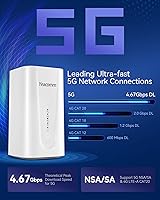
  • Peak Downlink: Maximum theoretical downlink speed reaches 4.67Gbps on 5G Sub-6, with LTE Cat20 supporting up to 1.6Gbps when 5G is unavailable.
  • WiFi Standard: The device uses Wi-Fi 6 (802.11ax) across dual bands, delivering up to 2400Mbps on 5GHz and up to 1146Mbps on 2.4GHz simultaneously.
  • SIM Type: A single Nano SIM card slot is built in, compatible with major US carriers including AT&T and T-Mobile.
  • Wired Ports: Port selection includes one 2.5G LAN/WAN port, one 1G LAN port, one RJ11 VoLTE phone port, and one USB 3.0 port.
  • Max Devices: The router can handle up to 64 connected devices simultaneously across both wireless bands.
  • VPN Support: Built-in VPN compatibility covers PPTP, L2TP, IPSec, and WireGuard protocols for both client and passthrough configurations.
  • Processor: A quad-core CPU running at 2GHz manages routing, wireless, and cellular modem tasks under sustained load.
  • Antennas: Six high-gain cellular antennas are integrated internally, covering the full range of supported 5G NR and LTE frequency bands.
  • 5G NR Bands: Supported 5G NR bands include N2, N5, N7, N12, N14, N25, N30, N41, N48, N66, N71, N77, and N78.
  • LTE Bands: LTE band support covers B2, B4, B5, B7, B12, B13, B14, B17, B25, B26, B29, B30, B41, B42, B48, B66, and B71.
  • Cooling: An active fan ventilation system maintains safe operating temperatures during continuous high-throughput sessions.
  • Dimensions: The unit measures 3.94 x 3.94 x 6.89 inches, making it a compact tower suitable for desk or shelf placement.
  • Weight: The router weighs 2.44 pounds, light enough to reposition easily but substantial enough to sit stably without a mount.
  • Power Input: The device accepts a wide DC input range of 9 to 24 volts, offering some flexibility for non-standard power setups such as RV installations.
  • Operating Temp: Rated for operation between -10°C and +50°C (14°F to 122°F), covering typical indoor and vehicle environments.
  • IP Protocol: Both IPv4 and IPv6 are supported, along with multiple PDN (Packet Data Network) configurations for carrier-specific requirements.

Related Reviews
Zyxel FWA510 5G NR WiFi 6 Router
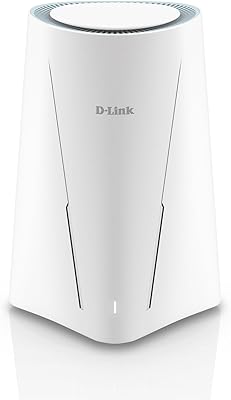
77%
78%
5G Connectivity Performance
83%
WiFi Coverage & Stability
81%
Cloud Management (Nebula)
61%
Value for Money
72%
Setup & Installation
More
D-Link G530 5G WiFi 6 Cellular Router
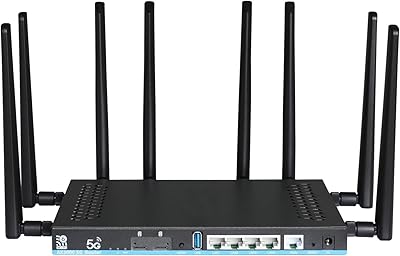
75%
81%
5G Signal Reception
88%
Dual-WAN Failover
69%
WiFi Coverage & Range
86%
Setup Experience
62%
FALCON App Quality
More
Wiflyer Z8102AX-T-RM520NGL 5G WiFi 6 Router
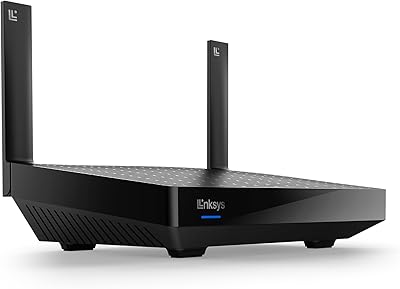
69%
74%
Cellular Performance
78%
Dual SIM Functionality
38%
US Carrier Compatibility
81%
WiFi 6 Performance
83%
Antenna System
More
Reyee E6 AX6000 WiFi 6 Router
78%
93%
Value for Money
86%
Wireless Range & Coverage
82%
Gaming Performance
88%
Ease of Setup
61%
Mobile App & Software Experience
More
NETGEAR R6700AXS AX1800 WiFi 6 Router
76%
78%
Wireless Performance
91%
Setup Experience
83%
Multi-Device Handling
86%
Network Security
67%
Coverage Range
More
Linksys MR7350 WiFi 6 Router
76%
91%
Setup & Onboarding
78%
WiFi Speed & Throughput
67%
Coverage & Range
83%
Device Handling & Congestion
72%
App & Remote Management
More
Gryphon AX Mesh WiFi 6 Router
73%
91%
Parental Controls
88%
Network Security
76%
WiFi Speed & Performance
78%
Coverage & Range
84%
Setup & Installation
More
Linksys MR20EC WiFi 6 Mesh Router
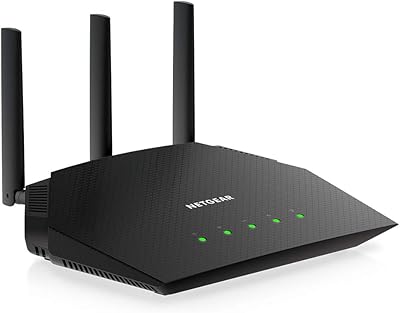
74%
78%
Wireless Performance
63%
Coverage & Range
91%
Setup & Installation
69%
App & Remote Management
82%
Device Handling & Congestion
More
Tenda RX2Pro AX1500 WiFi 6 Router
76%
91%
Value for Money
78%
Wireless Performance
72%
Coverage & Range
93%
Ease of Setup
74%
App Experience
More
Linksys E8450 AX3200 WiFi 6 Router
73%
91%
Ease of Setup
83%
WiFi Speed & Throughput
77%
Coverage & Range
86%
Multi-Device Performance
88%
Value for Money
More

FAQ

Yes, the NR330 covers the primary mid-band and low-band 5G frequencies used by both T-Mobile and AT&T in the US, including the heavily used n41 and n71 bands. That said, you should still verify your specific plan allows third-party gateway devices, as some carrier plans are tied to their own hardware.

This is where you need to be cautious. Verizon compatibility is not clearly documented for this router, and the band lineup does not explicitly confirm support for Verizon's primary 5G mmWave or C-band deployments. If you are a Verizon customer, contact the seller directly and confirm before purchasing.

The advertised peak speeds are theoretical maximums achieved under ideal lab conditions — most users will see a fraction of that in practice. Realistically, expect speeds in line with what your carrier plan and local tower congestion allow, which on a strong mid-band 5G connection could still be quite impressive, often in the hundreds of megabits per second range.

Basic setup is genuinely straightforward — insert your nano SIM, connect power, and the router handles network detection automatically. You do not need to configure anything manually just to get online. The more advanced features like band locking and VPN do require some networking knowledge, but those are optional.

The wide DC input range of 9 to 24 volts means it can work with step-up converters in 12V vehicle setups, though you would need an appropriate DC adapter rather than plugging it straight into a cigarette lighter port. Many RV users do run it this way successfully.

The fan is audible — it is not silent like a passive-cooled router. In a living room or office with background noise you likely will not notice it, but in a quiet bedroom or recording space it can be distracting. It is worth factoring in if the device will be placed near where you sleep or work in silence.

Yes, it supports VoLTE, meaning you can plug in a standard desk phone and make and receive calls over your cellular connection. It functions as a voice line replacement rather than just a pass-through, which is genuinely useful if you want a home phone without a landline subscription.

Unfortunately, the Yeacomm NR330 AX3600 5G WiFi 6 Router does not have external antenna ports, so you cannot attach aftermarket directional or window-mount antennas to boost the cellular signal. If you are in a marginal coverage area, placement near a window facing the nearest tower is your best practical option.

The router supports PPTP, L2TP, IPSec, and WireGuard natively. WireGuard in particular is a modern, efficient protocol that many higher-end routers still lack, so its inclusion here is a genuine plus for privacy-conscious users and remote workers who need secure tunneling back to a home or office network.

Yeacomm advertises a 24-hour response window, and buyer feedback generally reflects that they follow through on that. For a smaller brand, that level of responsiveness is reassuring. Keep in mind that complex technical issues may take longer to fully resolve, but initial contact and acknowledgment tend to be prompt.