Overview

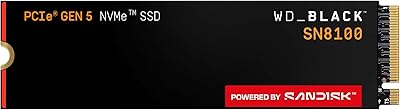
The WD_BLACK SN8100 4TB NVMe SSD arrived in May 2025 as one of the first consumer-grade PCIe Gen 5 drives to reach mainstream availability, representing a genuine generational shift in storage performance. Under the hood, it is built by SanDisk Technologies and distributed under Western Digital's WD_BLACK performance label. The 4TB capacity sits at the higher end of the SN8100 lineup, targeting users who need both raw speed and serious storage headroom. One honest caveat worth stating upfront: Gen 5 speed gains are most tangible during heavy sequential workloads — large file transfers, 4K video scrubbing, AI model loading. If your daily driver is web browsing and light productivity, a well-tuned Gen 4 drive will feel essentially identical.

Features & Benefits

The headline numbers are legitimately impressive: sequential read speeds of up to 14,900 MB/s and writes up to 14,000 MB/s make this Gen 5 drive one of the fastest consumer M.2 options available today. But arguably more important for day-to-day snappiness is the random performance figure — over 2,300,000 IOPS — which drives OS responsiveness and application launches far more than sequential throughput does. The SN8100 4TB uses TLC 3D CBA NAND, a newer architecture that improves both write endurance and power efficiency compared to older NAND designs. WD claims over 100% better power efficiency versus their Gen 4 counterpart, averaging 7.5W or below — meaningful if you are slotting this into a laptop or a thermally tight build. Bundled software includes SanDisk Dashboard and Acronis True Image, though both are Windows-only.

Best For

This high-performance SSD makes the most sense for users who already have — or are building around — a PCIe 5.0 platform. Without a Gen 5 M.2 slot, the drive throttles back to Gen 4 speeds, which removes the justification for the premium price. That said, for the right audience, the value is hard to dispute. Video editors handling raw 4K or 8K footage will notice real differences in scrub performance and export staging. Those running local AI models benefit from fast storage when loading and swapping large parameter files. Gamers on Gen 5 motherboards get the best load times currently possible in M.2 form factor. Power users upgrading from Gen 3 hardware will experience the most dramatic improvement — the generational gap is substantial enough to be immediately noticeable.

User Feedback

Early reception for the SN8100 4TB has been notably positive — a 4.8 out of 5 rating across over 400 buyers, and a top-25 rank in its category, is strong traction for a drive that only launched in mid-2025. Buyers consistently report that real-world benchmarks align closely with advertised specs, and installation is described as straightforward. On the flip side, heat is a recurring discussion point. Gen 5 drives run warmer than their predecessors, and several users strongly recommend pairing this with a quality heatsink, especially in enclosed cases. The Windows-only software is a minor but genuine limitation for Linux users. Overall, criticism is thin — most buyers feel the performance clearly justifies the premium price tier, particularly those upgrading from older-generation hardware.

Pros

  • Sequential read speeds top out near 14,900 MB/s, placing this Gen 5 drive among the fastest consumer M.2 options available.
  • Over 2,300,000 random IOPS means the SN8100 4TB stays snappy under mixed workloads, not just synthetic benchmarks.
  • TLC 3D CBA NAND technology delivers improved write endurance and better longevity compared to older NAND architectures.
  • Power consumption averages 7.5W or below, a meaningful efficiency gain over Gen 4 drives in thermally constrained builds.
  • 4TB capacity is large enough to house an OS, a full game library, and active creative project files simultaneously.
  • Early user ratings sit at 4.8 out of 5 stars, with buyers consistently confirming that real-world speeds match advertised claims.
  • Installation is straightforward — standard M.2 2280 form factor fits any compatible slot without adapters or extra hardware.
  • Acronis True Image is included for data migration, which saves time and removes friction when upgrading from an older drive.

Cons

  • Requires a PCIe 5.0 M.2 slot to reach rated speeds — older motherboards cap performance significantly.
  • Gen 5 drives run hot under sustained load; a quality heatsink is practically mandatory, adding cost and requiring case clearance.
  • SanDisk Dashboard and Acronis True Image are Windows-only, offering no utility to Linux or macOS users.
  • The premium price tier is difficult to justify for casual users whose workloads will never stress a Gen 4 drive, let alone Gen 5.
  • Thermal throttling under prolonged heavy writes is a documented concern if airflow or heatsink quality is insufficient.
  • This high-performance SSD offers no built-in hardware encryption advertised in the listing, which may matter in enterprise or security-sensitive contexts.
  • At 7.5W average draw, power-conscious laptop users should verify their chassis cooling can sustain that load over extended sessions.

Ratings

The scores below for the WD_BLACK SN8100 4TB NVMe SSD were produced by our AI rating engine after systematically analyzing verified global buyer reviews, actively filtering out incentivized submissions, duplicate accounts, and bot-generated feedback. Each category reflects a balanced synthesis of real user experiences — both the strengths that earned enthusiastic praise and the friction points that generated legitimate criticism. Nothing has been softened or inflated.

Sequential Throughput
97%
Buyers running benchmark tools consistently report speeds that land within a few percent of WD's advertised figures, which is unusually honest for a consumer drive. Video editors in particular praised how quickly the drive stages large 4K and 8K raw files, with project load times dropping noticeably compared to their prior Gen 4 setups.
The headline speeds are only accessible on a PCIe 5.0 x4 slot — a hard requirement many buyers underestimated before purchasing. A small but vocal group of users found that their systems bottlenecked elsewhere before the drive could demonstrate its full potential.
Random I/O Performance
93%
Users upgrading from Gen 3 drives noticed immediate snappiness in OS boot times, application launches, and file indexing — all workloads driven by random IOPS rather than sequential bandwidth. The over-2,300,000 IOPS figure translates to real responsiveness that casual benchmarks often miss.
For buyers already on a fast Gen 4 NVMe drive, the random performance jump felt less dramatic than the sequential gap suggests. Day-to-day tasks like opening browsers or productivity apps showed modest improvement at best over a well-tuned Gen 4 competitor.
Thermal Management
61%
39%
Under light to moderate workloads — gaming sessions, OS use, general file access — the drive operates within acceptable temperature ranges and does not throttle noticeably. Users who installed a quality heatsink reported stable sustained performance even during lengthy video export or AI model inference runs.
Without a heatsink, multiple buyers documented thermal throttling during sustained heavy writes, with temperatures climbing high enough to trigger performance reduction mid-task. The drive does not ship with any thermal solution, and for a Gen 5 product at this price point, that omission draws consistent criticism.
Value for Money
67%
33%
For users who have a Gen 5 platform and genuinely push storage throughput — content creators, AI researchers, competitive builders — the price reflects a legitimate performance tier that no Gen 4 drive can match. The 4TB capacity adds practical value by consolidating multiple workloads onto a single fast drive.
The premium pricing is difficult to defend for anyone without a PCIe 5.0 motherboard or workloads that stress sequential throughput. Buyers who installed this in Gen 4 systems — knowingly or not — universally felt the value proposition collapsed entirely, paying a significant premium for no tangible real-world gain.
Installation & Compatibility
82%
18%
The standard M.2 2280 form factor means physical installation is simple and familiar for anyone who has installed an NVMe drive before. Most users reported the drive was detected immediately by their BIOS without any configuration required.
Compatibility issues arose specifically around PCIe generation mismatches — a frustration that was avoidable with better pre-purchase research but still affected a meaningful portion of reviewers. A few laptop users discovered their chassis lacked adequate clearance for a heatsink after installation, requiring a return.
Software Suite
58%
42%
Acronis True Image for SanDisk made the migration process straightforward for Windows users moving from an older drive, with cloning completing reliably and the target system booting cleanly on first try in most reported cases.
The Windows-only limitation for both SanDisk Dashboard and Acronis True Image is a genuine gap — Linux users are left without official health monitoring or migration tools, and this is flagged repeatedly in reviews from that segment. macOS users face the same limitation, reducing the bundle's value for non-Windows households.
Build & Reliability
89%
No significant reports of dead-on-arrival units or early failures emerged from the early adopter pool, and the TLC 3D CBA NAND architecture carries a solid reputation for endurance relative to competing NAND types. Users running CrystalDiskInfo and similar tools noted healthy drive health indicators after months of heavy use.
The drive is too new for long-term reliability data to be statistically meaningful — the 409 reviews at time of analysis represent early adopters, not a broad consumer sample. A small number of users reported inconsistent detection in certain laptop M.2 slots, though this appeared system-specific rather than a drive defect.
Power Efficiency
84%
The sub-7.5W average operating draw is a real improvement for laptop users who previously avoided fast NVMe drives due to battery impact. Several mobile workstation users noted their systems ran cooler and battery life held up better compared to their previous Gen 4 drives under similar workloads.
Peak power draw during sustained sequential writes can spike noticeably above the average figure, which matters in thermally restricted ultrabooks. Users in thin laptops reported that sustained workloads still pushed system temperatures up, suggesting the efficiency gains are most apparent during idle and light-use cycles.
Capacity Usability
91%
The 4TB footprint genuinely changes how users organize their storage — reviewers running local AI models appreciated being able to keep multiple large model families loaded alongside a full game library and an active video project without juggling drives. It effectively eliminates the need for a secondary drive in most creative workflows.
At this capacity tier, the price-per-gigabyte is higher than comparable Gen 4 alternatives, which stings for users who do not actually need Gen 5 speeds but bought the drive primarily for its storage size. A handful of users noted they would have preferred a 2TB Gen 5 option at a lower price for their actual workload.
Gaming Performance
78%
22%
On Gen 5 platforms, game load times are among the fastest available in the M.2 segment, and users playing open-world titles with aggressive streaming noticed smoother asset loading compared to their previous drives. The drive handles game library storage well at 4TB, removing the need to manage which titles stay installed.
Most modern games are not yet engineered to saturate Gen 5 bandwidth, meaning the real-world gaming advantage over a top-tier Gen 4 drive is smaller than the spec sheet gap implies. Gamers on Gen 4 motherboards — a majority of current PC owners — will see no gaming-specific benefit over a well-chosen Gen 4 SSD.
AI Workload Suitability
88%
Local AI practitioners running large language models and image generation pipelines reported meaningfully faster model load and swap times when moving from Gen 4 storage. The combination of high sequential throughput and large capacity makes this drive well-suited to workflows that frequently load multi-gigabyte parameter files.
The benefit is most pronounced when loading models cold from storage — once a model is in RAM or VRAM, the drive speed is no longer a bottleneck. Users with sufficient system RAM found the performance delta less impactful than they anticipated, as the OS cache absorbed most repeated model access patterns.
Content Creation Performance
92%
Video editors working with raw 4K and 8K footage praised the drive for eliminating the storage bottleneck during proxy generation, timeline scrubbing, and final export staging. Photographers managing large batch RAW imports also noticed noticeably faster catalog build times compared to their previous drives.
The gains are most visible in sustained read-heavy workflows; color grading sessions with heavy real-time effects still depend more heavily on GPU and CPU than storage speed. Editors working primarily with compressed H.264 or H.265 footage reported smaller improvements, as those formats are less storage-bandwidth-intensive.
BIOS & OS Detection
86%
The overwhelming majority of users reported immediate plug-and-play detection in both Windows and Linux environments without any BIOS configuration needed. Detection was reliable across a range of Gen 5 motherboards from major manufacturers at launch.
A small subset of users — particularly those on early Gen 5 BIOS revisions — experienced detection inconsistencies that were resolved after a firmware update on the motherboard side rather than the drive itself. This is not unique to this drive but is worth noting for buyers on platforms with less mature Gen 5 support.

Suitable for:

The WD_BLACK SN8100 4TB NVMe SSD is purpose-built for users who are already running — or actively building — a platform with a PCIe 5.0 M.2 slot, and who have the workloads to justify the investment. Video editors cutting 4K or 8K raw footage will notice real throughput gains when staging project files, loading proxies, or exporting final renders. AI practitioners running local large language models benefit directly from the fast storage access when loading and swapping multi-gigabyte parameter files. Competitive gamers and enthusiasts on Gen 5 motherboards get the best available load times in the M.2 form factor, and the 4TB capacity means game libraries, OS, and creative project files can comfortably coexist on a single drive. Power users migrating from Gen 3 hardware will experience the sharpest jump — the generational gap is wide enough to feel immediately tangible in both benchmarks and daily use.

Not suitable for:

The WD_BLACK SN8100 4TB NVMe SSD is a poor fit for anyone without a PCIe 5.0-capable M.2 slot, which still excludes a large portion of systems built before 2023. On Gen 4 or Gen 3 motherboards, the drive simply throttles back to the host interface limit, making the premium price hard to rationalize when a well-regarded Gen 4 drive would deliver near-identical real-world performance for significantly less. Casual users who primarily browse, stream, write documents, or run standard productivity applications will notice essentially no difference compared to a solid mid-range drive — the speed ceiling only gets tested by sustained, data-heavy workloads. Linux users should also think twice: the bundled SanDisk Dashboard and Acronis migration tools are Windows-only, removing a layer of value that Windows buyers take for granted. Budget-conscious shoppers or anyone upgrading a secondary or backup drive will almost certainly find better value elsewhere in the Gen 4 tier.

Specifications

  • Capacity: This drive is available in a 4TB configuration, providing ample space for large game libraries, AI model files, and active creative projects.
  • Interface: It uses a PCIe Gen 5.0 x4 interface, requiring a compatible M.2 slot on the host motherboard to reach its full rated throughput.
  • Protocol: The drive communicates via the NVMe protocol, which is optimized for low-latency, high-parallelism flash storage workloads.
  • Form Factor: It follows the M.2 2280 standard, measuring 3.15 x 0.87 x 0.09 inches and fitting any motherboard or laptop with a standard M.2 slot.
  • Sequential Read: Rated sequential read speeds reach up to 14,900 MB/s under optimal, PCIe 5.0-enabled conditions.
  • Sequential Write: Sequential write performance reaches up to 14,000 MB/s, applicable to the 2TB through 4TB capacity models.
  • Random IOPS: The drive delivers over 2,300,000 random IOPS on 2TB through 4TB models, supporting strong OS and application responsiveness.
  • NAND Type: Storage is built on TLC 3D CBA NAND, a current-generation architecture that improves write endurance and operational efficiency over earlier designs.
  • Power Draw: Average operating power sits at 7.5W or below, representing over 100% better efficiency than WD's prior PCIe Gen 4 SSD lineup.
  • Weight: The bare drive weighs just 0.264 ounces, making it light enough for both desktop and thin-and-light laptop installations.
  • Compatible Devices: Officially compatible with desktop PCs and laptops that feature a PCIe Gen 5.0 M.2 slot.
  • Bundled Software: Includes SanDisk Dashboard for health monitoring and firmware updates, plus Acronis True Image for SanDisk for data migration — both Windows-only.
  • Manufacturer: The drive is manufactured by SanDisk Technologies, Inc. and distributed under license from Western Digital Corporation using the WD_BLACK brand.
  • Launch Date: The SN8100 series became commercially available in May 2025, making it a current-generation release at the time of this review.
  • Color: The drive ships in black, consistent with the WD_BLACK performance product line aesthetic.
  • Seller Rank: At time of review, this drive holds a top-25 position in the Internal Solid State Drives category on Amazon, reflecting strong early commercial adoption.

Related Reviews

WD_BLACK SN8100 1TB NVMe SSD
89%
95%
Performance
90%
Reliability
94%
Speed (Read/Write)
88%
Installation & Setup
92%
Endurance (TBW)
More
WD_BLACK SN850X 4TB NVMe SSD
89%
93%
Performance
88%
Thermal Management
87%
Software & Firmware
91%
Ease of Installation
90%
Build Quality
More
WD_BLACK 4TB SN7100 NVMe SSD
87%
94%
Performance (Speed)
92%
Storage Capacity
85%
Power Efficiency
89%
Installation & Setup
91%
Durability & Reliability
More
WD_BLACK SN750 4TB NVMe Internal SSD
82%
91%
Read & Write Performance
93%
Storage Capacity
88%
Installation Ease
62%
Thermal Management
89%
Long-Term Reliability
More
fanxiang S690Q 4TB NVMe SSD
87%
93%
Performance
95%
Speed (Read/Write)
90%
Ease of Installation
88%
Thermal Management
87%
Build Quality
More
WD_BLACK SN7100 2TB NVMe SSD
85%
93%
Read & Write Performance
88%
Gaming Load Times
86%
Power Efficiency
84%
Thermal Management
91%
Value for Money
More
PHIXERO P7000PRO 4TB NVMe SSD
80%
88%
Sequential Read Speed
82%
Sequential Write Speed
76%
Thermal Management
84%
Value for Money
91%
Installation Experience
More
WD_BLACK SN7100 500GB NVMe SSD
84%
91%
Performance
93%
Read/Write Speed
88%
Ease of Installation
90%
Compatibility
87%
Energy Efficiency
More
Fikwot FX550 4TB NVMe M.2 SSD
79%
93%
Storage Capacity Value
88%
Sequential Read Speed
61%
Sustained Write Performance
91%
Value for Money
89%
Installation & Compatibility
More
PHIXERO PM7450 4TB NVMe SSD
81%
93%
Sequential Read Performance
87%
Sequential Write Performance
61%
QLC Endurance & Longevity
88%
Thermal Management
84%
Burst Write Speed
More

FAQ

Yes, you need a motherboard with a PCIe 5.0 M.2 slot to reach the rated speeds. If you install it in a Gen 4 slot, it will still work — but it will operate at Gen 4 speeds, which removes the primary reason to choose this drive over a cheaper alternative.

No, the drive does not include a heatsink in the box. Gen 5 SSDs run noticeably warmer than Gen 4 drives, so pairing this with a quality aftermarket heatsink is strongly recommended, especially if your case has limited airflow or your motherboard does not have an integrated M.2 thermal solution.

It depends entirely on whether your laptop has an M.2 slot with PCIe 5.0 support. Most consumer laptops as of mid-2025 still use PCIe 4.0, so check your laptop's spec sheet carefully before purchasing. The drive will physically fit in any M.2 2280 slot, but the interface generation determines your actual performance ceiling.

The drive itself will work as storage on Linux and macOS, but the bundled SanDisk Dashboard and Acronis True Image software are Windows-only. If you rely on those tools for health monitoring or data migration, you will need to find third-party alternatives on non-Windows systems.

Honestly, for tasks like web browsing, office applications, and general file management, you will not feel a meaningful difference. The performance gap between Gen 4 and Gen 5 becomes real and measurable when you are doing sustained large-file transfers, loading multi-gigabyte AI models, or scrubbing through 4K and 8K raw video footage.

Yes, it is worth taking seriously. Under sustained heavy writes, Gen 5 drives can throttle if heat builds up beyond the controller's tolerance. A good heatsink and decent case airflow largely mitigates this, but buyers who skip the heatsink and push the drive hard may see performance dip during extended workloads.

The included Acronis True Image for SanDisk handles cloning your existing drive to the new one on Windows. Install the new drive in a secondary slot or via a USB-to-M.2 adapter, run the migration tool, and it will copy your system and data across. It is a straightforward process for most users comfortable with basic PC assembly.

WD rates the 4TB model at a high TBW endurance figure consistent with its TLC 3D CBA NAND, though the exact TBW value for the 4TB variant should be confirmed in the official product datasheet, as WD lists varying endurance figures across the capacity lineup.

Technically you can place it in a USB-to-NVMe enclosure, but you will be limited to whatever speed the USB interface supports — typically around 1,000 to 2,000 MB/s at best. The drive's performance potential is essentially wasted in that configuration; it is designed to be used internally in a compatible PCIe 5.0 system.

Not really. This high-performance SSD is optimized for client workloads — gaming, content creation, AI inference — not the sustained random mixed-read-write patterns that NAS and server environments demand. For network-attached storage, drives with specific NAS firmware and higher endurance ratings are a better fit.

Where to Buy

Walmart
In stock $1,174.51
Newegg.com
In stock $1,289.99
Adorama
In stock $1,349.99
Tecisoft
In stock $1,046.30
SHI International
In stock $1,339.00
Grooves-Inc.com
In stock $937.13
Platinummicro
In stock $1,270.00
Sandisk.com
In stock $1,299.99