Overview

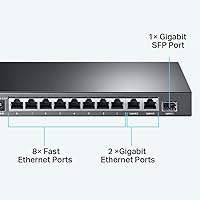
The TP-Link TL-SL1311MP 8-Port PoE+ Network Switch is a straightforward, no-frills option aimed at small businesses and home security installations that need reliable power delivery without the complexity of a managed switch. It packs 8 PoE+ Fast Ethernet ports, 2 Gigabit RJ45 uplinks, and a Gigabit SFP slot into a compact enclosure — 11 ports total in a surprisingly small footprint. With a 124W total PoE budget, you can realistically run six to eight IP cameras or access points simultaneously without starving any device. TP-Link has built a solid reputation for affordable, dependable networking gear, and this unmanaged PoE+ switch fits squarely into that tradition. Plug it in, connect your devices, and it just works.
Features & Benefits

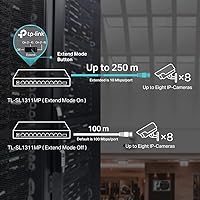
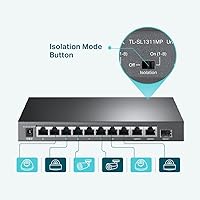
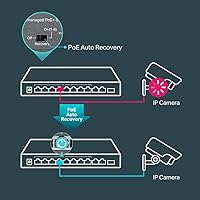
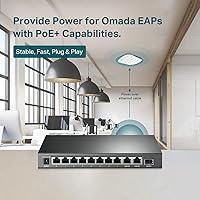
Where this TP-Link PoE switch earns its keep is in the details. Each of the 8 PoE+ ports (802.3at/af) delivers up to 30W, which comfortably covers most IP cameras, wireless access points, and VoIP phones. Extend Mode is a genuinely useful feature for long surveillance runs — it pushes power and data up to 250 meters, though you have to accept a downgrade to 10 Mbps to get there. Think of it as a built-in PoE extender with no extra hardware required. Isolation Mode quietly blocks broadcast storms and keeps device traffic separated, adding a basic layer of security without any configuration. The PoE Recovery function automatically resets hung devices, which saves a trip to physically reboot a camera mounted twelve feet in the air.

Best For

The TL-SL1311MP makes the most sense for anyone building a small IP camera network — a retail shop, a warehouse entrance, or a home with several outdoor cameras. Network installers will appreciate Extend Mode for long cable runs, removing the need for a separate PoE injector mid-line. Wireless access point deployments across multiple rooms are another natural fit, since the switch handles both power and data through a single cable. That said, this unmanaged PoE+ switch is not the right choice if you need VLANs, per-port controls, or any kind of management dashboard. If your goal is simple, dependable connectivity without ever touching a config screen, it delivers exactly that.

User Feedback

Buyers consistently highlight easy setup as the standout win — most report having cameras or access points running within minutes of unboxing. PoE performance draws steady praise, with users noting stable power delivery over months of continuous use. The criticism that surfaces most often is the 100 Mbps ceiling on the PoE ports; buyers expecting full Gigabit throughput on every port are in for a disappointment. Extend Mode earns mixed reactions — installers love the reach, but some feel the 10 Mbps speed trade-off is not communicated clearly enough upfront. On durability, the feedback skews positive: the switch runs cool, operates quietly, and the 3-year warranty with free tech support gives most buyers genuine long-term confidence.

Pros

  • Truly plug-and-play — no software, no login, no configuration required out of the box.
  • Eight PoE+ ports at up to 30W each handle most IP cameras, access points, and VoIP phones with ease.
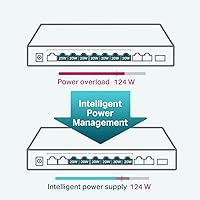
  • The 124W total PoE budget is generous enough to run six to eight devices simultaneously without throttling.
  • Extend Mode stretches power and data to 250 meters, reducing the need for additional PoE injectors on long runs.
  • Isolation Mode adds basic traffic segmentation to improve local network security with zero setup effort.
  • PoE Recovery automatically reboots frozen devices, saving manual intervention on hard-to-reach installations.
  • Two Gigabit uplink ports plus a Gigabit SFP slot provide solid upstream flexibility for various network topologies.
  • The compact footprint fits on a shelf, in a closet, or inside a small wall-mount rack without wasted space.
  • Runs quietly and stays cool in normal indoor environments, making it unobtrusive in office or home settings.
  • A 3-year warranty with free weekday tech support is a meaningful commitment at this price tier.

Cons

  • All 8 PoE ports are limited to 100 Mbps — not suitable for bandwidth-hungry devices expecting Gigabit speeds.
  • Extend Mode forces a drop to 10 Mbps, which is not clearly highlighted during the purchase decision for many buyers.
  • No management interface at all — you cannot monitor port status, traffic, or power consumption remotely.
  • No VLAN or QoS support means traffic prioritization and network segmentation are off the table entirely.
  • The 124W total PoE budget can run thin if you try to max out all 8 ports with high-draw devices simultaneously.
  • Tech support is limited to weekday business hours, which can be frustrating during a weekend outage or install.
  • Only one SFP slot limits fiber uplink redundancy for more demanding small business network layouts.
  • No wall-mount brackets included, so mounting options are limited without sourcing additional hardware separately.

Ratings

The scores below reflect AI-driven analysis of verified global buyer reviews for the TP-Link TL-SL1311MP 8-Port PoE+ Network Switch, with spam, bot activity, and incentivized feedback actively filtered out before scoring. Each category is evaluated against real-world expectations for this product tier, not against premium managed switches costing several times more. Both the genuine strengths and the frustrations that surface repeatedly in buyer experiences are reflected transparently in every score.

Ease of Setup
94%
Buyers across skill levels consistently describe getting cameras and access points running within a few minutes of unboxing. There are no drivers to install, no web portal to navigate, and no configuration decisions to make — just cables in and devices on.
A small number of users note that the total absence of any interface becomes a limitation when something goes wrong and there is no diagnostics screen to check. For pure beginners, the lack of any guided setup indicator lights can leave them unsure whether the switch is functioning correctly.
PoE Performance
88%
For the core use case of powering IP cameras and wireless access points, real-world PoE delivery is consistently solid. Users running five to seven cameras simultaneously report stable, uninterrupted power with no port dropouts, even after months of continuous operation.
The 124W shared budget feels adequate for moderate deployments but gets tight fast when mixing higher-draw devices like PTZ cameras or dual-band access points. A handful of installers note that maxing out all eight ports simultaneously causes the switch to throttle power to individual ports below expectations.
Port Speed & Throughput
52%
48%
For surveillance-only setups using cameras that stream at 4–8 Mbps per channel, the 100 Mbps Fast Ethernet ceiling on the PoE ports is entirely workable. Buyers who go in knowing the spec report no practical bottleneck for their specific camera-only use case.
This is the most cited source of buyer frustration. Users who assumed all ports would be Gigabit — a reasonable expectation in 2024 — feel misled when they discover the PoE ports are limited to 100 Mbps. It effectively rules out this switch for any use case involving large file transfers, NAS connectivity, or high-bitrate video recording on the same segment.
Extend Mode Utility
76%
24%
Professional installers working on warehouses, parking structures, and multi-building properties frequently praise Extend Mode for eliminating mid-run PoE injectors. Reaching a camera 200+ meters away over a single cable run is a genuine time and cost saver on larger surveillance projects.
The mandatory drop to 10 Mbps in Extend Mode catches many buyers off guard, especially those expecting to stream higher-resolution video at range. Documentation does not make this trade-off prominent enough, and several users have reported discovering the limitation only after installation was complete.
Build Quality
73%
27%
The metal enclosure feels more durable than competing plastic-bodied switches in the same price range, and port connections sit firmly without wobble. Most long-term reviewers report no physical wear or port degradation after a year or more of continuous use.
The chassis feels lightweight and somewhat hollow, and the overall finish does not project confidence in demanding environments. A few users have noted minor concerns about ventilation when the unit is enclosed in a tight cabinet with other hardware running nearby.
PoE Recovery Feature
83%
For anyone who has dealt with a frozen camera mounted on a ceiling or exterior wall, automated PoE Recovery is a meaningful quality-of-life improvement. Users managing remote properties or multi-site installations particularly appreciate not having to dispatch someone just to reboot a hung device.
There is no way to configure the recovery sensitivity or timing since the switch is unmanaged, so occasionally functional devices get briefly power-cycled if the switch misreads their status. This is infrequent but has been flagged by a small number of users with sensitive or slow-booting PoE equipment.
Isolation Mode
79%
21%
Network-conscious buyers who want to keep IoT cameras off the same logical segment as workstations appreciate that Isolation Mode provides a basic layer of traffic separation without requiring a managed switch. It is a meaningful differentiator over cheaper unmanaged switches that offer nothing in this space.
Isolation Mode is all-or-nothing — there is no selective port isolation or group configuration available. For users who want nuanced segmentation, such as isolating only a subset of cameras while allowing others to communicate freely, this feature falls well short of what a managed VLAN setup would provide.
Uplink Flexibility
81%
19%
Having two dedicated Gigabit uplink ports alongside a Gigabit SFP slot gives installers real flexibility in how they connect this switch upstream. The SFP slot in particular is a valued inclusion at this price, allowing fiber connectivity for longer backbone runs between buildings or floors.
Only one SFP slot limits redundancy options, and users who want link aggregation or failover between uplinks will be disappointed since neither feature is available on an unmanaged platform. The SFP slot's Gigabit ceiling is also a constraint for anyone looking toward 2.5G or 10G upstream infrastructure.
Value for Money
86%
Relative to what competing brands charge for a similar unmanaged PoE+ port count with comparable features, the TL-SL1311MP consistently earns high marks from budget-conscious buyers. For small business owners or home users who need straightforward camera power delivery without breaking the bank, the value proposition is difficult to dispute.
Buyers who purchase this expecting Gigabit PoE ports and discover the 100 Mbps limitation frequently revise their value rating downward sharply. At its price point the Fast Ethernet ceiling is defensible, but it still leaves a subset of buyers feeling they should have spent more on a fully Gigabit alternative from the start.
Long-Term Reliability
84%
A meaningful number of reviewers specifically return to leave positive updates after twelve to twenty-four months of continuous operation, reporting stable performance with no port failures or power delivery issues. TP-Link's hardware track record in the unmanaged switch space lends additional credibility to these long-term accounts.
A smaller subset of users report intermittent port dropouts emerging after extended use, particularly on units running near their PoE budget ceiling consistently. Whether this reflects product variance or environmental factors like heat is unclear, but it is worth noting for setups that need guaranteed uptime.
Thermal Management
77%
23%
The fanless design means the switch operates in complete silence, making it a good fit for offices, reception areas, or living spaces where fan noise would be intrusive. In well-ventilated environments, surface temperatures remain manageable even under moderate to high PoE load.
Without active cooling, heat buildup in poorly ventilated enclosures or equipment rooms is a real concern. Several users in warmer climates or tight cabinet installations report the chassis running uncomfortably warm, and a few link intermittent instability to sustained high ambient temperatures.
Physical Footprint
89%
At just 8.2″ × 4.9″ × 1″ and under 1.5 lbs, this unmanaged PoE+ switch fits just about anywhere — a desk corner, a utility shelf, inside a wall-mount enclosure, or zip-tied to a rack panel. Installers working in cramped network closets consistently highlight how much easier the compact form factor makes their job.
The switch does not include rack-mount ears or wall-mount brackets, which is a notable omission for professional installations where tidy cable management and secure mounting are expected. Buyers who want a clean rack-mount finish need to source compatible third-party hardware separately.
Warranty & Support
82%
18%
A 3-year warranty with free technical support is above average for a switch in this segment, and most buyers treat it as a genuine safety net rather than a marketing footnote. Users who have contacted TP-Link support report reasonably quick turnaround on replacement decisions for confirmed hardware defects.
Support hours are limited to weekday business hours Pacific time, which creates real frustration for users dealing with a failed switch during a weekend event or outside normal business hours. International buyers also note that warranty terms and support responsiveness can vary significantly by region.

Suitable for:

The TP-Link TL-SL1311MP 8-Port PoE+ Network Switch is a strong fit for small business owners, property managers, and home users who want to run an IP camera system without wrestling with complex network configuration. If you have four to eight cameras spread across a building — a small retail shop, a warehouse, a multi-room office — this switch handles power and data delivery through a single cable per device, which keeps installs clean and cabling costs low. Network installers will particularly appreciate Extend Mode, which pushes PoE up to 250 meters, eliminating the need for a mid-run injector on longer cable pulls. It also works well for anyone deploying wireless access points across multiple floors or rooms on a tight budget, since 30W per port covers virtually every consumer and prosumer AP on the market. The plug-and-play nature means non-technical users can set it up without reading a manual, and the 3-year warranty with free weekday tech support adds a layer of reassurance that you rarely get at this price point.
Not suitable for:

The TP-Link TL-SL1311MP 8-Port PoE+ Network Switch is not the right tool if you need full Gigabit throughput on your PoE device ports — the 8 PoE ports are capped at 100 Mbps, which is a genuine bottleneck for high-bitrate cameras, NAS devices, or anything transferring large files across the network. Anyone who requires VLANs, port mirroring, QoS prioritization, or any form of remote management will need to look at a managed switch instead, as this unmanaged PoE+ switch offers none of those controls. IT administrators running a mid-sized or growing network will quickly outgrow what it offers in terms of visibility and traffic management. If you plan to use Extend Mode and expect to stream 4K or high-definition video at the same time, the forced 10 Mbps downgrade will disappoint you. And if your cable runs are longer than 250 meters or your environment runs consistently hot, this switch may not meet your infrastructure requirements.
Specifications

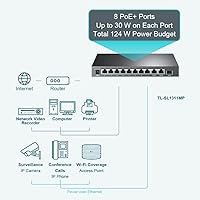
  • PoE Ports: Eight 802.3at/af PoE+ ports each deliver up to 30W, supporting IP cameras, wireless access points, and VoIP phones over standard Ethernet cabling.
  • PoE Budget: The total PoE power budget is 124W shared across all eight PoE+ ports simultaneously.
  • Uplink Ports: Two dedicated Gigabit RJ45 uplink ports connect the switch to a router or upstream network device at full 1000 Mbps speeds.
  • SFP Slot: One Gigabit SFP slot supports fiber or copper SFP modules for flexible upstream connectivity options.
  • PoE Port Speed: The eight PoE ports operate at 10/100 Mbps (Fast Ethernet) and do not support Gigabit speeds on those individual ports.
  • Extend Mode: Extend Mode stretches both power and data delivery up to 250 meters over a single cable, with a mandatory speed reduction to 10 Mbps.
  • Isolation Mode: Isolation Mode segments port-to-port traffic to prevent broadcast storms and improve basic LAN security without any configuration.
  • PoE Recovery: The PoE Recovery function automatically detects and reboots unresponsive PoE-powered devices by cycling power to the affected port.
  • Management: This is a fully unmanaged switch with no web interface, CLI, or software required — it operates entirely plug-and-play out of the box.
  • Total Ports: The switch provides 11 ports in total: 8 PoE+ Fast Ethernet ports, 2 Gigabit RJ45 uplinks, and 1 Gigabit SFP slot.
  • Dimensions: The unit measures 8.2″ long × 4.9″ wide × 1″ tall, making it compact enough for a shelf, desktop, or small wall-mount enclosure.
  • Weight: The switch weighs 0.6 kg (1.32 lbs), keeping it light and easy to reposition during installation.
  • Input Voltage: The included power adapter is rated for 110V input, suitable for standard North American electrical outlets.
  • Max Temperature: The switch is rated for operation in environments up to 40°C (104°F), suitable for indoor office or utility room deployments.
  • Warranty: TP-Link backs this switch with a 3-year warranty and provides free technical support Monday through Friday, 6am to 6pm PST.
  • In the Box: The package includes the TL-SL1311MP switch unit, a power adapter, and an installation guide — no additional accessories are bundled.
  • Brand & Model: Manufactured by TP-Link under the model designation TL-SL1311MP, released to the market in June 2021.

Related Reviews

TP-Link TL-SG1008MP 8-Port PoE+ Gigabit Switch
81%
96%
Ease of Setup
93%
PoE Coverage
91%
Build Quality
89%
Value for Money
88%
Reliability & Uptime
More
TP-Link TL-SG108PE
TP-Link TL-SG108PE
84%
88%
Build Quality
83%
PoE Performance
91%
Ease of Setup
79%
Management Interface
87%
Value for Money
More
TP-Link TL-SG2210P V3 8-Port PoE Switch
83%
91%
Value for Money
74%
PoE Performance
83%
Ease of Setup
86%
Omada SDN Integration
88%
Build Quality
More
TP-Link TL-SG108-M2 8-Port 2.5G Unmanaged Switch
81%
93%
Network Performance
97%
Ease of Setup
89%
Build Quality
74%
Thermal Management
81%
Value for Money
More
TP-Link TL-SL1218MP 16-Port PoE Network Switch
79%
91%
Value for Money
88%
PoE Performance
79%
Extend Mode Reliability
93%
Ease of Setup
62%
Build Quality
More
TP-Link TL-SG108E 8-Port Gigabit Switch
82%
91%
Build Quality
94%
Value for Money
83%
Ease of Setup
61%
Management Software
93%
Long-term Reliability
More
TP-Link TL-SF1006P 6-Port PoE Switch
88%
88%
Performance
95%
Ease of Setup
92%
Build Quality
89%
Reliability
91%
Power Delivery (PoE)
More
TP-Link TL-SF1009P 9-Port PoE+ Switch
80%
94%
Ease of Setup
78%
PoE Power Delivery
86%
Build Quality
71%
Extend Mode Performance
89%
Value for Money
More
TP-Link TL-SF1005P
TP-Link TL-SF1005P
82%
96%
Ease of Setup
81%
PoE Power Delivery
88%
Build Quality
94%
Fanless & Noise Level
67%
Extend Mode Performance
More
TP-Link TL-SG1005P
TP-Link TL-SG1005P
85%
96%
Ease of Setup
83%
PoE Power Delivery
91%
Build Quality
98%
Noise Level
89%
Gigabit Throughput
More

FAQ

No, none at all. The TP-Link TL-SL1311MP 8-Port PoE+ Network Switch is completely unmanaged, which means you just plug it into your router via one of the Gigabit uplink ports, connect your PoE devices, and everything comes up on its own. There is no web interface, no app, and no driver to install.
No, and this is worth knowing before you buy. Only the 2 uplink RJ45 ports and the SFP slot run at Gigabit speeds. The 8 PoE ports are Fast Ethernet, capped at 100 Mbps. For IP cameras and access points that is usually fine, but if you need Gigabit throughput on every port, you will need to look at a different switch.

The total PoE budget is 124W shared across all 8 ports. A typical outdoor IP camera draws between 10W and 15W, so you can comfortably run 7 to 8 cameras simultaneously without hitting the power ceiling. Higher-draw devices like PTZ cameras or certain access points pulling close to 30W each will reduce how many ports you can use at full power concurrently.

Extend Mode lets this unmanaged PoE+ switch push both power and data up to 250 meters over a single Ethernet cable — far beyond the normal 100-meter limit. The catch is real: the port drops to 10 Mbps in that mode. For low-bitrate surveillance cameras or door intercoms, that is usually workable. For anything that needs consistent bandwidth, it is not the right solution.

Yes, as long as your devices support the 802.3at or 802.3af PoE standard, they will work with this switch. It is not locked to any specific brand or ecosystem. Most mainstream IP cameras, wireless access points, and VoIP phones from brands like Hikvision, Dahua, Ubiquiti, and Cisco are 802.3at/af compliant.

When Isolation Mode is on, the PoE ports cannot talk directly to each other — they can only communicate through the uplink ports. This stops a faulty or compromised device from flooding the whole network with unnecessary traffic, and it adds a basic layer of separation between devices. It is not a substitute for a managed VLAN setup, but it is better than nothing for security-conscious setups.

That is exactly what the PoE Recovery feature is designed to address. The switch monitors connected PoE devices, and if one stops responding, it cycles the power to that port automatically to kick the device back to life. It saves you from climbing a ladder or walking to a closet every time a camera hangs — a genuinely practical feature for any surveillance setup.

The TL-SL1311MP has no fan, so it runs completely silent. Under normal indoor load it stays warm to the touch but well within its rated 40°C operating limit. If you are running all 8 PoE ports near their maximum power draw in a poorly ventilated space, you will want to make sure there is some airflow around the unit. In a typical office or home environment, heat is rarely a concern.

The switch is not a standard rack-mount width and does not come with rack-mount ears. It is designed for desktop or shelf placement. Some users mount it inside a small wall enclosure using third-party brackets, but out of the box it is strictly a shelf-top unit. If rack mounting is a requirement, you would need to look at TP-Link's rackmount PoE switch lineup instead.

The switch comes with a 3-year limited warranty covering hardware defects. TP-Link provides free technical support by phone and online Monday through Friday, 6am to 6pm PST. If the unit fails within that window due to a manufacturing issue, TP-Link will typically arrange a replacement. It is a solid warranty for a switch at this price point, and the support hours are reasonable for most business users.

Where to Buy