Overview

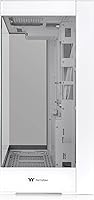
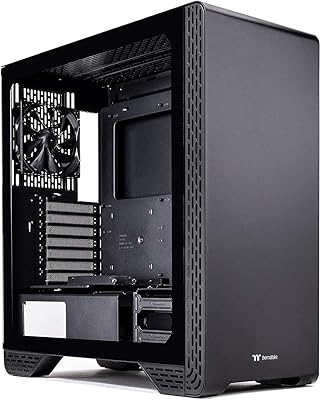
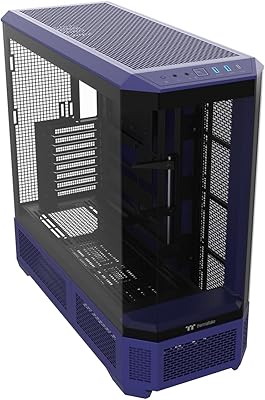
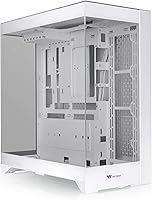
The Thermaltake E550 TG Mid Tower ATX Case is Thermaltake's answer to builders who want a showcase chassis without stepping up to a full tower. The defining structural decision here is the dual chamber layout, which physically separates the PSU and storage from the main build area — and that single choice shapes nearly every other aspect of the building experience. Three tempered glass panels wrap the Snow colorway in crisp white-framed visibility, giving wide sightlines from multiple angles. What sets this chassis apart from typical glass-heavy mid-towers is its support for hidden-connector motherboards like ASUS BTF and MSI PROJECT ZERO — a forward-looking feature that genuinely changes what a finished build can look like. At 32 pounds and over 20 inches tall, this is a substantial machine.
Features & Benefits

The three-panel glass setup means the front, side, and top of the build are all visible simultaneously — so cable management is not optional, it is mandatory. That pressure is alleviated by the dual chamber design, which tucks the PSU, drives, and most wiring behind a steel wall. For builders on hidden-connector boards, the interior can look almost completely wire-free. The three-way GPU installation is genuinely useful: mount your card horizontally the traditional way, vertically to display it through the glass, or at a floating angle using the included bracket. Cooling capacity is generous — six 140mm fans and a 420mm radiator in a mid-tower footprint. Front I/O includes a USB 3.2 Gen 2 Type-C port alongside two USB 3.0 Type-A connections, covering most everyday transfer and audio needs.

Best For

The E550 TG is purpose-built for a specific kind of builder — someone investing in a next-gen hidden-connector motherboard who wants the visual payoff that investment promises. If you are running ASUS BTF or a similar platform, this chassis is one of the few mid-towers designed to properly support it. Beyond that niche, it suits enthusiasts planning aggressive cooling setups: the 420mm radiator clearance and multi-fan capacity give real flexibility without the footprint of a full tower. Those who prefer displaying their GPU vertically will appreciate the three-way mounting options. That said, this mid-tower case measures over 20 inches tall and weighs 32 pounds — worth double-checking against your desk space before ordering. It is not a chassis for tight or compact setups.

User Feedback

With a 4.6-star average across around 79 ratings — a relatively modest sample size — this Thermaltake chassis has earned consistent praise for its build quality and aesthetics. The glass panels, steel construction, and overall fit-and-finish draw positive comments repeatedly. Where buyers get more candid is around the installation experience: aligning hidden-connector boards takes patience, and a few builders noted the process is less intuitive than standard ATX builds. The floating VGA bracket draws mixed reactions — most find it functional, but some question its long-term rigidity under heavier cards. A handful of buyers flagged the chassis weight during solo assembly as a genuine inconvenience. On balance, satisfaction runs high among the target audience, though this is a case that rewards prepared, methodical builders more than impulsive ones.

Pros

  • Three tempered glass panels provide exceptional interior visibility from multiple angles simultaneously.
  • Dual chamber design keeps PSU wiring and storage physically separated from the main build area.
  • One of the few mid-tower cases with dedicated support for hidden-connector motherboards like ASUS BTF.
  • Built-in three-way GPU mounting means no third-party riser bracket is needed for vertical or angled display.
  • 420mm radiator support is unusually generous for a chassis in this size class.
  • The E550 TG ships with a three-year warranty, which is reassuring for a chassis at this investment level.
  • Snow colorway and white framing look distinctly clean compared to the all-black competition.
  • Bottom-mount PSU placement and chamber separation make cable routing noticeably more organized.
  • Front I/O includes a USB 3.2 Gen 2 Type-C port, which is fast enough for modern external drives and peripherals.
  • Early buyer ratings are consistently strong, with build quality and panel fit cited repeatedly as highlights.

Cons

  • Hidden-connector motherboard alignment during installation requires patience and is not beginner-friendly.
  • At 32 pounds, solo assembly is genuinely awkward and a second pair of hands is strongly recommended.
  • The floating VGA bracket has drawn some skepticism around long-term rigidity under heavier graphics cards.
  • Buyers not using BTF or PROJECT ZERO motherboards miss out on the defining feature this case is built around.
  • Only around 79 ratings at time of writing — not enough real-world data to fully confirm long-term durability.
  • The chassis footprint may be too large for smaller desks, despite the mid-tower classification.
  • No fans are included in the box, meaning a full cooling build requires an additional investment upfront.
  • Three glass panels increase cleaning and fingerprint maintenance compared to single-panel alternatives.

Ratings

The scores below for the Thermaltake E550 TG Mid Tower ATX Case were generated by AI after analyzing verified buyer reviews from global sources, with active filtering applied to remove incentivized, bot-generated, and duplicate feedback. With a relatively modest pool of around 79 ratings at the time of analysis, we have weighted individual reviewer detail and consistency heavily, and both the standout strengths and the real friction points are reflected transparently in every category.
Aesthetic Design
93%
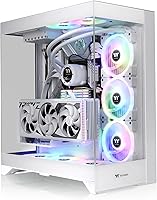
The three-panel tempered glass layout draws consistent praise from builders who want their system to look as good as it performs. The Snow colorway with white framing feels distinctive on a desk dominated by black chassis, and multiple buyers noted it photographs extremely well for build showcases.
Three glass surfaces mean fingerprints accumulate quickly, and buyers in dusty environments report needing to wipe the panels down more often than expected. A small number of users felt the all-white aesthetic limits long-term flexibility if their component color scheme changes.
Build Quality
88%
Steel construction feels solid throughout, and panel fitment is tight with minimal flex reported during the build process. Reviewers who have handled other cases in this price tier consistently describe the E550 TG as feeling more substantial than expected.
A handful of buyers noted minor alignment tolerances on the tempered glass hinges and some inconsistency in the magnetic dust filter fit. At 32 pounds, the chassis is heavy to maneuver, which can make it harder to assess panel fitment during assembly.
Cable Management
84%
The dual chamber design earns genuine appreciation from builders who have wrestled with cable clutter in conventional single-chamber cases. PSU cables, storage drives, and power routing all tuck behind the steel divider wall cleanly, and buyers on hidden-connector platforms describe the finished interior as impressively wire-free.
Builders using standard ATX motherboards find the cable management is good but not transformative — the real payoff requires a BTF or PROJECT ZERO board. A few reviewers noted the cable routing channels behind the motherboard tray are tighter than ideal for thicker modular cable sets.
Cooling Potential
91%
Supporting up to six 140mm fans and a 420mm radiator in a mid-tower footprint is genuinely impressive, and thermal enthusiasts specifically called this out as the primary reason they chose this chassis over competitors. The dual chamber layout also helps direct airflow more efficiently through the component area.
No fans are included in the box, so the substantial cooling capacity comes with an equally substantial add-on cost to actually populate the mounts. Buyers who assumed fans were bundled at this price point expressed clear frustration in their reviews.
GPU Installation Flexibility
86%
The three-way GPU mounting system — horizontal, vertical, and angled — is one of the most talked-about practical advantages of the E550 TG. Builders who want to display their graphics card through the glass side panel can do so without purchasing a third-party riser bracket, which is a meaningful convenience.
The floating VGA bracket has attracted a subset of skeptical feedback, particularly from users with very heavy flagship GPUs who are concerned about long-term sag. The angled mounting position also requires careful cable management to avoid tension on the PCIe power connectors.
Hidden-Connector Support
89%
For builders on ASUS BTF, MSI PROJECT ZERO, or GIGABYTE PROJECT STEALTH motherboards, this chassis is one of the few mid-towers engineered from the ground up to accommodate the specific routing and clearance those boards need. Reviews from this user group are consistently among the most enthusiastic.
Aligning hidden-connector boards during installation takes noticeably more time and patience than a standard ATX build, and several reviewers with less experience flagged this as stressful. The feature is also entirely irrelevant to the large majority of builders still using conventional motherboards.
Ease of Assembly
67%
33%
Builders with prior mid-tower experience generally describe the assembly process as logical once they understand the dual chamber layout. The large interior clearances make component installation comfortable, and tool-free drive bays reduce the hardware needed.
First-time builders and those attempting hidden-connector board installations report a steeper-than-expected learning curve. The 32-pound chassis is difficult to reposition during assembly solo, and a few buyers noted the instruction manual does not do full justice to the three-way VGA setup process.
Front I/O Usability
78%
22%
The inclusion of a USB 3.2 Gen 2 Type-C port is appreciated by buyers using modern external SSDs and fast-charge accessories, and its placement on the front panel makes it genuinely convenient for daily use. The combination with two USB 3.0 Type-A ports covers most common connectivity needs.
Some reviewers pointed out that only two Type-A ports feels limiting for users who plug in multiple peripherals simultaneously. There is no USB4 or Thunderbolt option, which is a noticeable gap for a chassis targeting premium builds.
Value for Money
74%
26%
For builders specifically targeting hidden-connector motherboard platforms, the E550 TG offers purpose-built support that would be difficult to replicate with a generic case, and that specialization justifies a premium position in the market. The three-year warranty adds meaningful long-term reassurance.
Builders not using BTF or PROJECT ZERO boards are effectively paying for a feature set that delivers only partial value, and at this price point the absence of included fans is a recurring complaint. Compared to competitors with fans bundled, the real-world cost to a fully functional build is higher than the sticker price suggests.
Airflow Design
81%
19%
The dual chamber separation naturally encourages a front-to-back or bottom-to-top airflow path through the main component area, and the generous fan mount positions give builders real flexibility in configuring positive or negative pressure setups. Reviewers running AIO coolers reported clean thermal results.
The tempered glass panels on three sides reduce passive mesh ventilation compared to cases with mesh front panels, which means the build is more dependent on active fan configuration for good thermals. Users in warmer ambient environments noted this is worth factoring into fan planning.
Glass Panel Durability
76%
24%
The tempered glass panels feel solid and well-secured once installed, and no buyers reported spontaneous cracking under normal use. The Snow frame trim protects panel edges reasonably well during the build process.
A small number of buyers received units with stress fractures in one of the panels on arrival, suggesting some vulnerability during shipping. Tempered glass replacement is also not straightforward and adds repair cost if a panel is damaged post-warranty.
Storage Support
71%
29%
Routing drives into the secondary chamber keeps the main build area clean, and most buyers found the drive bay configuration adequate for a typical ATX system with a primary NVMe drive plus one or two secondary HDDs or SSDs.
Heavy storage users — those running four or more drives — found the bay count limiting, and the tucked secondary chamber location makes swapping drives post-build less convenient than in cases with more accessible storage trays.
Noise Dampening
58%
42%
The steel construction and dual chamber layout do provide some passive isolation between the PSU fan and the main listening area, which is a modest but real benefit during lighter workloads. Builders running quiet AIO coolers in the main chamber report reasonably subdued acoustics.
There is no acoustic foam or noise dampening material included, which is a notable omission at this price tier. With three glass panels and no mesh-plus-foam hybrid surfaces, sound transmission from case fans under load is more noticeable than in dedicated silent-build chassis.
Footprint & Desk Fit
63%
37%
For buyers with adequate desk space, the chassis dimensions are proportional to its feature set and the mid-tower classification is accurate. The bottom-mount PSU keeps the center of gravity low, which helps with stability on a surface.
At over 20 inches tall and nearly 22 inches deep, this mid-tower case runs large for its class, and several buyers flagged it as unexpectedly bulky when positioned next to a monitor. Buyers with desks under 24 inches deep should measure carefully before ordering.

Suitable for:

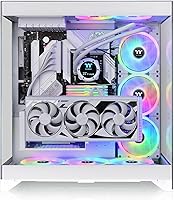
The Thermaltake E550 TG Mid Tower ATX Case is purpose-built for PC enthusiasts who are either already invested in hidden-connector motherboard platforms — ASUS BTF, MSI PROJECT ZERO, or GIGABYTE PROJECT STEALTH — or are planning to move in that direction. These boards route power and data connectors through the back of the PCB, leaving the front face of the motherboard completely clean, and the E550 TG is one of the few mid-towers designed with that aesthetic goal in mind from the ground up. Beyond the hidden-connector crowd, this chassis suits builders who want serious cooling capacity — a 420mm radiator and up to six 140mm fans is genuinely high-end for a mid-tower footprint. Anyone who has wanted to display their GPU vertically or at a floating angle without sourcing third-party brackets will appreciate the built-in three-way mounting system. If your priority is a gallery-quality showcase build with wide glass viewing angles and a clean interior, this mid-tower case is a strong match.
Not suitable for:

The Thermaltake E550 TG Mid Tower ATX Case is not the right choice for builders on a tight desk or in a compact space — at over 20 inches tall and 32 pounds, it demands real estate and handling confidence during assembly. If you are building with a standard ATX motherboard that uses conventional cabling, you will get the structural benefits of the dual chamber design, but the case's most distinctive feature — cable-free aesthetics — simply will not apply to your build. Budget-conscious builders may also find the feature set overpowers their needs; if you do not plan to run large radiators, display your GPU vertically, or use a hidden-connector board, you are paying for capabilities you will never use. First-time builders or anyone who prefers a straightforward, forgiving installation process may find the alignment requirements for hidden-connector boards and the VGA bracket system more fiddly than expected. This is a chassis that rewards experience and rewards planning.
Specifications

  • Form Factor: Supports full ATX motherboards in a mid-tower chassis configuration.
  • Dimensions: The case measures 20.2 x 21.99 x 10.63 inches (L x W x H).
  • Weight: The chassis weighs 32 pounds, which is on the heavier end for a mid-tower.
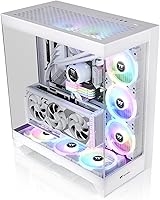
  • Glass Panels: Three tempered glass panels cover the front, side, and top for wide multi-angle interior visibility.
  • Chamber Design: A dual chamber layout physically separates the PSU and storage bay from the main motherboard area.
  • Fan Support: Accommodates up to six 140mm fans or three 120mm fans depending on configuration and radiator use.
  • Radiator Support: Supports radiators up to 420mm in length for high-performance liquid cooling setups.
  • GPU Mounting: Offers three GPU installation orientations — horizontal, vertical, and angled — via rotational PCIe slots and a floating bracket.
  • Motherboard Compatibility: Natively supports hidden-connector motherboards including ASUS BTF, MSI PROJECT ZERO, and GIGABYTE PROJECT STEALTH.
  • PSU Mounting: Power supply unit mounts at the bottom of the chassis within the secondary chamber.
  • Front I/O: Includes one USB 3.2 Gen 2 Type-C port, two USB 3.0 Type-A ports, and an HD Audio jack.
  • Materials: Constructed from steel framing with tempered glass panels on three sides and a Snow white finish.
  • Color: Available in Snow, a white colorway with white interior framing and panel trim.
  • Warranty: Covered by a three-year manufacturer warranty from Thermaltake.
  • Model Number: The official model identifier is CA-1Z8-00M6WN-00.
  • Brand: Manufactured by Thermaltake, a well-established PC hardware brand known for cases and cooling products.

Related Reviews

Thermaltake Tower 600 Mid-Tower ATX Case
79%
91%
Build Quality
93%
Aesthetic Design
88%
Cable Management
94%
Cooling Capacity
71%
Installation Experience
More
Thermaltake Versa H21 ATX Mid Tower Case
69%
91%
Ease of Assembly
86%
Interior Space
73%
Airflow & Ventilation
58%
Build Quality & Materials
67%
Cable Management
More
Thermaltake View 200 TG ARGB Mid Tower Case
71%
78%
Build Quality
53%
Airflow Performance
67%
Included Fans
84%
RGB & Lighting
62%
Cable Management
More
Thermaltake S300 Tempered Glass Edition ATX Mid-Tower Case
85%
88%
Build Quality
85%
Cooling Performance
91%
Ease of Setup
90%
Design and Aesthetics
87%
Compatibility with Motherboards
More
HYTE Y40 Mid-Tower ATX Case
85%
89%
Design & Aesthetics
86%
Cooling Performance
91%
Cable Management
93%
Build Quality
72%
GPU Compatibility
More
KEDIERS P6 Mid Tower ATX PC Case
75%
88%
Aesthetic Design
71%
Build Quality
84%
Included Fans & Lighting
78%
Airflow & Thermal Performance
81%
Radiator & Cooling Support
More
SAMA 3509 ATX Mid Tower PC Case
74%
88%
Value for Money
74%
Build Quality
81%
Airflow & Cooling Performance
67%
Pre-installed Fan Quality
86%
Tempered Glass Panel
More
darkFlash DS900 ATX Mid-Tower PC Case
84%
89%
Cooling Performance
88%
Build Quality
91%
Ease of Installation
85%
Design & Aesthetics
92%
Value for Money
More
Zalman T6 ATX Mid Tower PC Case
71%
83%
Value for Money
67%
Build Quality
71%
Airflow & Cooling
79%
Interior Space & Layout
76%
Cable Management
More
Zalman S4 Mid-Tower ATX PC Case
81%
88%
Airflow and Cooling
80%
Build Quality and Materials
92%
Ease of Installation
60%
Acrylic Panel Durability
70%
Cable Management
More

FAQ

No, the Thermaltake E550 TG Mid Tower ATX Case works with standard ATX motherboards just fine. That said, the case is specifically engineered to support hidden-connector platforms like ASUS BTF and MSI PROJECT ZERO, which route cables through the back of the PCB for a wire-free front face. If you use a conventional board, you still benefit from the dual chamber design and cooling capacity, but the signature clean-interior aesthetic will not fully materialize without that board type.
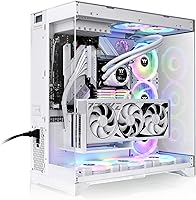
Hidden-connector motherboards relocate power and data connectors to the underside or rear of the board, so no cables are visible on the component-facing side of your build. Brands like ASUS call their platform BTF, MSI uses PROJECT ZERO, and GIGABYTE calls theirs PROJECT STEALTH. This case has dedicated routing and clearance built around those platforms, making it one of the cleaner ways to achieve a truly cable-free interior without custom modifications.

Yes. The E550 TG includes a floating VGA bracket and rotational PCIe slots that support vertical and angled GPU installation out of the box — no third-party riser cable or bracket required. Horizontal mounting is still available if you prefer the traditional setup. Just keep in mind that for vertical mounting, PCIe riser cable length matters for clearance, so double-check your GPU length against the available space before committing to that orientation.

Most buyers report it works well for typical GPU weights, but a handful of users have expressed some hesitation about long-term rigidity with very heavy flagship cards. If you are mounting a particularly large or dense GPU, it is worth checking Thermaltake's support documentation for any weight limits, and monitoring the bracket after installation to make sure there is no sag over time.

No, the E550 TG does not ship with fans included. Given that it supports up to six 140mm fans and a 420mm radiator, you will need to factor fan or AIO costs into your total build budget separately. The fan mounts are generously sized, so 140mm fans are the recommended choice for maximizing airflow efficiency in this chassis.

At 32 pounds, this mid-tower case is noticeably heavy compared to lighter steel-and-glass competitors. You can absolutely build in it solo, but having someone hold the case steady while you seat the motherboard or manipulate the dual chamber panel makes the process a lot smoother. If you are building alone, set it on a stable surface at a comfortable working height before starting.

A microfiber cloth slightly dampened with isopropyl alcohol or a dedicated glass cleaner works well for the panels. Avoid abrasive cloths or paper towels, which can leave micro-scratches on tempered glass over time. The three-panel design means fingerprints will be visible more frequently than on a single-panel case, so a quick wipe-down every week or two keeps it looking sharp.

Yes, a 420mm radiator fits in this chassis — that is one of the more notable specs for a mid-tower. Radiator placement options depend on your exact configuration, so it is worth checking Thermaltake's official compatibility chart for your specific AIO before purchasing. The dual chamber design helps by keeping the PSU and storage out of the way, which opens up more room for large cooling hardware in the main chamber.

The case is primarily designed around ATX boards, but Micro-ATX and Mini-ITX boards will typically fit in an ATX case with standard standoff configurations. If you are planning a Micro-ATX or Mini-ITX build, just keep in mind that some of the internal space — particularly around cable routing for hidden-connector support — is optimized for full ATX layouts.

Thermaltake backs this case with a three-year warranty, which covers manufacturing defects. For shipping damage or missing parts, the typical process is to contact Thermaltake's customer support with photos and your order details. It is good practice to inspect the glass panels carefully on arrival, since tempered glass can develop stress fractures during transit that are not always immediately obvious.