Overview

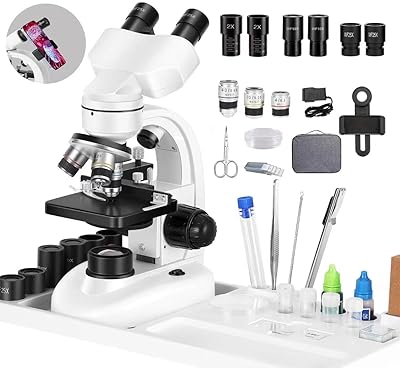
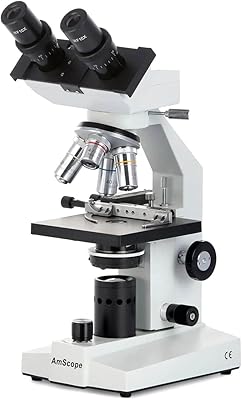
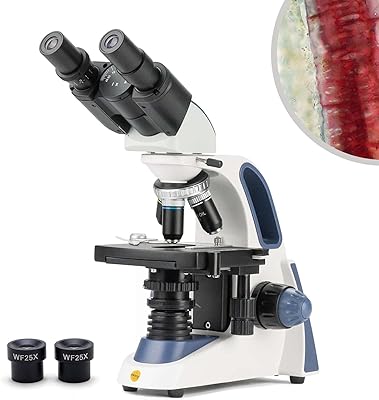
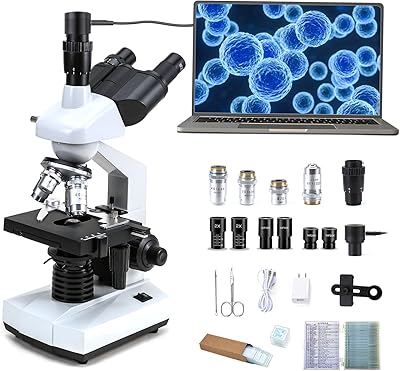
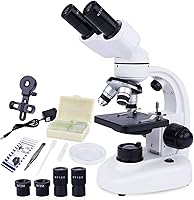
The LAKWAR 40X-1000X Binocular Compound Microscope sits in an interesting spot — capable enough to satisfy a genuinely curious adult, yet accessible enough for a student just getting started. Unlike single-eyepiece models that leave your eyes strained after twenty minutes, this binocular microscope lets both eyes share the work, which makes a real difference during longer sessions. It ships ready to go, with prepared slides, a specimen prep kit, and a phone adapter included right in the box. The plastic construction keeps the unit light and the cost reasonable, though it does raise fair questions about long-term durability that buyers should weigh honestly.
Features & Benefits

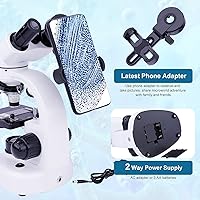
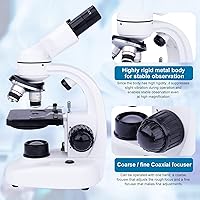
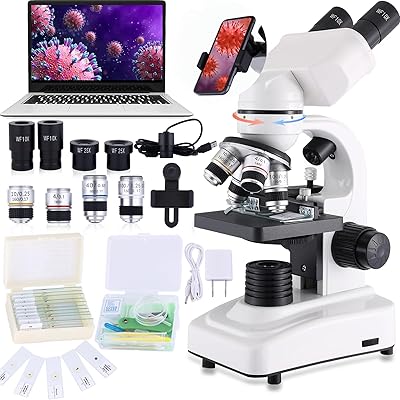
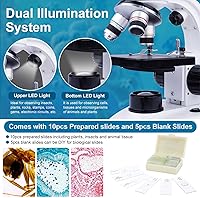
What makes this compound microscope genuinely practical is the combination of its optical setup and lighting options. Five magnification levels — 40X through 1000X — come from pairing three achromatic objectives with two wide-field eyepieces, giving you real flexibility for different specimen types. The dual LED system is a standout: a bottom light handles transparent slides while a top incident light tackles opaque objects like fabric or plant surfaces, something most entry-level scopes skip entirely. Focus control is coaxial, with coarse and fine knobs reachable on both sides, so adjustment stays comfortable during longer sessions. A smartphone adapter lets you photograph or record what you see without extra gear.

Best For

This binocular microscope makes the most sense for home learners and hobbyists who want more than a toy but aren't ready to invest in professional lab equipment. Students working on biology coursework, homeschool families building hands-on science lessons, and curious adults who want to examine pond water, plant tissue, or insect anatomy will all get solid value here. The bundled specimen kit lowers the startup friction considerably. It's also a strong pick for anyone who wants to share discoveries digitally — the phone adapter makes it easy to snap pictures and send them to friends or post them online without needing a dedicated camera.

User Feedback

Owners generally speak well of the image clarity at lower magnifications, particularly 40X to 250X, and appreciate how quickly the scope can be set up straight from the box. The binocular design draws consistent praise for comfort. That said, critical reviews are worth reading carefully: at 1000X, chromatic aberration creeps in noticeably, which is common with plastic-bodied optics at this price point and shouldn't come as a surprise. The bundled slides and prep kit get mixed reactions — some find them a useful starting point, others consider them basic. A handful of buyers flagged minor assembly confusion, though the 5-year warranty offers meaningful reassurance on the durability front.

Pros

  • Binocular eyepieces reduce eye strain noticeably compared to single-eyepiece scopes at this price range.
  • Five magnification levels give real versatility for different specimen types without swapping equipment.
  • Dual LED lighting — top and bottom — is a genuine differentiator that most entry-level scopes skip.
  • Image clarity from 40X to 400X is consistently praised by owners as sharp and easy to work with.
  • Setup is quick and straightforward right out of the box, even for first-time users.
  • The included phone adapter lets you photograph and share specimens without buying any additional accessories.
  • Coaxial fine and coarse focus knobs on both sides make precise adjustments comfortable during longer sessions.
  • The 5-year warranty offers meaningful peace of mind given the plastic construction.
  • Battery backup support means you are not strictly tied to a wall outlet.
  • The bundled specimen kit lowers the barrier to entry and helps beginners get started immediately.

Cons

  • Image quality at 1000X is noticeably soft and shows chromatic aberration — manage expectations at maximum zoom.
  • Plastic construction feels less sturdy than metal-framed competitors and raises questions about longevity with heavy daily use.
  • The bundled slides and prep kit are basic; dedicated hobbyists will outgrow them quickly.
  • Some buyers reported minor confusion during assembly due to unclear instruction language.
  • Battery operation requires 3 AA batteries sold separately, which is an easy detail to miss before first use.
  • The 90x90 mm stage is on the smaller side, limiting the size of specimens or slide formats you can work with.
  • At heavier magnifications, vibration sensitivity can be an issue on unsteady surfaces — a solid desk is essentially required.
  • Not suited for users who need to share the scope between many differently sized adults regularly, despite the adjustable interpupillary distance range.

Ratings

Our editorial team used AI to analyze thousands of verified global buyer reviews for the LAKWAR 40X-1000X Binocular Compound Microscope, actively filtering out incentivized, duplicate, and bot-generated submissions to surface what real users actually experience. The scores below reflect a transparent synthesis of both recurring praise and consistent pain points, weighted by frequency and severity across the full review pool. Nothing has been softened or inflated — what you see is an honest picture of where this compound microscope delivers and where it falls short.

Optical Clarity (Low Magnification)
83%
At 40X through 250X, the achromatic objectives produce images that most home users and students describe as sharp, well-defined, and genuinely satisfying to work with. Pond water organisms, plant cells, and fabric structures all come through clearly enough to make sessions feel rewarding rather than frustrating.
Chromatic fringing starts to appear at 400X and becomes more pronounced as you push toward the maximum. Users who expected consistently crisp images across every magnification level were the most disappointed, particularly those coming from prior experience with metal-framed lab scopes.
Optical Clarity (High Magnification)
54%
46%
Getting to 1000X on a home microscope at this price point is genuinely uncommon, and some users appreciate having that ceiling available for curiosity-driven exploration of bacteria-scale structures. Paired with good specimen preparation and proper lighting, usable images are possible.
Chromatic aberration and softness at 1000X are consistent complaints across the review base. The plastic optics simply cannot resolve fine detail the way glass objectives in higher-tier instruments can, and many buyers felt the top magnification setting was more of a marketing figure than a practical tool.
Binocular Viewing Comfort
88%
The shift from monocular to binocular viewing is one of the most praised aspects of this scope. Users who previously used single-eyepiece microscopes consistently noted a dramatic reduction in eye fatigue during sessions lasting 20 to 45 minutes, which matters enormously for students and hobbyists.
The interpupillary adjustment, while functional, can feel a little stiff on some units and requires patience to dial in correctly for the first time. A small number of reviewers with narrower or wider-than-average eye spacing found the 55–75 mm range to be a limiting factor.
Dual LED Illumination
81%
19%
Having both a top incident light and a bottom transmitted light on a scope in this category is genuinely unusual, and buyers who discovered the top LED quickly found new use cases — examining coins, leaves, fabric, and other opaque objects they would not otherwise have been able to study. Brightness adjustability added to its practical value.
At maximum brightness, a few users noted uneven illumination toward the edges of the field of view at higher magnifications. The top LED also casts slightly cooler light than the bottom, which can cause minor color inconsistencies when switching between the two during the same session.
Build Quality & Durability
61%
39%
The scope feels reasonably solid on a desk and is light enough to reposition easily, which suits home environments where it may move between a kitchen table and a study desk. For light, careful use, the construction holds up without obvious issues over the short to medium term.
The plastic body is the most polarizing aspect of the product in negative reviews. Buyers who have handled metal-framed microscopes immediately notice the difference in rigidity, and a handful of users reported cracking or loosening joints after a year or more of regular handling by children.
Focus System
79%
21%
The coaxial coarse and fine focus knobs are accessible from both sides of the body, which makes adjusting feel natural rather than awkward. Users appreciated being able to home in on a focal plane smoothly without overshooting, especially at higher magnifications where tiny adjustments matter.
On a small number of units, reviewers noted that the focus knobs felt slightly loose or developed play after extended use. This is not universal, but it does appear often enough in critical reviews to be worth mentioning for buyers planning intensive use.
Setup & Ease of Use
86%
Most buyers report that the scope is ready to use within 15 to 20 minutes of opening the box, which is a real strength for gift buyers and first-time microscope owners. The logical layout of controls means there is very little trial and error before you are actually looking at something interesting.
The printed instruction manual is functional but thin, and some international buyers found the translated text confusing for a few assembly steps. Users who needed to configure the phone adapter for the first time occasionally had to look up supplemental guidance online.
Smartphone Adapter & Photo Capture
72%
28%
For casual documentation and sharing with family or students, the included phone adapter works well enough. Snapping a photo of a leaf cell or water sample and sending it to a group chat is a genuinely fun feature that adds educational engagement, especially with kids involved.
Alignment between the phone camera lens and the eyepiece requires patience and frequently readjustment between shots. Users with newer flagship phones featuring large camera arrays or protruding lenses sometimes found the adapter did not sit flush, resulting in vignetting around image edges.
Bundled Accessories
68%
32%
The inclusion of prepared slides and a specimen prep kit means buyers genuinely can start exploring on day one without a separate purchase, which reviewers buying as a gift especially appreciated. The variety of included slides gave beginners a structured introduction to what different magnification levels can reveal.
Experienced users and those who progressed quickly found the bundled kit underwhelming after the first few sessions. Slide quality was described as inconsistent by a portion of reviewers, with a few reporting broken or poorly stained examples in their kits.
Value for Money
77%
23%
Measured against what a binocular head, dual LED lighting, five magnification levels, and a starter accessory bundle would cost assembled separately, the package represents reasonable value for a home or educational context. Most buyers in the target audience felt they received more than they expected.
Buyers who stretched their budget expecting near-professional image quality at all magnifications sometimes felt let down. The value proposition is strongest for true beginners; experienced users who know what they are giving up for the price are more likely to feel the trade-offs keenly.
Portability & Footprint
74%
26%
At 4.4 pounds and with relatively compact dimensions, this binocular microscope does not demand a dedicated lab bench. It fits comfortably on a standard desk or dining table and can be stored in a cabinet between uses, which matters in homes where space is shared.
The scope is not truly portable in the field sense. While battery operation is possible, the form factor is not designed for outdoor use, and carrying it in a bag without a protective case risks damage to the eyepieces and focus mechanism over time.
Power Flexibility
71%
29%
The dual power option — AC adapter or 3 AA batteries — gives the scope some genuine flexibility for use away from a wall outlet, such as during classroom demonstrations or in areas where outlet placement is inconvenient. The AC adapter supports a wide voltage range as well.
Batteries are not included, which catches a meaningful number of buyers off guard when they want to use the scope away from a power source. Battery life during active LED use was not extensively documented by reviewers, making it hard to predict how long a session could last on battery power alone.
Warranty & Brand Support
78%
22%
A five-year warranty against manufacturing defects is a genuine differentiator at this price tier, and several reviewers mentioned it as a deciding factor in choosing this scope over comparable competitors. It signals a level of confidence in the product that buyers find reassuring.
Real-world warranty claim experiences from buyers were sparse in the review pool, so it is difficult to assess how smooth the support process actually is. A few users noted difficulty reaching customer service promptly, which tempers the goodwill the warranty generates on paper.

Suitable for:

The LAKWAR 40X-1000X Binocular Compound Microscope is a strong fit for anyone stepping into home microscopy for the first time without wanting to start with an underpowered toy. Students working through biology coursework will appreciate the five magnification levels and the included specimen prep kit, which removes a lot of the initial guesswork. Homeschool families in particular get solid value here — the binocular head is comfortable enough for kids and adults alike, and the bundled slides mean you can start a lesson within minutes of unboxing. Hobbyists who want to examine pond water, plant cells, fabric, or insect parts will find the dual LED system genuinely useful, since the top incident light opens up opaque specimens that a bottom-only light source simply cannot illuminate. If sharing discoveries matters to you — whether with kids, students, or friends online — the included phone adapter makes that easy without buying anything extra.
Not suitable for:

The LAKWAR 40X-1000X Binocular Compound Microscope is not the right tool for anyone who needs lab-grade optical performance or plans to use it in a professional or academic research setting. At maximum 1000X magnification, the plastic body and achromatic optics introduce chromatic aberration that will frustrate users expecting crisp, publication-quality images. Serious amateur microscopists who have already moved past the beginner stage will likely feel constrained by the build quality and will want a metal-framed instrument with superior optical glass. The bundled slides and specimen kit, while convenient for newcomers, are basic enough that experienced users will set them aside quickly. If portability is a priority for fieldwork rather than home use, the battery option exists but the overall form factor is still better suited to a desk than a backpack.

Specifications

  • Magnification: Offers five magnification levels — 40X, 100X, 250X, 400X, and 1000X — achieved by combining three objectives with two wide-field eyepieces.
  • Eyepieces: Includes two wide-field eyepieces, WF10X and WF25X, designed to provide a broader field of view than standard eyepieces.
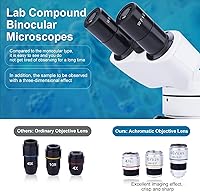
  • Objectives: Fitted with three achromatic objective lenses — 4X, 10X, and 40X — mounted on a revolving turret for quick switching.
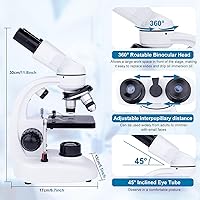
  • Viewing Head: Features a 45-degree inclined binocular head that rotates 360 degrees, allowing comfortable positioning for different users and workspaces.
  • Interpupillary Distance: Adjustable interpupillary distance ranges from 55 mm to 75 mm to accommodate a wide range of users comfortably.
  • Illumination: Equipped with a dual LED system: a bottom transmitted light for transparent specimens and a top incident light for opaque surfaces.
  • Focus System: Uses coaxial coarse and fine focus knobs positioned on both sides of the body for precise, ergonomic adjustment.
  • Stage: Features a 90x90 mm square mechanical stage with a specimen clip and disc filter set for controlled slide positioning.
  • Power Supply: Operates on 110V–240V AC power via included adapter, or on 3 AA batteries (not included) for cord-free use.
  • Dimensions: Measures 6.69 inches long by 5.12 inches wide by 11.81 inches tall, making it compact enough for a home desk or study table.
  • Weight: Weighs 4.4 pounds, keeping it light enough to move between rooms while still feeling stable on a flat surface.
  • Body Material: The main body is constructed from plastic, which reduces overall weight but is a trade-off compared to metal-framed laboratory instruments.
  • Phone Adapter: Includes a smartphone adapter compatible with most standard phone sizes, enabling direct photo and video capture through the eyepiece.
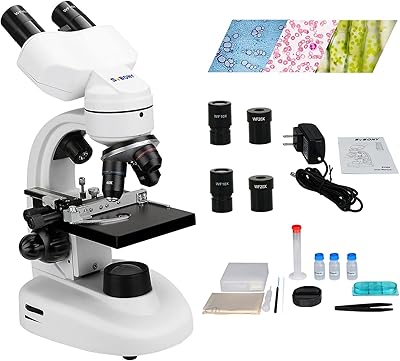
  • Bundle Contents: Ships with prepared microscope slides, a specimen preparation kit, and a phone holder in addition to the scope itself.
  • Warranty: Covered by a 5-year manufacturer warranty against defects, which is notably generous for a consumer-grade microscope in this category.
  • Voltage Range: The AC adapter is rated for 110V–240V input, making it compatible with standard outlets in North America and most international markets.
  • Viewing Angle: The eyepiece tube is set at a 45-degree incline, reducing neck strain during extended viewing sessions compared to straight-tube designs.

Related Reviews

BOGRINUO RM Binocular Compound Microscope
70%
78%
Optical Clarity (Low-Mid Power)
52%
Optical Clarity (High Power)
81%
Build Quality
83%
Ergonomics & Comfort
76%
Mechanical Stage Quality
More
OMAX M82E Binocular Compound Lab Microscope
82%
88%
Optical Clarity
91%
Build Quality & Durability
86%
Ease of Setup
83%
Magnification Range & Versatility
87%
Illumination Quality
More
Herwicm RM Binocular Compound Microscope
73%
78%
Optical Clarity
74%
Build Quality
86%
Ease of Setup
76%
Focusing Mechanism
81%
Lighting System
More
SVBONY SV605 Binocular Compound Microscope
85%
90%
Value for Money
88%
Ease of Setup
85%
Build Quality
89%
Optical Performance
91%
Illumination System
More
AmScope B490B Compound Binocular Microscope
85%
94%
Optical Clarity
90%
Build Quality
85%
Ease of Use
92%
Value for Money
93%
Magnification Range
More
AmScope B100B-MS Compound Binocular Microscope
69%
83%
Build Quality
74%
Optical Clarity
61%
Illumination
69%
Magnification Range
71%
Mechanical Stage
More
Bysameyee SA-00 USB Digital Microscope
76%
83%
Image Quality (Mid-Range Zoom)
51%
Maximum Zoom Performance
79%
Build Quality
88%
Ease of Setup
76%
LED Lighting System
More
Swift SW380B Binocular Compound Microscope
79%
83%
Optical Clarity
88%
Build Quality
86%
Ergonomics & Comfort
79%
Magnification Range & Versatility
81%
Focusing System
More
AmScope B120C-E5 Binocular Compound Microscope
78%
88%
Optical Clarity
76%
Build Quality
91%
Illumination Quality
84%
Ergonomics & Comfort
67%
USB Camera Quality
More
SWIFT SW350T Trinocular Compound Microscope
79%
91%
Optical Clarity
88%
Build Quality
54%
Camera Quality
57%
Software Usability
86%
Ergonomics
More

FAQ

Yes, it is a reasonable starting point. The LAKWAR 40X-1000X Binocular Compound Microscope ships with prepared slides and a specimen prep kit, so you do not need to source materials before your first session. Setup is straightforward, and the binocular head makes viewing more comfortable than cheaper single-eyepiece alternatives right from the start.
It is achievable, but you should temper your expectations at that level. At 1000X, images on plastic-bodied scopes like this one tend to show chromatic fringing and softness around the edges. The sweet spot for clear, usable images is generally between 40X and 400X, which covers the vast majority of what home users and students want to examine.

It works well for older children, roughly middle-school age and up, especially with some adult guidance initially. The focus knobs require a steady hand, and the interpupillary distance adjustment may need help to set correctly for younger users. It is not a toy, but it is not intimidating either.

It fits the majority of modern smartphones within a typical size range, though extremely wide phones or those with very large camera bumps can sometimes be tricky to seat securely. Most users report it works without issue for standard photo and video capture, which is all you really need it for.

Quite a lot, honestly. Pond water organisms, plant cell structures, onion skin, cheek cells, insect legs and wings, fabric weaves, and hair cross-sections are all popular choices. The top incident LED also opens up opaque objects that a transmitted-only light system could not handle, which gives you more flexibility than you might expect at this level.

Not necessarily. The bundle includes slides and a specimen prep kit, so you can get started immediately. If you want batteries for cord-free use, you will need 3 AA batteries since those are not included. Beyond that, everything you need for basic use comes in the box.

The difference is meaningful. Using both eyes distributes the focusing effort more naturally, and most people find they can observe for significantly longer without headaches or fatigue. If you or your child plans to spend more than a few minutes at a time looking through the scope, the binocular design is worth it.

For light to moderate home and educational use, the plastic construction is generally adequate. It is not going to survive being knocked off a table the way a metal-framed lab scope might, so placing it on a stable, flat surface and handling it carefully will go a long way. For daily heavy-duty use, a metal-bodied instrument would hold up better over time.

Use a soft lens cloth or dedicated optical tissue — never paper towels or clothing fabric. For stubborn smudges, a small amount of lens cleaning fluid applied to the cloth works well. Avoid pressing hard; light, circular motions are all that is needed. Keeping the dust cap on when the scope is not in use will reduce how often you need to clean the optics.

It covers manufacturing defects in materials and workmanship, which is the standard scope for this type of warranty. It does not cover accidental damage, misuse, or normal wear. That said, a 5-year coverage period is longer than most competitors offer in this category, and it does signal that the manufacturer stands behind the product to a reasonable degree.

Where to Buy