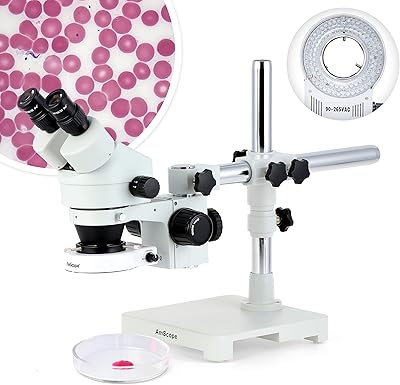
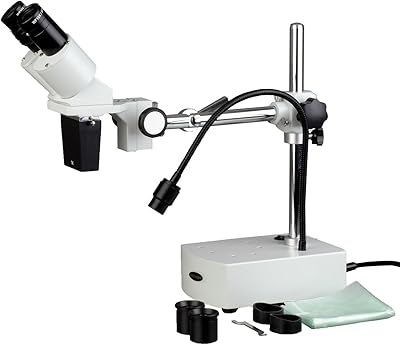
AmScope SM-4B Stereo Zoom Microscope Boom Stand
AmScope SM-4B Stereo Zoom Microscope Boom Stand — image 1
AmScope SM-4B Stereo Zoom Microscope Boom Stand — image 2
AmScope SM-4B Stereo Zoom Microscope Boom Stand — image 3
AmScope SM-4B Stereo Zoom Microscope Boom Stand — image 4
AmScope SM-4B Stereo Zoom Microscope Boom Stand — image 5
AmScope SM-4B Stereo Zoom Microscope Boom Stand — image 6
AmScope SM-4B Stereo Zoom Microscope Boom Stand — image 7
AmScope SM-4B Stereo Zoom Microscope Boom Stand — image 8
AmScope SM-4B Stereo Zoom Microscope Boom Stand — image 9
76%
24%

Overview

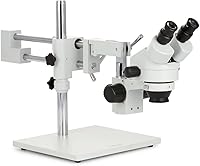
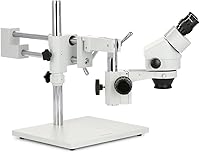
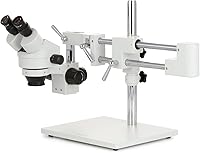
The AmScope SM-4B Stereo Zoom Microscope Boom Stand has been a quiet workhorse in the upper mid-range stereo microscope market since 2011 — and with a 4.3-star rating across a solid base of buyers, it has clearly earned its longevity. What separates it from standard pillar-mounted scopes is the double-arm boom stand, which suspends the optical head overhead and keeps the work surface completely clear. That matters enormously when you are soldering a PCB, shaping a dental crown, or painting a miniature. This is not a beginner toy, but it is also not a full research-grade instrument — it sits squarely where serious hobbyists and working professionals overlap.

Features & Benefits

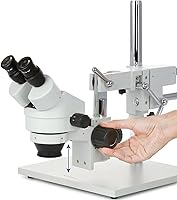
The SM-4B's continuous zoom range — from 7X up to 45X — is one of its most practical strengths. You can pull back to get a wide orientation view of a circuit board, then dial in tight on a single solder joint without repositioning anything. The three-axis boom arm handles the repositioning instead: its 20-inch arms and 17-inch pillar let you swing, raise, or extend the head over virtually any object on the bench. The binocular head sits at a fixed 45-degree angle, which is much easier on the neck than a straight-down viewing position during extended sessions. One honest caveat: there is no built-in light source, so a separate ring light or lamp is a practical necessity.

Best For

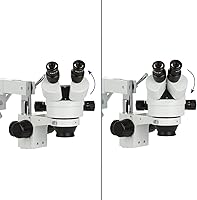
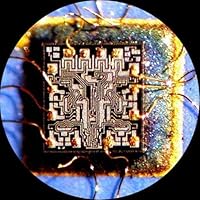
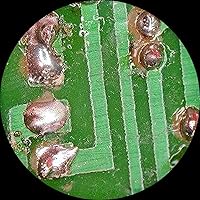
This boom stand microscope earns its place in workshops and small labs where the work itself is hands-on and the specimen is often large, irregular, or actively being modified. Electronics repair technicians use it to inspect and rework PCBs without craning over a fixed stage. Dental lab workers and jewelers benefit from the overhead positioning freedom that a boom arm provides — no awkward angles, no fighting the stand. It also works well in shared teaching environments, since the head rotates a full 360 degrees for easy group viewing. That said, if you need transmitted illumination, a compact footprint, or portability, this scope is not the right fit.

User Feedback

Buyers who stick with the SM-4B long-term consistently praise its build quality and zoom smoothness — the steel construction feels durable in a way that cheaper alternatives simply do not. The wide field of view at lower magnifications draws specific praise from electronics and jewelry users who appreciate seeing the full picture before zooming in. The most common frustration is the absent light source; most owners end up purchasing a separate ring light, which adds to the overall cost. A few reviewers note that balancing the boom arm takes some initial adjustment. At 55 pounds, this stereo zoom scope stays put — ideal on a dedicated bench, but a real commitment if your workspace changes often.

Pros

  • The boom arm keeps the entire work surface clear, which is a genuine advantage when handling large or delicate specimens.
  • Continuous 7X to 45X zoom lets you shift from a broad overview to fine detail without repositioning your work.
  • Steel construction gives the SM-4B a solidity that budget alternatives cannot match — it does not flex or drift mid-task.
  • The 45-degree binocular head angle meaningfully reduces neck and eye strain during long work sessions.
  • Wide-field 10x eyepieces deliver a noticeably larger view than standard eyepieces, especially useful at lower magnifications.
  • 360-degree head rotation makes it practical to share the view instantly with a colleague or student.
  • This stereo zoom scope has been on the market since 2011 and maintains strong ratings — a proven track record is worth something.
  • Adjustable interpupillary distance accommodates a wide range of users without fuss.
  • Three-axis arm movement allows precise positioning over any point on the bench without touching the specimen.

Cons

  • No built-in light source is a real omission — a ring light or gooseneck lamp is a near-mandatory additional purchase.
  • At 55 pounds, relocating this boom stand microscope between workstations is not a casual task.
  • Initial boom arm balancing has a learning curve that can frustrate first-time users during setup.
  • The total cost rises once you factor in a quality external illuminator, which is not included.
  • The fixed 45-degree head inclination suits most users but cannot be adjusted for personal preference.
  • There is no camera port on base configurations, so adding digital capture requires additional accessories.
  • The large physical footprint demands a dedicated, stable bench — a cramped or shared desk setup will struggle.

Ratings

The scores below reflect an AI-driven analysis of verified global buyer reviews for the AmScope SM-4B Stereo Zoom Microscope Boom Stand, with spam, bot activity, and incentivized feedback actively filtered out before scoring. Each category captures what real users — electronics technicians, dental lab workers, jewelers, and serious hobbyists — actually experienced over extended use. Both the standout strengths and the genuine frustrations are represented transparently, so you can make a fully informed decision.

Build Quality
93%
The all-steel construction is consistently singled out by long-term owners as the defining reason they trust this boom stand microscope on a daily basis. Users report zero flex in the arm joints and no degradation in the zoom mechanism even after years of regular bench use — a level of durability that cheaper alternatives simply cannot replicate.
A handful of buyers noted that the sheer weight of the steel frame, while a stability asset, makes any accidental knock or table bump feel consequential. A small number of international buyers also flagged surface coating inconsistencies on units shipped to certain regions.
Optical Clarity
88%
The achromatic objective and WH10x super-widefield eyepieces draw consistent praise from users who do precision work — PCB repair techs describe crisp solder joint detail, and jewelers report accurate color rendering that helps distinguish metal finishes. The wide field of view at lower magnifications is a specific and frequently mentioned strength.
At the upper end of the zoom range, around 45X, some users notice a soft edge in the image — typical of this class of stereo zoom optic but worth knowing if you do a lot of work at maximum magnification. A few reviewers also noted that image brightness drops noticeably at the top of the zoom range without a strong external light source.
Boom Stand Versatility
91%
The three-axis repositioning capability is the feature users return to most in their reviews. Electronics repair technicians in particular describe being able to position the head precisely over any point on a motherboard or PCB without moving the board itself, which speeds up workflow significantly during rework sessions.
Getting the boom arm properly balanced during initial setup takes patience, and several first-time users described an unexpected learning curve before the head would hold its position without slowly drifting. Once tensioned correctly the problem disappears, but the setup documentation does not address this clearly enough.
Illumination
41%
59%
Because the SM-4B uses ambient lighting, it is completely silent and eliminates any heat or glare issues that can arise from built-in LED ring illuminators — a small number of users working with heat-sensitive specimens actually appreciated this design choice for that specific reason.
The absence of any built-in light source is the single most complained-about aspect of this stereo zoom scope. The overwhelming majority of buyers had to purchase a separate ring light or gooseneck LED lamp within days of receiving the unit, adding both cost and setup complexity that many felt should have been included at this price tier.
Ergonomics
82%
18%
The fixed 45-degree binocular head inclination earns repeated praise from users who work extended sessions — dental lab technicians and watchmakers specifically cite less neck tension compared to scopes with a steeper or straight-down viewing angle. The adjustable interpupillary distance accommodates a wide range of users sharing the same bench scope.
The head inclination is fixed and cannot be adjusted to personal preference, which is a minor frustration for a handful of users who prefer a different angle. Users with very narrow or very wide interpupillary distances occasionally reported that the adjustment range did not fully accommodate them.
Zoom Mechanism
89%
The continuous zoom action is smooth enough that users routinely describe it as one of the SM-4B's best functional qualities — no jumping, no dead zones, and no image shift when moving through the range. For electronics repair and inspection work where you constantly toggle between wide and close views, this smoothness translates directly into faster, less frustrating workflow.
A small subset of buyers reported slight stiffness in the zoom ring on first use, though this appears to resolve with break-in time in most cases. There is no click-stop or indexed position to return to a repeatable magnification, which can be a minor issue for users who need to document work at consistent zoom levels.
Setup & Assembly
63%
37%
Most users report that the physical assembly of the boom stand is logical once you lay out all the components, and the steel construction means nothing feels cheap or flimsy during the process. Users who follow third-party video guides rather than the included instructions tend to report a much smoother experience.
The included instruction manual is widely described as inadequate for a mechanism this complex, particularly regarding boom arm tension adjustment. First-time stereo microscope owners may spend an hour or more on initial setup, and the absence of any illumination setup guidance leaves buyers to figure out lighting entirely on their own.
Stability
94%
At 55 pounds, this boom stand microscope does not move unless you deliberately move it, which is exactly what users doing precise bench work need. Jewelers and PCB technicians describe a complete absence of vibration-induced image drift even when tools are being used directly on the work surface beneath the scope.
The stability that comes from the steel frame and substantial weight is a double-edged reality — if your bench has any vibration source nearby, such as a running compressor or HVAC unit, it can transmit through the floor into the stand. Also, once positioned, most users do not move it at all, which limits flexibility for shared or multi-use workspaces.
Value for Money
72%
28%
Among stereo microscopes with a genuine double-arm boom stand and professional-grade optics, the SM-4B is competitively positioned and many experienced buyers consider it strong value when measured against comparable instruments from European or Japanese optical brands. Its decade-plus track record also reduces the risk of buying into an unproven product.
When you factor in the mandatory external light source purchase, the total cost of ownership rises meaningfully, which shifts the value calculation for budget-conscious buyers. Users who do not need the boom stand and would be satisfied with a pillar-mounted scope can achieve similar optical quality at a noticeably lower price point.
Head Rotation
86%
The 360-degree rotation is consistently highlighted by users in small-team or teaching environments as a practical and frequently used feature. Being able to swing the view toward a colleague instantly — without adjusting the specimen or the arm — makes collaborative inspection fast and natural.
The rotation lock mechanism, while functional, has been described by some users as slightly imprecise, occasionally allowing minor unintended movement when tightening. In solo-use bench environments, the rotation feature is rarely needed and adds no practical value.
Portability
18%
82%
The SM-4B was never designed to be portable, and users who understood this from the outset have no complaints — it is a dedicated bench instrument and performs exactly as expected in that role. Its footprint is large but not unreasonable for a professional workshop or lab bench.
At 55 pounds and with dimensions exceeding 21 inches on multiple axes, moving this stereo zoom scope between rooms or workstations is a genuine physical effort requiring two people. Users who purchased it expecting occasional portability expressed significant regret, and this is the primary driver of negative reviews from buyers who did not research it adequately beforehand.
Eyepiece Quality
84%
The WH10x super-widefield eyepieces provide a noticeably broader view than standard 10x eyepieces, and users transitioning from entry-level scopes frequently mention this as an immediate and welcome improvement. Eyeglass wearers also report comfortable use thanks to adequate eye relief on the eyepiece design.
The eyepieces do not come with individual diopter adjustment on both sides in all configurations, which can be a limitation for users with a significant difference in vision between their two eyes. A few users also noted that the eyepiece rubber cups show wear faster than the rest of the instrument.
Durability Over Time
92%
The product has been available since 2011, and a meaningful number of reviews come from buyers who have owned it for multiple years — the consistently positive long-term reports are one of the strongest signals of real-world durability in the category. Owners describe the optical and mechanical performance holding steady over years of daily professional use.
Long-term owners occasionally report that the foam or rubber elements on the eyepieces and certain arm joints degrade before the steel hardware does, requiring minor replacement parts. AmScope's parts availability and customer support responsiveness receive mixed reviews, which adds some uncertainty to long-term ownership.

Suitable for:

The AmScope SM-4B Stereo Zoom Microscope Boom Stand is purpose-built for professionals and serious hobbyists who need their hands completely free while working under magnification. Electronics repair technicians will find the boom arm invaluable — it hovers overhead without occupying any bench space, letting you solder, probe, or rework a PCB without ever bumping the stand. Dental lab workers and jewelers benefit in much the same way, since the three-axis arm can position the optical head over awkward, three-dimensional objects that would never sit flat on a traditional microscope stage. Model builders and miniature painters who work on large or irregularly shaped pieces will also appreciate how the scope adapts to the work rather than forcing the work to adapt to the scope. In shared teaching or small-team environments, the 360-degree rotating head makes it easy to pass the view around without touching the specimen.

Not suitable for:

The AmScope SM-4B Stereo Zoom Microscope Boom Stand is a poor match for buyers who need a self-contained, ready-to-use setup right out of the box — the complete absence of a built-in light source means you will need to budget for and source a separate ring light or gooseneck lamp before the scope is truly functional. At 55 pounds and with a footprint approaching 22 inches on each side, this is a permanent-bench instrument; anyone hoping to pack it away between sessions or move it between workstations will find it impractical. Researchers or scientists who require transmitted illumination for thin-section or slide-based specimen work should look at a different class of microscope entirely. Budget-conscious buyers stepping into stereo microscopes for the first time may find the investment steep when simpler pillar-stand models could meet their needs at a lower entry point. Portability, compact storage, and plug-and-play lighting are simply not part of what this scope offers.

Specifications

  • Magnification Range: The scope provides continuous zoom from 7X to 45X, covering both wide-area inspection and close detail work without swapping objectives.
  • Zoom Objective: A 0.7X to 4.5X zoom objective delivers the full magnification range through smooth, continuous adjustment.
  • Eyepieces: Paired WH10x super-widefield eyepieces are included, offering a broader visible field than standard 10x eyepieces of the same magnification.
  • Head Inclination: The binocular viewing head is fixed at a 45-degree vertical inclination to reduce neck and eye strain during extended use.
  • Head Rotation: The optical head rotates a full 360 degrees around its mounting point, allowing the view to be shared without repositioning the specimen.
  • Interpupillary Distance: The binocular head offers adjustable interpupillary distance to accommodate different users comfortably.
  • Boom Arm Length: Each of the two boom arms measures 20 inches, providing substantial reach over a workbench.
  • Pillar Height: The vertical pillar stands 17 inches tall, establishing the base height from which the boom arms extend.
  • Positioning Axes: The double-arm boom stand allows independent movement along three axes — horizontal (X), lateral (Y), and vertical (Z) — for precise head placement.
  • Light Source: No illuminator is built in; the scope relies on ambient lighting, and users are expected to supply their own external light source such as a ring light.
  • Objective Lens Type: The objective lens is achromatic, which corrects for chromatic aberration and produces sharper, more color-accurate images across the zoom range.
  • Stand Material: The boom stand and main body are constructed from steel, contributing to the unit's stability and long-term durability.
  • Product Dimensions: The assembled unit measures approximately 21.89 x 18.86 x 21.65 inches, requiring a dedicated and stable bench surface.
  • Weight: The complete unit weighs 55 pounds, making it a permanent bench fixture rather than a portable instrument.
  • Viewing Configuration: The binocular head accepts two eyepieces simultaneously for standard two-eye stereo viewing.
  • Market Availability: This model has been commercially available since March 2011 and has not been discontinued by the manufacturer.
  • Model Identifier: The unit is sold under model number SM-4B and ASIN B006QXBP6I on Amazon.
  • Brand: Manufactured and sold by AmScope, a brand specializing in optical instruments for professional, educational, and hobbyist use.

Related Reviews
AmScope SM-3T Trinocular Stereo Zoom Microscope
77%
88%
Optical Clarity
91%
Build Quality
93%
Boom Stand Design
86%
Zoom Range & Versatility
84%
Ergonomics & Comfort
More
AmScope SM-4TPZ Trinocular Stereo Zoom Microscope
76%
88%
Optical Clarity
91%
Build Quality
93%
Boom Stand Versatility
86%
Zoom Range & Flexibility
74%
Trinocular Camera Integration
More
AmScope SM-3B Binocular Zoom Stereo Microscope
73%
88%
Optical Clarity
91%
Zoom Range & Versatility
83%
Boom Stand Design
86%
LED Ring Light
84%
Build Quality & Durability
More
AmScope SM-4TZ-144-5MT Trinocular Stereo Microscope
77%
93%
Optical Clarity
91%
Build Quality
89%
LED Ring Illumination
88%
Zoom Range & Versatility
79%
Camera Quality
More
AmScope SE305R-PZ Stereo Microscope
75%
86%
Build Quality
78%
Optical Clarity
71%
Lighting System
91%
Ease of Setup
82%
Ergonomics & Comfort
More
AmScope SW-3T24Z Trinocular Stereo Microscope
87%
92%
Magnification Quality
88%
Ergonomics & Comfort
84%
Boom Stand Adjustability
91%
Image Clarity
85%
Build Quality & Durability
More
AmScope SE306R-PZ-LED Stereo Microscope
84%
88%
Value for Money
91%
Build Quality
85%
Ease of Use
78%
Magnification Range
89%
Lighting Performance
More
AmScope SE508 8X Magnification Binocular Stereo Microscope
85%
91%
Build Quality
88%
Usability & Ergonomics
80%
Magnification Performance
85%
LED Illumination Effectiveness
93%
Stability
More
AmScope SE400-Z Binocular Stereo Microscope
77%
88%
Build Quality
79%
Optical Clarity
93%
Working Distance & Clearance
86%
Boom Arm Flexibility
81%
Eyepiece Comfort & Ergonomics
More
AmScope SE306R-P-LED Stereo Microscope
79%
83%
Optical Clarity
88%
Build Quality
79%
Illumination Quality
54%
Magnification Range
81%
Ergonomics & Comfort
More

FAQ

No, it does not. The SM-4B relies entirely on ambient lighting, which means you will need to source an external light separately. Most users pair it with a ring light or a flexible gooseneck LED lamp positioned to illuminate the specimen from the side or above. Budget for this addition before you buy.

There is a bit of a learning curve when you first set it up. The double-arm boom needs to be properly tensioned so the head stays in position rather than drifting. Once you dial it in, it holds firmly — but expect to spend some time during the initial assembly getting it right. The instructions provided are serviceable, and there are helpful setup videos available online.

The base SM-4B configuration does not include a camera port or trinocular head, so adding imaging capability requires purchasing a separate adapter or upgrading to a trinocular variant. If photography or video capture is important to your workflow, check whether AmScope offers a compatible trinocular version of this model before committing.

At 55 pounds, this boom stand microscope is genuinely heavy and has a large footprint. A lightweight or flimsy desk is not going to work well. You want a solid workbench or a heavy-duty table that will not wobble, because any vibration in the surface will show up in the image. Think of it as permanent bench equipment, not something you set up and pack away.

A ring light that mounts around the objective is the most popular choice because it provides even, shadow-free illumination directly onto the specimen. A gooseneck LED arm lamp is a lower-cost alternative that many users find adequate. Avoid overhead fluorescent lighting alone — it rarely delivers enough contrast for detailed inspection work.

Yes, it is one of the more practical choices for that kind of work specifically because the boom arm keeps the entire bench surface clear. You can position the head directly overhead while your hands work underneath with a soldering iron without any part of the stand getting in the way. The zoom range also gives you the flexibility to survey the whole board and then tighten in on a single joint.

It is a binocular scope, so only one person can look through it at a time. However, the head rotates a full 360 degrees, which makes it easy to swing the view toward a colleague without moving the specimen. In a teaching or small-team setting, this works well for passing the view around quickly.

The achromatic objective and wide-field eyepieces produce a noticeably cleaner, more color-accurate image than entry-level scopes in the sub-200-dollar range. At lower magnifications especially, the field of view is wide and bright. That said, this is a stereo zoom scope — not a compound research microscope — so there are inherent limits to resolution at the top of the zoom range, which is normal for this class of optic.

It is well-suited for both. Jewelers benefit from the overhead boom positioning, which lets them work on rings, chains, and settings without fighting the stand for access. Watchmakers appreciate the smooth zoom control for switching between examining a full movement and focusing on a single gear or jewel. The stable steel construction also means the image does not shake when you nudge the workpiece.

This stereo zoom scope has been on the market since March 2011 and has not been discontinued. Its longevity is actually a meaningful signal — AmScope has maintained it for well over a decade, spare parts and accessories remain available, and the sustained buyer ratings suggest it has held up in real-world use over time.

Where to Buy