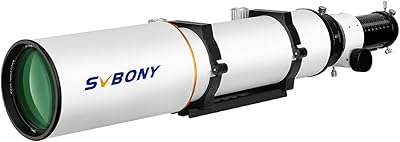
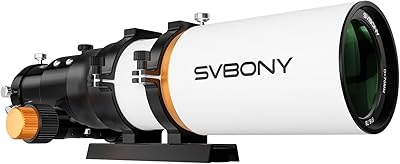
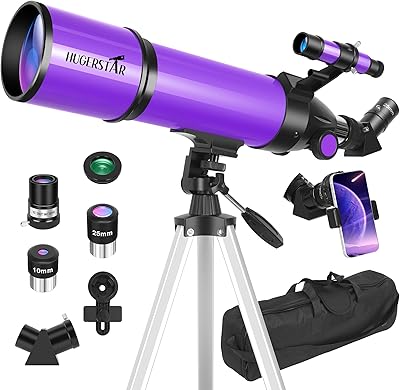
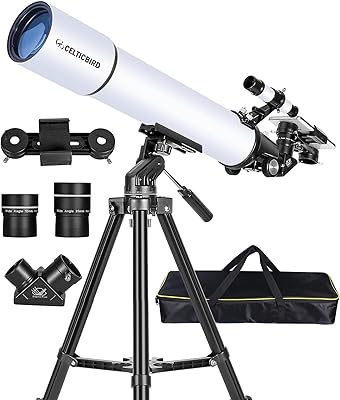
Overview

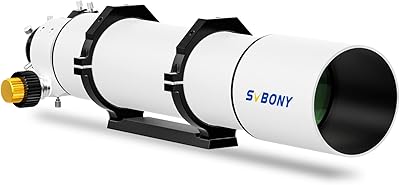
The SVBONY SV503 80mm ED Refractor Telescope is not a beginner's first scope — it's the one you reach for when your entry-level refractor starts feeling limiting. Where a standard achromat at this aperture will frustrate you with purple fringing around bright stars and the Moon, this ED refractor uses extra-low dispersion glass to deliver noticeably cleaner, truer color. It handles double duty well: rewarding visual sessions and a capable platform for entry-level astrophotography. Don't expect to resolve fine planetary surface detail the way a larger aperture would, but for what it is, the machined aluminum build feels genuinely solid and well above its price tier.
Features & Benefits

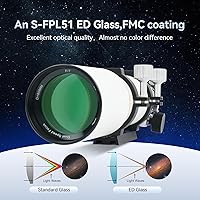
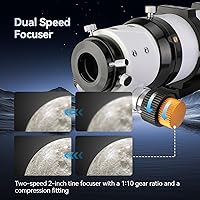
The real story here is the ED glass objective. At F7, even a decent achromat can produce noticeable color fringing on high-contrast targets — this SVBONY scope largely sidesteps that problem, producing crisp, color-accurate images that make a real difference on star clusters and lunar detail. The dual-speed focuser deserves equal attention: that 1:10 fine-adjustment ratio lets you nudge focus in tiny, controlled increments rather than overshooting and hunting back. For astrophotography, that precision matters enormously when nailing critical focus with a camera attached. All optical surfaces carry ultra-wideband multi-coating to keep light transmission high, and the 560mm focal length at F7 sits in a useful sweet spot — wide enough for larger deep-sky targets, tight enough for the Moon and brighter planets.

Best For

This ED refractor hits its stride with a specific kind of buyer. If you started on a budget achromat and now want something that genuinely rewards careful observing, this is a logical next step. Grab-and-go portability is a real strength — at under 9 pounds, it travels well and balances easily on a mid-range alt-az or equatorial mount. Visual observers will appreciate sharp views of open clusters, the Moon, and bright nebulae; just keep expectations honest for faint galaxies. On the imaging side, it pairs naturally with entry-level astronomy cameras and tracking mounts for wide-field deep-sky work. Buyers who plan to build within the SVBONY ecosystem will find accessory compatibility a practical advantage rather than a marketing footnote.

User Feedback

The SV503 80ED has earned a strong community reputation, and the high rating across several hundred reviews reflects consistent satisfaction rather than a cluster of enthusiastic outliers. Buyers repeatedly praise focuser smoothness and build quality — the tube genuinely feels like it costs more than it does. Image sharpness on the Moon and star fields draws consistent compliments, and astrophotographers specifically appreciate how the focuser holds position under camera load without drifting. The recurring frustration, though, is what is missing from the box: no eyepiece, no finder scope, no mount. New buyers frequently underestimate the total setup cost. A smaller share of users also wished for broader third-party accessory compatibility. Still, the overall critical consensus is genuinely positive for this price tier.

Pros

  • ED glass delivers noticeably cleaner, color-accurate views compared to standard achromats at this aperture.
  • The dual-speed focuser with a 1:10 fine-ratio makes hitting critical focus far easier, especially for astrophotography.
  • Fully multi-coated optics on all surfaces keep light transmission high, making images brighter than bare aperture suggests.
  • The machined aluminum tube feels genuinely solid and well-finished — it holds up well to regular field use.
  • Weighing just over 8 pounds, the SV503 80ED is light enough for travel mounts and easy single-handed carry.
  • Sharp, high-contrast lunar views are a consistent highlight among long-term users.
  • The F7 focal ratio suits both visual observing and entry-level wide-field astrophotography without major compromises.
  • Compatibility with SVBONY cameras, filters, and focal reducers makes it a scalable platform rather than a dead-end purchase.
  • No collimation required — one less technical hurdle for observers moving up from simpler gear.
  • The strong community rating across hundreds of verified buyers signals consistent quality control, not just lucky units.

Cons

  • No eyepiece, finder scope, or mount is included — the real setup cost is significantly higher than the tube price alone.
  • Residual false color on very bright targets like Venus is reduced but not fully eliminated.
  • Focuser can slip slightly under heavier camera and filter combinations during long imaging sessions.
  • 80mm aperture limits faint galaxy and dim deep-sky object performance regardless of glass quality.
  • No field flattener built in — star shapes degrade toward the edges of larger imaging sensors.
  • The included documentation is minimal, leaving newer buyers without clear guidance on setup and compatible accessories.
  • Some third-party 2-inch accessories have fitment quirks that buyers relying on non-SVBONY gear will need to troubleshoot.
  • The included dovetail bar is basic and may need shimming to sit perfectly true on some mount saddles.
  • Focus drift during the first 15 to 20 minutes of a session requires refocusing as the tube acclimates to outdoor temperatures.
  • A dedicated carry or storage case is a near-essential additional purchase that most buyers did not budget for initially.

Ratings

The SVBONY SV503 80mm ED Refractor Telescope scores below are generated by AI after analyzing verified global buyer reviews, with spam, bot-submitted, and incentivized feedback actively filtered out. The ratings reflect a honest cross-section of real-world experiences — from first-light impressions to long-term astrophotography sessions — and do not shy away from the recurring frustrations buyers encountered alongside the genuine strengths.
Optical Clarity
91%
The ED glass makes a noticeable, immediate difference for anyone who has previously used a standard achromat at this aperture. Stars snap to tight, round points with minimal color fringing, and the Moon's terminator shows clean, high-contrast detail that budget glass simply cannot match.
A small number of buyers reported slight residual false color on extremely bright targets like Venus near maximum elongation — not eliminated entirely, just well-controlled. At very high magnifications, some softening at the edge of the field was noted, which is typical for this optical design.
Focuser Quality
88%
The dual-speed rack-and-pinion focuser is the component buyers mention most positively. The 1:10 fine-focus ratio lets you creep toward focus in tiny, controlled steps — a real practical advantage when imaging, where overshooting critical focus costs you a session. It feels precise and well-dampened under normal loads.
Under heavier camera and filter combinations, a handful of imaging-focused users reported minor focuser slip over long exposures, requiring occasional re-tightening of the tension ring. It is not a dealbreaker, but buyers planning serious astrophotography setups should be aware.
Chromatic Aberration Control
86%
For an 80mm F7 scope in this price range, the chromatic aberration control is genuinely impressive. Lunar observers and double-star enthusiasts in particular praised how clean the image looked compared to similarly priced non-ED scopes, with no distracting purple or green halos around star disks.
It is worth being clear: ED glass reduces chromatic aberration significantly but does not eliminate it entirely. On very high-contrast bright targets, a faint residual fringe is detectable if you are actively looking for it, which occasionally disappointed buyers expecting apochromatic-level correction.
Build Quality & Materials
89%
The CNC-machined aluminum tube with baked paint finish punches noticeably above its price tier in feel and appearance. Buyers consistently described it as solid, with no flexing, rattling, or cheap plastics anywhere in the optical path. The finish holds up well to regular field use and temperature swings.
The dovetail bar included in the box is functional but basic — a few buyers found it needed minor shimming to sit perfectly square on their mount saddles. The objective lens cap, while adequate, felt like the one component where cost-cutting was visible compared to the rest of the tube.
Value for Money
83%
Considered as an OTA alone, the SV503 80ED sits in a competitive sweet spot: ED glass and a quality dual-speed focuser at this price is a combination that would cost meaningfully more from established Western brands. For buyers who already own a mount and eyepieces, the perceived value is high.
The sticker price can feel deceptive once buyers realize the scope ships with no eyepiece, no finder scope, and no mount. For someone genuinely starting from scratch, the total outlay to have a functional observing setup is substantially higher than the tube price alone suggests.
Portability & Form Factor
84%
At just over 8 pounds and 460mm in tube length, this ED refractor is genuinely grab-and-go. Apartment observers and those who travel to dark sites regularly found it easy to transport in a backpack or moderate carry case, and it balances well on lighter travel mounts without tipping.
The tube is not tiny — it will not disappear into a camera bag, and a dedicated carry case is a worthwhile additional purchase that most buyers did not anticipate needing. Those comparing it to smaller 60mm or 70mm refractors will feel the difference in packability.
Astrophotography Performance
78%
22%
For beginners entering astrophotography, the SV503 80ED offers a solid starting platform. The focuser holds well enough for short-to-medium exposure imaging sessions, and the F7 focal ratio is workable with a dedicated astronomy camera on open clusters and larger nebulae.
More advanced imagers noted that F7 without a focal reducer makes for slower imaging speeds on faint targets, and the lack of a built-in field flattener means star shapes can degrade toward the edges of full-frame or larger sensors. It is a beginner imaging scope, not a serious deep-sky imaging rig.
Coating & Light Transmission
87%
The ultra-wideband multi-coating across all glass surfaces keeps internal reflections low and light throughput noticeably high. Observers using it for visual work on nebulae and star clusters found the image brightness punched above what bare aperture numbers might suggest.
Verifying coating quality independently without specialized equipment is difficult for the average buyer, and a few skeptical reviewers questioned whether the coating specification was fully met. No consistent pattern of underperformance was documented, but it is worth noting the uncertainty.
Ease of Setup
76%
24%
The SVBONY scope ships in a well-organized box with clear component labeling, and attaching it to a dovetail-compatible mount is straightforward for anyone with basic familiarity. Collimation is not required for a refractor, which removes one common beginner headache entirely.
Without an included finder scope, star-hopping to targets is genuinely harder — especially for newer users not yet comfortable with naked-eye navigation. First-time buyers without an existing finder or red-dot sight reported real frustration during initial sessions in the dark.
Accessory Ecosystem Compatibility
74%
26%
Buyers who committed to the SVBONY accessory lineup found the ecosystem reasonably well-integrated, with focal reducers, dedicated cameras, and filter drawers designed to work smoothly with this tube. For those building a budget astrophotography kit around a single brand, it simplifies purchasing decisions.
Buyers who preferred mixing third-party accessories encountered occasional fitment quirks — particularly with some non-SVBONY 2-inch eyepieces and camera adapters. The brand ecosystem is coherent internally, but it is not as universally plug-and-play as some buyers assumed.
Lunar & Planetary Views
81%
19%
Lunar performance is where this SVBONY scope earns its most consistent praise from visual observers. Crater rims, mountain ranges, and the subtle gradations along the terminator look sharp and high-contrast, and the color rendering is honest rather than the washed-out or tinged views a budget achromat produces.
Planetary detail is limited by the 80mm aperture rather than by the optics — and that is an important distinction. Saturn's rings and Jupiter's main cloud bands are visible, but fine detail like the Cassini Division or festoons requires steady seeing and is not a reliable nightly experience at this aperture.
Deep-Sky Visual Performance
73%
27%
For brighter deep-sky objects — the Orion Nebula, the Pleiades, the Beehive Cluster — the SV503 80ED delivers genuinely pleasing wide-field views with good contrast. Star fields look clean and well-resolved, and the coating helps pull out subtle nebulosity that cheaper glass mutes.
Faint galaxies and dim planetary nebulae push the limits of 80mm of aperture regardless of glass quality. Buyers hoping to observe a wide catalog of Messier objects were often satisfied, but those expecting to chase NGC objects routinely found the aperture limiting on darker targets.
Thermal Acclimation
79%
21%
The aluminum tube acclimates reasonably quickly compared to larger reflectors or SCTs, which is a practical advantage for observers who do not want to wait 45 minutes before the image stabilizes. Most users reported workable stability within 15 to 20 minutes of outdoor setup.
On nights with significant temperature swings — moving from a warm car to a cold dark site — some focus drift was noted during the first portion of a session. It is not severe, but it requires a refocus check after the tube has fully settled, which interrupts early-session observations.
Packaging & Out-of-Box Experience
71%
29%
The tube arrives well-protected with dense foam inserts, and the box contents are organized cleanly. The included 2-inch to 1.25-inch adapter ring and dovetail bar mean a buyer with an existing mount and eyepieces can be set up outdoors within minutes of unboxing.
The absence of any documentation beyond a basic product sheet left some buyers guessing about collimation checks, proper balance points, and compatible accessories. A more thorough quick-start guide — even digital — would meaningfully improve the out-of-box experience for less experienced buyers.

Suitable for:

The SVBONY SV503 80mm ED Refractor Telescope is built for the amateur astronomer who has outgrown their first scope and wants a meaningful optical upgrade without crossing into serious professional territory. If you started on a budget achromat and kept running into that soft, color-fringed view on bright targets, this ED refractor answers that frustration directly. Visual observers who spend most of their time on the Moon, open star clusters, and brighter nebulae will find the image quality genuinely satisfying at this aperture. It also makes a practical entry point for astrophotography — paired with an entry-level equatorial tracking mount, the SV503 80ED handles wide-field deep-sky imaging well enough to produce results that will encourage you to keep going. Apartment dwellers and travelers who need a compact, manageable tube that sets up quickly will appreciate how little space it demands compared to a reflector of equivalent light-gathering ability. Buyers who plan to stay within the SVBONY accessory ecosystem — adding focal reducers, dedicated cameras, or filter systems over time — will find the compatibility genuinely useful rather than a marketing promise.
Not suitable for:

The SVBONY SV503 80mm ED Refractor Telescope is a poor fit for anyone who expects a complete, ready-to-observe setup out of the box. There is no mount, no eyepiece, and no finder scope included — a fact that catches a surprising number of buyers off guard, and which means the real cost of getting outside on your first night is considerably higher than the tube price alone. True beginners with no existing astronomy gear should factor in those additional purchases carefully before committing. Experienced observers chasing faint galaxies or fine planetary surface detail will also find 80mm of aperture a ceiling that no amount of glass quality can fully overcome — this is not a scope that competes with a 6-inch or 8-inch reflector on deep or dim targets. Advanced astrophotographers who need a dedicated imaging refractor with a built-in field flattener, fast focal ratios, and rock-solid focuser performance under heavy camera loads will quickly feel constrained by what this SVBONY scope was designed to do. And if you strongly prefer mixing third-party accessories from different brands, be prepared for occasional fitment inconsistencies that a more universally standardized tube would avoid.
Specifications

  • Aperture: The objective lens measures 80mm in diameter, determining how much light the telescope collects for both visual observing and imaging.
  • Focal Length: The optical system has a focal length of 560mm, setting the base magnification and field of view when combined with any given eyepiece.
  • Focal Ratio: At F7, the scope sits in a moderate range — manageable for visual use and workable for wide-field astrophotography without requiring a fast dedicated imaging refractor.
  • Objective Lens: The objective uses an ED (Extra-low Dispersion) double-separation lens structure designed to significantly reduce chromatic aberration compared to standard achromatic glass.
  • Optical Coating: All air-to-glass surfaces carry ultra-wideband fully multi-layer coatings to maximize light transmission and minimize internal reflections across the visible spectrum.
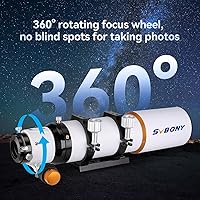
  • Focuser Type: A 2-inch dual-speed rack-and-pinion focuser with a 1:10 fine-adjustment gear ratio provides precise, controlled focus travel suited to both visual observing and camera use.
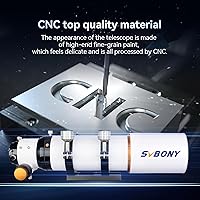
  • Tube Material: The optical tube is CNC-machined aluminum finished with a fine-grain baked paint process, offering structural rigidity and resistance to minor field handling wear.
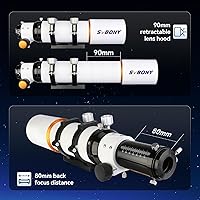
  • Tube Length: The optical tube measures 460mm in length when the focuser is in a mid-travel position, making it compact relative to its focal length.
  • Dimensions: Overall packaged dimensions are 20.47″ x 7.87″ x 8.07″, reflecting the full tube assembly including the focuser and dew shield.
  • Weight: The tube assembly weighs 8.14 pounds, light enough for use on mid-range alt-az or equatorial mounts without overloading the payload capacity.
  • Limiting Magnitude: Under good conditions, the scope can theoretically reach a limiting stellar magnitude of 11.6, enabling observation of brighter deep-sky objects invisible to the naked eye.
  • Resolution: The theoretical resolving power is 1.5 arcseconds, sufficient to split moderately close double stars and reveal fine lunar surface detail under steady seeing conditions.
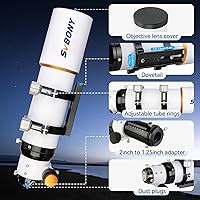
  • Focuser Diameter: The primary focuser accepts 2-inch eyepieces and accessories, with a supplied step-down adapter ring for 1.25-inch eyepieces and diagonals.
  • Mount Interface: A Vixen-style dovetail bar is included in the package, allowing direct attachment to most standard alt-az and equatorial mount saddles.
  • Mount Included: No mount of any kind is included — this is sold strictly as an optical tube assembly (OTA) intended for use with a separately purchased mount.
  • Finder Scope: No finder scope or red-dot sight is included in the standard package; buyers will need to source and attach one independently for practical star-hopping.
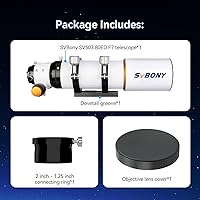
  • Package Contents: The box contains the SV503 80ED telescope OTA, a 2-inch to 1.25-inch adapter ring, a Vixen-style dovetail bar, and an objective lens cap.
  • Manufacturer: The scope is designed and sold by SVBONY, a Chinese optical brand that produces a range of telescopes, cameras, and astronomy accessories primarily for amateur use.

Related Reviews

SVBONY SV503 102mm ED Refractor Telescope
82%
88%
Optical Performance
93%
Focuser Quality
84%
Chromatic Aberration Control
91%
Build Quality
86%
Astrophotography Suitability
More
SVBONY SV503 70mm Refractor Telescope
83%
88%
Optical Clarity
91%
Field Flattener Performance
83%
Chromatic Aberration Control
79%
Focuser Quality
86%
Build & Tube Construction
More
HUGERSTAR 80600 Refractor Telescope
70%
78%
Optical Clarity
88%
Ease of Setup
61%
Tripod Stability
83%
Value for Money
84%
Portability
More
Celticbird 80mm 800mm Refractor Telescope
75%
83%
Optical Clarity
91%
Ease of Assembly
78%
Mount Usability
61%
Tripod Stability
58%
Included Eyepiece Quality
More
SVBONY SV48P 102mm Refractor Telescope OTA
74%
83%
Optical Clarity
86%
Build Quality
88%
Focuser Performance
79%
Astrophotography Suitability
81%
Value for Money
More
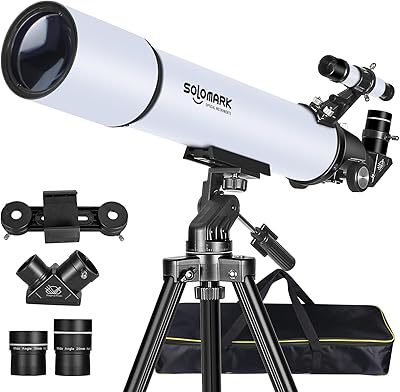
SOLOMARK 80900 Refractor Telescope
76%
83%
Optical Clarity
71%
Build Quality
62%
Tripod Stability
88%
Ease of Assembly
81%
Value for Money
More
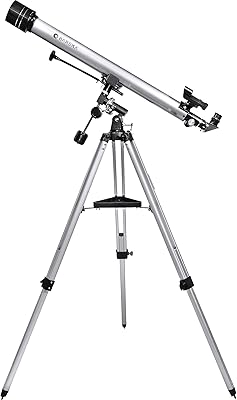
Barska Starwatcher Refractor Telescope 60mm
80%
91%
Value for Money
88%
Ease of Setup
93%
Portability
85%
Performance (Planetary Viewing)
62%
Performance (Deep-Sky Viewing)
More
HEXEUM AZ50070 70mm Refractor Telescope
73%
78%
Optical Clarity
88%
Value for Money
57%
Tripod Stability
66%
Ease of Assembly
63%
Finderscope Usability
More
Barska Starwatcher 70mm Refractor Telescope
66%
72%
Optical Clarity
58%
Magnification Performance
54%
Build Quality
84%
Ease of Setup
88%
Portability & Storage
More
PISEZ 90800 90mm Refractor Telescope
68%
83%
Optical Clarity
81%
Value for Money
72%
Ease of Setup
68%
Magnification Range
61%
Tripod Stability
More

FAQ

Not quite — and this is the single most important thing to know before buying. The SVBONY SV503 80mm ED Refractor Telescope is sold as an optical tube assembly only. You will need to purchase a mount, at least one eyepiece, and ideally a finder scope or red-dot sight separately. If you are starting from scratch, budget for those additions before your first night out.
The included dovetail bar follows the standard Vixen-style format, so it is compatible with a wide range of alt-az and equatorial mounts that accept that saddle type. For casual visual observing, a sturdy alt-az mount works fine. If you plan to do any astrophotography, an equatorial mount with motorized tracking is strongly recommended — manual tracking while imaging is not practical.

It handles both reasonably well, but with different expectations. For visual use, it excels. For astrophotography, it is a solid beginner imaging platform — particularly for wide-field targets like nebulae and star clusters using a dedicated astronomy camera. Advanced imagers who need a fast focal ratio, built-in field flattener, or rock-steady focuser under heavy camera loads will eventually want something more specialized.

Yes, the difference is real and noticeable, especially on high-contrast targets like the Moon, bright stars, and planets. A standard achromat at 80mm F7 typically shows visible purple or green fringing around bright objects. This ED refractor reduces that significantly — not to zero, but to a level that most visual observers and beginner imagers will find entirely acceptable. If you have been frustrated by color fringing on your current scope, this is a meaningful upgrade.

Yes, easily. Saturn's rings are clearly visible and genuinely striking, and Jupiter's four Galilean moons are straightforward targets. You will also see Jupiter's main equatorial cloud bands. What 80mm of aperture cannot do reliably is show fine planetary surface detail — subtle features like the Cassini Division in Saturn's rings or detailed storm structure on Jupiter require steadier seeing and larger aperture to reveal consistently.

The focuser accepts both 2-inch and 1.25-inch eyepieces via the included adapter. To get started, a 25mm eyepiece gives you a good wide-field view at around 22x, and a 10mm or 8mm eyepiece for higher magnification on the Moon and planets is a practical second choice. Plössl eyepieces are a cost-effective and optically solid starting point at this level.

Roughly 15 to 20 minutes under typical conditions, which is faster than most reflectors or catadioptric scopes. If you are moving from a warm indoor environment to a cold dark site, expect some focus drift during the first portion of your session — just refocus periodically until the tube has fully settled. It is a minor inconvenience rather than a serious problem.

Mostly yes, but with some caveats. Standard 2-inch and 1.25-inch accessories from other brands generally fit and work fine. However, a handful of buyers have reported minor fitment quirks with certain third-party adapters and camera T-rings. SVBONY's own accessories are designed to pair cleanly with this tube, so if you are building a kit from scratch, staying within the ecosystem tends to be the smoother path.

Refractors like this one do not require collimation under normal use, which is one of their practical advantages over reflectors. The lens cell is factory-aligned and sealed. As long as you handle the tube reasonably carefully and avoid significant impacts, the optical alignment should remain stable indefinitely without any user intervention.

It is genuinely compact by refractor standards — under 9 pounds and around 20 inches long — which makes it manageable for car camping and dark-site travel. Airline travel is trickier; the tube does not fit in most standard carry-on bags, and checking it as luggage without a solid hard case is risky. Investing in a dedicated carry case is strongly recommended if travel portability is important to you.

Where to Buy