Overview

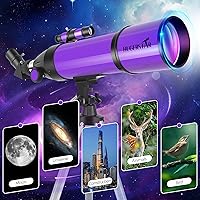
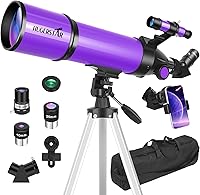
The HUGERSTAR 80600 Refractor Telescope is designed squarely for curious beginners, families, and gift-givers — not seasoned astronomers chasing faint nebulae. Built around an 80mm aperture and 600mm focal length, it delivers a solid optical foundation for its price tier. Think of the aperture like a bucket collecting light: at 80mm, it gathers noticeably more than the 50–60mm scopes often sold at toy stores, making stars crisper and the moon genuinely impressive. Whether you want to scan the night sky or spy on birds from a distance, this beginner refractor handles both roles without demanding any technical know-how. It won't replace a serious hobbyist's instrument, but that was never the goal.
Features & Benefits

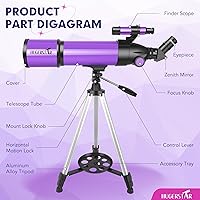
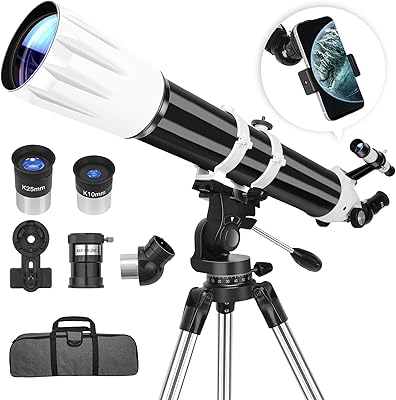
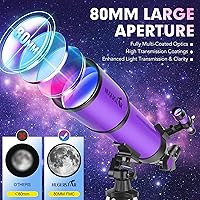
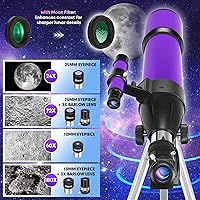
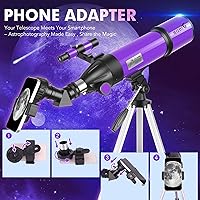
The optics are respectable for a starter scope. The objective lens carries full multi-coating, which improves light throughput and cuts internal reflections — a meaningful step up from single-coated glass on cheaper alternatives. You get two Kellner eyepieces (25mm for wide, low-power views and 10mm for closer detail) plus a 3x Barlow lens, covering 24x to 180x magnification. Practically, 24x to around 100x is where this beginner refractor performs comfortably. The altazimuth mount keeps things intuitive — just point and tilt, no polar alignment needed. A 5x24 finder scope, moon filter, phone adapter, and adjustable aluminum tripod round out an accessory kit that genuinely punches above its weight.

Best For

This starter telescope is a natural fit for kids and teenagers just beginning to look up and wonder. It also makes a thoughtful gift — the kind that sparks a real interest in science rather than collecting dust after one session. Campers and hikers will appreciate the carry bag and the fact that the scope weighs under six pounds assembled; it won't strain your pack. For lunar observers specifically, this is a strong entry point: the 80mm aperture pulls in enough light to make craters and the lunar maria look genuinely dramatic. If you want family backyard sessions rather than serious deep-sky work, the HUGERSTAR scope fits that need well.

User Feedback

Buyers consistently praise how quickly it assembles — most report being ready to observe in under fifteen minutes, which matters when you're trying to hold a child's attention. Lunar views draw particular enthusiasm, with many describing their first clear look at craters as a genuine wow moment. That said, honest reviews also surface recurring gripes. Push magnification above 150x and image sharpness drops noticeably — expected physics for an 80mm tube, not a product defect. The tripod, adequate at mid-height, can wobble at full extension outdoors with any breeze. A handful of buyers noted the phone adapter fit varies across different smartphone sizes. Overall, feedback reflects a scope that delivers when used within its actual limits.

Pros

  • Quick assembly means kids can be observing in under fifteen minutes, keeping excitement alive.
  • The 80mm multi-coated lens delivers genuinely sharp, bright lunar views that impress first-time users.
  • Three magnification options via two eyepieces and a Barlow lens offer real versatility for a starter kit.
  • The altazimuth mount is intuitive — no manuals needed to point it at the moon or a distant bird.
  • Included moon filter makes extended lunar sessions comfortable, reducing eye strain noticeably.
  • At under six pounds, this beginner refractor is easy to carry to campsites or dark-sky spots.
  • The phone adapter lets users snap and share views with friends, adding a social dimension to stargazing.
  • Works well as a daytime spotting scope for birds and wildlife, not just a nighttime astronomy tool.
  • The carry bag is a practical inclusion that actually protects the scope during transport.

Cons

  • Image quality softens considerably above 120x magnification, limiting useful high-power viewing.
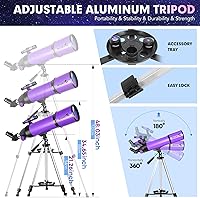
  • The tripod wobbles at full extension, especially outdoors with any wind — even a light breeze causes vibration.
  • The phone adapter fit is inconsistent; larger or oddly shaped smartphones may not seat securely.
  • The 5x24 finder scope is dim and narrow, making it harder to locate targets in a dark sky.
  • No slow-motion control knobs on the altazimuth mount, so fine adjustments can be jerky and imprecise.
  • Plastic components on the focuser and eyepiece holder feel flimsy and may wear faster with regular use.
  • Not suitable for deep-sky objects — faint galaxies and nebulae are largely beyond what this scope can show.
  • The rack-and-pinion focuser can be stiff out of the box, which frustrates younger or less patient users.
  • There is no carrying case with rigid protection; the soft bag offers minimal padding against bumps.

Ratings

The scores below were generated by AI after analyzing thousands of verified buyer reviews for the HUGERSTAR 80600 Refractor Telescope from global marketplaces, with spam, bot activity, and incentivized feedback actively filtered out. The result is an honest, balanced snapshot of where this beginner refractor genuinely delivers and where real users have run into friction. Both the highlights and the frustrations are reflected here transparently.
Optical Clarity
78%
22%
At low to moderate magnification — particularly with the 25mm eyepiece on the moon — users consistently describe crisp, bright images that exceed expectations for a first scope. The multi-coated lens makes a visible difference in contrast compared to cheaper uncoated alternatives buyers have tried before.
Push the magnification past 120x and the image loses sharpness noticeably; fine lunar detail that was clear at 90x becomes soft and murky at 180x. A portion of buyers also reported mild chromatic fringing around high-contrast edges, which is common in this aperture and price class but still disappointing for some.
Ease of Setup
88%
This is one of the most consistently praised aspects across buyer feedback — most users report being fully set up and looking through the eyepiece within ten to fifteen minutes, even without reading the instructions first. Parents assembling it as a gift-night surprise found it completely manageable, and kids aged ten and up could follow the process independently.
A small number of buyers found the finder scope alignment fiddly out of the box, requiring some patience to get it pointing in the same direction as the main tube. The rack-and-pinion focuser can also feel stiff initially, which frustrated a few younger users trying to focus on their own for the first time.
Tripod Stability
61%
39%
At mid-height the aluminum tripod holds the scope steady enough for comfortable lunar viewing in calm backyard conditions. Users who kept the legs at a conservative extension reported minimal vibration during casual observing sessions.
At full extension the tripod wobbles meaningfully — any accidental knock or light breeze sends the view shaking for several seconds, which is genuinely frustrating when you have finally found a target at high magnification. Outdoor observers on uneven ground or in open fields flagged this as a recurring and significant annoyance.
Value for Money
83%
When measured against what buyers actually receive — 80mm multi-coated optics, two eyepieces, a Barlow lens, moon filter, phone adapter, finder scope, tripod, and carry bag — the accessory bundle at this price tier is genuinely difficult to match from competing brands. Most buyers felt the total package represented fair value for an introductory kit.
Users who came in expecting performance comparable to mid-range astronomy club scopes felt let down; the value equation only holds if your expectations are calibrated to a true beginner instrument. A handful of buyers felt a few of the included plastic accessories felt cheap relative to what the price implied.
Portability
84%
At under six pounds with a dedicated carry bag, this starter telescope is one of the more travel-friendly options in its class. Campers reported easily fitting the disassembled scope into a car boot alongside other gear, and hikers appreciated being able to carry it over short trails to dark-sky spots.
The soft carry bag offers very little rigid protection — a few buyers who traveled with it on bumpy roads or in checked luggage reported minor cosmetic damage to the tube. True backpackers will find the bulk and weight of the tripod adds up quickly when combined with other hiking essentials.
Moon Viewing Performance
91%
Lunar observation is the undisputed strength of this beginner refractor. Buyers consistently describe their first crisp view of craters, the lunar terminator, and the maria as a genuine wow moment that justified the purchase entirely. The included moon filter makes extended sessions comfortable and dramatically reduces the eye strain caused by the moon's brightness.
At maximum magnification the lunar image can break down into an indistinct blur rather than revealing finer surface detail, which leaves some users wanting more resolving power. A small number of buyers also noted the moon filter threads did not seat perfectly on one of the supplied eyepieces, requiring careful handling.
Planet Viewing Performance
67%
33%
Jupiter's disk, cloud bands, and four Galilean moons are visible and genuinely exciting for a first-time observer. Saturn's rings are unmistakable even at modest magnification, and buyers who caught Saturn on their first night out described it as a life-changing view.
Beyond Jupiter and Saturn, planetary detail is limited — Mars shows only a small reddish disk near opposition, and fainter planets like Uranus and Neptune are essentially featureless points of light. Buyers hoping to see surface features on multiple planets were consistently underwhelmed beyond the two gas giants.
Phone Adapter Usability
54%
46%
When it works well, the included phone adapter allows users to capture and share surprisingly respectable moon photos through the eyepiece. Buyers with slim, case-free smartphones had the most positive experiences and shared results they were genuinely proud of on social media.
Fit is inconsistent across different phone sizes — users with larger or thicker phones reported that the adapter clamp either would not close securely or created unwanted vignetting in their images. The process of aligning the phone camera with the eyepiece also takes trial and error, which can feel tedious mid-session.
Daytime Observation
72%
28%
As an occasional daytime spotting scope for birdwatching or wildlife, this beginner refractor performs respectably at low power. Users on porches or balconies reported being able to identify bird species at distances they could not manage with standard binoculars.
Like all refractor telescopes without an erecting prism, the image is inverted — upside down — which is disorienting for daytime use and takes real adjustment. Several buyers who purchased primarily for birdwatching flagged this as a meaningful limitation that was not made clear before purchase.
Finder Scope Utility
58%
42%
For bright targets like the moon and planets, the 5x24 finder scope does its job adequately — it narrows the search area enough that most users can locate the target in the main eyepiece within a minute or two of practice.
The finder scope is noticeably dim on faint targets and has a narrow enough field that locating star clusters or even moderately dim stars requires patience. Several buyers also noted that the finder scope bracket felt loose over time, causing alignment drift that needed periodic correction.
Build Quality
63%
37%
The optical tube itself feels reasonably solid and the aluminum tripod legs hold up well under normal use. For the price tier, the overall assembly impresses buyers who were expecting something closer to a toy than a functional instrument.
The focuser barrel, eyepiece holder, and some tripod fittings use plastic components that feel noticeably flimsy under regular handling. A portion of buyers reported the focuser loosening with repeated use, and the tripod leg locks showed early signs of wear after several months of regular outdoor sessions.
Accessory Quality
69%
31%
The sheer quantity of included accessories — moon filter, phone adapter, two eyepieces, Barlow lens, finder scope, and carry bag — is a strong point that buyers cite frequently as a reason they chose this over competing scopes that charge extra for the same additions.
Quality varies across the bundle. The moon filter and eyepieces are functional, but the phone adapter and finder scope bracket feel like afterthoughts in terms of fit and finish. A few buyers found one of the included eyepieces had inconsistent edge sharpness straight out of the box.
Beginner Friendliness
86%
The altazimuth mount eliminates the intimidating complexity of equatorial setups, letting complete novices simply point at what interests them and start observing. Parents repeatedly noted that their children grasped the basic operation without any adult coaching after the first session.
The included instruction manual is functional but basic, leaving some first-time users without enough context to understand concepts like using the finder scope effectively or knowing which targets are realistic for this aperture. A downloadable or more illustrated guide would noticeably improve the new-user experience.
Deep-Sky Capability
38%
62%
The Orion Nebula and the Pleiades star cluster are within reach at low power from a reasonably dark location, giving casual observers a taste of objects beyond the solar system. For a complete beginner, even these modest deep-sky views can feel genuinely rewarding.
Galaxies, faint nebulae, and globular clusters are largely beyond what 80mm of aperture can reveal with any useful detail — most appear as faint smudges at best. Buyers who purchased specifically for deep-sky work consistently expressed disappointment, and this is a clear mismatch of expectations rather than a product defect.
Long-Term Durability
59%
41%
Users who handle the scope carefully and store it in the carry bag between sessions report it holding up well over six to twelve months of regular backyard use. The optical tube itself shows no degradation in image quality for those who have kept it clean and stored appropriately.
The plastic mechanical components — particularly the focuser, eyepiece holder, and tripod locks — tend to show wear sooner than the optics do. Buyers who use it frequently outdoors report that the tripod leg locks begin to feel unreliable within a year, and the phone adapter bracket on some units showed cracking at stress points.

Suitable for:

The HUGERSTAR 80600 Refractor Telescope is an ideal match for parents, grandparents, or gift-givers searching for a first telescope that a child or teenager can actually use without adult supervision. Kids curious about the moon, planets, or backyard birds will find this beginner refractor genuinely rewarding — the 80mm aperture is large enough to show real lunar detail, including craters and mountain ridges, which tends to hook young minds far more effectively than smaller, cheaper scopes do. Families who want a shared outdoor activity — whether in the backyard or at a campsite — will appreciate that it sets up in minutes and packs into a carry bag without drama. Casual daytime users, like birdwatchers or hikers who want an occasional long-range optics tool, also get solid value here. If your goal is to spark curiosity and have fun outdoors rather than conduct serious observation sessions, this starter telescope fits that bill cleanly.
Not suitable for:

If you already have a few months of stargazing experience and are chasing faint deep-sky objects — galaxies, nebulae, star clusters — the HUGERSTAR 80600 Refractor Telescope will leave you frustrated. An 80mm aperture simply cannot gather enough light for serious deep-sky work, and the altazimuth mount offers no motorized tracking, meaning objects drift out of view quickly at higher magnifications. Experienced observers who want to push past 120x magnification regularly will also run into the optical limits of this scope — image softness and vibration become noticeable problems at the upper end of its range. Astrophotographers expecting clean, shake-free long-exposure images should look elsewhere; the tripod is not built for that kind of stability. This is also not the right choice for anyone who wants a scope they can grow into for years — most dedicated hobbyists will outgrow this beginner refractor within a single season.
Specifications

  • Aperture: The objective lens measures 80mm in diameter, allowing meaningful light collection for lunar and planetary observation.
  • Focal Length: The optical tube has a 600mm focal length, producing an f/7.5 focal ratio suited to wide and medium-field viewing.
  • Eyepieces: Two Kellner eyepieces are included — a 25mm for low-power wide views and a 10mm for closer, higher-magnification observation.
  • Barlow Lens: A 3x Barlow lens is included, effectively tripling the magnification of each eyepiece without requiring additional purchases.
  • Magnification Range: Combined with the supplied eyepieces and Barlow, usable magnification spans from 24x at the low end up to 180x at the high end.
  • Optical Coating: All lens surfaces carry full multi-coatings designed to improve light transmission and reduce internal reflections and glare.
  • Finder Scope: A 5x24 straight-through finder scope is mounted on the tube to assist with locating and centering objects before main viewing.
  • Mount Type: The scope uses an altazimuth mount, allowing straightforward up-down and left-right movement without any polar alignment requirement.
  • Tripod: The included aluminum tripod adjusts in height from 21.2 to 44 inches, providing stable support across different observing positions.
  • Focus Mechanism: Focusing is achieved via a rack-and-pinion focuser, which the user turns manually to bring objects into sharp view.
  • Moon Filter: A threaded moon filter is included and attaches directly to the eyepiece barrel to reduce glare during bright lunar sessions.
  • Phone Adapter: A universal phone adapter is included for afocal smartphone photography, allowing users to photograph views through the eyepiece.
  • Carry Bag: A soft carry bag is included for storing and transporting the disassembled scope, eyepieces, and accessories together.
  • Tube Dimensions: The optical tube measures approximately 23.23″ in length, 4.92″ in width, and 8.27″ in height when measured as packaged.
  • Item Weight: The complete kit weighs approximately 5.99 pounds (2.72 kg), keeping it portable enough for camping and hiking use.
  • Brand & Model: This scope is manufactured by HUGERSTAR under the model designation 80600, available in a purple colorway variant.

Related Reviews

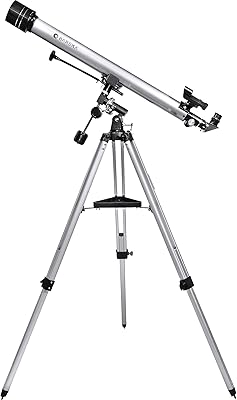
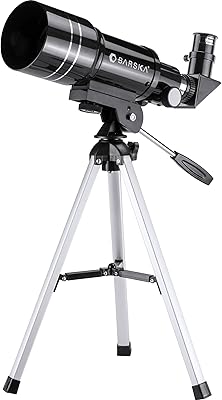
Barska Starwatcher 70mm Refractor Telescope
66%
72%
Optical Clarity
58%
Magnification Performance
54%
Build Quality
84%
Ease of Setup
88%
Portability & Storage
More
PISEZ 90800 90mm Refractor Telescope
68%
83%
Optical Clarity
81%
Value for Money
72%
Ease of Setup
68%
Magnification Range
61%
Tripod Stability
More
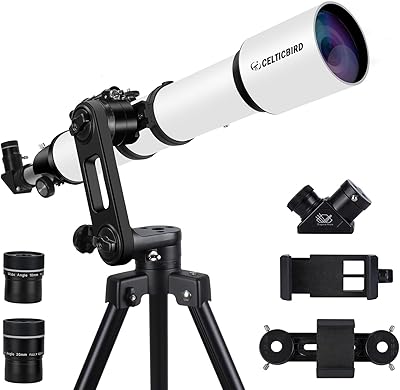
Celticbird 80mm 800mm Refractor Telescope
75%
83%
Optical Clarity
91%
Ease of Assembly
78%
Mount Usability
61%
Tripod Stability
58%
Included Eyepiece Quality
More
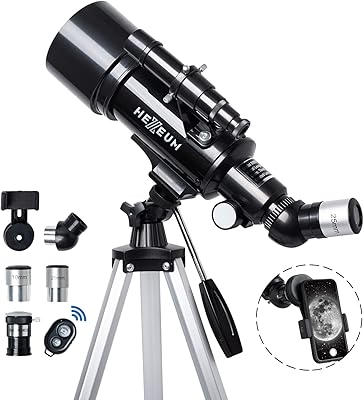
HEXEUM AZ50070 70mm Refractor Telescope
73%
78%
Optical Clarity
88%
Value for Money
57%
Tripod Stability
66%
Ease of Assembly
63%
Finderscope Usability
More
Barska Starwatcher Refractor Telescope 60mm
80%
91%
Value for Money
88%
Ease of Setup
93%
Portability
85%
Performance (Planetary Viewing)
62%
Performance (Deep-Sky Viewing)
More
CELTICBIRD 90700 90mm Refractor Telescope
70%
83%
Optical Clarity
76%
Mount Precision
88%
Tripod Stability
81%
Ease of Assembly
62%
Finderscope Usability
More
SVBONY SV503 102mm ED Refractor Telescope
82%
88%
Optical Performance
93%
Focuser Quality
84%
Chromatic Aberration Control
91%
Build Quality
86%
Astrophotography Suitability
More
SVBONY SV503 80mm ED Refractor Telescope
81%
91%
Optical Clarity
88%
Focuser Quality
86%
Chromatic Aberration Control
89%
Build Quality & Materials
83%
Value for Money
More
Hawkko 90900 Refractor Telescope
75%
83%
Optical Clarity
76%
Build Quality
69%
Mount Smoothness
88%
Ease of Setup
71%
Magnification Range
More
Celestron Travel Scope 50 Refractor Telescope
75%
74%
Optical Clarity
91%
Portability & Weight
88%
Ease of Setup
58%
Build Quality & Materials
53%
Tripod Stability
More

FAQ

Most users have the HUGERSTAR 80600 Refractor Telescope assembled and ready to observe in about ten to fifteen minutes. The mount clicks onto the tripod, the tube attaches without tools, and the eyepiece drops straight in. If you read the included instructions once before starting, the process is genuinely straightforward even for kids.
Yes, lunar detail is where this beginner refractor genuinely shines. Using the 25mm eyepiece at low power gives you a wide, bright view of the whole lunar surface, while swapping to the 10mm eyepiece brings individual craters, mountain ridges, and the dark flat plains called maria into clear focus. The included moon filter also helps a lot — the moon is surprisingly bright through a telescope and the filter makes extended viewing much more comfortable.

The moon is the showpiece target, but the HUGERSTAR scope handles bright planets reasonably well too. You can make out Jupiter as a clear disk with its main cloud bands and spot its four Galilean moons as small points of light. Saturn's rings are visible and will likely be the highlight of any observing session. Mars shows a reddish disk near opposition, and Venus displays clear phases. Faint planets like Uranus or Neptune appear only as tiny dots, with no surface detail possible at this aperture.

At mid-height it holds steady well enough for comfortable viewing. The issue appears when you extend the legs to full height — any breeze or accidental nudge causes vibration that takes a few seconds to settle. If you are observing in a calm backyard, it is fine. Outdoors on uneven ground or in even light wind, keep the tripod at a lower setting and plant the feet firmly for the best experience.

It works with most standard smartphones, but fit is inconsistent across the wider range of phone sizes and cases on the market today. Slim phones with no case generally seat well. Very wide phones or those in thick protective cases can be awkward to clamp securely. It is worth removing your phone case before trying, and being patient with the adjustment — it is not an instant snap-in process.

Kids around ten and older can typically use this starter telescope on their own once an adult helps with initial setup. The altazimuth mount is simple enough that older children quickly learn to sweep across the sky themselves. Younger children will benefit from a parent nearby, mainly to help aim the finder scope and swap eyepieces safely.

It works reasonably well for daytime use. At low magnification the image is bright and clear enough for birdwatching at moderate distances. One thing to know: refractor telescopes produce an inverted image, meaning what you see will be upside down. This is normal for astronomy but can take some getting used to for daytime bird or wildlife viewing. Some users adapt quickly; others find it a nuisance.

It is genuinely portable by telescope standards. At under six pounds and with a dedicated carry bag, you can pack the disassembled scope into a car without any hassle. It fits in an overhead luggage compartment on most commercial flights when disassembled, though the tripod may need to be checked. For backpacking it is on the heavier and bulkier side, but car camping is a practical and popular use case.

Practically speaking, 100x to 120x is the comfortable ceiling for this beginner refractor. Yes, the Barlow and 10mm eyepiece can push it to 180x, but at that level the image softens, the field of view shrinks dramatically, and any vibration becomes magnified along with the target. You will genuinely see more detail at 90x with a stable, crisp image than at 180x with a mushy, shaky one. Stick to the lower range and you will be much happier.

HUGERSTAR markets its scopes as backed by customer satisfaction support, though specific warranty terms should be confirmed with the seller at the point of purchase as policies can vary by retailer. If the scope arrives with a damaged optical component or missing part, contact the seller directly through the purchase platform as a first step — most reputable sellers resolve these issues quickly through a replacement or refund.