Overview

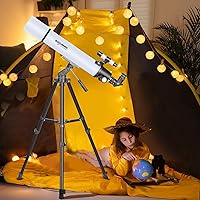
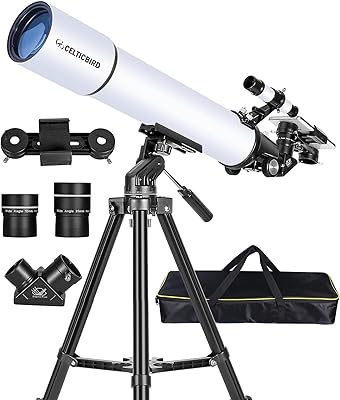
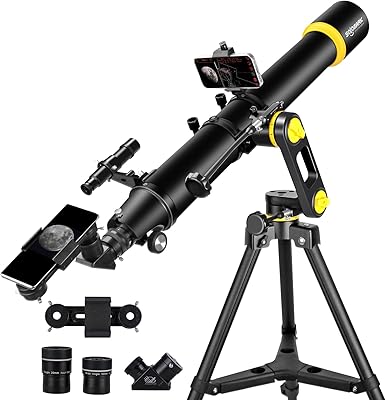
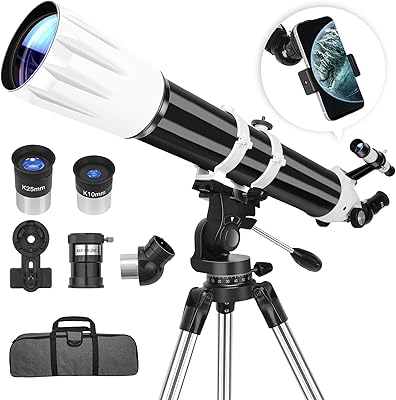
The SOLOMARK 80900 Refractor Telescope sits in an interesting spot — capable enough to outperform the toy-grade scopes cluttering department store shelves, yet approachable enough that a total beginner won't feel lost setting it up. The 80mm aperture gives it a genuine edge over the 60–70mm entry-level crowd, pulling in noticeably more light on dark nights. It ships as a complete ready-to-use kit: tripod, two eyepieces, finderscope, diagonal, and a carrying bag all included. SOLOMARK is a mid-tier Chinese optics brand building a quiet following on Amazon, and while they're not a household name in amateur astronomy circles, this refractor telescope punches reasonably well for its price tier.
Features & Benefits

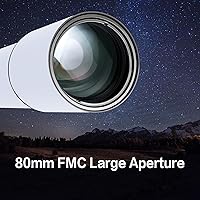
The fully coated objective lens makes a real difference when you're trying to pull detail out of the lunar surface — coated glass cuts internal reflections and passes more light through to your eye compared to the bare lenses on cheaper scopes. The two included eyepieces give you 45x and 90x magnification right out of the box, which covers a solid range for moon-gazing and wide-field star clusters. The altazimuth mount is deliberately simple: no polar alignment headaches, just point and look. Worth noting — the aluminum tripod feels stable at lower magnifications, but at 90x any vibration becomes noticeable, so a gentle touch matters more than you'd expect.

Best For

This beginner-to-intermediate scope is a natural fit for first-time adult stargazers who want something meaningfully better than a toy without diving into the complexity of a serious amateur rig. It's also a strong choice for parents buying for a teenager who's genuinely curious about astronomy — the complete kit means no scrambling for extra accessories on day one. Travelers will appreciate the included carrying bag, which keeps everything tidy for trips. That said, if you're hoping to photograph deep-sky nebulae or track planets with motorized precision, this refractor telescope will leave you wanting more. It's an honest starter scope, not a do-everything instrument.

User Feedback

With a 4.5-star average across roughly 130 ratings, this refractor telescope has earned a cautiously positive reception — though that's still a modest sample size, so treat it with appropriate skepticism. Buyers consistently highlight crisp lunar views and painless assembly, which matters a lot for newcomers. The recurring frustration is tripod wobble at higher magnifications, and the included phone adapter, while a welcome extra, requires fiddling to get usable shots. A few users specifically mention customer support responsiveness as a genuine plus, which is worth knowing if something goes wrong out of the box. Overall: strong for casual use, underwhelming for those pushing the scope beyond its natural limits.

Pros

  • The 80mm coated objective lens pulls in noticeably more light than typical entry-level 60–70mm scopes.
  • Lunar views are a genuine highlight — crater detail and surface texture impress beginners on the very first night.
  • Two eyepieces out of the box give you a practical magnification range without any immediate extra spending.
  • Assembly is beginner-friendly, typically taking under 20 minutes with no prior experience required.
  • The carrying bag keeps the full kit organized and protected during transport — a thoughtful, practical inclusion.
  • The altazimuth mount is intuitive for newcomers: no polar alignment, no confusing axes, just point and look.
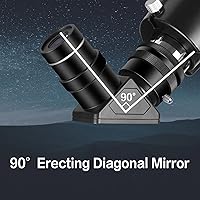
  • Works well as a dual-purpose instrument for daytime terrestrial use thanks to the erect-image diagonal.
  • SOLOMARK offers responsive direct customer support, which matters when something goes wrong out of the box.
  • The complete kit format removes the hidden costs that often catch first-time telescope buyers off guard.

Cons

  • Tripod wobble at 90x magnification is a persistent and well-documented frustration among real-world users.
  • The phone adapter requires patience to align properly and rarely produces sharp, shareable astrophotography results.
  • Short eye relief on the included eyepieces makes viewing uncomfortable for eyeglass wearers.
  • Edge sharpness in the eyepieces falls off noticeably — a quality upgrade will likely feel necessary within months.
  • The 5x24 finderscope struggles in light-polluted suburban skies where fainter guide stars are washed out.
  • Plastic connection points raise durability concerns for buyers who plan to transport the scope frequently.
  • No slow-motion tracking controls means manually chasing the moon across the field of view during long sessions.
  • The carrying bag shows wear relatively quickly and is not built for serious repeated travel use.
  • At 90x, atmospheric turbulence becomes a limiting factor that the optics cannot compensate for on average nights.

Ratings

The SOLOMARK 80900 Refractor Telescope has been evaluated by our AI system after analyzing verified buyer reviews from global markets, with spam, bot-generated, and incentivized feedback actively filtered out before scoring. The ratings below reflect a balanced picture — real strengths alongside the friction points that actual owners have encountered. Both sides are represented honestly, so you can make a genuinely informed decision.
Optical Clarity
83%
Most users report crisp, well-defined views of the lunar surface, with crater edges and mountain ridges coming through cleanly on steady nights. The fully coated glass makes a noticeable difference compared to cheaper uncoated lenses at the same price point — contrast holds up well.
At 90x magnification, atmospheric distortion becomes a real limiting factor, and the optics can't fully compensate. Some users notice slight color fringing around bright objects like the moon, which is typical for refractors at this focal ratio but can be surprising for first-time buyers.
Build Quality
71%
29%
The optical tube feels solid and the focuser moves smoothly without excessive play, which matters when you're trying to dial in a sharp image at night. For a kit scope in this price range, the overall assembly quality is a step above what most beginners expect.
Plastic is present in several key connection points, and a few owners report that fittings loosened after regular transport. It's a usable build, but experienced hobbyists will recognize that long-term durability is a real question mark if the scope sees heavy use.
Tripod Stability
62%
38%
At lower magnifications — say, 45x with the 20mm eyepiece — the aluminum tripod performs adequately and holds a target reasonably well under calm conditions. For casual backyard sessions on firm ground, most beginners won't find it a dealbreaker.
Push to 90x and the tripod's limitations become hard to ignore. Any accidental nudge sends the image bouncing for several seconds, which is genuinely frustrating when you're trying to hold a planet in view. Wind makes things worse, and this is the single most cited complaint across user reviews.
Ease of Assembly
88%
Buyers consistently highlight how quickly the scope goes from box to ready-to-use, often under 20 minutes even without prior experience. The instruction manual is clear enough that most adults and older teenagers can figure it out independently without needing video tutorials.
The finderscope alignment process trips up some first-timers, and the manual's explanation of that step could be more detailed. A handful of users also mention that accessory fit tolerances are slightly loose, requiring minor adjustments before the first session.
Value for Money
81%
19%
Getting an 80mm refractor with a full accessory kit — tripod, two eyepieces, finderscope, diagonal, and carrying bag — without needing immediate upgrades is genuinely good value at this tier. It removes the common beginner trap of buying a cheap scope and quickly outgrowing it.
Buyers who later compare it to similarly priced dedicated brands sometimes feel the individual components are optimized for cost rather than performance. The value proposition is strong as a complete starter kit, but weaker if you evaluate each part individually against standalone alternatives.
Magnification Range
76%
24%
The 45x and 90x out-of-the-box range covers the practical sweet spot for beginners — wide enough at 45x for open star clusters and terrestrial views, and punchy enough at 90x to pick out lunar detail that genuinely impresses newcomers.
Ninety times is a reasonable ceiling for this aperture, and chasing higher magnification with aftermarket eyepieces will expose the limits of the optics rather than reveal more detail. Users expecting Saturn's rings to look like textbook photographs at 90x will need to recalibrate their expectations.
Portability
84%
The carrying bag is one of the more genuinely useful accessories in the kit — everything packs away neatly, and the setup can be moved between locations without anything rattling loose. Campers and travelers who want a dual-purpose terrestrial and nighttime instrument find this particularly practical.
At just under 10 pounds assembled, it is manageable but not lightweight. Carrying it on a longer hike to a dark-sky site requires real commitment, and the tripod legs can feel unwieldy when navigating narrow spaces or uneven terrain in the dark.
Phone Adapter & Astrophotography
54%
46%
The included phone adapter is a welcome bonus that lets curious users capture snapshots of the moon, and for a social share or a personal memory, those shots can look surprisingly fun. Kids especially enjoy being able to photograph what they see through the eyepiece.
Aligning the adapter with the eyepiece is fiddly, and maintaining that alignment while tapping the shutter is genuinely difficult. Image quality is limited by both the adapter design and vibration from touching the phone, so anyone hoping to build an astrophotography workflow around this will be disappointed quickly.
Finderscope Usability
73%
27%
Having a 5x24 finderscope with a crosshair reticle makes locating targets substantially easier than trying to sweep the main scope blindly across the sky. Once properly aligned, it significantly reduces the frustration that kills interest for many first-time observers.
The 5x magnification and 24mm aperture keep the finder quite dim, making it genuinely hard to use in washed-out suburban skies where fainter guide stars aren't visible. Alignment can also drift after transport, requiring a re-zero before each session.
Altazimuth Mount Handling
78%
22%
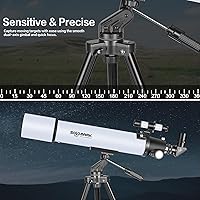
For beginners, the altazimuth design is the right choice — up, down, left, right is intuitive in a way that equatorial mounts simply are not. The included azimuth and altitude scales add a useful reference point when trying to return to a previously found target.
Tracking moving objects like the moon requires constant manual adjustment, which becomes tedious during longer viewing sessions. Advanced users will quickly feel constrained by the lack of fine slow-motion controls for precise centering at higher magnifications.
Eyepiece Quality
68%
32%
The wide-angle eyepieces deliver acceptable sharpness across most of the field of view, and for the intended use case of lunar and planetary observation at beginner level, they get the job done without obvious optical failures.
Edge sharpness falls off noticeably, and the eye relief is short enough to be uncomfortable for eyeglass wearers. Experienced observers will want to upgrade to quality Plossl or wide-field eyepieces fairly quickly, which is an additional expense worth budgeting for.
Customer Support
79%
21%
SOLOMARK actively markets its direct support access, and several buyers confirm that responses to setup questions or minor hardware issues came through reasonably quickly. For a brand at this tier, that responsiveness is a meaningful differentiator.
Support quality appears inconsistent — some users report helpful, detailed replies while others describe generic responses that didn't resolve their issue. There is no dedicated community forum or knowledge base to supplement direct contact.
Terrestrial Viewing Performance
82%
18%
The erect image diagonal is a thoughtful inclusion that makes daytime terrestrial use practical — landscape views and birdwatching-style observations come through right-side-up and reasonably sharp, giving the scope genuine dual-purpose utility.
At higher magnifications, heat shimmer and atmospheric haze during the day reduce image quality noticeably. For serious daytime spotting, a dedicated spotting scope would outperform this refractor, but for casual outdoor use it handles the role adequately.
Packaging & Unboxing Experience
86%
The carrying bag doubling as storage and packaging is a smart design choice that leaves buyers with an immediately useful accessory rather than a pile of discarded foam. Components are well-organized, reducing the chance of losing small parts during setup.
Some users note that the bag's internal organization could be tighter — accessories shift during transit in ways that create minor anxiety about component safety. The bag itself is functional rather than durable, and signs of wear appear after repeated travel use.

Suitable for:

The SOLOMARK 80900 Refractor Telescope is built for adults who are genuinely curious about astronomy but have no idea where to start — people who want a real instrument, not a toy, without facing a steep learning curve on their first night out. It is an especially smart buy for parents who want to nurture a teenager's interest in space without committing to a serious hobbyist investment upfront. Gift buyers will appreciate that the entire kit arrives ready to use: no hunting for a compatible tripod, no sourcing a separate finderscope, no wondering which eyepiece to order first. Travelers and campers who want one portable instrument that works for both daytime scenic views and nighttime stargazing will find the carrying bag and erect-image diagonal make it genuinely dual-purpose. If your primary goal is crisp lunar views, wide star fields on dark nights, and the simple satisfaction of finding a planet with your own eyes, this beginner-to-intermediate scope will deliver that experience reliably.
Not suitable for:

The SOLOMARK 80900 Refractor Telescope has clear boundaries, and buyers who push past them will end up frustrated. If you are serious about astrophotography — even at an intermediate level — this scope will hit a wall quickly: the mount has no motorized tracking, the phone adapter is fiddly at best, and 90x on an 80mm lens is not going to resolve deep-sky objects with any satisfaction. Observers who want to study Saturn's ring structure in detail or resolve the cloud bands on Jupiter will find the optics capable of hinting at those features but not delivering the kind of crisp planetary views that require larger apertures. Anyone already owning a decent beginner scope and looking to upgrade meaningfully should look further up the price ladder rather than sideways. The tripod, while functional at lower magnifications, genuinely struggles at high power — if steady high-magnification views are non-negotiable for you, that instability will become a constant irritant. And if you live under heavily light-polluted skies and expect to hunt faint nebulae or galaxies, an 80mm refractor is simply not the right tool for that job.
Specifications

  • Aperture: The objective lens measures 80mm in diameter, giving the scope meaningful light-gathering capability for lunar and planetary observation.
  • Focal Length: The optical tube has a 900mm focal length, resulting in a focal ratio of f/11.25 that favors high-contrast planetary views over wide-field deep-sky work.
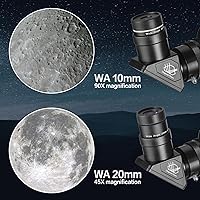
  • Eyepieces: Two eyepieces are included — a 20mm for 45x magnification and a 10mm for 90x — covering a practical range for beginners without additional purchases.
  • Lens Coating: The objective lens uses fully coated green optics glass to improve light transmission and reduce internal reflections during observation.
  • Focus Type: Focusing is achieved manually via a rack-and-pinion or sliding focuser mechanism adjusted by hand to bring targets into sharp view.
  • Mount Type: An altazimuth mount with marked altitude and azimuth scales allows straightforward up-down and left-right movement without requiring polar alignment.
  • Tripod: A full-size adjustable aluminum tripod is included, with leg height adjustable to suit different observers and viewing positions.
  • Finderscope: A 5x24 finderscope with a crosshair reticle is included to help locate and center targets before switching to the main eyepiece.
  • Diagonal: An erect-image diagonal is included, making the scope practical for both daytime terrestrial viewing and standard nighttime astronomical use.
  • Phone Adapter: A smartphone adapter is included for basic afocal photography through the eyepiece, compatible with most standard smartphones.
  • Carrying Bag: A soft carrying bag is included that accommodates the optical tube, tripod, and all accessories in a single organized package for transport.
  • Product Weight: The complete setup weighs approximately 9.88 pounds, making it portable for car camping or backyard use but less practical for long hikes.
  • Assembled Size: When fully assembled, the telescope measures approximately 39.37″ deep by 15.75″ wide by 59.06″ tall.
  • Tube Length: The optical tube alone measures 900mm in length, which is typical for a refractor of this focal length.
  • Optical Design: This is a refracting telescope design, using a lens rather than a mirror to gather and focus light onto the eyepiece.
  • Brand & Model: Manufactured by SOLOMARK under model number 80900-W, first made available in April 2024.

Related Reviews

Celticbird 80mm 800mm Refractor Telescope
75%
83%
Optical Clarity
91%
Ease of Assembly
78%
Mount Usability
61%
Tripod Stability
58%
Included Eyepiece Quality
More
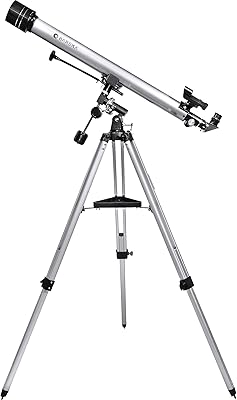
Barska Starwatcher 70mm Refractor Telescope
66%
72%
Optical Clarity
58%
Magnification Performance
54%
Build Quality
84%
Ease of Setup
88%
Portability & Storage
More
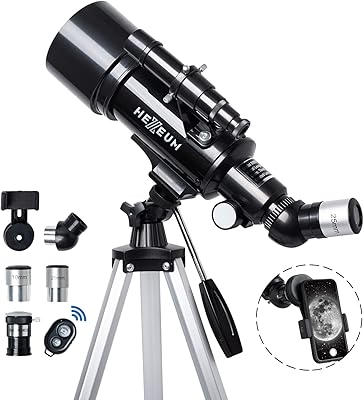
HEXEUM AZ50070 70mm Refractor Telescope
73%
78%
Optical Clarity
88%
Value for Money
57%
Tripod Stability
66%
Ease of Assembly
63%
Finderscope Usability
More
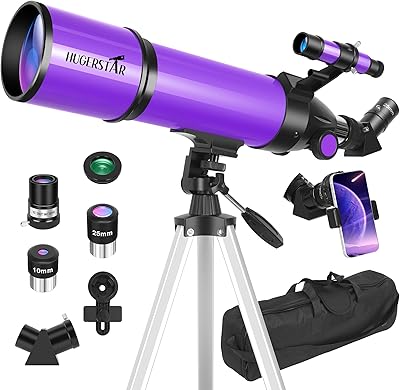
HUGERSTAR 80600 Refractor Telescope
70%
78%
Optical Clarity
88%
Ease of Setup
61%
Tripod Stability
83%
Value for Money
84%
Portability
More
Barska Starwatcher Refractor Telescope 60mm
80%
91%
Value for Money
88%
Ease of Setup
93%
Portability
85%
Performance (Planetary Viewing)
62%
Performance (Deep-Sky Viewing)
More
CELTICBIRD 90700 90mm Refractor Telescope
70%
83%
Optical Clarity
76%
Mount Precision
88%
Tripod Stability
81%
Ease of Assembly
62%
Finderscope Usability
More
PISEZ 90800 90mm Refractor Telescope
68%
83%
Optical Clarity
81%
Value for Money
72%
Ease of Setup
68%
Magnification Range
61%
Tripod Stability
More
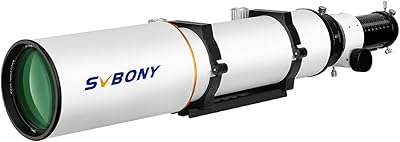
SVBONY SV503 80mm ED Refractor Telescope
81%
91%
Optical Clarity
88%
Focuser Quality
86%
Chromatic Aberration Control
89%
Build Quality & Materials
83%
Value for Money
More
SVBONY SV503 102mm ED Refractor Telescope
82%
88%
Optical Performance
93%
Focuser Quality
84%
Chromatic Aberration Control
91%
Build Quality
86%
Astrophotography Suitability
More
Hawkko 90900 Refractor Telescope
75%
83%
Optical Clarity
76%
Build Quality
69%
Mount Smoothness
88%
Ease of Setup
71%
Magnification Range
More

FAQ

Most users get the SOLOMARK 80900 Refractor Telescope up and running in under 20 minutes on the first attempt. The instruction manual is reasonably clear, and no tools are required for basic assembly. The trickiest part for most beginners is aligning the finderscope, which is worth doing in daylight before your first night session.
Yes, you can see Saturn's rings — but manage your expectations going in. At 90x magnification through an 80mm lens, the rings are visible as a distinct oval shape around the planet, but you won't see the Cassini Division or fine ring detail that larger apertures reveal. It is genuinely exciting for a first-time view, just not a textbook-quality image.

Lunar viewing is honestly where this refractor shines brightest. At 45x you get a sweeping panoramic view of the entire lunar surface, and at 90x you can pick out crater walls, mountain ridges, and shadowed valleys with satisfying clarity. It is one of the strongest use cases for this beginner-to-intermediate scope.

At 45x the tripod handles most conditions without much trouble. At 90x, however, any accidental bump or even a moderate breeze will cause the image to bounce around for a few seconds. It is manageable if you develop a habit of touching the scope gently and waiting for vibration to settle, but it is a real limitation worth knowing about before you buy.

The included phone adapter makes it possible to capture snapshots, and moon photos in particular can look fun and shareable. That said, aligning the phone camera precisely with the eyepiece takes patience, and vibration from tapping the shutter tends to blur results. Treat it as a casual bonus feature rather than a real astrophotography setup.

It does, thanks to the included erect-image diagonal that flips the view right-side-up for terrestrial observation. Image quality during the day is decent at lower magnifications. Just keep in mind that at higher power, heat shimmer from the ground tends to degrade the view, so stick to 45x or below for the clearest daytime results.

A quality 25mm wide-field eyepiece is a worthwhile upgrade for open star cluster views, and a simple moon filter will make high-magnification lunar sessions more comfortable on your eyes. A Barlow lens can extend your magnification range, though at 90x you are already near the practical limit for this aperture, so push beyond that cautiously.

With adult help during initial setup and finderscope alignment, yes — most engaged kids around 10 to 12 can absolutely use and enjoy this refractor. The altazimuth mount is intuitive enough for younger observers, and lunar views tend to produce exactly the kind of wow moment that keeps kids interested in astronomy.

To align it, point the main scope at a distant daytime target — a rooftop antenna or treetop works well — center it in the main eyepiece, then adjust the finderscope's bracket screws until the crosshair lines up on the same target. Alignment generally holds during a single session but can drift if the scope is transported, so a quick re-check before each outing is good practice.

Under dark rural skies, this refractor can show brighter deep-sky objects like the Orion Nebula as a faint fuzzy patch, and open clusters like the Pleiades look genuinely beautiful at low power. However, galaxies will appear as small, dim smudges with little detail, and dark nebulae or faint emission nebulae are effectively out of reach. If deep-sky observing is your primary goal, you would be better served by a larger aperture instrument.

Where to Buy