Overview

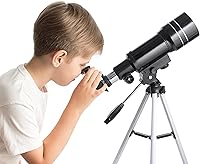
The Barska Starwatcher 70mm Refractor Telescope is a compact, entry-level scope designed for first-time stargazers, curious students, and anyone who wants a low-commitment introduction to astronomy. Unlike tall floor-standing instruments that demand dedicated storage space, this tabletop refractor sits on a small tripod and fits on a desk or balcony railing with ease. Barska occupies the budget end of the optics market, and that context matters — you're not getting precision observatory hardware here. What you are getting is a ready-to-use kit with a decent accessory bundle that makes the price feel reasonable for someone just testing the waters of the night sky.
Features & Benefits

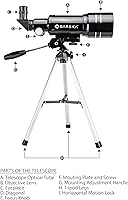
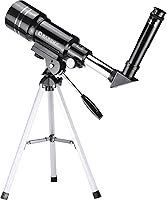
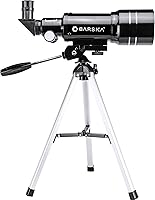
The 70mm objective lens is the heart of this setup — wide enough to pull in useful amounts of light for crisp views of the Moon's craters and the rings of Saturn on a clear night. At 300mm focal length, the two included eyepieces deliver practical low-to-mid power views, and the bundled 3x Barlow lens stretches those options without requiring any extra purchases. Coated optics help cut glare noticeably compared to bare-glass alternatives at similar prices. The 90-degree diagonal is a thoughtful inclusion — it means you're not craning your neck at awkward angles during a long session. And the compact tripod keeps everything portable enough to carry in the included soft case.

Best For

This starter telescope was practically built for gift-giving — it hits a sweet spot between affordable and genuinely functional that parents, relatives, and partners often search for. Kids and teenagers will find the Moon-gazing experience genuinely exciting, and curious adults who've always meant to try astronomy but never committed to a serious instrument will appreciate being able to start without a major investment. Apartment dwellers with limited closet space will value the compact footprint. That said, if you're already reading deep-sky catalogs or planning to photograph nebulae, this tabletop refractor is not your instrument. It's purpose-built for bright-object observing — the Moon, planets, and perhaps a double star or two.

User Feedback

With a 3.8-star average across 175 ratings, the Barska Starwatcher earns mostly positive marks from buyers who approached it with realistic expectations. The most consistent praise centers on easy assembly and satisfying lunar views straight out of the box. On the critical side, several users flagged the plastic focuser as feeling cheap and noted that the tabletop tripod wobbles at higher power settings. There's also a notable point worth flagging upfront: the advertised 225x magnification is theoretical — in real-world use, 75 to 100x is about where the optics perform reliably. Some buyers found finderscope alignment tricky initially. Overall, satisfied owners tend to be those who understood they were buying an entry point, not a long-term instrument.

Pros

  • Moon views are genuinely impressive for the price — craters and mountain ranges come through with satisfying clarity.
  • The full accessory kit means you can start observing the same night it arrives, with no extra purchases required.
  • At just over 3 pounds, the Barska Starwatcher is light enough to carry in a backpack for dark-sky outings.
  • The 90-degree diagonal is a thoughtful inclusion that makes overhead viewing comfortable for extended sessions.
  • Coated optics noticeably reduce glare compared to bare-glass alternatives at similar price points.
  • Setup is quick and tool-free — most first-timers are up and running within 20 minutes of opening the box.
  • The bundled Deepsky software gives absolute beginners a helpful starting point for learning the night sky.
  • The compact footprint is a genuine advantage for urban observers with limited outdoor or storage space.
  • Saturn's rings are visible on clear nights — a wow moment that makes the scope worth it for curious beginners.

Cons

  • The plastic focuser feels imprecise and introduces enough wobble to make fine-tuning frustrating at higher power.
  • Real usable magnification tops out around 75x to 100x — the marketed 225x figure sets unrealistic expectations.
  • The tabletop tripod wobbles noticeably when touched, and vibrations take several seconds to fully settle.
  • Finderscope alignment is fiddly out of the box, and the manual provides little useful guidance on the process.
  • The soft carry case offers almost no impact protection — it is barely adequate for transport in a padded bag.
  • Chromatic aberration produces visible color fringing around bright objects like the Moon and planets.
  • The H4mm eyepiece delivers a narrow, dim view that frustrates more than it impresses at high magnification.
  • No fine-focus adjustment means holding sharp focus at higher power requires a steady, careful hand.
  • Tripod joints and the focuser mechanism show signs of wear relatively quickly with frequent use.

Ratings

The Barska Starwatcher 70mm Refractor Telescope has been evaluated by our AI rating system after processing verified buyer reviews from multiple global markets, with spam, bot-generated, and incentivized feedback actively filtered out. Scores reflect the honest consensus of real owners — beginners, gift recipients, and casual stargazers — and are calibrated to surface both where this starter telescope genuinely delivers and where it falls short. Strengths and frustrations are weighted equally so you get a clear picture before committing.
Optical Clarity
72%
28%
For a budget refractor, the coated optics punch above their weight on lunar targets. Users consistently report crisp, high-contrast views of the Moon's craters and maria, and on steady nights Saturn's rings are discernible — a genuinely exciting moment for any first-timer.
Chromatic aberration becomes noticeable on bright planets and stars, producing faint color fringing around high-contrast edges. This is a fundamental limitation of short-focal-length refractors at this price point, not a defect unique to this model.
Magnification Performance
58%
42%
At lower power settings — around 30x to 75x — the views are stable and reasonably sharp. The included eyepiece and Barlow combination gives beginners enough range to explore the Moon's surface in satisfying detail without needing to buy anything extra.
The advertised 225x figure misleads many buyers. In practice, images at that power are dim, blurry, and shaky. Usable magnification caps out closer to 90x to 100x, and buyers who push beyond that frequently report disappointment and feel the marketing overclaims.
Build Quality
54%
46%
The optical tube itself feels reasonably solid for the category, and the overall assembly holds together well for casual, occasional use. Several buyers noted the scope survived being packed and unpacked for travel without any structural issues.
The focuser draws the most consistent criticism — it feels plasticky and imprecise, making fine-tuning focus at higher magnifications genuinely frustrating. The tabletop tripod, while convenient, lacks the rigidity to dampen vibrations quickly, which compounds the focuser problem.
Ease of Setup
84%
Assembly is straightforward enough that most buyers had the scope pointing at the Moon within 15 to 20 minutes of opening the box. No tools are required, and the included instructions are clear enough for kids and non-technical adults to follow without confusion.
The finderscope alignment trips up a notable portion of new users, particularly those without any prior telescope experience. Getting it properly collimated with the main tube takes some trial and error, and the lack of a detailed tutorial in the manual does not help.
Portability & Storage
88%
The tabletop form factor is genuinely one of this scope's strongest practical advantages. At just over 3 pounds and compact enough to fit in the included soft case, it travels easily in a backpack, fits in apartment closets, and sets up on any flat surface.
The included soft case offers minimal impact protection — it is more of a dust cover than a travel case. Anyone planning to carry this scope on hikes or in checked luggage would need to source more protective padding independently.
Value for Money
76%
24%
Relative to similarly priced competitors, the accessory bundle here — two eyepieces, a Barlow lens, diagonal, finderscope, case, and software — represents genuine value for a first-time buyer. You get a functional, ready-to-use kit without spending extra out of the gate.
If expectations are set by the marketing copy rather than realistic beginner benchmarks, the value perception collapses quickly. Buyers who expected near-photographic planetary views at 225x universally feel shortchanged, which skews the lower end of the rating distribution.
Stability & Mount
51%
49%
For low-power, wide-field viewing of the Moon, the tabletop tripod is adequate. On a solid surface like a sturdy table or a flat rooftop ledge, vibrations settle within a few seconds and do not ruin the viewing experience at modest magnifications.
At anything above 100x, even minor vibrations — a passing car, a footstep — send the image bouncing for several seconds. The tripod head also lacks fine adjustment controls, making it difficult to track celestial objects smoothly as they drift across the field of view.
Finderscope Usability
62%
38%
Having a finderscope included at this price is a genuine plus — it dramatically reduces the frustration of locating targets with the main eyepiece alone, especially for beginners who have no intuitive sense of how narrow a telescope's true field of view actually is.
Multiple buyers report spending considerable time getting the finderscope aligned to match the main scope's aim, with some never fully succeeding. The adjustment mechanism is stiff and fiddly, and the lack of clear alignment guidance in the manual makes it harder than it needs to be.
Accessories Completeness
79%
21%
The out-of-the-box kit is more complete than many competitors at this tier. The 3x Barlow lens alone effectively doubles the versatility of the two included eyepieces, and the 90-degree diagonal makes overhead viewing comfortable without requiring an awkward posture.
Eyepiece quality is basic — the H4mm in particular delivers a narrow, somewhat dim view. Upgrading to a quality 6mm or 9mm eyepiece makes a tangible difference, which means buyers may end up spending a bit more than the sticker price to get the experience they were hoping for.
Image Brightness
67%
33%
The 70mm aperture captures enough light for satisfying views of the Moon and the brighter planets. On a dark night away from city lights, users with calibrated expectations can make out the Orion Nebula as a fuzzy patch and spot the Pleiades cluster cleanly.
Deep-sky objects are largely beyond this scope's practical reach. Galaxies and faint nebulae appear as indistinct smudges at best, and the short focal length limits the light-gathering time needed for meaningful contrast on such targets.
Ease of Focusing
60%
40%
For the Moon and bright planets, achieving a sharp focus is reasonably quick once users learn the feel of the focuser. The manual rack-and-pinion mechanism is intuitive in principle, and most buyers find their footing with it after a few sessions.
The focuser's plastic construction introduces slop — small wobbles in the drawtube that shift the image slightly when releasing your hand. At higher magnifications, this makes holding precise focus difficult, and the lack of a fine-focus adjuster is a meaningful omission at this power range.
Software & Extras
63%
37%
The bundled Deepsky software gives complete beginners a helpful reference for planning sessions and identifying objects. It is a thoughtful inclusion that many competing kits at this price skip entirely, and new users generally appreciate having a guided starting point.
The software feels dated and is not a substitute for modern apps like SkySafari or Stellarium. Most users migrate to free mobile apps relatively quickly, making the software a nice-to-have rather than a genuine asset over the long term.
Durability Over Time
57%
43%
For occasional use — a few sessions per month — the scope holds up adequately. Users who treat it gently and store it properly report no degradation in optical performance over the first year of ownership, which is reasonable for the price tier.
The plastic focuser and tripod joints show wear with regular, frequent use. Buyers who move through a beginner phase quickly and begin observing several times a week tend to notice loosening joints and focuser slop developing faster than expected.
Instruction Quality
55%
45%
The basic assembly steps are covered clearly enough that most buyers complete setup without confusion. The diagrams are simple but functional, and the overall layout of the manual is at least logical for a complete beginner with no prior optics experience.
The manual falls short on the operational side — there is very little guidance on eyepiece selection, how to align the finderscope, or what magnifications actually work well for different targets. First-timers frequently turn to online forums to fill the gaps the manual leaves open.

Suitable for:

The Barska Starwatcher 70mm Refractor Telescope is a strong fit for anyone taking their very first steps in amateur astronomy — particularly children, teenagers, and curious adults who want a genuine sky-watching experience without committing to a serious investment. Parents looking for an educational gift that goes beyond a toy will find this scope delivers real, memorable views of the Moon and the brighter planets in our solar system. It also makes practical sense for apartment and condo dwellers who simply do not have room to store a tall, floor-standing instrument — the compact tabletop form factor means it lives comfortably on a shelf and sets up on a balcony railing in minutes. Gift buyers will appreciate that everything needed for a first session comes in the box, removing the guesswork of sourcing accessories separately. If your goal is to understand whether astronomy is worth pursuing further before spending several hundred dollars on a proper intermediate scope, this starter telescope is a sensible, low-risk way to find out.
Not suitable for:

The Barska Starwatcher 70mm Refractor Telescope is not the right choice for anyone who has moved past the beginner phase and wants to observe deep-sky objects like galaxies, nebulae, or star clusters with any real clarity. The 70mm aperture and short focal length impose hard physical limits — faint objects will remain frustratingly indistinct no matter how much you push the magnification. Speaking of magnification, buyers drawn in by the advertised 225x figure should know that number is largely theoretical; attempting to use it in practice produces dim, blurry, and vibration-prone images that are more discouraging than impressive. Astrophotography enthusiasts should also look elsewhere — this tabletop refractor has no tracking mechanism, no camera adapter provisions, and a mount that lacks the rigidity needed to capture even basic planetary images. Anyone expecting the kind of precision or optical quality found in mid-range instruments in the 200-to-400 dollar range will be disappointed, and experienced observers considering this as a portable secondary scope will likely find the focuser and mount quality beneath what they are willing to tolerate.
Specifications

  • Objective Lens: The primary lens measures 70mm in diameter, providing sufficient light-gathering for clear views of the Moon and brighter planets.
  • Focal Length: The optical tube has a focal length of 300mm, yielding a relatively wide field of view suited to low-to-mid power observations.
  • Optics Type: This is a refracting telescope with coated glass optics designed to reduce glare and improve contrast over uncoated budget alternatives.
  • Eyepieces: Two eyepieces are included — an H20mm for lower power wide-field views and an H4mm for higher magnification detail work.
  • Barlow Lens: A 3x Barlow lens is included, which multiplies each eyepiece's effective magnification threefold without requiring additional accessories.
  • Max Magnification: The theoretical maximum magnification is 225x, though practical, usable magnification in real observing conditions is approximately 75x to 100x.
  • Diagonal: A 90-degree erecting diagonal is included, allowing comfortable eye placement when the telescope is pointed at high angles toward the zenith.
  • Finderscope: A reflex-style finderscope is attached to the optical tube to help users locate and center objects before viewing through the main eyepiece.
  • Mount Type: The telescope uses a manual tabletop tripod mount, which sits on any flat surface and supports the tube without floor-standing legs.
  • Focus System: Focusing is achieved via a manual rack-and-pinion focuser with no motorized or fine-focus adjustment mechanism included.
  • Tube Length: The optical tube measures 300mm in length, keeping the overall instrument compact relative to longer focal length refractors.
  • Dimensions: Assembled product dimensions are approximately 14″ deep by 4″ wide by 19″ tall.
  • Weight: The complete setup weighs 3.15 pounds, making it light enough to carry in a backpack for portable observing sessions.
  • Power Source: The telescope requires no batteries or external power source — all functions are entirely hand-operated.
  • Included Accessories: The package includes the optical tube, tabletop tripod, two eyepieces, 3x Barlow lens, 90-degree diagonal, reflex finderscope, soft carrying case, and Deepsky software.
  • Software: Deepsky astronomy software is bundled with the telescope, providing beginners with a reference guide to celestial objects and sky navigation.
  • Carry Case: A soft fabric carrying case is included for storing and transporting the telescope and its accessories between sessions.
  • Manufacturer: The telescope is designed and sold by Barska, a U.S.-based brand specializing in budget-tier optics including binoculars, riflescopes, and telescopes.
  • Model Number: The manufacturer model number for this configuration is AE12932, which can be used when contacting Barska support or sourcing replacement parts.
  • Availability: This model was first made available in December 2017 and is listed as currently in production by the manufacturer.

Related Reviews

Barska Starwatcher Refractor Telescope 60mm
80%
91%
Value for Money
88%
Ease of Setup
93%
Portability
85%
Performance (Planetary Viewing)
62%
Performance (Deep-Sky Viewing)
More
HEXEUM AZ50070 70mm Refractor Telescope
73%
78%
Optical Clarity
88%
Value for Money
57%
Tripod Stability
66%
Ease of Assembly
63%
Finderscope Usability
More
FREE SOLDIER 70mm Refractor Telescope
74%
78%
Optical Clarity
86%
Ease of Setup
58%
Tripod Stability
82%
Value for Money
84%
Moon & Planet Viewing
More
SVBONY SV503 70mm Refractor Telescope
83%
88%
Optical Clarity
91%
Field Flattener Performance
83%
Chromatic Aberration Control
79%
Focuser Quality
86%
Build & Tube Construction
More
ToyerBee 70mm Refractor Telescope
71%
76%
Optical Clarity
63%
Build Quality
54%
Tripod & Mount Stability
71%
Magnification Range
82%
Ease of Assembly
More
CELTICBIRD 90700 90mm Refractor Telescope
70%
83%
Optical Clarity
76%
Mount Precision
88%
Tripod Stability
81%
Ease of Assembly
62%
Finderscope Usability
More
HUGERSTAR 80600 Refractor Telescope
70%
78%
Optical Clarity
88%
Ease of Setup
61%
Tripod Stability
83%
Value for Money
84%
Portability
More
PISEZ 90800 90mm Refractor Telescope
68%
83%
Optical Clarity
81%
Value for Money
72%
Ease of Setup
68%
Magnification Range
61%
Tripod Stability
More
Celticbird 80mm 800mm Refractor Telescope
75%
83%
Optical Clarity
91%
Ease of Assembly
78%
Mount Usability
61%
Tripod Stability
58%
Included Eyepiece Quality
More
Hawkko 90900 Refractor Telescope
75%
83%
Optical Clarity
76%
Build Quality
69%
Mount Smoothness
88%
Ease of Setup
71%
Magnification Range
More

FAQ

Yes, on a clear, steady night Saturn's rings are visible through this starter telescope, typically at around 50x to 75x magnification. They will appear as a distinct oval halo around the planet rather than the crisp, detailed view you would get from a larger instrument, but for a beginner it is a genuinely exciting sight. Seeing conditions and light pollution in your area will have a big impact on the result.

Not really, and it is worth being upfront about this. The 225x figure is a theoretical maximum based on the optics, but in practice the image at that power is too dim, too blurry, and too sensitive to vibration to be useful. Most experienced users find that 75x to 100x is the sweet spot where the views are actually sharp and enjoyable. Pushing beyond that tends to produce frustration rather than detail.

Most buyers have the scope assembled and pointed at the Moon within 15 to 20 minutes of opening the package. No tools are required, and the assembly process is straightforward enough for children to complete with minimal adult guidance. The part that takes the most patience is aligning the finderscope with the main tube, which can take a few extra minutes on the first night.

It can be used for daytime terrestrial viewing, but it is not optimized for it. The included 90-degree diagonal flips the image, which feels natural when looking at stars but makes text and landscapes appear mirror-reversed. If daytime nature observation is a priority, a dedicated spotting scope or binoculars would serve you better.

Start with the H20mm eyepiece on its own — it gives you a lower magnification with a wider field of view, which makes it much easier to locate and center the Moon before zooming in. Once you have it in frame, you can swap to the H4mm or add the Barlow lens to increase the power and pick out crater details. Jumping straight to maximum magnification before learning to navigate is a common beginner frustration.

Only to a very limited degree. The Barska Starwatcher 70mm Refractor Telescope can show the Orion Nebula as a soft glow and resolve the Pleiades cluster cleanly, but galaxies and most faint nebulae will appear as indistinct smudges or may not be visible at all, especially from a light-polluted location. If deep-sky observing is your main goal, you would need a significantly larger aperture instrument.
For basic Moon and planet viewing, the included kit is genuinely complete — you have two eyepieces, a Barlow lens, a diagonal, and a finderscope right out of the box. The main upgrade most users eventually consider is a better quality mid-range eyepiece, such as a 9mm or 6mm, which can noticeably improve planetary views. But for a first session, nothing extra is required.

Yes, it is a reasonable gift for a child in that age range, provided expectations are managed. The assembly is simple enough for older kids to handle mostly independently, and the Moon views are vivid enough to hold their attention. Just make sure they understand upfront that this is an entry-level scope — setting the right expectations is the key to whether it becomes a beloved hobby tool or ends up on a shelf.

To align the finderscope, point the main telescope at a distant daytime target — a rooftop or treetop works well — center it in the main eyepiece, then adjust the finderscope's small bracket screws until the same target sits in the center of the finderscope's crosshairs. Once aligned, finding objects at night becomes much faster because you use the finderscope to aim before looking through the main eyepiece. Skipping this step is the most common reason new users struggle to locate anything in the sky.

For occasional use — a few times a month — it holds up well enough. The optical tube is reasonably solid, and the glass itself should remain intact with normal handling. The weak points with heavy use are the plastic focuser mechanism and the tripod joints, both of which can develop looseness over time. If the scope is going to be used several times a week for an extended period, treat it gently and consider it a learning instrument rather than a long-term workhorse.