Overview

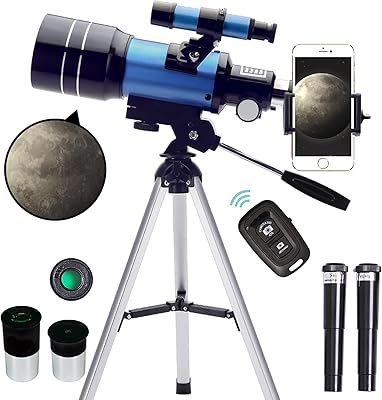
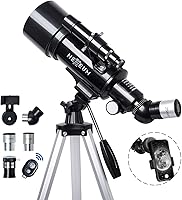
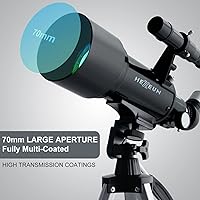
The HEXEUM AZ50070 70mm Refractor Telescope is an entry-level refractor that performs reasonably well for its price bracket, built around a 70mm aperture and 500mm focal length that make it a capable tool for lunar and bright-planet viewing. It ships as a complete kit — tripod, phone adapter, wireless remote, and carrying bag all included — so there is no scrambling for extras on the first night out. The altazimuth mount keeps things intuitive: point, tilt, look. No polar alignment, no confusing knobs. At under five pounds, it is light enough for a child to carry to the backyard without help, which counts for a lot when you are trying to keep a kid engaged.

Features & Benefits

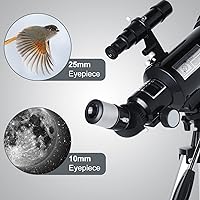
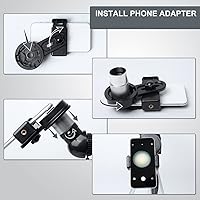
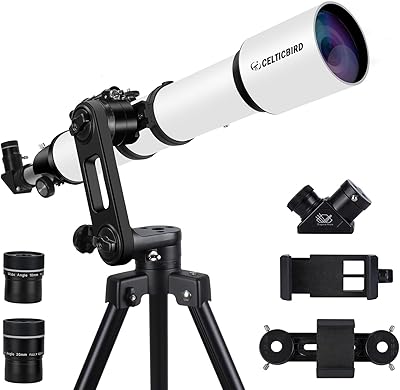
The scope ships with two Kellner eyepieces — 25mm for wide, comfortable views and 10mm for tighter looks — plus a 3x Barlow lens that triples the effective magnification of each, giving a solid range of zoom options without buying anything extra. The fully multi-coated optics keep views bright and reasonably crisp at this aperture class, which is not guaranteed at this price point. A 5x24 finderscope helps you sweep the sky and zero in on a target before switching to higher power — genuinely useful when you are new to star-hopping. The smartphone adapter and wireless remote make casual Moon photography practical, though expectations should stay realistic: this is a fun add-on, not a serious imaging setup.

Best For

This starter telescope is an ideal first scope for children around age 8 and up — old enough to work the focuser and appreciate what they are seeing. It works equally well for adults curious about astronomy who are not ready to make a serious financial commitment. Families will find it a genuinely enjoyable shared activity on clear nights, particularly when the Moon is full. The brighter planets are where it earns its keep: Saturn's rings come through clearly, Jupiter shows cloud banding, and lunar craters look dramatic. Just set realistic expectations for anything fainter — deep-sky objects like nebulae and distant galaxies are largely beyond what a 70mm aperture can resolve.

User Feedback

Across nearly 4,000 ratings and a 4.3-star average, the HEXEUM refractor has built a solid reputation among first-time buyers. The most consistent praise centers on Moon views straight out of the box and the genuine excitement of spotting Saturn's rings for the first time. The wireless remote and phone adapter also generate surprising goodwill — buyers did not expect them to be this useful. On the downside, tripod wobble at higher magnifications is a recurring complaint worth knowing about before you buy. The setup instructions are another sore point, particularly for younger users assembling it alone. Finderscope alignment sometimes needs a quick adjustment out of the box, but that is a minor and easy fix.

Pros

  • Moon views are genuinely impressive for the price — crater detail is clearly visible on the first try.
  • Saturn's rings and Jupiter's cloud bands are resolvable, which makes early observing sessions memorable.
  • The all-in bundle includes everything needed to start the same night, with no follow-up purchases required.
  • Altazimuth mount is intuitive enough for children and complete beginners to operate independently.
  • At under five pounds, this beginner scope is easy to carry to the backyard or pack into a car.
  • Six usable magnification combinations from two eyepieces and a Barlow lens give real flexibility.
  • The wireless remote and phone adapter are genuinely fun additions that most buyers did not expect to work as well as they do.
  • A 4.3-star average across nearly 4,000 ratings signals broad, consistent satisfaction among real buyers.
  • Fully multi-coated lenses keep views noticeably brighter than uncoated alternatives at this price tier.
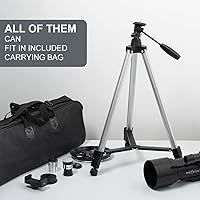
  • The carrying bag makes storage and transport practical for families with limited space.

Cons

  • Tripod wobble at high magnification is a real and recurring frustration, not a minor quibble.
  • The instruction manual is poorly illustrated and creates unnecessary difficulty during first-time assembly.
  • Finderscope alignment frequently needs correction straight out of the box before it is usable.
  • Plastic components around the diagonal and eyepiece holder feel noticeably cheaper than the optical tube itself.
  • Image sharpness degrades at the upper end of the magnification range, where the aperture is being pushed past its comfort zone.
  • Phone-based astrophotography is inconsistent — vibration and alignment drift make repeatable results difficult.
  • The carrying bag offers minimal padding, providing little real protection during travel over rough terrain.
  • Customer support quality is uneven, with some buyers reporting difficulty sourcing replacement parts for fragile accessories.
  • Chromatic aberration is visible around bright objects at higher power, which can bother detail-oriented observers.
  • Deep-sky targets like nebulae are essentially beyond what this scope can resolve, regardless of magnification used.

Ratings

The HEXEUM AZ50070 70mm Refractor Telescope earns its strong community reputation across nearly 4,000 verified global ratings, and the scores below reflect what real buyers actually experienced — not marketing copy. Our AI rating engine analyzed confirmed purchase reviews worldwide, actively filtering out incentivized, bot-generated, and outlier feedback to surface genuine sentiment. Both the highlights and the honest frustrations are reflected here so you can make a confident, informed decision.

Optical Clarity
78%
22%
For a scope in this price tier, the views of the Moon are genuinely impressive — crater walls, shadows, and surface texture come through with satisfying detail. Buyers consistently mention the first clear look at Saturn's rings as a standout moment, which says a lot about the glass quality relative to the cost.
At higher magnification combinations, image sharpness drops off noticeably, and chromatic aberration creeps in around bright objects like the Moon's limb. Deep-sky targets like nebulae or star clusters are essentially washed out, so this is firmly a solar-system scope.
Value for Money
88%
The all-in bundle — eyepieces, Barlow lens, phone adapter, wireless remote, and carrying bag — delivers far more perceived value than the price tag suggests. Most buyers feel they got significantly more than they expected, especially when the Moon views exceeded their anticipation on the first clear night.
A small number of buyers who compared it directly to similarly priced competitors felt the tripod let the overall package down, arguing that the money could have been better balanced toward a sturdier base and fewer accessories.
Tripod Stability
57%
43%
On flat, hard surfaces like a patio or driveway, the aluminum tripod holds reasonably steady at lower magnifications. For casual Moon-gazing with the 25mm eyepiece, most users found the setup stable enough to enjoy without constant readjustment.
Push the magnification up with the Barlow lens and the tripod becomes a real frustration — vibrations from the slightest touch take several seconds to settle, making high-power viewing genuinely difficult. This is the most cited complaint across user reviews and worth factoring into your decision before buying.
Ease of Assembly
66%
34%
Adults with any mechanical confidence typically get the scope assembled and pointed at the sky within 20 to 30 minutes. The physical components are straightforward, and the altazimuth mount requires no complicated alignment procedure to start observing.
The included instruction manual is sparse and poorly illustrated, which creates real friction for younger users or anyone assembling a telescope for the first time. Several parents noted having to rely on third-party video tutorials to get the finderscope properly aligned and the eyepiece diagonal seated correctly.
Finderscope Usability
63%
37%
The 5x24 finderscope is a practical addition for beginners still learning to navigate the sky — once aligned, it genuinely speeds up the process of locating the Moon, bright planets, and star clusters before switching to higher power.
Out-of-the-box alignment is hit or miss, and buyers frequently mention that it needs adjustment before the first use. For younger children working independently, this alignment step can be a real stumbling block that kills momentum early.
Portability & Storage
86%
At under five pounds and with a dedicated carrying bag included, this beginner scope is easy to move from room to backyard, toss in a car trunk for a camping trip, or store on a shelf without taking up serious space. The compact form factor is a genuine strength for families without dedicated storage.
The carrying bag is functional rather than protective — it is more of a soft storage sleeve than a padded case, so traveling with it on anything rougher than a car ride carries some risk of minor knocks to the optical tube.
Magnification Range
74%
26%
The combination of two eyepieces and a 3x Barlow lens gives beginners six usable magnification steps, which is genuinely flexible for a starter kit. Having that range available without buying additional eyepieces is a practical advantage for new astronomers still learning what they prefer.
The upper end of the magnification range — using the 10mm eyepiece with the Barlow — stretches the 70mm aperture past its comfortable limits, producing dim and slightly mushy images. Experienced users will recognize this ceiling quickly, though beginners may initially wonder if they are doing something wrong.
Smartphone Astrophotography
61%
39%
The included phone adapter and wireless remote shutter are a genuinely fun pairing — snapping a photo of the Moon through the eyepiece with your phone is straightforward and produces shareable results that will surprise anyone trying it for the first time.
This setup is very much a novelty feature rather than a serious imaging capability. Keeping the phone adapter centered over the eyepiece requires patience, and vibration from even light wind significantly degrades results. Anyone expecting repeatable, clean astrophotos will find it inconsistent.
Mount & Pointing Ease
81%
19%
The altazimuth mount design is perfectly matched to this scope's beginner audience — up, down, left, right, with simple tension controls. There is no learning curve, and kids can take over pointing duties independently after just a few minutes of explanation.
The slow-motion controls, while present, feel slightly loose and can overshoot the target when making fine adjustments at higher magnification. Tracking a planet as it drifts across the field of view requires repeated small corrections, which can frustrate users expecting smoother motion.
Optics Coating Quality
76%
24%
The fully multi-coated lenses do a solid job of maximizing light throughput for a 70mm instrument, keeping views noticeably brighter and with better contrast than uncoated or single-coated alternatives in the same price range. The difference is visible on lunar detail.
Coatings vary slightly between production batches based on buyer reports, with a minority noting one eyepiece feeling slightly less sharp than the other. It is not a widespread issue, but quality consistency is not perfectly uniform across all units.
Build & Materials
67%
33%
The optical tube itself feels solid and well-constructed for the price, and the focuser moves smoothly without significant wobble or play. The overall impression is of a product that was thoughtfully designed even if some cost-cutting is visible in the accessories.
The plastic components — particularly around the eyepiece holder and diagonal mirror housing — feel noticeably cheaper than the tube itself, and a few buyers reported minor fit issues at those junctions out of the box. The tripod leg locks, while functional, do not inspire confidence over the long term.
Gift Readiness
83%
The scope arrives in organized, well-presented packaging with all accessories included, making it a genuinely satisfying unboxing experience for a child receiving it as a birthday or holiday gift. The all-in-one nature means no awkward follow-up purchases are needed to start using it that same night.
The instruction gap is a recurring theme that slightly dampens the out-of-box gifting experience — without a parent or older sibling to help navigate setup, a younger child may hit a wall before ever looking through the eyepiece. A better quick-start guide would solve most of this.
Customer Support
71%
29%
HEXEUM markets a lifetime maintenance policy, and a meaningful share of buyers reported receiving helpful responses from the brand when they reached out with questions or part requests. For an entry-level brand, the after-sale responsiveness earned genuine goodwill in the review section.
Response times and resolution quality appear inconsistent — positive experiences are real but not universal. Some buyers described hitting dead ends when seeking replacement parts for accessories like the phone adapter bracket, which is a fragile component that occasionally breaks with regular use.

Suitable for:

The HEXEUM AZ50070 70mm Refractor Telescope is a strong fit for parents shopping for a first telescope for a child aged 8 and up — it is approachable enough that a kid can take ownership of it quickly, yet capable enough to produce genuinely rewarding views of the Moon and bright planets on the first clear night. Adults who have always been curious about astronomy but feel intimidated by the complexity or cost of higher-end gear will find this beginner scope a low-risk, low-friction way to find out whether the hobby is for them. Families looking for a shared outdoor activity will appreciate that the altazimuth mount requires no prior knowledge to operate — anyone can point it and look. Campers and travelers benefit from the lightweight build and included carrying bag, which make it realistic to bring along without dedicating serious luggage space. If the primary targets are the Moon, Saturn, Jupiter, or the occasional bright star cluster, this starter telescope delivers real satisfaction at its price point.

Not suitable for:

The HEXEUM AZ50070 70mm Refractor Telescope is not the right choice for anyone who has already spent time behind a telescope and is looking to step up their experience. A 70mm aperture hits a hard ceiling when it comes to faint or deep-sky objects — galaxies, nebulae, and dim star clusters will largely disappoint, so buyers specifically motivated by those targets should budget for a larger instrument. Anyone who expects rock-solid stability at high magnification will find the included tripod a recurring frustration; it is functional at lower power but noticeably shaky when pushing the Barlow lens to its limits. Serious astrophotographers should look elsewhere entirely — the phone adapter is a novelty that produces inconsistent results, not a foundation for real imaging work. Children under 8 or those expected to assemble and align it independently may also struggle, given the sparse instruction manual. If durability and premium materials matter as much as optical performance, the plastic accessory components may feel underwhelming over time.

Specifications

  • Aperture: The optical tube has a 70mm objective lens diameter, which determines how much light the telescope collects for viewing.
  • Focal Length: The focal length measures 500mm, yielding a focal ratio of f/7.1 for the optical tube.
  • Eyepieces: Two Kellner eyepieces are included: a 25mm for wide, lower-power views and a 10mm for closer, higher-magnification observation.
  • Barlow Lens: A 3x Barlow lens is included, which effectively triples the magnifying power of each eyepiece when inserted.
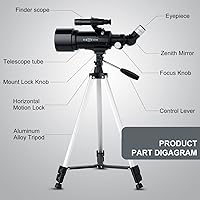
  • Finderscope: A 5x24 reflex finderscope is mounted on the tube to help locate targets in the sky before switching to main eyepiece viewing.
  • Optics Coating: All optical surfaces are fully multi-coated to reduce light loss and improve contrast and brightness at this aperture level.
  • Mount Type: The scope uses an altazimuth (AZ) mount, allowing straightforward up-down and left-right movement without any polar alignment requirement.
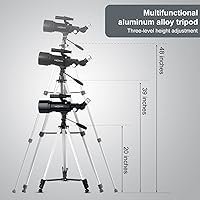
  • Tripod: The included tripod is constructed from aluminum with adjustable leg height to accommodate different users and terrain conditions.
  • Focus Mechanism: Focusing is manual, achieved by turning the focuser knob on the eyepiece holder to bring objects into sharp view.
  • Dimensions: Assembled, the unit measures approximately 22.8″ in length by 8.6″ wide by 5″ in height.
  • Weight: The complete setup weighs 4.59 pounds, making it light enough for children and easy to transport between locations.
  • Phone Adapter: A smartphone camera adapter is included, allowing users to position a phone over the eyepiece for casual lunar photography.
  • Wireless Remote: A wireless shutter remote is included to trigger a connected smartphone camera without physically touching the phone, reducing vibration.
  • Carrying Bag: A soft carrying bag is included for storing and transporting the telescope and its accessories together in one package.
  • Power Source: The telescope itself requires no battery power; the adapter reference applies only to optional electronic accessories.
  • Optical Tube Length: The optical tube measures 500mm in length, consistent with the stated focal length of the instrument.
  • Manufacturer: This telescope is manufactured and sold under the HEXEUM brand, model designation AZ50070.
  • Warranty: HEXEUM advertises a lifetime maintenance policy, with customer support available for product and service questions.

Related Reviews
Barska Starwatcher 70mm Refractor Telescope
83%
92%
Value for Money
89%
Ease of Setup
90%
Portability
85%
Optical Clarity
72%
Magnification Power
More
SVBONY SV503 70mm F6.78 Refractor Telescope
86%
89%
Image Quality
93%
Ease of Use for Beginners
85%
Build Quality
90%
Portability
92%
Value for Money
More
FREE SOLDIER RM 70mm 500mm Refractor Telescope
79%
91%
Value for Money
88%
Ease of Setup
85%
Portability
80%
Optical Performance
60%
Stability in Wind
More
ToyerBee 70mm Beginner Telescope
84%
91%
Ease of Use
88%
Portability
78%
Magnification Power
83%
Image Clarity
94%
Setup Process
More
HUGERSTAR 80600Purple 80mm Refractor Telescope
83%
94%
Ease of Setup
92%
Portability
85%
Image Quality
71%
Mount Stability
68%
Tripod Height
More
PISEZ 90mm Refractor Telescope 800mm
82%
92%
Value for Money
89%
Ease of Setup
88%
Image Clarity
85%
Portability
76%
Build Quality
More
CELTICBIRD 90700 90mm Refractor Telescope
83%
88%
Optical Performance
91%
Ease of Use
85%
Mount Stability
86%
Build Quality
83%
Portability
More
CELTICBIRD 80mm 800mm Refractor Telescope
82%
87%
Optical Clarity
92%
Ease of Setup
90%
Portability
78%
Build Quality
63%
Tripod Stability
More
Barska Starwatcher Refractor Telescope 60mm
80%
91%
Value for Money
88%
Ease of Setup
93%
Portability
85%
Performance (Planetary Viewing)
62%
Performance (Deep-Sky Viewing)
More
SVBONY SV503 102mm F7 Refractor Telescope
85%
90%
Astrophotography Performance
88%
Image Clarity
85%
Ease of Use
83%
Build Quality
87%
Precision of Focus
More

FAQ

Honestly, most kids that age will need some adult help for the initial assembly and finderscope alignment — the instruction manual is not particularly clear for younger users. Once it is set up and pointed at the Moon though, children can absolutely take over and operate it independently. Think of the first session as a together activity, and subsequent nights as solo exploration.

Yes, Saturn's rings are genuinely visible with this beginner scope under clear skies, and that tends to be the moment most new owners get hooked. You will not see fine ring structure or the Cassini Division clearly, but the rings themselves are unmistakable. Jupiter's cloud bands and the Galilean moons are also within reach on a steady night.

In practical terms, a 70mm aperture performs best up to roughly 140x magnification — beyond that, images get dim and soft. Using the 10mm eyepiece with the 3x Barlow technically pushes past that ceiling, and you will notice the image quality suffers. The sweet spot for most targets is the 25mm eyepiece, with the Barlow used selectively for the Moon.

At low magnification it is manageable — the kind of minor vibration that settles within a second or two after you touch the scope. At high magnification, any nudge to the tube or tripod sends the image bouncing noticeably, and it takes longer to settle. Setting the tripod on a solid, flat surface like a patio rather than grass helps considerably. It is a real limitation worth knowing about upfront.

It sits somewhere in between. Snapping a photo of the Moon through the eyepiece is genuinely doable and produces shareable results that will impress anyone who has never tried it before. The wireless remote makes a real difference since touching the phone causes blur. For anything beyond casual Moon shots — planets, star clusters — the results are inconsistent enough that you should treat it as a fun bonus rather than a core feature.

It does not arrive fully assembled — you will need to attach the tripod legs, mount the optical tube, and align the finderscope before first use. Most adults get through it in 20 to 30 minutes. The trickier part is finderscope alignment, which the manual does not explain well; a quick search for a short video tutorial makes that step much easier.

Technically yes, but refractor telescopes at this focal length typically produce an inverted image, which makes daytime terrestrial use awkward. The included diagonal helps correct orientation somewhat, but it is not ideal. This scope is designed around astronomical use, and daytime viewing is really a secondary capability rather than a selling point.

Light pollution affects all telescopes, but it hurts small-aperture scopes most when trying to view faint objects. For Moon and planetary viewing from a suburban backyard, light pollution is largely a non-issue — those targets are bright enough to cut through it easily. Where you will feel the suburban sky more acutely is with deep-sky targets, which are already at the edge of what a 70mm scope can show even from a dark site.

The brand markets it to kids and beginners broadly, but realistically age 8 is a sensible floor. Younger children can certainly look through it with adult supervision, but the focusing mechanism and finder alignment require enough fine motor control and patience that independent use before age 8 is a stretch. For a gift, knowing a parent will be involved in early sessions helps set everyone up for success.

Standard 1.25-inch eyepieces are a universal size and widely available from astronomy accessory brands, so upgrading or replacing eyepieces down the line is straightforward and relatively affordable. The more proprietary accessories like the phone adapter bracket are harder to source, and a few buyers have reported difficulty getting replacement parts through HEXEUM directly. Treating those smaller plastic components carefully is worth the extra care.