Overview

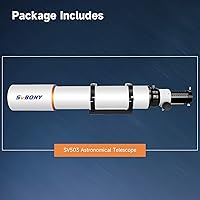
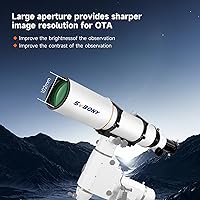
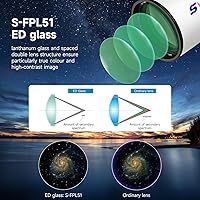
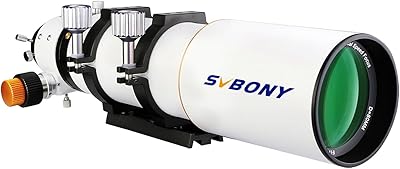
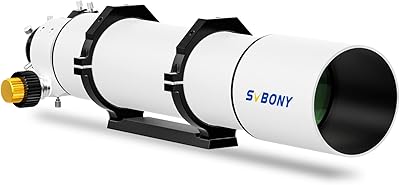
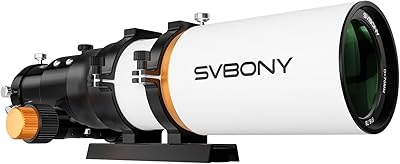
The SVBONY SV503 102mm ED Refractor Telescope sits in an interesting spot — clearly aimed at hobbyists who've outgrown their first scope and want something more capable without jumping to professional-grade pricing. The 102mm aperture paired with an f/7 focal ratio gives it real versatility for both visual observing and astrophotography. What separates it from ordinary achromats is the S-FPL51 ED glass, which keeps color fringing impressively controlled for a doublet design. The aluminum tube feels solid, ships in a foam-lined case, and includes a retractable dew shield — small details that signal genuine build quality. The dual-speed focuser alone puts it ahead of most rivals at this price tier.
Features & Benefits

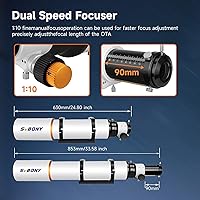
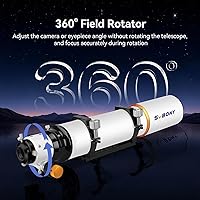
The S-FPL51 extra-low-dispersion glass is the optical heart of this ED refractor, and it shows — bright stars stay crisp white at the edges rather than blooming with the purple halos that plague cheaper doublets. Fully multi-coated lens surfaces push light throughput higher, which translates to noticeably brighter deep-sky targets at the eyepiece or camera sensor. The 1:10 dual-speed focuser is a genuine highlight: coarse adjustments get you close fast, and the fine-speed knob locks in precise focus without introducing vibration — a real advantage during long imaging exposures. The 360-degree field rotator lets you reframe a shot without disturbing polar alignment, and the 90mm back focus keeps most DSLRs and mirrorless cameras in reach without extra extension tubes.

Best For

The SV503 102 makes the most sense for amateur astrophotographers chasing nebulae, star clusters, and wide galaxy fields — the f/7 ratio produces a generous field of view while still resolving fine detail. Visual planetary observers will appreciate the low color fringing on Jupiter's cloud bands and Saturn's rings, where inferior achromats introduce distracting blue or purple fringes. If you already own an equatorial or alt-az mount, this imaging-ready OTA slots in cleanly via the included dovetail bar. The retractable lens hood makes it equally practical for suburban backyard observers dealing with light pollution or damp evenings. It even handles daytime terrestrial targets surprisingly well for a dedicated astronomy tube.

User Feedback

With a 4.7-out-of-5 rating across over 300 buyers, this ED refractor earns strong marks overall — but the feedback is worth reading carefully. Focuser smoothness and the foam-lined carry case come up repeatedly as highlights that owners genuinely didn't expect at this price. On the critical side, quite a few reviewers flag that no eyepiece ships in the box, which catches first-time buyers off guard — plan to budget for one separately before your first night out. Others note that the scope needs a solid mount to reach its potential; pair it with something flimsy and vibration becomes a real frustration. These are fair caveats, but overall buyer satisfaction here is notably high for the category.

Pros

  • The S-FPL51 ED glass keeps chromatic aberration noticeably low, especially impressive for a doublet design at this price tier.
  • A 1:10 dual-speed focuser makes nailing precise focus straightforward, whether you are imaging or observing visually.
  • The 360-degree field rotator saves real time during imaging sessions by letting you reframe without redoing polar alignment.
  • Fully multi-coated optics deliver bright, high-contrast views that hold up well against comparably priced competitors.
  • The included foam-lined carry case is a genuine bonus — protective, well-fitted, and not an afterthought.
  • A 90mm back focus distance means most DSLR and mirrorless camera rigs fit without buying extra extension hardware.
  • The retractable 133mm lens hood does double duty, blocking stray light and slowing dew buildup on cold nights.
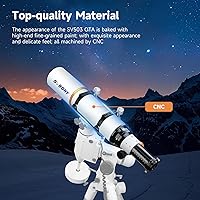
  • Build quality feels solid throughout — the aluminum tube, focuser action, and included dovetail bar all suggest a durable long-term investment.
  • A 4.7-out-of-5 rating across hundreds of verified buyers points to consistently high satisfaction across different use cases.
  • Versatile enough for daytime terrestrial viewing, making it useful beyond purely nighttime astronomy sessions.

Cons

  • No eyepiece is included in the box, which adds an immediate extra purchase most first-time buyers do not anticipate.
  • The mount is sold separately, and the scope genuinely needs a sturdy one — budget mounts will limit its performance significantly.
  • At roughly 4kg for the tube alone, it is not a lightweight grab-and-go option for travel or hiking astronomy.
  • As an achromatic doublet, it cannot fully match the color correction of a true apochromatic triplet on very bright targets or under high magnification.
  • The scope length of 630mm means it needs meaningful clearance in storage and during transport — not ideal for tight spaces.
  • Buyers upgrading from a complete beginner kit will need to budget for a mount, eyepiece, and possibly a camera separately, pushing total cost up considerably.
  • No finderscope is included in the standard package, so locating targets manually may be tricky for those new to star-hopping.

Ratings

The scores below reflect an AI-driven analysis of verified global buyer reviews for the SVBONY SV503 102mm ED Refractor Telescope, with spam, incentivized, and bot-generated feedback actively filtered out before scoring. Each category is rated independently based on what real owners reported after extended use — not marketing claims. Both the genuine strengths and the recurring frustrations are reflected transparently in every score.

Optical Performance
88%
Reviewers consistently report that the S-FPL51 ED glass delivers noticeably cleaner images than standard achromats at a comparable price — particularly on bright planets where color fringing is usually the first thing experienced observers notice. Jupiter's cloud bands and Saturn's ring gap come through with convincing sharpness on nights of good seeing.
At higher magnifications or on very bright targets like Venus, a residual trace of chromatic aberration is still visible, which is an inherent limitation of the doublet achromatic design regardless of glass grade. Buyers expecting true apochromatic performance will find this does not fully close that gap.
Focuser Quality
93%
The dual-speed rack-and-pinion focuser with 1:10 gear reduction is one of the most praised aspects across the entire review pool. Imagers love the fine-knob control during long-exposure sessions, where even a slight nudge on a standard single-speed focuser can ruin a carefully composed shot.
A small number of users reported minor focuser slippage under the weight of heavier camera setups, particularly DSLRs with large lenses attached. Adding a tension lock or focuser upgrade may be necessary for very heavy imaging rigs.
Chromatic Aberration Control
84%
For an achromatic doublet in this price range, the CA performance genuinely impressed experienced users who had used standard non-ED refractors before. Stars at the field edge stay tighter, and bright objects like the Moon retain their natural appearance without the distracting purple glow common in lesser designs.
This is still a doublet and not a true APO triplet, so under critical examination — especially with a camera sensor that records detail more ruthlessly than the eye — some color fringing around high-contrast edges remains. Users doing narrowband imaging will notice it less, but broadband imagers may still see it.
Build Quality
91%
The aluminium tube feels solid and purposeful in hand, and the retractable lens hood adds a layer of practical protection that many similarly priced competitors skip entirely. The foam-lined carry case is consistently described by buyers as a genuinely protective and well-fitted accessory rather than an afterthought.
A few buyers noted that the focuser drawtube finish and some minor fittings feel slightly less refined than premium Western brands, though none reported functional failures. At this price tier it is a fair trade-off, but detail-oriented buyers will notice the difference on close inspection.
Astrophotography Suitability
86%
The 360-degree field rotator is a real workflow improvement for imagers — being able to reframe a target without adjusting the mount or losing polar alignment saves meaningful time during short imaging windows. The 90mm back focus also removes a common compatibility headache with popular camera adapters.
The scope ships without a motorized focuser, which becomes a limitation for serious long-exposure astrophotographers who want remote or automated focus control. Adding a compatible motorized focuser unit is an additional cost that imaging-focused buyers should plan for.
Value for Money
87%
Compared to similarly specified ED refractors from established Western brands, this imaging-ready OTA delivers very competitive optical and mechanical performance at a noticeably lower price point. For buyers who already own a mount, the total entry cost into capable refractor astrophotography is meaningfully lower with this tube.
When you factor in the additional cost of a sturdy mount, an eyepiece, and any imaging accessories, the all-in budget climbs quickly — and the lack of bundled eyepiece in particular feels like a missed opportunity at this tier. Buyers should budget conservatively for accessories from the start.
Ease of Setup
76%
24%
For users who already own a compatible mount with a dovetail saddle, attaching and balancing this OTA is straightforward. The included dovetail bar, tube rings, and adapter mean most of the essential mechanical pieces are ready to go right out of the foam case.
First-time telescope buyers are likely to find the setup more involved than expected, particularly because no mount, tripod, or eyepiece is included. Without prior experience, sourcing compatible accessories and achieving a working, balanced setup can take several hours of research and additional spending.
Portability
67%
33%
At under 4kg for the tube alone, the SV503 102 is not excessively heavy for its aperture class, and the foam-lined case makes vehicle transport to dark-sky sites practical and safe. Many owners describe a comfortable car-trunk-to-field workflow for regular observing sessions.
This is firmly a drive-to-your-site scope — the tube length, weight, and separate mount requirement make it impractical for hiking or backpacking astronomy. Users who prioritize portability above all else would be better served by a compact 80mm or smaller grab-and-go refractor.
Planetary Viewing
83%
Visual planetary observers report genuinely satisfying views of the Moon, Jupiter, and Saturn — the ED glass keeps color edges controlled enough that detail in cloud belts and ring structure is the focus rather than optical artifacts. At moderate magnifications around 100x to 150x, the views are consistently described as clean and rewarding.
At the top of its useful magnification range, atmospheric seeing becomes the limiting factor before the optics do, which is generally a sign of decent optical quality — but it also means buyers in areas with poor seeing conditions may rarely push the scope hard enough to appreciate its full potential.
Deep-Sky Visual Performance
79%
21%
The 102mm aperture pulls in enough light to make open clusters, brighter globular clusters, and showpiece nebulae like the Orion Nebula genuinely impressive in a dark suburban backyard. The fully multi-coated objective keeps background sky contrast higher than uncoated or single-coated lenses, which helps fainter targets stand out.
For very faint deep-sky objects — think small galaxies or dim planetary nebulae — a 102mm aperture hits its natural limits regardless of glass quality. Observers chasing challenging Messier or NGC objects from light-polluted areas will find aperture, not optics, the binding constraint here.
Focuser Rotation Feature
89%
The 360-degree field rotator received consistent praise from imaging users who described it as one of those features that sounds minor on paper but becomes indispensable in practice. Rotating a galaxy to a more pleasing angle in the frame without repointing the mount is a genuine quality-of-life improvement during sessions.
Some users noted that the rotator can introduce a very slight shift in focus position when rotated across large angles under heavy camera loads, requiring a minor focus touch-up after rotation. This is a minor complaint but worth noting for those planning very precise narrowband imaging sequences.
Dew & Stray Light Management
81%
19%
The 133mm retractable lens hood does measurable work in the field — users in humid climates report it extends usable observing time before dew becomes a problem, and the contrast improvement in light-polluted suburban skies from blocking stray light is noticeable compared to tubes without a hood.
In persistently damp conditions, the lens hood alone is not a substitute for a dedicated dew heater strap, and buyers in regularly foggy or humid climates will likely need to purchase one as an additional accessory. The hood is a genuine help but not a complete dew management solution.
Included Accessories
58%
42%
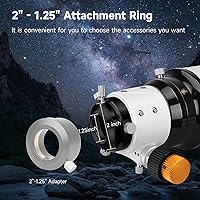
The foam-lined carry case is the standout inclusion and genuinely useful from day one — it holds the tube securely during transport and storage. The 2-inch to 1.25-inch adapter and dovetail bar are also practical additions that save at least one extra purchase.
The absence of an eyepiece is the most widely cited disappointment in the entire review pool, particularly among buyers transitioning from complete beginner kits that included one. No finderscope is included either, making initial target acquisition more challenging for newcomers to the hobby.
Camera Compatibility
85%
The generous 90mm back focus distance and the included 2-inch to 1.25-inch adapter mean this OTA works with a wide range of imaging setups without the frustrating adapter-stacking that plagues some competing designs. Most popular DSLR T-ring systems reach focus with room to spare.
Users with certain mirrorless cameras using thicker adapters or with flattener-reducer combinations occasionally report needing additional extension to reach focus, so checking back-focus math against your specific camera and accessory combination before purchasing is a worthwhile step.
Long-Term Reliability
82%
18%
Based on multi-month ownership reports in the review pool, the optical collimation held stable through regular transport and use, and the focuser mechanism showed no meaningful degradation in smoothness over time. Buyers who treat it as a long-term investment rather than a short-term trial tend to report high satisfaction.
SVBONY is a newer brand in Western markets with a shorter track record than established names like Sky-Watcher or Celestron, so long-term reliability data beyond two to three years of ownership is still limited. Warranty support response times have occasionally been flagged as slower than buyers expected.

Suitable for:

The SVBONY SV503 102mm ED Refractor Telescope is a strong match for hobbyists who have already spent a season or two with an entry-level scope and are ready for a meaningful step up in optical quality. Astrophotographers chasing nebulae, open clusters, and wide galaxy fields will find the f/7 focal ratio and ED glass combination genuinely capable — especially paired with a DSLR or dedicated astronomy camera, since the 90mm back focus works with most setups without adapter headaches. Visual observers who do a lot of planetary work will notice a real difference coming from a standard achromat; Jupiter's cloud belts and Saturn's ring separation look cleaner, with far less of the blue-purple fringing that becomes irritating over long sessions. Suburban backyard observers benefit particularly from the retractable lens hood, which cuts stray light and helps manage dew on humid nights. If you already own a decent equatorial or alt-az mount and are shopping purely for an OTA upgrade, this ED refractor represents excellent value without forcing you to replace your whole setup.
Not suitable for:

The SVBONY SV503 102mm ED Refractor Telescope is not the right choice for someone buying their very first telescope with no supporting gear already in hand. The scope ships without a mount and without an eyepiece — two omissions that add meaningful cost and shopping decisions on top of the tube itself, which can frustrate or mislead newcomers who expect a ready-to-use package. Buyers on a tight total budget should factor in a solid mount, because a wobbly tripod will undermine everything this optical tube is capable of delivering; the focuser precision means nothing if the whole rig shakes in a light breeze. Serious deep-sky imagers using narrowband filters or chasing very faint targets may eventually outgrow an achromatic doublet design regardless of glass quality, and might be better served by an apochromatic triplet if budget allows. Those wanting extreme portability — think hiking or travel astronomy — should note that at nearly 4kg for the tube alone, this is a backyard instrument, not a grab-and-go one.
Specifications

  • Aperture: The objective lens measures 102mm (approximately 4 inches) in diameter, giving it meaningful light-gathering ability for both visual observing and astrophotography.
  • Focal Length: The optical tube has a focal length of 714mm, producing a usable field of view well suited to wide deep-sky targets and moderate planetary magnification.
  • Focal Ratio: At f/7, this refractor sits in a practical middle ground — fast enough for deep-sky imaging but long enough for comfortable planetary work.
  • Glass Type: The objective is a doublet air-spaced achromatic design using S-FPL51 extra-low-dispersion glass, which significantly reduces chromatic aberration compared to standard crown-and-flint achromats.
  • Lens Coating: All optical surfaces are fully multi-coated (FMC) to maximize light transmission and minimize internal reflections, resulting in brighter and higher-contrast images.
  • Focuser Type: A dual-speed rack-and-pinion focuser with 1:10 gear reduction provides both coarse and fine focusing control, allowing precise, vibration-free focus acquisition during imaging sessions.
  • Field Rotator: The focuser includes a 360-degree rotating collar that allows the eyepiece or camera to be repositioned at any angle without disturbing the achieved focus point.
  • Back Focus: The design provides 90mm of back focus distance, which is sufficient to accommodate most DSLR, mirrorless, and dedicated astronomy cameras without additional extension tubes.
  • Lens Hood: A 133mm retractable lens hood is built into the front of the tube to block stray ambient light, reduce internal reflections, and slow the onset of dew on the objective.
  • Tube Material: The optical tube is constructed from aluminium, keeping overall weight reasonable while providing a rigid structure that maintains collimation during normal handling and transport.
  • Tube Dimensions: The optical tube measures 630mm in length with an outer diameter of 121mm when the lens hood is fully retracted.
  • Tube Weight: The optical tube assembly weighs 3.95kg (8.6 lbs) without a mount, eyepiece, or camera attached.
  • Resolving Power: The theoretical resolving capacity is 1.17 arcseconds, making it capable of splitting close double stars and resolving fine planetary surface detail under good seeing conditions.
  • Limiting Magnitude: The limiting stellar magnitude is approximately 12.1, meaning faint deep-sky objects and stars well beyond naked-eye visibility are within reach from a reasonably dark site.
  • Max Magnification: The maximum useful magnification is rated at 204x, though practical performance depends heavily on atmospheric seeing conditions and eyepiece quality.
  • Mount Compatibility: The tube attaches via a standard dovetail bar and is compatible with most equatorial and alt-az mounts that accept this fitting; no mount is included in the package.
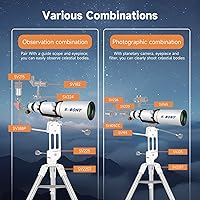
  • Included Accessories: The package includes a 2-inch to 1.25-inch adapter, a metal tube hoop, a dovetail bar, an objective focuser wheel cover, and a foam-lined protective carrying case.
  • Focus Type: Focusing is entirely manual via the dual-speed focuser knobs; there is no motorized or electronic autofocus system included with the standard package.

Related Reviews
SVBONY SV503 80mm ED Refractor Telescope
81%
91%
Optical Clarity
88%
Focuser Quality
86%
Chromatic Aberration Control
89%
Build Quality & Materials
83%
Value for Money
More
SVBONY SV503 70mm Refractor Telescope
83%
88%
Optical Clarity
91%
Field Flattener Performance
83%
Chromatic Aberration Control
79%
Focuser Quality
86%
Build & Tube Construction
More
SVBONY SV48P 102mm Refractor Telescope OTA
74%
83%
Optical Clarity
86%
Build Quality
88%
Focuser Performance
79%
Astrophotography Suitability
81%
Value for Money
More
Barska Starwatcher 70mm Refractor Telescope
66%
72%
Optical Clarity
58%
Magnification Performance
54%
Build Quality
84%
Ease of Setup
88%
Portability & Storage
More
HEXEUM AZ50070 70mm Refractor Telescope
73%
78%
Optical Clarity
88%
Value for Money
57%
Tripod Stability
66%
Ease of Assembly
63%
Finderscope Usability
More
HUGERSTAR 80600 Refractor Telescope
70%
78%
Optical Clarity
88%
Ease of Setup
61%
Tripod Stability
83%
Value for Money
84%
Portability
More
PISEZ 90800 90mm Refractor Telescope
68%
83%
Optical Clarity
81%
Value for Money
72%
Ease of Setup
68%
Magnification Range
61%
Tripod Stability
More
Celticbird 80mm 800mm Refractor Telescope
75%
83%
Optical Clarity
91%
Ease of Assembly
78%
Mount Usability
61%
Tripod Stability
58%
Included Eyepiece Quality
More
Barska Starwatcher Refractor Telescope 60mm
80%
91%
Value for Money
88%
Ease of Setup
93%
Portability
85%
Performance (Planetary Viewing)
62%
Performance (Deep-Sky Viewing)
More
CELTICBIRD 90700 90mm Refractor Telescope
70%
83%
Optical Clarity
76%
Mount Precision
88%
Tripod Stability
81%
Ease of Assembly
62%
Finderscope Usability
More

FAQ

The mount and tripod are sold separately — this is an optical tube assembly only. It ships with a dovetail bar so it can attach to most standard equatorial or alt-az mounts, but you will need to source a suitable mount on your own. Factor that into your total budget before purchasing.

No, an eyepiece is not included, which genuinely catches some buyers off guard. You will need to purchase at least one 1.25-inch or 2-inch eyepiece separately before you can do any visual observing. A 2-inch to 1.25-inch adapter is included so you have flexibility with eyepiece sizes.

Yes, most DSLRs and mirrorless cameras will work without issue. The 90mm back focus distance is generous enough to accommodate standard camera adapters and T-rings, so you should not need extra extension tubes in most setups. A dedicated astronomy camera will also connect cleanly via the focuser.

Noticeably better, which is the whole point of the S-FPL51 ED glass. On bright stars and planetary targets, color fringing is much more controlled than you would see with a typical crown-and-flint achromat of the same aperture. It is not a true apochromatic triplet, so some residual fringing can appear at very high magnification, but for most visual and imaging work it performs well above its class.

For imaging, a motorized equatorial mount with a payload rating comfortably above the tube weight is the right choice — something like a Sky-Watcher HEQ5 or iOptron CEM26 class mount is a popular pairing. The tube weighs just under 4kg bare, but cameras, rings, and accessories add up quickly. Avoid lightweight alt-az or single-arm mounts if long-exposure imaging is your goal.

It lets you rotate the eyepiece or camera to any angle around the optical axis without touching the focus position. In practice, this means you can reframe a deep-sky object — rotating the field of view to fit a galaxy at a better angle, for instance — without having to refocus or adjust the mount. It is a real time-saver during imaging sessions.

It handles both reasonably well. The f/7 ratio and ED glass combination produce clean, contrasty planetary views, and the Moon in particular looks excellent with good detail in craters and rilles. Deep-sky wide-field targets like the Pleiades or the Orion Nebula are also well within reach. It is more of an all-rounder than a dedicated planetary instrument.

The focuser has two speeds controlled by two separate knobs. The main knob moves the focuser quickly so you can get close to focus fast, and then a smaller knob on the side engages a 1:10 gear reduction for ultra-fine movement. That fine knob is what matters for imaging — it lets you dial in perfect focus without accidentally nudging the scope or introducing vibration into a long exposure.

It is manageable but not a true grab-and-go scope. The foam-lined carry case makes transport safer, and at under 4kg the tube is not backbreaking, but you still need to bring a mount, tripod, and accessories separately. Most owners drive to their observing sites rather than hiking with it. If ultraportability is a priority, a smaller 70mm or 80mm refractor might suit you better.

It helps slow dew formation by creating a physical barrier around the objective lens, reducing exposure to humid air. It is not a heater, so in persistently damp conditions you may still want a dedicated dew heater strap for longer sessions. That said, most users in moderate climates find the hood provides a useful extra window of time before dew becomes a problem.

Where to Buy

Camera Concepts & Telescope Solutions
In stock $689.00