Overview

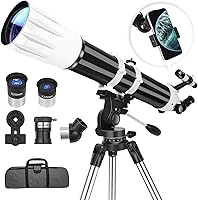
The Hawkko 90900 Refractor Telescope sits in an interesting spot for anyone stepping beyond curiosity and into actual astronomy — substantial enough to feel like a real instrument, but not so complex it drives a newcomer away. Built around a 90mm aperture and 900mm focal length, the optical identity here is straightforward: this is a scope designed for lunar detail and planetary views, not a glorified toy from a department-store shelf. Hawkko is a newer name competing against more established beginner brands, but they've clearly thought about what first-time buyers actually need, bundling every essential accessory into one ready-to-go package.

Features & Benefits

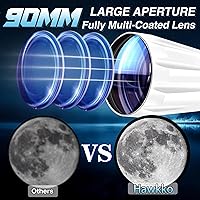
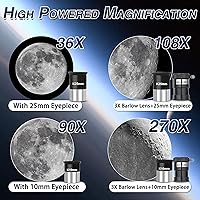
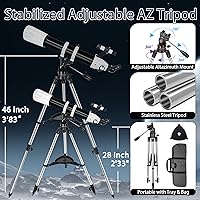
The optical core of this refractor telescope centers on a fully multi-coated lens — those anti-reflective layers reduce glare and improve light transmission, which translates directly into sharper moon craters and cleaner planetary edges. The 900mm focal length works with two Kellner eyepieces and a 3x Barlow to cover a practical magnification range from around 36x to 270x, though real-world atmospheric conditions typically cap useful views well below that upper figure. The altazimuth mount pans and tilts smoothly enough for casual tracking, the tripod adjusts between 28″ and 46″ for comfortable use at various heights, and a carry bag makes taking the whole kit outdoors genuinely convenient.

Best For

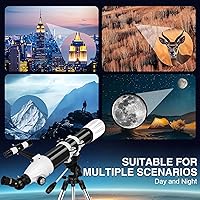
This beginner scope is a strong match for adults who want to act on their astronomy curiosity without diving into complicated equatorial setups or specialized gear. Families with kids who are serious about learning the night sky will find assembly straightforward enough to tackle together, and the dual-use capability works just as well aimed at a distant landscape as it does at Saturn. However, it is worth being honest about what this refractor telescope is not built for: deep-sky astrophotography or precision tracking are outside its design intent. The f/10 focal ratio suits moon and planet observation well, but faint nebulae will remain largely out of reach.

User Feedback

With a 4.3-star average across roughly 350 ratings, this beginner scope has earned a solid reputation for a brand that only launched in mid-2024. Buyers consistently highlight lunar image clarity and surprisingly painless assembly — most report getting set up within the claimed 15-minute window. The smartphone adapter earns genuine praise, though reviewers are candid that it suits moon photography far better than anything more ambitious. On the critical side, finder scope alignment frustrates some users, and a handful note the mount feeling stiff when pushing toward higher magnifications. A few buyers have also flagged minor packaging inconsistencies, so it is worth doing a quick check of all components on arrival.

Pros

  • The 90mm multi-coated lens delivers genuinely sharp lunar views that surprise first-time owners.
  • Most buyers report a complete, frustration-free setup in under 15 minutes — even without prior experience.
  • Six usable magnification steps from one pair of eyepieces and a Barlow covers months of learning.
  • The stainless steel tripod feels meaningfully more solid than plastic alternatives at the same price.
  • Everything needed for the first observing session ships in one box — no follow-up accessory orders required.
  • The carry bag makes it realistic to actually take this beginner scope outside rather than leaving it on a shelf.
  • Saturn's rings and Jupiter's cloud bands are visible on steady nights — a milestone moment for new observers.
  • The altazimuth mount is intuitive enough that beginners can track the moon without any prior training.
  • The smartphone adapter produces shareable lunar photos that genuinely motivate new astronomers to keep going.
  • At 11 pounds, the overall kit is light enough for one person to carry to a dark-sky location without difficulty.

Cons

  • Finder scope alignment drifts after transport and needs re-checking almost every session.
  • The focuser drawtube has noticeable play that becomes irritating when swapping between accessories frequently.
  • Mount vibrations at higher magnifications can take several seconds to settle after any adjustment.
  • The straight-through finder scope forces awkward viewing angles when the tube points near the zenith.
  • Quality control is not perfectly consistent — some units arrive with loose fittings or minor packaging damage.
  • The carry bag offers no rigid protection, leaving the optical tube vulnerable to knocks during transit.
  • The instruction manual ends at assembly and offers almost no guidance on actually finding objects in the sky.
  • Chromatic aberration around the lunar limb and bright stars is visible and distracting at high magnification.
  • The Kellner eyepieces are functional but noticeable as the weakest link once you try better glass elsewhere.
  • Leg leveling on uneven outdoor terrain requires patience, and the leg-lock clamps feel imprecise under load.

Ratings

The scores below reflect an AI-driven analysis of verified buyer reviews for the Hawkko 90900 Refractor Telescope, drawn from global feedback and actively filtered to exclude incentivized, bot-generated, and duplicate submissions. Each category captures what real owners experienced after unboxing, assembling, and using this beginner scope under actual night skies — not just initial impressions. Both the genuine strengths and the recurring frustrations are represented transparently, so you can make a genuinely informed decision.

Optical Clarity
83%
Reviewers who pointed this beginner scope at the moon were consistently impressed by the level of crater and ridge detail visible. The fully multi-coated lens does meaningful work at this aperture, reducing color fringing and keeping contrast sharp enough to satisfy adults who previously owned only cheap department-store optics.
At higher magnifications — especially when using the 3x Barlow with the 10mm eyepiece — atmospheric shimmer exposes the limits of the optics. Some buyers noted slight chromatic aberration around bright objects like the moon's limb, which is typical for refractors at this focal ratio but still worth knowing in advance.
Build Quality
76%
24%
The optical tube feels solid for the price tier, and the stainless steel tripod legs inspire more confidence than the flimsy plastic alternatives found on cheaper beginner scopes. Most buyers described the overall assembly as sturdy enough for regular backyard use and occasional travel.
A handful of reviewers flagged minor inconsistencies in packaging and component fit — specifically some looseness in the focuser drawtube and the accessory tray connection point. These are not widespread failures, but they suggest quality control is not perfectly consistent across every unit shipped.
Mount Smoothness
69%
31%
For lunar tracking and basic planetary observation, the altazimuth mount does its job reasonably well. Beginners find the pan-and-tilt motion intuitive to learn, and casual observers report being able to follow the moon across the sky without much frustration during the first few sessions.
Push the magnification above 150x and the mount's limitations become harder to ignore — small vibrations from nudging the tube can take several seconds to settle, and some users found the tension adjustment on the azimuth axis either too stiff or too loose out of the box. It is functional, but not refined.
Ease of Setup
88%
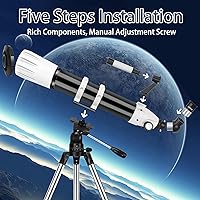
The assembly experience is one of the clearest wins here. The majority of buyers — including those with no prior telescope experience — report being fully set up and looking at the moon within 15 minutes of opening the box, which aligns with the brand's own claim. The printed instructions are clear enough that most adults do not need to consult a video tutorial.
A small portion of buyers ran into trouble aligning the straight-through finder scope, which requires patience and good initial polar orientation to do correctly. If you skip this step or rush it, finding objects in the main eyepiece becomes genuinely frustrating, especially for first-timers.
Magnification Range
71%
29%
The combination of two eyepieces and a 3x Barlow gives six distinct magnification steps, covering wide-field moon views down to moderate planetary detail. For most beginners, that range is more than enough to stay engaged for months without needing additional accessories right away.
The advertised 270x figure is theoretical and rarely usable in practice — atmospheric turbulence and the physical limits of a 90mm aperture cap truly sharp views closer to 150x to 180x on a steady night. Buyers who go in expecting the top magnification to deliver sharp planetary detail will likely be disappointed.
Finder Scope Usability
58%
42%
Having any finder scope included at this price point is a genuine help during the learning phase. Once aligned correctly, the straight-through design works adequately for locating bright objects like the moon and Jupiter, letting beginners build the habit of star-hopping before committing to a red-dot finder upgrade.
The straight-through orientation is awkward when the telescope is pointed near the zenith, forcing users into uncomfortable viewing angles. Alignment drift after transporting the scope is a recurring complaint, and several buyers describe re-aligning the finder scope as a tedious ritual every time they set up.
Smartphone Adapter
62%
38%
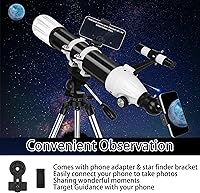
The included phone adapter clips onto the eyepiece and enables surprisingly decent moon photography — enough to share a recognizable lunar image on social media after a few minutes of fiddling with alignment. Buyers who treated it as a fun bonus rather than a serious imaging tool came away satisfied.
Compatibility varies noticeably by phone model, and larger flagship phones with wide camera modules can be tricky to center properly. Long-exposure planetary imaging is not realistic with this adapter and a manual altazimuth mount, so buyers with serious astrophotography ambitions should plan for a dedicated camera solution instead.
Accessories Completeness
84%
The kit covers everything a beginner needs to start observing the same evening it arrives — two eyepieces, a Barlow, a finder scope, a zenith mirror, a phone adapter, and a carry bag. Compared to competitors that charge extra for even a second eyepiece, the included set represents solid out-of-box readiness.
The eyepiece quality, while adequate, is not exceptional — the Kellner design is functional but leaves room for improvement if you later invest in Plossl or wider-field eyepieces. The carry bag is also on the basic side, offering minimal padding protection for the optical tube during transit.
Tripod Stability
72%
28%
The adjustable stainless steel tripod provides a noticeably more stable base than the all-plastic alternatives common in the same price range. Observers using it on flat ground — a patio, a driveway, a campsite — generally reported stable views at low to moderate magnification without needing to sandbag or brace the legs.
On uneven ground or grass, getting all three legs properly leveled takes trial and error, and the leg-lock clamps can feel imprecise. At the upper end of the height range (around 46″), the setup becomes more susceptible to vibration from wind or accidental knocks, which compounds the mount-settling issue at high magnification.
Portability
79%
21%
At around 11 pounds all-in, this refractor telescope is light enough to carry from the car to a dark-sky spot without straining, and the included bag keeps everything consolidated. Campers and weekend observers who want a scope that actually makes it out of the house will find the weight and size reasonable for a 90mm instrument.
The tube length of roughly 32 inches makes it awkward to pack into smaller vehicle trunks alongside other camping gear, and the carry bag offers no rigid structure to prevent the tube from rolling around. It is portable in the casual sense, but not truly compact the way a short-tube refractor or a Maksutov-Cassegrain would be.
Value for Money
81%
19%
For adults making their first real investment in astronomy, the overall package — optics, mount, accessories, and carry bag — delivers tangible value. The optical performance on the moon and bright planets punches above what most buyers expected at this price tier, and the brand has clearly prioritized the unboxing and getting-started experience.
Buyers comparing it closely to established competitors like Sky-Watcher or Celestron in the same segment may find the build tolerances slightly looser and the mount less refined. It is a strong value for pure beginners, but those with even a little prior experience may notice where corners were cut.
Image Brightness
77%
23%
The 90mm aperture gathers enough light to render the lunar surface in impressive brightness and contrast, and the multi-coated optics keep internal reflections low. Observers in suburban backyards reported satisfying views of Saturn's rings and Jupiter's main cloud bands on clear nights.
As a 90mm refractor, this scope has real limits on faint-object brightness — globular clusters appear as unresolved fuzzy patches and most deep-sky objects require genuinely dark skies to show any detail at all. Buyers drawn in by visions of colorful nebula images from Hubble will need to recalibrate their expectations significantly.
Focuser Quality
63%
37%
The manual rack-and-pinion focuser handles focus pull-in adequately for lunar and planetary work, and most users achieve sharp focus without major difficulty once they understand the sensitivity of the adjustment. Short rotation arcs are generally enough to move between eyepieces without losing the object entirely.
The focuser has notable play — small amounts of wobble in the drawtube that become more apparent when swapping between heavier accessories. Some buyers noted that the focuser tightens inconsistently across units, suggesting the mechanism could benefit from tighter manufacturing tolerances on individual components.
Instruction Clarity
82%
18%
The printed manual that ships with this beginner scope is clearly written and well-illustrated, which is genuinely important for buyers who have never assembled a telescope before. Most reviewers describe the assembly steps as logical and followable, and the included quick-start layout reduces the intimidation factor considerably.
The instructions thin out quickly once assembly is complete — there is little guidance on how to collimate, how to polar-align, or how to actually find objects in the sky. New astronomers will likely need to supplement with online resources or apps, which is a reasonable expectation, but worth flagging for buyers who assumed the manual covered everything.

Suitable for:

The Hawkko 90900 Refractor Telescope is genuinely well-matched to adults who have always been curious about astronomy but have never owned a serious scope — people who want to move past the frustration of cheap toy-store optics without immediately committing to a complex, high-maintenance instrument. Families with curious teenagers or younger children who are ready for real stargazing will find the setup approachable enough to do together, and the complete accessory kit means there is no scramble to source missing parts before the first clear night. Backyard observers who primarily want sharp, satisfying views of the moon and bright planets like Saturn and Jupiter will get genuine performance from the 90mm multi-coated lens and the 900mm focal length — this is a refractor that can deliver those iconic ring views that hook people on astronomy for life. Campers and outdoor enthusiasts who want one portable optical instrument for both daytime landscapes and evening stargazing will also find the carry bag and adjustable tripod a practical combination. If your goal is to learn the sky, build observing habits, and enjoy the night sky casually without a steep learning curve, this beginner scope delivers on that promise.

Not suitable for:

The Hawkko 90900 Refractor Telescope is not the right tool for observers who have already worked through the beginner phase and are ready to chase faint deep-sky targets like galaxies, nebulae, or globular clusters — the 90mm aperture simply cannot gather enough light to make those objects rewarding under typical suburban skies. Buyers who are primarily motivated by astrophotography should approach with real caution: the included smartphone adapter is a casual accessory, not an imaging platform, and the manual altazimuth mount offers none of the tracked, motorized movement that long-exposure photography requires. Experienced stargazers who already own or have used entry-level scopes from established brands may notice the mount refinement and build tolerances feel a step behind what they are used to. Anyone who needs a compact, ultra-portable instrument that fits easily in a backpack or small luggage will also find the 32-inch tube length impractical. And if you are shopping for a scope that will grow with you into intermediate or advanced astronomy over several years, you will likely outgrow this refractor faster than its price point suggests.

Specifications

  • Aperture: The objective lens measures 90mm in diameter, allowing the scope to gather meaningful light for lunar and bright planetary observation.
  • Focal Length: The optical tube has a 900mm focal length, which defines the scope's magnification potential and its suitability for high-contrast planetary viewing.
  • Focal Ratio: The focal ratio is f/10, making this a slow refractor well-suited to planetary and lunar work rather than wide-field deep-sky observation.
  • Magnification Range: Using the included eyepieces and 3x Barlow lens, the scope covers a magnification range from approximately 36x up to a theoretical maximum of 270x.
  • Eyepieces Included: Two Kellner-design eyepieces are included — a 25mm for wider, lower-power views and a 10mm for closer, higher-magnification observation.
  • Barlow Lens: A 3x Barlow lens is included, which triples the effective magnification of any eyepiece it is paired with.
  • Optical Coating: The objective lens features full multi-layer coating (FMC), which improves light transmission and reduces internal reflections compared to single-coated optics.
  • Mount Type: The telescope uses an altazimuth (AZ) mount, which allows straightforward up-down and left-right movement without the complexity of an equatorial setup.
  • Tripod Material: The tripod legs are constructed from stainless steel, providing a more rigid and stable base than the all-plastic tripods common in lower-tier beginner scopes.
  • Tripod Height: The tripod is adjustable between 28″ and 46″, accommodating a range of observer heights and allowing use while seated or standing.
  • Finderscope: A straight-through finderscope is included to help users locate and center objects before viewing them through the main eyepiece.
  • Focus Mechanism: Focusing is achieved through a manual rack-and-pinion focuser, which the observer adjusts by hand to achieve a sharp image.
  • Tube Length: The optical tube is approximately 31.89 inches (900mm) long, which determines the scope's overall packed size and portability.
  • Product Weight: The complete setup weighs approximately 11 pounds (around 5 kg), making it manageable for one person to carry short distances.
  • Smartphone Adapter: A smartphone adapter is included in the kit, designed to mount a phone over the eyepiece for basic afocal lunar photography.
  • Zenith Mirror: A 90-degree zenith mirror is included, redirecting the optical path to a more comfortable viewing angle for objects at higher elevations.
  • Carry Bag: A soft carry bag is included for transporting the telescope and its accessories as a single consolidated kit.
  • Accessory Tray: A spreader-mounted accessory tray is included with the tripod, providing a flat surface to hold eyepieces and small accessories during a session.
  • Dimensions (Packed): The product dimensions are approximately 31.89 inches deep by 5.91 inches wide by 10.24 inches tall when packed for transport.
  • Model Number: The official model number is 100900-001, and the Amazon identifier (ASIN) is B0D1QBBSDX, useful for cross-referencing accessories and replacement parts.

Related Reviews
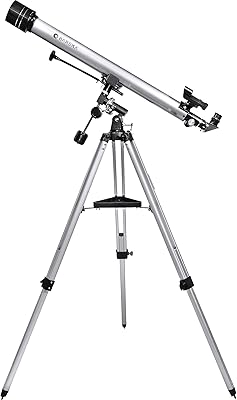
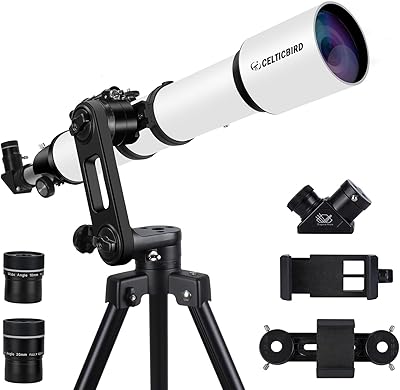
Celticbird 80mm 800mm Refractor Telescope
75%
83%
Optical Clarity
91%
Ease of Assembly
78%
Mount Usability
61%
Tripod Stability
58%
Included Eyepiece Quality
More
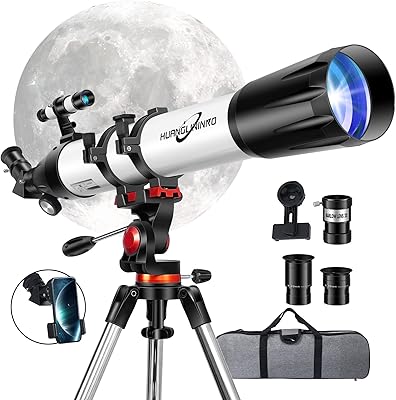
Barska Starwatcher 70mm Refractor Telescope
66%
72%
Optical Clarity
58%
Magnification Performance
54%
Build Quality
84%
Ease of Setup
88%
Portability & Storage
More
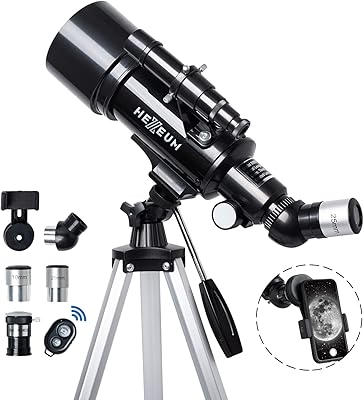
PISEZ 90800 90mm Refractor Telescope
68%
83%
Optical Clarity
81%
Value for Money
72%
Ease of Setup
68%
Magnification Range
61%
Tripod Stability
More
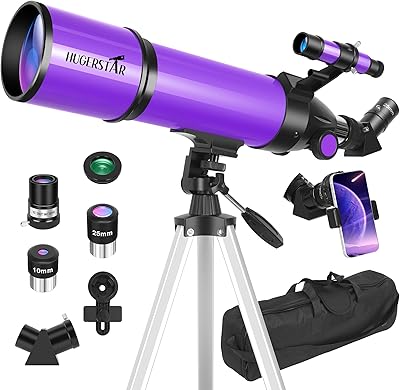
HUGERSTAR 80600 Refractor Telescope
70%
78%
Optical Clarity
88%
Ease of Setup
61%
Tripod Stability
83%
Value for Money
84%
Portability
More
Barska Starwatcher Refractor Telescope 60mm
80%
91%
Value for Money
88%
Ease of Setup
93%
Portability
85%
Performance (Planetary Viewing)
62%
Performance (Deep-Sky Viewing)
More
CELTICBIRD 90700 90mm Refractor Telescope
70%
83%
Optical Clarity
76%
Mount Precision
88%
Tripod Stability
81%
Ease of Assembly
62%
Finderscope Usability
More
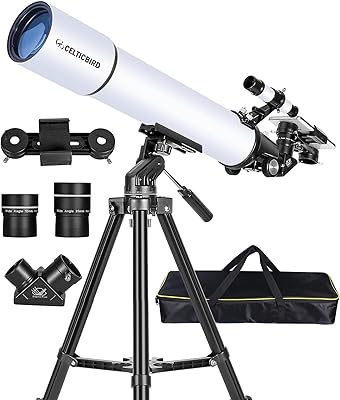
HEXEUM AZ50070 70mm Refractor Telescope
73%
78%
Optical Clarity
88%
Value for Money
57%
Tripod Stability
66%
Ease of Assembly
63%
Finderscope Usability
More
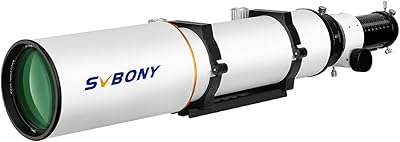
SVBONY SV503 80mm ED Refractor Telescope
81%
91%
Optical Clarity
88%
Focuser Quality
86%
Chromatic Aberration Control
89%
Build Quality & Materials
83%
Value for Money
More
SVBONY SV503 102mm ED Refractor Telescope
82%
88%
Optical Performance
93%
Focuser Quality
84%
Chromatic Aberration Control
91%
Build Quality
86%
Astrophotography Suitability
More
SVBONY SV48P 102mm Refractor Telescope OTA
74%
83%
Optical Clarity
86%
Build Quality
88%
Focuser Performance
79%
Astrophotography Suitability
81%
Value for Money
More

FAQ

Yes, and it is one of the genuine highlights of owning this beginner scope. On a steady night with good atmospheric conditions, the 90mm aperture and 900mm focal length will show Saturn's rings clearly separated from the planet's disk. You will not see extreme detail in the rings themselves, but the view is more than enough to be genuinely memorable — especially if it is your first time.

No tools are required. Most buyers report being fully assembled and looking at the moon within 10 to 15 minutes, which aligns with what the brand claims. The process involves attaching the optical tube to the mount, extending the tripod legs, and sliding accessories into place. The instructions are clear enough that first-timers rarely struggle — just take your time reading each step rather than improvising.

It lands somewhere in between, honestly. For moon photography it works reasonably well — many buyers manage to capture recognizable, shareable lunar images on their first try. For anything more ambitious, like planetary detail or long-exposure shots, it is not a practical solution. Treat it as a fun bonus that enhances the experience for beginners, not as a serious imaging tool.

Yes, the optics work fine for daytime terrestrial viewing. The zenith mirror does invert and mirror the image, which takes a little getting used to for landscapes, but it is not a dealbreaker for casual use. If daytime observation is a major priority, you can purchase an erecting prism separately to correct the image orientation.

It takes a bit of patience the first time, but the process itself is not complicated — you align the finder to the main scope by pointing at a distant daytime object and adjusting the finder's small set screws until both are centered on the same point. The more common frustration is that alignment can drift slightly after transport, so plan to do a quick check at the start of each session rather than assuming it stays put.

Quite a lot for a beginner. The moon in detail — craters, mountain ranges, and the terminator line — is endlessly interesting. Jupiter with its four Galilean moons and visible cloud bands, Saturn with the rings clearly separated, and Mars as a reddish disk during opposition are all achievable. Deep-sky targets like the Orion Nebula and open star clusters are visible too, though faint galaxies and nebulae require darker skies than most suburban locations offer.

With an adult present for the initial setup and alignment, yes — a motivated 10 to 12 year old can absolutely operate this scope. The altazimuth mount is intuitive to move, and there is no complicated polar alignment to learn. The tripod at its lower height settings is comfortable for younger observers. It is a shared family instrument more than a child's standalone toy, so having an adult involved in the first few sessions will make the experience much better.

In practice, the atmosphere is usually your limiting factor before the optics are. On an average night, views tend to fall apart above 150x to 180x due to atmospheric turbulence — the image just becomes a shimmering blur rather than gaining useful detail. The theoretical 270x figure is achievable under exceptional conditions, but it is not something you should plan your expectations around. Starting at lower magnifications and working up is always the better approach.

No — the kit covers everything you need for your first sessions right out of the box. The two eyepieces, Barlow lens, zenith mirror, finder scope, and smartphone adapter are all there. If you stick with the hobby, you will likely want to upgrade to a Plossl or wider-field eyepiece eventually, and a red-dot finder is a popular swap for the straight-through finder scope, but none of that is necessary to begin.

The main practical difference is in portability and maintenance. This refractor requires no collimation (mirror alignment) and the sealed tube keeps dust off the optics — both real advantages for beginners who want a grab-and-go experience. A reflector of similar price would typically offer more aperture for the money, which helps with fainter objects, but it needs occasional collimation and is generally bulkier. For someone focused on moon and planet viewing who wants minimal fuss, this refractor is a solid choice; for someone wanting maximum aperture on a tight budget, a reflector may be worth considering.