
Overview

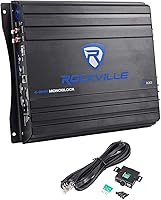
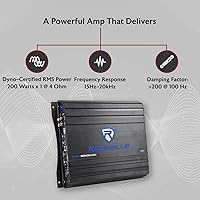
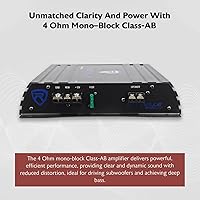
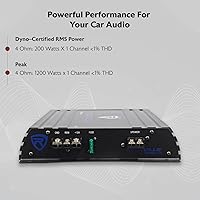
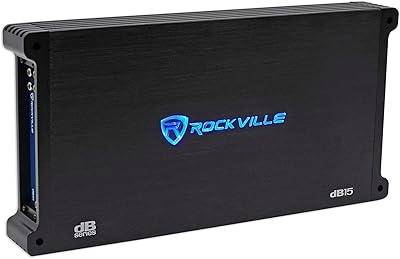
The Rockville RVA600.1 Mono Car Amplifier has been quietly holding its own in the budget car audio space since 2014 — a long run that counts for something. Before anything else, ignore the 1200W peak figure on the box; the number that actually matters is 200W RMS at 4 ohm, which is what you'll realistically get when driving a single subwoofer. That's an honest, usable amount of power for most entry-level builds. At 15.5 x 11.5 x 3.5 inches and just 3 pounds, this mono amp fits without drama in a trunk corner or under a rear seat, making it genuinely practical for first-time installers working with tight spaces.

Features & Benefits

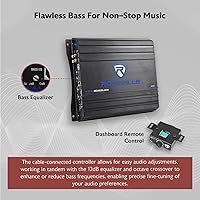
The onboard tuning options are where the RVA600.1 earns its keep. An adjustable low-pass crossover sweeping from 50Hz to 250Hz means you can dial in the exact frequency cutoff your subwoofer needs rather than guessing. The subsonic filter, covering 10Hz to 50Hz, is genuinely useful if you're running a ported box — it blocks ultra-low rumble that wastes power and can damage a woofer over time. The narrow Q bass EQ at 45Hz tightens punch without bloating the response. Rounding things out, the wired bass remote is a practical touch; adjusting output from the driver's seat beats crawling into the trunk every time you want less thump at a red light.

Best For

This Rockville amplifier makes the most sense for someone putting together their first subwoofer setup on a tight budget. If you're pairing a single 4-ohm subwoofer with a factory head unit or a basic aftermarket receiver, this mono amp handles the job without unnecessary complexity. The auto-start circuitry is a small but real convenience for those who haven't wired an amplifier before. It also works well as a no-fuss choice for a second vehicle where you want decent bass without spending serious money. Anyone chasing audiophile-level output or planning to run a demanding low-impedance driver should look at a higher-tier option — this amp isn't built for that.

User Feedback

With 74 ratings and a 4.2-star average, feedback on the RVA600.1 is encouraging but should be taken in context — that's a relatively modest sample size. Buyers frequently highlight easy installation and solid value for the price, with several noting it delivers real, usable bass without fuss. The recurring criticism centers on power claims; a few users feel actual output falls short of what the marketing suggests, which is a fair concern given the wide gap between peak and rated RMS figures. Long-term reliability is harder to judge from available data, and warranty service experiences appear mixed, so keeping expectations aligned with the price point is wise.

Pros

  • Honest 200W RMS rating gives a realistic performance baseline rather than chasing inflated peak numbers.
  • Adjustable low-pass crossover from 50Hz to 250Hz makes tuning straightforward for most subwoofer setups.
  • Subsonic filter protects ported-enclosure woofers from damaging ultra-low frequencies during heavy use.
  • Wired bass remote lets drivers adjust output from the front seat without any hassle.
  • Auto-start circuitry simplifies installation, especially for beginners without dedicated remote wire access.
  • Compact 3-pound build fits easily in tight trunk spaces or under rear seats.
  • High-level speaker input means it can work directly with factory head units lacking RCA outputs.
  • Built-in thermal and overload protection adds a layer of safety during extended listening sessions.
  • The RVA600.1 has been available since 2014, giving it more real-world exposure than most budget amps at this price.
  • Narrow Q bass EQ at 45Hz adds noticeable punch without creating a bloated, boomy low end.

Cons

  • The 1200W peak figure is misleading marketing; real-world output is a fraction of that number.
  • At 74 ratings, the review pool is small — patterns in feedback may not reflect long-term ownership trends.
  • Warranty service experiences from buyers appear inconsistent, which is a genuine risk at this price tier.
  • No 2-ohm stable rating limits flexibility if you want to upgrade to a more demanding subwoofer later.
  • Power output may feel underwhelming to buyers who took the peak wattage claim at face value.
  • Long-term reliability data is thin; it is unclear how well this mono amp holds up after two or more years of daily use.
  • No wireless remote option — the included wired remote requires routing a cable through the cabin.
  • Lacks balanced XLR inputs, which limits compatibility with higher-end source units or signal processors.

Ratings

The Rockville RVA600.1 Mono Car Amplifier has been scored by our AI rating engine after processing verified buyer reviews from multiple global platforms, with spam, bot-generated, and incentivized submissions actively filtered out. Scores reflect the honest spread of real ownership experiences — not just the highlights — so both the genuine strengths and recurring frustrations of this mono amp are transparently represented below.

Value for Money
83%
For buyers on a tight budget putting together their first subwoofer system, the RVA600.1 punches well above what you'd expect for the price. Most owners feel they got a functional, reasonably capable amp without spending more than they needed to, which is exactly what this segment demands.
A handful of buyers feel the value calculation shifts once they factor in the gap between the hyped peak wattage and the real 200W RMS output. If you bought in expecting near-1200W performance, the reality can feel like a letdown regardless of the actual price paid.
Sound Quality
74%
26%
For a budget mono amp driving a single 4-ohm subwoofer in a sealed or ported box, most users report clean, punchy bass with no obvious distortion at moderate listening levels. The narrow Q bass EQ at 45Hz noticeably tightens the low-end response compared to leaving the EQ flat.
At higher volume levels, some buyers notice the sound quality begins to compress and lose definition, particularly in the upper bass range. This mono amp is not going to satisfy anyone chasing audiophile-grade reproduction, and its limitations become more apparent with a higher-quality subwoofer that can reveal the amp's ceiling.
Ease of Installation
88%
Installation is frequently cited as one of the strongest selling points for this Rockville amplifier. The auto-start circuitry and high-level speaker input make the wiring process genuinely accessible for first-timers, removing two common stumbling blocks that trip up beginners working with a factory head unit.
While setup is simple for most users, a few report that the labeling on the terminal block and gain controls is smaller than ideal, making it harder to read in a dimly lit trunk during installation. The wired bass remote cable also lacks length for some larger vehicle configurations.
Power Accuracy
52%
48%
The 200W Dyno-Certified RMS rating is at least a concrete, tested number, which is more than many competitors at this price tier provide. Buyers who focus on the RMS spec rather than the peak claim tend to find the actual output matches their expectations reasonably well.
The 1200W peak figure printed prominently on the product causes persistent frustration among buyers who did not understand the difference between peak and RMS at the time of purchase. This is one of the most consistently mentioned pain points across reviews, and it erodes trust in the brand even when the amp technically performs as rated.
Build Quality
67%
33%
The chassis feels reasonably solid for the price, and the heatsink design appears adequate for normal listening sessions. Several owners note the amp looks more substantial in person than they expected based on its low price point, which works in its favor during initial impressions.
Long-term build durability is an open question. A subset of buyers report issues emerging after extended ownership — connector quality and internal component longevity are the most cited concerns — though the review pool of 74 ratings is too small to draw firm conclusions about how representative these cases are.
Thermal Management
71%
29%
The built-in thermal protection has received genuine praise for doing its job — the amp shuts down safely rather than failing silently when it gets too hot during a long listening session on a warm day. For a budget unit, functional protection circuitry is not something to take for granted.
Some users find the amp runs noticeably warm even at moderate output levels, which raises mild concerns about sustained performance in hot climates or poorly ventilated trunk installations. The heatsink does its job, but it is not oversized for the application.
Crossover & EQ Controls
78%
22%
Having an adjustable low-pass crossover that sweeps from 50Hz all the way to 250Hz gives users real flexibility to match this mono amp to different subwoofer types and enclosure designs. The subsonic filter is a meaningful inclusion for ported-box users who would otherwise risk mechanical damage from infrasonic content.
The physical control knobs feel a bit lightweight and the detent feedback is minimal, making precise adjustment feel slightly imprecise. There is no onboard gain indicator or LED metering to assist with calibration, so setting gains accurately requires either a multimeter or a keen ear.
Bass Remote Usability
81%
19%
The wired bass remote is one of the more practical accessories bundled with any amp at this price. Being able to reduce the subwoofer level at a drive-through or in a quiet neighborhood without pulling over is a quality-of-life feature buyers regularly mention appreciating after a few weeks of ownership.
The remote cable length may fall short for longer cabin runs in larger SUVs or trucks, and there is no volume indicator or position display on the knob itself — you are adjusting by feel alone. A wireless option would have been a notable upgrade, even if not realistic at this price.
Compatibility
79%
21%
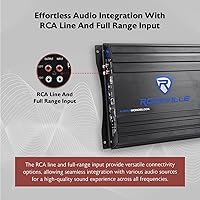
The combination of RCA line input and high-level speaker input makes this Rockville amplifier unusually flexible for its tier. It works with aftermarket head units, OEM factory stereos, and even basic signal processors, which broadens its usability across a wide range of vehicle types and existing audio setups.
The amp is rated for 4-ohm loads only, which limits subwoofer pairing options for users who want to run a dual-voice-coil driver wired to 2 ohms. Anyone planning to upgrade their subwoofer to a more demanding load will likely need a different amplifier alongside it.
Protection Circuitry
76%
24%
Thermal, overload, and speaker short-circuit protection are all present and functional, which is genuinely reassuring in a budget amplifier where corners are often cut on safety features. Multiple buyers have confirmed the protection system trips correctly and the amp recovers cleanly after the fault condition is resolved.
Some users report the protection circuit can be overly sensitive under certain conditions, triggering shutdowns at output levels that should not be problematic. Diagnosing which protection mode triggered — thermal, overload, or short — is difficult without additional diagnostic tools since the indicator LED system is basic.
Warranty & Support
55%
45%
A one-year manufacturer warranty is at least present, and some buyers report straightforward resolution when they contacted Rockville support within the warranty window. For a budget product, having any structured warranty coverage is better than the no-warranty situation common with lesser-known brands.
Warranty service experiences are inconsistent enough across reviews to be a legitimate concern. Buyers outside the US in particular report difficulty accessing timely support, and the resolution process for defective units can be slow. This variability makes the warranty feel less reliable than its stated terms suggest.
Noise Floor
69%
31%
Under typical installation conditions — clean power and ground connections, RCA inputs from a quality head unit — most users report a quiet noise floor with no audible hiss at idle. For a budget Class-AB amp, this is a meaningful positive that affects daily usability every time you start the car.
Alternator whine and ground loop noise have been flagged by a minority of users, particularly those using the high-level speaker input rather than RCA. Proper grounding is essential and not always intuitive for first-time installers, which can make this issue feel like an amp defect when it is often an installation variable.
Size & Fitment
84%
At 15.5 x 11.5 x 3.5 inches and just 3 pounds, this mono amp is easy to position in tight spaces where full-size amplifiers simply will not fit. Owners of smaller sedans and hatchbacks frequently mention this as a deciding factor, appreciating that they can mount it under a seat or in a shallow trunk corner.
For users who need to mount the amp vertically or in a non-standard orientation, the surface-mount-only design without side-mounting options adds some constraint. The relatively flat profile also means heat dissipation relies heavily on airflow around the heatsink, which can be limited in tightly enclosed mounting locations.

Suitable for:

The Rockville RVA600.1 Mono Car Amplifier is a solid pick for anyone stepping into car audio for the first time and working with a realistic budget. If you're pairing a single 4-ohm subwoofer with a factory head unit or a basic aftermarket stereo, this mono amp gives you enough clean, usable power to make a genuine difference without overcomplicating the install. The auto-start turn-on circuitry and high-level speaker input are particularly helpful for beginners who haven't wired an amp before, since they reduce the number of steps and potential mistakes during setup. It's also a smart choice for a secondary vehicle — a daily commuter, a teenager's first car, or a weekend truck — where you want noticeable bass improvement without committing serious money. Drivers who appreciate adjusting bass on the fly will find the included wired remote a practical, everyday convenience.

Not suitable for:

The Rockville RVA600.1 Mono Car Amplifier is not the right tool if your build demands high output, low-impedance loads, or audiophile-grade performance. Buyers planning to run a 2-ohm or 1-ohm subwoofer setup should look elsewhere, as this amp is rated at 4 ohms and pushing it harder will likely lead to reliability issues or underperformance. If you're investing in a premium subwoofer — something in the higher price tiers — pairing it with this Rockville amplifier would be a mismatch; the amp's output ceiling would bottleneck your woofer's potential. Enthusiasts building a competition-oriented system or anyone sensitive to the gap between advertised peak wattage and real RMS delivery may find this amp frustrating rather than satisfying. Long-term durability is also an open question at this price point, so it's not the best fit for buyers who need a workhorse amp that holds up under sustained, high-volume daily use over several years.

Specifications

  • Model Number: This amplifier carries the manufacturer model designation RVA600.1.
  • Amplifier Class: It operates as a Class-AB design, balancing efficiency and audio fidelity for subwoofer applications.
  • RMS Power Output: Delivers 200W RMS at 4 ohm with less than 1% total harmonic distortion under Dyno-Certified test conditions.
  • Peak Power: The manufacturer lists a peak power rating of 1200W, which reflects momentary burst capacity rather than sustained output.
  • Channels: Single-channel mono configuration, purpose-built for driving one subwoofer or a paralleled subwoofer load.
  • Power Supply: Uses a high-speed MOSFET power supply operating on a 50V rail for stable voltage delivery under load.
  • Output Stage: BiPolar audio transistors handle the output stage, contributing to linear amplification across the bass frequency range.
  • Low-Pass Crossover: Onboard adjustable low-pass crossover spans 50Hz to 250Hz, allowing precise roll-off tuning to match a connected subwoofer.
  • Subsonic Filter: A built-in subsonic filter covers the 10Hz to 50Hz range, blocking infrasonic content that can damage ported-enclosure woofers.
  • Bass EQ: A narrow Q bass equalizer is centered at 45Hz to add controlled punch without broadening the low-frequency response.
  • Signal Inputs: Accepts both RCA line-level input and high-level speaker input, enabling compatibility with head units that lack RCA outputs.
  • Signal Output: Includes an RCA line output for looping signal to additional amplifiers or signal processors if needed.
  • Turn-On Method: Features auto-start turn-on circuitry that can trigger the amp without requiring a dedicated remote wire from the head unit.
  • Included Remote: Ships with a wired dashboard bass remote for adjusting subwoofer output level from the driver's seat.
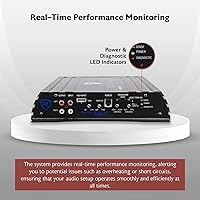
  • Protection: Onboard computerized IC control provides thermal, overload, and speaker short-circuit protection to safeguard components during heavy use.
  • Dimensions: The amplifier measures 15.5 x 11.5 x 3.5 inches, keeping its footprint manageable for trunk or under-seat mounting.
  • Weight: Unit weighs 3 pounds, making handling and positioning during installation straightforward.
  • Mounting Type: Designed for surface mounting, compatible with standard amplifier installation brackets and trays.
  • Warranty: Backed by a one-year manufacturer warranty covering defects in materials and workmanship.
  • Availability: First listed in January 2014 and currently still in production, giving it an unusually long active lifespan for a budget amplifier.

Related Reviews
Rockville dB15 Mono Car Amplifier
73%
83%
Value for Money
78%
Bass Output
86%
Ease of Installation
61%
Thermal Management
58%
Power Accuracy
More
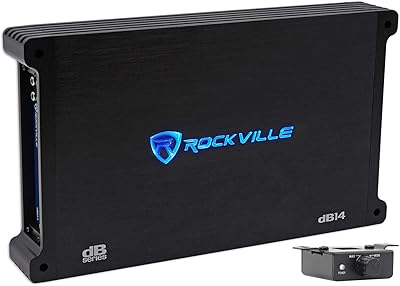
Rockville dB14 Mono Class-D Car Amplifier
74%
83%
Value for Money
78%
Power Accuracy
67%
Build Quality
54%
Long-Term Reliability
86%
Ease of Installation
More
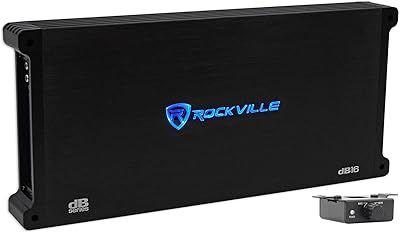
Rockville dB16 Mono Car Amplifier
73%
83%
Bass Output
78%
Value for Money
81%
Ease of Installation
59%
Thermal Management
62%
Power Accuracy
More
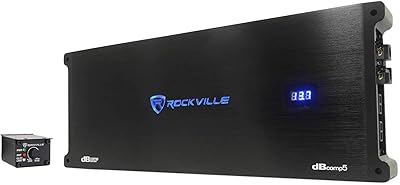
Rockville dBcomp5 Mono Car Amplifier
75%
88%
Verified Power Output
82%
Build Quality
91%
Onboard Tuning Flexibility
87%
1-Ohm Stability
79%
Remote Sub Control
More
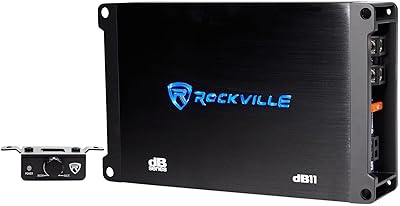
Rockville dB11 1400W Mono Car Amplifier
85%
93%
Bass Performance
70%
Ease of Installation
89%
Compact Design
91%
Sound Clarity
85%
Build Quality
More
Rockville dBcomp4 3000W Mono Car Amplifier
85%
94%
Power Output
91%
Bass Performance
87%
Ease of Installation
89%
Build Quality
67%
Thermal Management
More
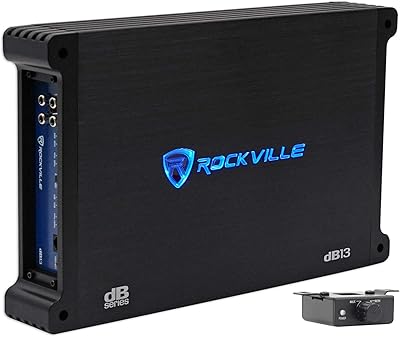
Rockville dB13 Mono Car Amplifier
75%
83%
Value for Money
54%
Power Output Accuracy
61%
Thermal Management
88%
Ease of Installation
79%
Onboard Sound Controls
More
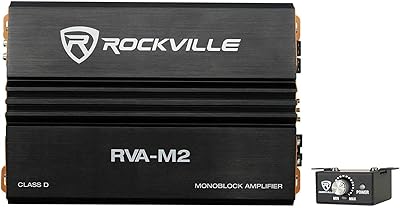
Rockville RVA-M2 Mono Car Amplifier
78%
83%
Value for Money
88%
Power Accuracy
71%
Build Quality
79%
Thermal Management
84%
Filter & Tuning Controls
More
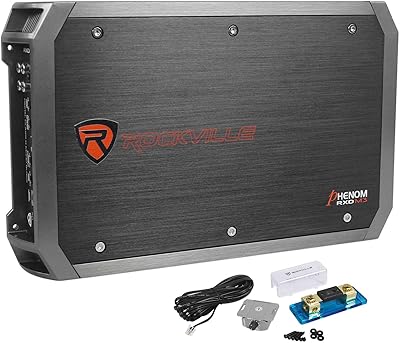
Rockville RXD-M3 Mono Car Amplifier
66%
83%
Value for Money
76%
Power Output
58%
Build Quality
52%
Long-Term Reliability
67%
Thermal Management
More
Rockville RXD-M0 Mono Car Amplifier
75%
88%
Value for Money
83%
Power Accuracy
91%
Ease of Installation
79%
Bass Performance
61%
Thermal Management
More

FAQ

The number that matters for day-to-day performance is 200W RMS at 4 ohm — that is the continuous, sustained power your subwoofer will actually receive. The 1200W peak figure refers to an instantaneous burst under ideal lab conditions and is not something you will experience in normal use. Always compare amplifiers by their RMS ratings, not peak claims.

Yes. The RVA600.1 includes a high-level speaker input, which lets you tap directly into your existing speaker wiring without needing RCA jacks on the head unit. It is one of the more beginner-friendly features on this mono amp and works well with most OEM stereos.

For a 200W RMS amplifier, a 25- to 30-amp inline fuse close to the battery is generally appropriate, and 8-gauge power and ground wire is a common and sufficient choice for runs under about 10 feet. If your power wire run is longer, stepping up to 4-gauge is worth considering to avoid voltage drop.

Rockville does not publish a 2-ohm rating for this model, and based on its design tier, running it at 2 ohms is not advisable. Stick to a 4-ohm load to stay within the amp's rated operating range and protect it from overheating or shutting down.

The included remote plugs into a dedicated jack on the amplifier chassis and runs a thin cable up to the dash or center console where you mount the knob. It controls subwoofer output level in real time, so you can dial back the bass at a red light or crank it up on the highway without touching the amp itself.

For a sealed box, the subsonic filter is largely unnecessary since sealed enclosures naturally roll off the lowest frequencies on their own. It becomes genuinely useful with ported or bandpass enclosures, where infrasonic frequencies can over-excite the woofer and cause mechanical damage over time.

It will work, but you will get less output than the rated 200W RMS since power delivery drops as impedance rises. If your subwoofer is rated at 8 ohms, you are leaving headroom on the table; a 4-ohm driver will get the most out of this amp.

At 200W RMS into a reasonably efficient subwoofer in a well-tuned enclosure, you will notice a clear, satisfying bass improvement over a head unit running full-range. It is not going to rattle license plates off neighboring cars, but for everyday listening in a standard sedan or SUV, the output is genuinely enjoyable.

This Rockville amplifier uses an internal computerized IC that monitors temperature and load conditions. If it detects excessive heat, an overload condition, or a shorted speaker output, it shuts itself down to prevent damage. The power or protection LED on the chassis usually indicates which fault triggered the shutdown.

Honestly, long-term reliability data is limited for any product in this price range, and the relatively modest review count makes it hard to draw firm conclusions about multi-year ownership. The one-year manufacturer warranty covers defects in materials and workmanship, but buyer experiences with warranty service appear mixed based on available feedback. Treating it as a capable short-to-mid-term solution — rather than a set-it-and-forget-it investment — sets realistic expectations.

Where to Buy