

Overview

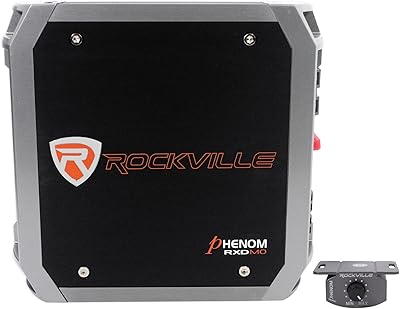
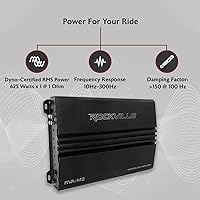
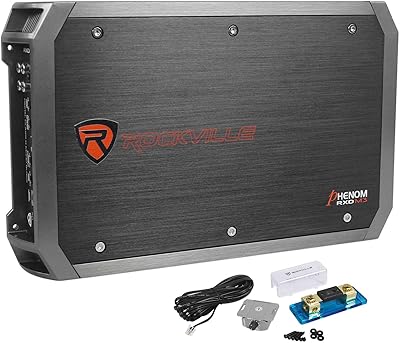
The Rockville RVA-M2 Mono Car Amplifier is a Class-D mono amp built specifically to drive a single subwoofer, and it earns its place in mid-range car audio builds by being upfront about what it actually delivers. That distinction matters: the advertised 625W RMS at 1 ohm is dyno-certified, not a wishful peak figure inflated for shelf appeal. At 13″ x 8.5″ x 2.24″, the unit is compact enough to tuck into a trunk corner or slide under a rear seat without major fabrication work. Available since mid-2020, it has collected enough real-world feedback to give buyers a reasonably honest picture of how it holds up over time.

Features & Benefits

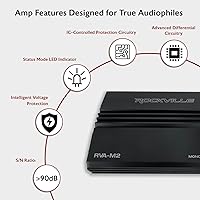
The Class-D design paired with a MOSFET power supply is rated at up to 83.7% efficiency — a manufacturer claim, though one that aligns with what Class-D topology typically delivers in practice. In real terms, that efficiency translates to less heat buildup and less strain on your vehicle's electrical system during long listening sessions. The adjustable low-pass filter sweeps from 32Hz to 300Hz, the subsonic filter handles 10Hz to 50Hz, and a 0–12dB bass equalizer gives you tuning control that many amps at this price skip entirely. Add an extruded aluminum heatsink for thermal management and IC-controlled protection circuitry against shorts and overvoltage, and you have a solid foundation for a dependable daily setup.

Best For

This mono amp makes the most sense for DIY car audio enthusiasts who want to add a single subwoofer without overthinking the install. The compact dimensions mean it can fit in spots where larger amps simply won't, and the straightforward filter controls won't intimidate someone doing their first subwoofer build. The included metal bass remote is genuinely useful for daily driving — adjusting bass on the fly without touching the head unit is a small convenience that adds up quickly. If your priority is verified power output at a reasonable price rather than a spec sheet loaded with impressive-sounding but unverified numbers, this Class-D subwoofer amp sits in a comfortable spot.

User Feedback

Across roughly 183 ratings, this mono amp holds a 4.3-star average, which is respectable for a mono amp in this segment. Buyers consistently mention that installation is straightforward and that power delivery feels honest — it hits about as hard as the certified RMS figure suggests. On the critical side, a handful of users have raised concerns about long-term reliability and customer support responsiveness when problems arise. A few also note that competing amps at similar price points offer comparable output. It's not a flawless record, but the majority of owners report satisfaction well past the initial setup period, which speaks reasonably well for the value here.

Pros

  • Dyno-certified 625W RMS rating is an honest power benchmark, not an inflated marketing figure.
  • Compact dimensions make installation viable in tight spaces where most mono amps will not fit.
  • Adjustable low-pass and subsonic filters give meaningful tuning flexibility at this price point.
  • The included metal bass remote is a practical daily-use addition that cheaper competitors often skip.
  • Class-D design keeps heat generation and battery draw lower than older amp topologies.
  • IC-controlled protection circuitry reduces the risk of damage from common electrical faults.
  • A 4.3-star average across over 180 ratings suggests consistent real-world satisfaction from actual buyers.
  • The 0–12dB bass equalizer is a useful onboard tuning tool that many similarly priced amps omit.
  • Straightforward controls make setup approachable for first-time car audio installers.

Cons

  • Some buyers have reported inconsistent customer support responses when warranty issues arise.
  • A small number of users question long-term reliability beyond the first year of use.
  • At 7 pounds and with moderate output, it may disappoint buyers expecting to push a large, high-demand subwoofer.
  • The 83.7% efficiency figure is a manufacturer claim and has not been independently verified by third parties.
  • Competing amps at a similar price point exist, meaning this mono amp is not the only credible option in its tier.
  • LED status indicators and remote are functional but feel basic compared to higher-end amp accessories.
  • The review pool, while positive, is still relatively modest in size for drawing firm long-term reliability conclusions.
  • No built-in crossover bypass or direct subwoofer-level input may require additional wiring steps for some head unit configurations.

Ratings

The Rockville RVA-M2 Mono Car Amplifier has been scored by our AI system after analyzing verified buyer reviews from global sources, with spam, bot-generated, and incentivized feedback actively filtered out. The scores below reflect a balanced picture of where this mono amp genuinely impresses and where real owners have run into friction. Both the strengths and the recurring pain points are represented transparently so you can make a confident buying decision.

Value for Money
83%
Most buyers feel they are getting honest, certified output without paying a premium price, and that sense of fair exchange comes through clearly in the feedback. For DIY installers on a mid-range budget, the combination of dyno-verified RMS power and onboard tuning controls at this price tier is difficult to replicate from competing brands.
A small segment of buyers who compared this amp side-by-side with alternatives at similar prices felt the gap in value was narrower than expected. If you push beyond basic subwoofer duty, the cost-per-feature ratio starts to feel less compelling.
Power Accuracy
88%
The dyno-certified 625W RMS claim holds up better than most buyers expect from a value-tier amp, and that credibility is one of the most frequently praised aspects in reviews. Owners consistently report that the bass output feels proportional to the rated figure, which builds confidence in the brand's transparency.
A handful of users noted that the 2500W peak figure prominently displayed on marketing materials can create initial confusion before they dig into the RMS spec. The gap between peak and sustained output is wide enough that buyers who do not research the distinction may feel misled at first glance.
Build Quality
71%
29%
The extruded aluminum chassis feels solid for the price, and the heatsink construction is noticeably more substantial than what you find on cheaper mono amps. The included metal bass remote also stands out as a better-quality accessory than the plastic units bundled with competing products.
Some owners have flagged that the overall finish and component tolerances feel functional rather than refined, with minor fit issues on terminal covers and knobs reported in a portion of reviews. It is a capable build for the price, but it does not feel overbuilt or particularly premium under close inspection.
Thermal Management
79%
21%
The radiation-cooling aluminum heatsink does its job well during typical listening sessions, and most users report that the amp stays within a comfortable operating temperature range under normal conditions. Thermal shutdowns are not a common complaint among buyers who installed the amp in open or semi-open spaces.
Users who mounted the amp in tight, enclosed spaces without airflow reported more frequent thermal protection triggers, particularly during long drives in hot weather. The passive cooling design works well when ventilation is adequate but has no active fan fallback for worst-case thermal scenarios.
Filter & Tuning Controls
84%
The combination of an adjustable low-pass filter, a subsonic filter, and an onboard bass equalizer gives users a tuning toolkit that most amps at this price point simply do not offer. Car audio newcomers find the controls intuitive enough to get a clean, well-shaped bass response without needing external processors.
Experienced installers have noted that the filter sweep ranges, while broad, lack the precision detents or fine-resolution adjustments found on higher-end amps. Getting the subsonic filter exactly right on a ported enclosure can require a bit more trial and error than a more granular control would allow.
Ease of Installation
91%
Installation feedback is among the most consistently positive aspects across the review pool, with buyers of all experience levels reporting straightforward wiring and a logical terminal layout. The compact dimensions make physical placement less of a puzzle than with bulkier amps, which first-time installers especially appreciate.
A small number of users noted that the included documentation is minimal and assumes some baseline familiarity with car audio wiring conventions. Complete beginners who have never run power wire from a battery may want to supplement with an online guide before starting.
Bass Remote Quality
76%
24%
The metal construction of the included bass remote is a meaningful upgrade over the flimsy plastic remotes that typically ship with budget amps, and daily drivers who adjust bass frequently find it genuinely useful. The remote connects reliably and responds smoothly during normal use.
The remote's cable length may not reach the ideal mounting position in all vehicle layouts, particularly in larger trucks or SUVs where the amp is mounted in a rear cargo area. A few users also noted the knob feel is adequate but not precise, making small incremental adjustments slightly difficult.
Long-Term Reliability
62%
38%
The majority of owners who have used this Class-D subwoofer amp for six months to a year report no significant failures, and the protection circuitry appears to do its job in preventing damage from common electrical events. For buyers running the amp within its rated load range, day-to-day reliability has generally been solid.
A recurring thread in critical reviews involves units failing or degrading in performance beyond the one-year mark, raising questions about component longevity under sustained use. The review pool is still relatively modest in size, so long-term durability data beyond two years is limited and not yet conclusive.
Customer Support
53%
47%
Some buyers have reported that Rockville's support team was responsive when contacted promptly after purchase, and warranty replacements have been processed in straightforward cases. For buyers who never need post-sale help, the support experience is a non-issue.
Inconsistency in customer service response times and warranty resolution outcomes is one of the most pointed criticisms in the review pool. Several buyers described delays or unhelpful interactions when dealing with defective units outside a narrow post-purchase window, which is a real risk factor to weigh.
Signal Clarity
74%
26%
At typical listening volumes, this mono amp produces clean bass output with minimal audible noise floor, which is a reasonable expectation for a Class-D design in this category. Buyers pairing it with a quality subwoofer and a decent head unit generally report satisfying, well-defined low-end reproduction.
A portion of users detected a faint noise or hum in specific vehicle electrical setups, which is often a grounding or RCA cable issue but still surfaces often enough to note. Critical listeners who have used higher-end amps may notice a slight reduction in bass articulation at maximum output levels.
Efficiency & Battery Draw
81%
19%
The Class-D design keeps current draw noticeably lower than older amplifier topologies, and several owners with modest factory alternators report no electrical strain during extended use. Running this amp on a stock 12V system without an upgraded alternator is a realistic proposition for most mid-range builds.
The 83.7% efficiency rating is a manufacturer claim and has not been independently benchmarked, so buyers should treat it as an approximation rather than a guaranteed spec. At high volume with a low-impedance load, some owners noted slightly elevated current draw compared to their initial expectations.
Compact Footprint
87%
The 13″ x 8.5″ x 2.24″ profile is genuinely compact for an amp rated at this output level, and owners consistently mention that it fits in spaces where other mono amps in the same power class simply do not. Under-seat and shallow trunk-wall installations that would be impossible with larger units become practical options.
While compact overall, the 7-pound weight means it still requires solid mounting to prevent vibration-induced movement over time. A few buyers also noted that the depth, though modest, was still enough to rule out certain flat under-seat mounting scenarios in lower-profile sedans.
Protection Circuitry
82%
18%
The IC-controlled protection system has drawn consistent praise for doing its job without nuisance tripping during normal listening sessions, which is a real differentiator from cheaper amps that either fail silently or trigger protection at the slightest fluctuation. Owners report confidence knowing the amp protects itself and downstream components automatically.
In a small number of cases, buyers reported that the protection circuit triggered and the amp would not reset without a full power cycle, which in a vehicle context means pulling over and disconnecting the battery. This is a minor inconvenience rather than a design flaw, but it is worth knowing upfront.

Suitable for:

The Rockville RVA-M2 Mono Car Amplifier is a practical pick for DIY installers who want to add a single subwoofer to their car without overcomplicating the build or overspending. If you are working with a compact trunk space or a tight under-seat installation, the amplifier's relatively small footprint gives you real flexibility that larger amps simply do not. Buyers who care about honest power figures will appreciate that the 625W RMS rating is dyno-certified rather than a peak number cooked up for marketing purposes. The onboard filter controls are approachable enough for first-time builders, yet detailed enough that more experienced hobbyists can dial in a clean, controlled low end. The included metal bass remote is a genuine convenience for daily drivers who want quick bass adjustments without rerouting through their head unit.

Not suitable for:

The Rockville RVA-M2 Mono Car Amplifier is not the right tool for anyone chasing high-output competition builds or trying to push multiple subwoofers hard. At 625W RMS, the headroom runs out quickly if you are pairing it with a large, power-hungry woofer rated well above that threshold. Buyers who prioritize long-term brand support should be aware that some users have flagged inconsistent customer service experiences, which is a real consideration if something goes wrong after the warranty window. This amp is also not aimed at critical listening enthusiasts who demand audiophile-grade signal purity — it is built around value and practicality, not ultra-low distortion figures. If you are upgrading from an already capable amp in a mature system, the output and feature set here may feel like a lateral move rather than an improvement.

Specifications

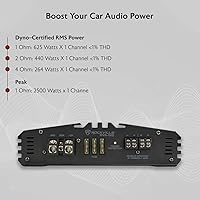
  • Output Power: Delivers 625W RMS at 1 ohm, a dyno-certified figure that reflects real sustained output rather than a theoretical peak.
  • Peak Power: Rated at 2500W peak, though buyers should focus on the RMS figure as the practical measure of daily performance.
  • Amplifier Class: Class-D topology is used for efficient power conversion, which reduces wasted energy compared to older Class-A or Class-AB designs.
  • Power Supply: MOSFET-based power supply contributes to stable voltage regulation and consistent output under varying electrical loads.
  • Efficiency: Manufacturer-rated efficiency is up to 83.7%, which is in line with typical Class-D performance and helps minimize heat generation.
  • Channels: Single-channel mono configuration makes this amp purpose-built for driving one subwoofer rather than full-range speakers.
  • Low-Pass Filter: Adjustable low-pass filter sweeps from 32Hz to 300Hz, allowing users to isolate the bass frequencies sent to the subwoofer.
  • Subsonic Filter: Subsonic filter is adjustable from 10Hz to 50Hz, blocking inaudible low frequencies that can stress a subwoofer without adding perceived bass.
  • Bass Equalizer: Onboard bass equalizer offers 0 to 12dB of boost, providing additional low-end shaping beyond what the crossover filters alone can achieve.
  • Heatsink: Extruded aluminum heatsink with radiation cooling is built into the chassis to manage thermal load during extended use.
  • Protection: IC-controlled protection circuitry monitors for overvoltage, overheating, and short circuits, shutting down the amp before damage occurs.
  • Dimensions: The amp measures 13″ x 8.5″ x 2.24″, a compact footprint that suits trunk corners or under-seat installations.
  • Item Weight: The unit weighs 7 pounds, making handling and mounting manageable for a single installer without additional help.
  • Operating Voltage: Designed to operate within a 9V to 16V range, which covers standard 12V automotive electrical systems including those with slight voltage fluctuation.
  • Material: The chassis is constructed from aluminum, which serves both as a structural housing and a passive heat-dissipation surface.
  • Certifications: FCC certification indicates the amp has passed federal electromagnetic compatibility requirements for use in the United States.
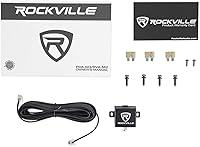
  • Included Accessories: Package includes a metal bass remote control and LED status indicators for monitoring amp state during operation.
  • Package Dimensions: The shipping box measures 17.48 x 10.75 x 4.09 inches, with standard cardboard packaging for transit protection.
  • Model Number: Official model designation is RVA-M2, manufactured by Rockville and first made available in July 2020.

Related Reviews
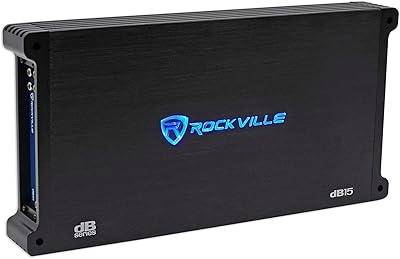
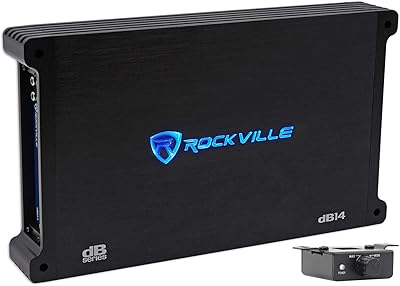
Rockville dB14 Mono Class-D Car Amplifier
74%
83%
Value for Money
78%
Power Accuracy
67%
Build Quality
54%
Long-Term Reliability
86%
Ease of Installation
More
Rockville dB15 Mono Car Amplifier
73%
83%
Value for Money
78%
Bass Output
86%
Ease of Installation
61%
Thermal Management
58%
Power Accuracy
More
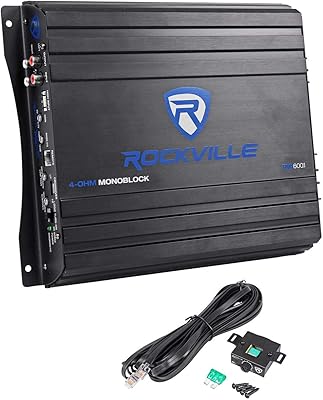
Rockville RVA600.1 Mono Car Amplifier
74%
83%
Value for Money
74%
Sound Quality
88%
Ease of Installation
52%
Power Accuracy
67%
Build Quality
More
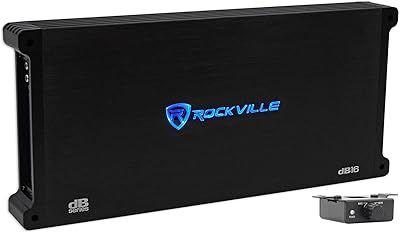
Rockville dB16 Mono Car Amplifier
73%
83%
Bass Output
78%
Value for Money
81%
Ease of Installation
59%
Thermal Management
62%
Power Accuracy
More
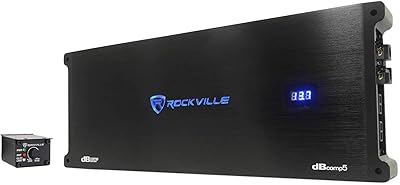
Rockville dBcomp5 Mono Car Amplifier
75%
88%
Verified Power Output
82%
Build Quality
91%
Onboard Tuning Flexibility
87%
1-Ohm Stability
79%
Remote Sub Control
More
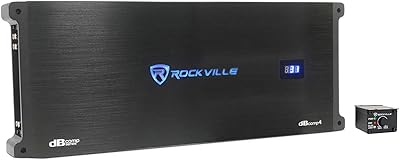
Rockville dBcomp4 3000W Mono Car Amplifier
85%
94%
Power Output
91%
Bass Performance
87%
Ease of Installation
89%
Build Quality
67%
Thermal Management
More
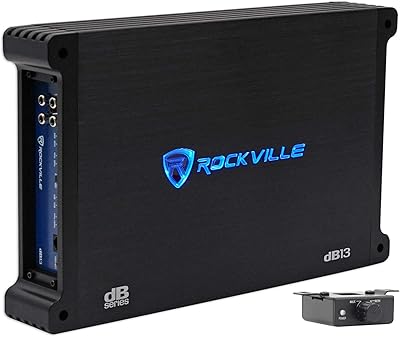
Rockville dB13 Mono Car Amplifier
75%
83%
Value for Money
54%
Power Output Accuracy
61%
Thermal Management
88%
Ease of Installation
79%
Onboard Sound Controls
More
Rockville dB11 1400W Mono Car Amplifier
85%
93%
Bass Performance
70%
Ease of Installation
89%
Compact Design
91%
Sound Clarity
85%
Build Quality
More
Rockville RXD-M1 2000W Mono Car Amplifier
86%
88%
Sound Quality
91%
Power Output
85%
Ease of Installation
87%
Durability & Build Quality
89%
User Control & Adjustments
More
Rockville RXD-M0 Mono Car Amplifier
75%
88%
Value for Money
83%
Power Accuracy
91%
Ease of Installation
79%
Bass Performance
61%
Thermal Management
More

FAQ

This mono amp is rated at 625W RMS at 1 ohm, so you will get maximum output with a 1-ohm load. It will also work at 2 ohms or 4 ohms, but output will be lower at those impedances. Match your subwoofer's wiring configuration to your power needs before buying.

Not really, and that is true of nearly every amp on the market. Peak power is a momentary theoretical ceiling that rarely reflects everyday listening. The number worth paying attention to is the 625W RMS, which is dyno-certified and represents what the amp can sustain continuously.

Yes, the compact dimensions make under-seat installation realistic in many vehicles, especially trucks and SUVs with raised rear bench seats. Just make sure there is adequate airflow around the heatsink, since restricted ventilation is one of the more common causes of thermal shutdown.

Basic car audio wiring skills are enough to get this running. You will need a power wire from the battery, a ground connection, a remote turn-on wire, RCA cables from your head unit, and speaker wire to the subwoofer. There are no unusual or proprietary connections involved.

Start by setting the low-pass filter around 80Hz to 100Hz as a baseline, which cuts off higher frequencies before they reach the subwoofer. From there, adjust by ear while playing music with consistent bass content. The subsonic filter is best set around 25Hz to 35Hz for a ported enclosure, or slightly higher for a sealed box.

For an amp in this power range, 4-gauge power and ground wiring is the standard recommendation. Using undersized wire can restrict current delivery and cause voltage drop, which hurts both performance and reliability over time.

Yes, the included metal bass remote connects directly to the amp itself rather than to the head unit, so it is compatible regardless of what source unit you are running. It simply adjusts the amp's onboard bass level control remotely.

Rockville typically covers their amplifiers with a one-year warranty, but it is worth confirming directly with the seller at the time of purchase since terms can vary by retailer. Some users have noted that warranty service experiences have been inconsistent, so keep your purchase documentation handy.

This Class-D subwoofer amp has one output channel, so driving two separate subwoofers independently is not an option. You can wire two subwoofers together in parallel to reach a 1-ohm load and connect them as a single combined load, but that requires both subs to be compatible with that wiring configuration.

Like most Class-D amps, the Rockville RVA-M2 runs warm but not excessively hot under normal listening conditions. The aluminum heatsink handles thermal management passively. If you are playing loud bass-heavy music for extended periods in a hot environment, make sure the amp has breathing room and is not enclosed in a sealed box or covered by carpet.