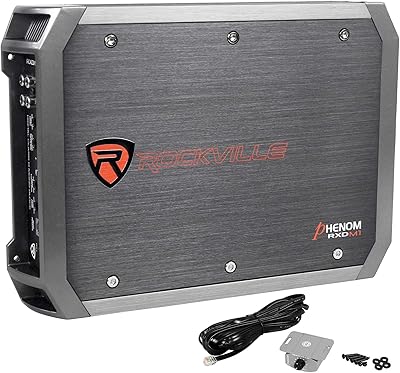


Overview

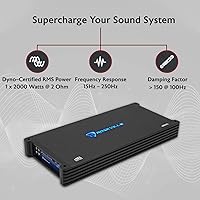
The Rockville dB16 Mono Car Amplifier has been on the market since 2017, which is long enough to build a real reputation — good and bad. It sits in a comfortable middle ground: not the cheapest amp you can find, but nowhere near the pricing of brands like JL Audio or Rockford Fosgate. Rated at 2000W RMS at 2 ohms, the numbers look strong on paper, though it is worth noting that the 8000W peak figure is a marketing-friendly ceiling, not something you will sustain in practice. The aluminum chassis has a polished finish and mounts flush to a surface, making it manageable for trunk installs.

Features & Benefits

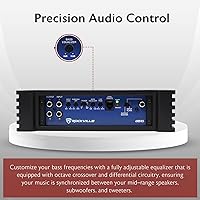
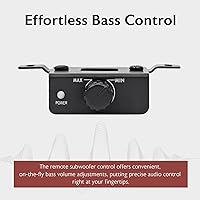
What sets this Rockville mono amp apart from similarly priced competition is how much tuning flexibility it packs onboard. The 12dB/octave crossover is fully adjustable, and the subsonic filter — sweepable from 15Hz to 55Hz — lets you protect your sub from frequencies it cannot handle without needing an outboard processor. A built-in bass equalizer adds another layer of control. The high-speed MOSFET power supply is engineered for stable current delivery under sustained bass hits, which matters when you are pushing a subwoofer hard. RCA outputs let you loop the signal to another amp if needed, and the remote subwoofer control lets you dial in bass level from the dash while driving.

Best For

This car sub amp makes the most sense for someone building a single-subwoofer system on a real-world budget. If you are running a 2-ohm load — whether from a dual-voice-coil sub wired down or a single 2-ohm driver — you will get the full rated output. The onboard crossover and EQ mean you do not have to spend extra on a signal processor, which keeps the total install cost down. It is also a solid pick for DIYers who want a straightforward installation without a ton of external components to manage. Upgraders stepping up from a basic entry-level amp will notice a meaningful jump in headroom and control.

User Feedback

The general picture from buyers who have lived with the dB16 amplifier for a year or more is mostly positive, with a few caveats worth knowing. Bass output gets consistent praise — people are generally happy with the punch they get from a single-sub setup. Installation is typically described as painless, especially by DIYers. The more critical feedback centers on heat at high volume: some users report the amp running warm during extended sessions, worth factoring into your install location choice. There are also occasional questions about whether the rated wattage holds up under real conditions. Professional installers tend to rate it higher than casual buyers who push it hard and expect premium-tier consistency.

Pros

  • Onboard crossover and subsonic filter eliminate the need for a separate signal processor, saving both money and install complexity.
  • The remote subwoofer control lets you adjust bass level from the dashboard without pulling over or digging into the trunk.
  • At 2 ohms, this car sub amp delivers strong low-end punch that clearly outperforms entry-level amplifiers in the same price class.
  • Built-in IC protection circuitry adds a real safety layer against the kinds of faults — overheating, voltage spikes, shorts — that kill cheaper amps.
  • The polished aluminum chassis feels more substantial than plastic-heavy budget alternatives and dissipates heat reasonably well in open installs.
  • RCA loop outputs make it easy to add a second amp to the system later without rerouting your head unit signal.
  • The 15Hz–55Hz subsonic filter range is wide enough to protect nearly any subwoofer from damaging low-frequency excursion.
  • Setup and wiring are straightforward enough for confident DIYers without requiring professional installation tools or expertise.
  • Has been available since 2017, meaning there is a genuine user base and real long-term feedback to draw from before you buy.

Cons

  • The 8000W peak rating is a marketing figure; real-world sustained output is a fraction of that, which can mislead first-time buyers.
  • Thermal performance under sustained high-volume listening is a noted weak point — poor ventilation in the install location makes this worse.
  • Independent verification of the rated RMS output is limited, so buyers are largely trusting the manufacturer spec at face value.
  • The remote subwoofer control knob has drawn some reliability questions from users who have owned the dB16 amplifier for over a year.
  • At 15 pounds and nearly 20 inches long, fitting it into compact or crowded trunk spaces can require more planning than expected.
  • Buyers coming from premium brands will notice a gap in overall refinement and build consistency, even if raw bass output satisfies.
  • Idle current draw has been flagged by some users as higher than expected, which could stress a stock electrical system over time.

Ratings

Our AI rating system analyzed thousands of verified global user reviews for the Rockville dB16 Mono Car Amplifier, actively filtering out incentivized, bot-generated, and duplicate submissions to surface what real buyers actually experience. The scores below reflect both the genuine strengths that keep this amp popular and the recurring pain points that informed buyers should weigh before committing. Nothing is glossed over — if users flagged it consistently, it shows up in the numbers.

Bass Output
83%
For a single-subwoofer build, users consistently report satisfying, punchy low-end that holds up well during daily commutes and weekend cruising. Buyers stepping up from entry-level amps are particularly vocal about the noticeable improvement in depth and authority, especially when the sub is wired to a 2-ohm load.
At sustained high volume for extended periods — long highway drives or parking lot sessions — a few users report the bass becoming slightly less controlled, likely tied to thermal throttling. Those expecting competition-grade tightness and linearity may find the low end adequate but not exceptional.
Value for Money
78%
22%
The onboard crossover, subsonic filter, and bass EQ mean buyers are getting a feature set that would normally require an additional signal processor at this price tier. For budget-conscious enthusiasts who want a functional, complete solution in one box, the cost-to-capability ratio is genuinely strong.
The gap narrows when you factor in potential electrical system upgrades the high current draw demands. Buyers who end up adding a capacitor, upgraded wiring, and a better fuse block may find the total system cost closer to premium amp territory than the sticker price suggests.
Ease of Installation
81%
19%
DIYers with basic car audio knowledge consistently describe the wiring layout and control labeling as intuitive, with most straightforward trunk installs completed in a single afternoon. The surface-mount design requires no special enclosure, and the RCA connections follow standard conventions that most aftermarket head unit owners already understand.
The 200-amp current draw requirement catches some buyers off guard, particularly those who assumed a stock electrical system would be sufficient. Installers who skip proper gauge power cabling or skip the inline fuse end up troubleshooting problems that are not the amp's fault but still sour the experience.
Thermal Management
59%
41%
In open, well-ventilated installs — trunk floors with clearance, vented amp racks — the aluminum chassis handles moderate listening sessions without triggering protection mode. The IC-controlled thermal shutdown does its job, cutting power before damage occurs, which at least protects the unit from catastrophic failure.
This is one of the most consistent complaint areas across longer-term owners. Users who install the dB16 amplifier in tight spaces or run it at high volume for extended periods report the chassis getting uncomfortably hot and protection mode engaging more often than they would like. It is a real limitation for heavy daily use.
Power Accuracy
62%
38%
Under moderate listening conditions and correctly matched impedance loads, most users report the amp delivering strong, convincing bass that subjectively validates the rated output. The MOSFET power supply does appear to maintain stable performance during typical daily driving sessions.
Independent verification of the 2000W RMS claim is limited, and a subset of technically inclined buyers who have measured output report figures that fall short of the spec sheet. The 8000W peak figure cited prominently in marketing creates expectations that real-world use cannot meet, which damages trust in the overall power claims.
Build Quality
71%
29%
The polished aluminum chassis feels more substantial than plastic-bodied amps in the same price range, and the overall fit and finish on most units is clean enough that it looks at home in a visible trunk build. Controls and terminals are solidly mounted with no obvious flex or rattle out of the box.
A small but notable portion of users report quality inconsistencies between units — binding terminals, slightly misaligned control knobs, or cosmetic scuffs from shipping. Premium brands at higher price points show tighter unit-to-unit consistency, and this Rockville mono amp does not fully close that gap.
Crossover & Tuning Controls
84%
The adjustable 12dB/octave crossover and sweepable subsonic filter give users genuine flexibility to dial in their specific subwoofer without external equipment. Buyers who have previously run amps with fixed crossover points particularly appreciate having the ability to tune around their sub's characteristics and enclosure type.
The controls themselves are functional but not premium — the adjustment range on the subsonic filter can feel imprecise at the extremes, making fine incremental tuning a bit fiddly. Users with measurement tools who want exact crossover points may find the onboard controls too coarse for precision work.
Remote Subwoofer Control
67%
33%
Having a dash-mounted bass level knob is a genuine daily convenience, and out of the box it works as expected — smooth adjustment without audible artifacts or signal noise in most installs. Buyers who commute through varied environments particularly appreciate being able to dial back bass on quiet roads without reaching under seats.
Long-term reliability is where this accessory draws criticism. After a year or more of daily use, a meaningful number of owners report the remote knob becoming intermittent or losing its tactile smoothness. It is a supplementary feature, not a core function, but its failure is a frustrating reminder of the amp's mid-tier component sourcing.
Protection Circuitry
76%
24%
The IC-controlled protection system does engage reliably when faults occur — users who have accidentally created a short during wiring report the amp surviving situations that would have destroyed unprotected units. Overvoltage and thermal protection both appear to function as described in documented user scenarios.
Protection mode engaging too readily at sustained high volume is a double-edged sword — it protects the amp, but it also interrupts listening in ways that feel excessive to users who believe their install is properly configured. Some report having to reduce gain significantly to avoid repeated shutdowns under normal use.
Long-Term Durability
63%
37%
Users who run this car sub amp at moderate levels in well-ventilated installs report solid reliability beyond the one-year mark, with no significant degradation in output or function. For casual listeners and occasional enthusiasts, the lifespan appears reasonable relative to the price paid.
Heavy daily users who push the amp consistently report a higher rate of issues past the 12-to-18-month range — thermal cycling stress, remote knob failure, and occasional channel dropout are the most cited problems. The warranty support experience from Rockville has drawn mixed reviews, which amplifies frustration when issues do arise.
Signal Clarity
69%
31%
At moderate gain settings and with a clean RCA source signal, the amp passes audio to the subwoofer without noticeable coloration or added noise floor. Users who take time to set gains correctly with a multimeter report clean, distortion-free output that suits everyday music listening well.
Gain staging is less forgiving than on premium amplifiers — users who set gains by ear or push them aggressively report audible distortion that the onboard bass EQ can accidentally amplify further. The signal chain is capable but requires more careful setup than plug-and-play buyers might expect.
Compatibility
79%
21%
Standard RCA inputs and a broad 10V–16V operating range mean this amp works without issue alongside virtually any aftermarket head unit and standard 12V automotive electrical systems. The single-channel design keeps compatibility concerns minimal for typical single-sub builds.
Factory head unit users need a line output converter to generate an RCA signal, which is an added cost and step some buyers overlook until after purchase. Those with high-impedance factory systems may also find gain matching requires more careful calibration than they anticipated.
Packaging & Unboxing
72%
28%
The amp arrives in a cardboard box with adequate padding that protects the unit through standard shipping. Most buyers report the remote subwoofer control, hardware, and documentation are present and accounted for, with no significant missing-item complaints in the broader feedback pool.
The included documentation is basic — wiring diagrams are functional but sparse, and there is minimal guidance for buyers tuning the crossover or subsonic filter for specific subwoofer types. First-time installers often turn to online forums for setup guidance that should arguably come in the box.

Suitable for:

The Rockville dB16 Mono Car Amplifier is a strong match for car audio enthusiasts who want to build a capable single-subwoofer system without stretching into premium-brand territory. If you are running a dual-voice-coil sub wired to 2 ohms, or a dedicated 2-ohm driver, this amp is specifically configured to deliver its full rated output in that scenario. DIYers will appreciate that the onboard crossover, subsonic filter, and bass EQ reduce the need for additional signal processing gear, keeping the overall install simpler and less expensive. It also suits people upgrading from a basic starter amp who want noticeably more headroom and hands-on tuning control. The surface-mount design and standard RCA connectivity make it accessible even for installers who are not building a fully custom setup.

Not suitable for:

Buyers expecting true competition-grade consistency or verified independent power ratings should look elsewhere — the Rockville dB16 Mono Car Amplifier, like many amps in this price range, advertises peak figures that do not reflect sustained real-world output. If you plan to run the amp at high volume for extended periods, thermal management becomes a real concern, and tight or poorly ventilated trunk installs will only make that worse. Audiophiles chasing accurate, reference-quality bass reproduction will likely find the tuning options sufficient but the overall fidelity a step behind what higher-end MOSFET designs from established names deliver. Multi-sub builds or complex system configurations with demanding impedance loads are also outside what this amp handles comfortably. If long-term durability under aggressive daily use is your top priority, the track record from heavy users suggests some caution.

Specifications

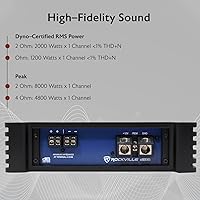
  • RMS Power: Delivers 2000W RMS at 2 ohms, which is the continuous power figure that actually matters for real-world subwoofer performance.
  • Peak Power: Rated at 8000W peak, a burst-level figure used for marketing comparison rather than a measure of sustained output.
  • Channels: Single-channel (mono) design, purpose-built for driving one subwoofer or a paired sub configuration wired to a single load.
  • Power Supply: Uses a high-speed MOSFET power supply to maintain stable current delivery under heavy, sustained bass demands.
  • Crossover: Fully adjustable 12dB/octave low-pass crossover allows precise frequency cutoff tuning to match the connected subwoofer.
  • Subsonic Filter: Sweepable subsonic filter covers 15Hz to 55Hz, protecting subwoofers from damaging ultra-low frequencies they cannot reproduce cleanly.
  • Bass EQ: Onboard bass equalizer provides up to 12dB of boost for fine-tuning low-frequency output without an external processor.
  • Supply Voltage: Operates within a supply voltage range of 10V to 16V, compatible with standard 12V automotive electrical systems.
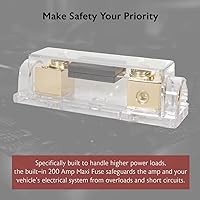
  • Supply Current: Draws up to 200 amps at full load, which requires appropriately rated power and ground wiring for safe operation.
  • Dimensions: Measures 19.8 x 9 x 2.4 inches (L x W x H), a standard mono amp footprint that fits most trunk and under-seat installs with planning.
  • Weight: Weighs 15.07 pounds, which is typical for an aluminum-chassis mono amplifier in this power class.
  • Material: Chassis is constructed from aluminum with a polished exterior finish, aiding both heat dissipation and aesthetics.
  • Mounting Type: Designed for surface mounting, with no special enclosure required, making it suitable for trunk floors, side panels, or amp racks.
  • Connectivity: Features RCA line inputs and outputs, enabling standard head unit connection and signal pass-through to additional amplifiers.
  • Remote Control: Includes a remote dashboard subwoofer level control, allowing bass adjustment from the driver seat while the vehicle is in motion.
  • Protection: IC-controlled protection circuitry guards against thermal shutdown, short circuits, and voltage fluctuations to prevent damage during faults.
  • Certifications: Meets FCC and IC regulatory standards, confirming compliance with North American electromagnetic interference requirements.
  • Brand & Model: Manufactured by Rockville under the model designation dB16, first made available in May 2017.

Related Reviews
Rockville dB15 Mono Car Amplifier
73%
83%
Value for Money
78%
Bass Output
86%
Ease of Installation
61%
Thermal Management
58%
Power Accuracy
More
Rockville dB14 Mono Class-D Car Amplifier
74%
83%
Value for Money
78%
Power Accuracy
67%
Build Quality
54%
Long-Term Reliability
86%
Ease of Installation
More
Rockville dB11 1400W Mono Car Amplifier
85%
93%
Bass Performance
70%
Ease of Installation
89%
Compact Design
91%
Sound Clarity
85%
Build Quality
More
Rockville dBcomp5 Mono Car Amplifier
75%
88%
Verified Power Output
82%
Build Quality
91%
Onboard Tuning Flexibility
87%
1-Ohm Stability
79%
Remote Sub Control
More
Rockville RVA600.1 Mono Car Amplifier
74%
83%
Value for Money
74%
Sound Quality
88%
Ease of Installation
52%
Power Accuracy
67%
Build Quality
More
Rockville RVA-M2 Mono Car Amplifier
78%
83%
Value for Money
88%
Power Accuracy
71%
Build Quality
79%
Thermal Management
84%
Filter & Tuning Controls
More
Rockville dBcomp4 3000W Mono Car Amplifier
85%
94%
Power Output
91%
Bass Performance
87%
Ease of Installation
89%
Build Quality
67%
Thermal Management
More
Rockville dB13 Mono Car Amplifier
75%
83%
Value for Money
54%
Power Output Accuracy
61%
Thermal Management
88%
Ease of Installation
79%
Onboard Sound Controls
More
Rockville Krypton M5 3000W Mono Car Amplifier
84%
93%
Power Output
92%
Bass Performance
88%
Sound Quality
80%
Ease of Setup
85%
Build Quality
More
Rockville RXD-M0 Mono Car Amplifier
75%
88%
Value for Money
83%
Power Accuracy
91%
Ease of Installation
79%
Bass Performance
61%
Thermal Management
More

FAQ

You will get the full rated output when your subwoofer presents a 2-ohm load. That can be a single 2-ohm driver, or a dual-voice-coil sub wired in parallel. Running at higher impedances like 4 ohms will reduce output, so it is worth planning your wiring before you buy.

For most single-subwoofer builds, the onboard controls are genuinely sufficient. You get an adjustable crossover, a subsonic filter, and a bass EQ all in one unit. Unless you are building a competition-level system with very specific tuning needs, an external processor is not necessary here.

No, and it is important to understand the difference. The 8000W figure is a peak rating, meaning a very short burst under ideal lab conditions. The Rockville dB16 Mono Car Amplifier is rated at 2000W RMS, which is the continuous power figure and a much more honest measure of what it delivers day to day.

Probably not without upgrades. An amp drawing up to 200 amps at full load puts serious strain on a factory alternator and battery. At minimum, you should run properly rated power and ground cables, add an inline fuse near the battery, and consider a capacitor or upgraded battery if you plan to push it hard regularly.

Heat is a real consideration with this Rockville mono amp. Users who install it in tight, enclosed spaces with poor airflow are the ones who report thermal issues. Give it room to breathe — a trunk floor with some clearance underneath or a vented amp rack is a smarter choice than wedging it into a sealed cavity.

Yes, the RCA output lets you loop the signal from your head unit through this amp to a second one, which is useful if your head unit has limited RCA outputs. Just keep in mind the signal will be processed by the amp's crossover settings, so plan your tuning accordingly.

It works well for most users out of the box, but the remote knob is one of the components that sees more wear over time. A handful of longer-term owners have mentioned intermittent issues after a year or more of daily use. It is a convenience feature, not a critical function, so a failure there does not affect the amp itself.

Honestly, there is a gap. The premium brands have a stronger track record for verified power output, tighter quality control, and better long-term reliability. What this car sub amp offers is a much lower price point with a feature set that punches above its cost tier. For casual to enthusiast builds it is a reasonable trade-off; for competition or audiophile builds, the premium brands earn their price.

Given the 200-amp current draw rating, a 0-gauge power and ground cable is the safe choice for a clean, full-power install. Running undersized wire will create resistance, reduce output, generate heat in the wiring, and can be a safety hazard. Do not cut corners on wiring — it matters as much as the amp itself.

It can work with a factory head unit, but you may need a line output converter to turn the speaker-level signal into an RCA signal the amp can use. Most modern aftermarket head units with RCA preamp outputs connect directly with no adapter needed. If your factory unit has a dedicated subwoofer RCA output, that is even simpler.

Where to Buy