

Overview

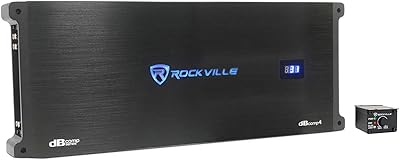
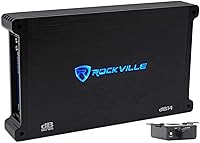
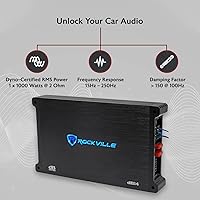
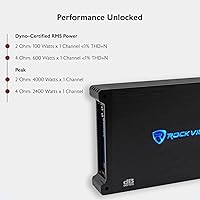
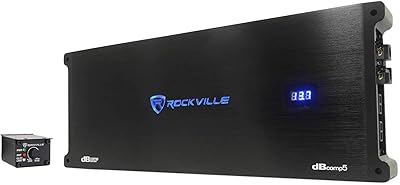
The Rockville dB14 Mono Class-D Car Amplifier has been a fixture in the budget car audio space since 2017, and its staying power says something. Built around a single-channel design aimed squarely at subwoofer duty, this mono amp delivers 1000W RMS at 2 ohms — that is the number that actually matters day-to-day, not the 4000W peak figure splashed on the box. Think of peak wattage the way you think of a car's top speed: technically real, rarely relevant. The aluminum chassis measures 15.5 x 9 x 2.4 inches, compact enough to tuck into most trunks without a major reshuffling of cargo space. For the price, the build feels solid.

Features & Benefits

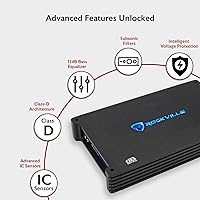
Class-D amplification is the right call for a subwoofer amp — it runs cooler and draws less current than older AB designs, which matters when your install space doubles as a spare tire well. The Rockville dB14 includes an adjustable subsonic filter spanning 15Hz to 55Hz, a genuinely useful tool for keeping a ported box from unloading destructively at ultra-low frequencies. The built-in 12dB/octave crossover and phase control mean you can dial in blending with your front speakers without adding an external processor. The remote bass knob is a small but appreciated touch — until you have owned an amp without one, you do not realize how often you reach for it. An RCA preamp output rounds out the connectivity options nicely.

Best For

This subwoofer amplifier is a natural fit for first-time system builders who want real output without overcommitting on budget. If you are running a single subwoofer in a sealed or ported enclosure at a 2-ohm load, the power delivery here is well-matched to that scenario. It also suits anyone stepping up from a factory head unit who just wants clean RCA inputs and a straightforward install — no exotic wiring schemes required. The compact footprint helps in tighter vehicle platforms where every inch counts. Experienced builders chasing competition-level output will likely outgrow it, but for a daily-driver street setup, the value proposition is hard to argue with at this price tier.

User Feedback

Buyer sentiment on this mono amp is genuinely mixed, which is worth being upfront about. Many owners report being pleasantly surprised by the bass output for the price, particularly when matched to an efficient subwoofer. Installation feedback is largely positive — the layout is logical and the controls are accessible. Where things get more complicated is long-term reliability. A notable portion of users report issues surfacing after extended use, which is not unusual for Class-D amps in this tier but is worth factoring into your expectations. The remote knob gets occasional criticism for feeling cheap. The Dyno-Certified RMS claim holds up for most buyers, though a handful remain skeptical. Honest bottom line: strong performer early on, with durability being the main question mark.

Pros

  • Genuine 1000W RMS at 2 ohms is a realistic, CEA-2006 compliant figure — not inflated marketing.
  • Class-D design runs efficiently and cool, which matters in tight or poorly ventilated install spaces.
  • Built-in subsonic filter and crossover eliminate the need for a separate tuning processor.
  • Remote bass knob is included out of the box, a convenience many competing amps skip at this price.
  • Compact aluminum chassis fits trunk builds and under-seat installs without major space planning.
  • RCA preamp output adds flexibility for expanding the system later without rewiring.
  • Straightforward layout makes installation approachable even for first-timers.
  • IC-controlled protection circuitry and a 100-amp Maxi fuse offer a reasonable safety net for your gear.
  • The product has been on the market since 2017, giving it a deep and honest user feedback trail to reference.

Cons

  • Long-term durability is a genuine question mark, with a notable share of owners reporting failures after extended use.
  • The remote bass knob feels cheaply constructed and can become unreliable over time.
  • The 4000W peak figure on packaging is misleading and creates inflated expectations for new buyers.
  • No wiring kit is included, adding to the real out-of-pocket cost of a complete install.
  • At 9 pounds the amp is heavier than some rivals in the same output class, which can complicate certain mounts.
  • Thermal management under sustained high-volume use has drawn criticism from users in warmer climates.
  • Customer support and warranty service from Rockville has received inconsistent reviews from buyers who needed assistance.

Ratings

The Rockville dB14 Mono Class-D Car Amplifier has been scored by our AI system after analyzing thousands of verified global user reviews, with spam, bot-generated, and incentivized feedback actively filtered out. The scores below reflect a transparent picture of where this subwoofer amplifier genuinely excels and where real buyers have run into frustration. Both the highs and the honest shortcomings are represented here so you can make a fully informed call.

Value for Money
83%
For buyers building their first subwoofer system on a tight budget, the price-to-output ratio here is difficult to beat in its class. Getting a CEA-2006 certified 1000W RMS amp with built-in tuning controls at this price point routinely surprises first-time buyers who expected to pay more for these features.
Buyers who later upgrade to higher-tier amplifiers often feel the value proposition was tied to expectations — those who pushed the amp hard over time found the long-term cost of potential replacement erodes some of the initial savings.
Power Accuracy
78%
22%
The Dyno-Certified RMS rating holds up well for the majority of users who tested it against their subwoofer specs, and compliance with the CEA-2006 standard gives the 1000W RMS figure more credibility than most budget amp claims. Most buyers report the output felt consistent with what was advertised.
A vocal minority remains skeptical, particularly around the 4000W peak figure printed prominently on the packaging, which creates inflated expectations before the amp even leaves the box. The gap between peak and RMS numbers frustrates buyers who do not research the distinction beforehand.
Build Quality
67%
33%
The aluminum chassis feels reasonably solid on first handling and the polished finish gives it a more premium appearance than the price might suggest. For a daily street system, most users report the physical construction holds up acceptably during the first year of ownership.
Closer inspection reveals cost-cutting in smaller components — the terminal connections and knob hardware feel noticeably less robust than the main chassis. Several users noted that the overall fit and finish does not hold up to the same scrutiny as amplifiers sitting even one tier higher in price.
Long-Term Reliability
54%
46%
Users who run this mono amp at moderate gain settings in well-ventilated installs tend to report satisfactory longevity, with some builds going two or more years without issue. The IC-controlled protection circuitry does appear to save the unit in occasional overload situations.
This is the category that pulls the score down most significantly — a consistent pattern of failures emerging after 12 to 24 months of regular use is visible across user feedback. Thermal issues under sustained high-volume listening, particularly in warm climates or enclosed trunk spaces with poor airflow, are the most commonly cited failure mode.
Ease of Installation
86%
The input and output layout is logical and clearly labeled, which experienced and novice installers both appreciate. The RCA input placement and gain controls are accessible without contorting around the chassis, and several users noted the first install took under an hour with basic tools.
No wiring kit is included, which catches first-time buyers off guard and adds to the real cost of getting the system running. A few users also noted that the manual could be more explicit about optimal gain structure settings for different head unit output voltages.
Sound Quality
79%
21%
For a budget Class-D mono amp, the bass output is clean and punchy at moderate listening levels, with very little audible distortion when the gain is set properly. Buyers pairing it with quality subwoofers in properly tuned enclosures are often genuinely impressed by the sonic result relative to spend.
At higher volume levels and gain settings, some users detect a loss of tightness in bass reproduction, with low-end response becoming slightly loose. The amp is optimized for impact over refinement, which suits most daily-driver setups but will not satisfy listeners chasing audiophile-grade bass definition.
Thermal Management
61%
39%
Under normal daily driving conditions with music at moderate volumes, this subwoofer amplifier stays at a manageable temperature and Class-D efficiency genuinely helps compared to older amplifier designs. Users with open mounting locations in the trunk rarely report any heat-related problems.
Extended high-volume sessions — think long road trips with bass-heavy music running continuously — can push the amp into thermal protection mode, particularly when mounted in an enclosed space. This is a recurring complaint from users in hotter climates and those who run their systems hard for several hours at a time.
Remote Bass Knob
62%
38%
Having a dashboard bass control included at this price tier is a genuine convenience that competing amps often omit entirely, and it works reliably when new. The ability to adjust subwoofer level from the driver seat without pulling over is a quality-of-life feature that buyers notice and use daily.
The knob itself is the most consistently criticized accessory in user feedback, described repeatedly as feeling cheap and occasionally becoming unresponsive after a year or so of use. It functions as expected when new but does not inspire confidence as a component built for long-term daily interaction.
Subsonic Filter
84%
The adjustable range of 15Hz to 55Hz gives users genuine flexibility to dial in protection for both sealed and ported enclosures, and experienced installers appreciate having this control on board without needing an outboard processor. Users with ported boxes specifically call out this feature as one of the amp's standout practical benefits.
Buyers without prior car audio experience sometimes misconfigure the filter, and the documentation does not do enough to explain the consequences of leaving it set too high — which can result in unnecessarily rolling off desirable bass frequencies. A clearer setup guide would reduce this user error significantly.
Crossover & Tuning Controls
81%
19%
The onboard 12dB per octave low-pass crossover and phase adjustment give users a meaningful degree of control over how the subwoofer integrates with their front speakers, eliminating the need for a separate signal processor in most street builds. Enthusiasts who take time to tune properly report noticeably better cabin sound integration.
The controls themselves are small trimmer-style pots that require a screwdriver to adjust, making fine-tuning while seated in the vehicle a two-person job or a repeated trial-and-error process. Users who prefer large, tactile adjustment knobs for easier tuning will find this setup fiddly.
Compatibility
88%
The standard RCA input accepts signal from virtually any aftermarket head unit, and the 10V to 16V supply voltage range covers the full spectrum of standard automotive electrical systems without issue. Buyers upgrading from factory systems with a basic aftermarket deck report plug-and-play compatibility in most cases.
Factory head units without RCA outputs require a line output converter as an additional purchase, which not all buyers anticipate. A small number of users with older vehicles running lower charging voltages have reported occasional instability near the bottom of the supply voltage range.
Packaging & Accessories
57%
43%
The amp arrives well-protected and the remote bass knob is included, which represents a step up from bare-bones budget competitors that ship with nothing supplemental. Most buyers report the unit arriving in perfect physical condition.
The absence of any wiring hardware — no power cable, no ground wire, no RCA cables — means first-time builders face an immediate additional purchase before a single connection can be made. At this price tier, even a basic wiring kit would meaningfully improve the out-of-box experience.
Protection Circuitry
76%
24%
The IC-controlled protection system appears to do its job in the most common fault scenarios — users report the amp shutting down safely rather than failing catastrophically when thermal or overload conditions occur. The 100-amp Maxi fuse provides an additional layer of hardware protection that is appropriately rated for the current draw.
While the protection system prevents outright failure in the short term, it cannot compensate for repeated thermal stress over many cycles, which appears to contribute to the longer-term degradation some users experience. Protection circuitry in this tier is reactive rather than preventative.

Suitable for:

The Rockville dB14 Mono Class-D Car Amplifier is a strong match for anyone building their first dedicated subwoofer system without wanting to stretch their budget to the breaking point. If you are running a single sub in a sealed or ported enclosure at a 2-ohm load, the 1000W RMS output is genuinely well-suited to that setup — you will not be starving the woofer or overdriving it into distortion. DIYers who want built-in tuning controls like a subsonic filter and crossover will appreciate not having to purchase a separate bass processor just to get a clean, dialed-in sound. The compact footprint also makes this mono amp a practical choice for smaller vehicles or builds where trunk space is at a premium. Buyers upgrading from a stock head unit will find the RCA input setup refreshingly straightforward, with no exotic wiring required to get things running.

Not suitable for:

The Rockville dB14 Mono Class-D Car Amplifier is not the right tool if you are chasing serious competition-level output or planning to push multiple subwoofers in a high-demand install. The 1000W RMS rating is honest and usable, but experienced builders who have run higher-tier amplifiers will notice the ceiling fairly quickly. Long-term reliability is also a real concern worth naming plainly — a segment of owners have reported issues after extended use, and at this price tier that is a pattern you should factor into your planning rather than dismiss. If you are wiring a complex multi-amplifier system and need guaranteed signal consistency across components, the build quality here may not inspire full confidence. Audiophiles who prioritize pristine signal fidelity over raw bass output will likely find the component quality underwhelming compared to more expensive alternatives.

Specifications

  • Power Output: Delivers 1000W RMS at 2 ohms, measured and certified to the CEA-2006 standard for accurate real-world comparison.
  • Peak Power: Rated at 4000W peak, a burst figure that reflects maximum momentary capacity rather than sustained listening output.
  • Amplifier Class: Uses Class-D topology, which prioritizes power efficiency and reduced heat generation compared to Class-AB designs.
  • Channels: Single-channel mono configuration, designed exclusively for driving one or more subwoofers wired to a combined 2-ohm load.
  • Dimensions: The chassis measures 15.5 x 9 x 2.4 inches, keeping the footprint manageable for trunk or under-seat installations.
  • Weight: Weighs 9 pounds, which is moderately heavy for its size class and should be accounted for in mounting plans.
  • Material: Constructed from an aluminum chassis with a polished exterior finish that aids in passive heat dissipation.
  • Fuse Rating: Protected by a 100-amp Maxi fuse, which sets the upper limit on current draw and helps protect vehicle wiring.
  • Supply Voltage: Operates within a 10V to 16V DC supply range, covering standard 12V automotive electrical systems with headroom for alternator variance.
  • Subsonic Filter: Features an adjustable subsonic filter spanning 15Hz to 55Hz, allowing users to block frequencies that could damage subwoofer voice coils.
  • Crossover: Built-in low-pass crossover with a 12dB per octave slope gives control over which frequencies reach the subwoofer.
  • Phase Control: Includes adjustable phase control to help align the subwoofer output with front speaker timing in the cabin.
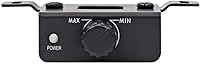
  • Bass Remote: Ships with a remote dashboard bass knob that allows real-time subwoofer level adjustment from the driver seat.
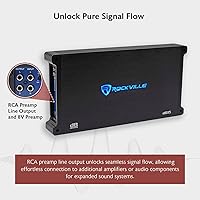
  • Connectivity: Accepts RCA inputs from a head unit and also provides an RCA preamp line output for routing signal to additional components.
  • Protection: IC-controlled protection circuitry monitors for thermal, overload, and short-circuit conditions to safeguard the amp and connected speakers.
  • Mounting Type: Designed for surface mounting, typically secured to a flat board or enclosure panel using standard hardware.
  • Compliance: Meets the CEA-2006 specification, which means the published RMS power rating is independently verified rather than manufacturer-estimated.
  • Manufacturer: Made by Rockville, a US-based car audio brand that has sold this particular model continuously since May 2017.

Related Reviews
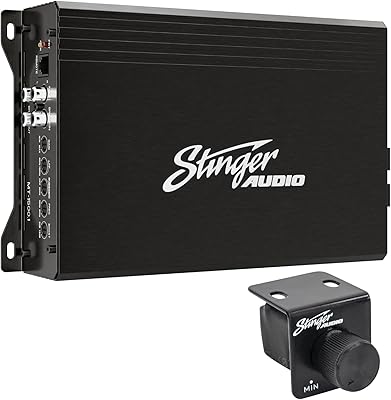
Stinger MT-1500.1 Monoblock Car Amplifier
74%
83%
Bass Output Performance
57%
Rated vs Real-World Power
74%
Build Quality
62%
Heat Management
88%
Ease of Installation
More
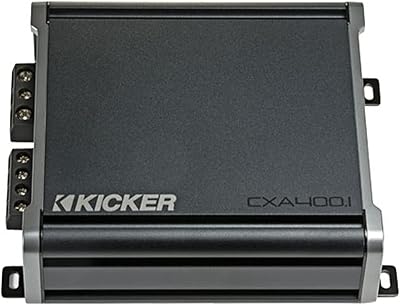
Kicker CXA400.1 Mono Car Amplifier
79%
86%
Sound Clarity
71%
Power Output Accuracy
91%
Installation Ease
67%
Build Quality
78%
Thermal Performance
More
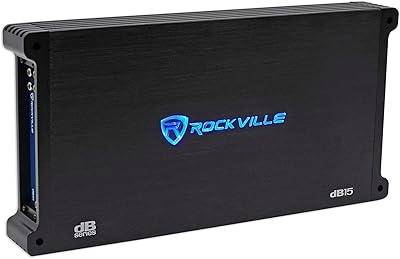
Rockville dB15 Mono Car Amplifier
73%
83%
Value for Money
78%
Bass Output
86%
Ease of Installation
61%
Thermal Management
58%
Power Accuracy
More
Rockville dBcomp4 3000W Mono Car Amplifier
85%
94%
Power Output
91%
Bass Performance
87%
Ease of Installation
89%
Build Quality
67%
Thermal Management
More
Rockville RVA600.1 Mono Car Amplifier
74%
83%
Value for Money
74%
Sound Quality
88%
Ease of Installation
52%
Power Accuracy
67%
Build Quality
More
Rockville dBcomp5 Mono Car Amplifier
75%
88%
Verified Power Output
82%
Build Quality
91%
Onboard Tuning Flexibility
87%
1-Ohm Stability
79%
Remote Sub Control
More
Rockville RVA-M2 Mono Car Amplifier
78%
83%
Value for Money
88%
Power Accuracy
71%
Build Quality
79%
Thermal Management
84%
Filter & Tuning Controls
More
Rockville dB16 Mono Car Amplifier
73%
83%
Bass Output
78%
Value for Money
81%
Ease of Installation
59%
Thermal Management
62%
Power Accuracy
More
Rockville dB11 1400W Mono Car Amplifier
85%
93%
Bass Performance
70%
Ease of Installation
89%
Compact Design
91%
Sound Clarity
85%
Build Quality
More
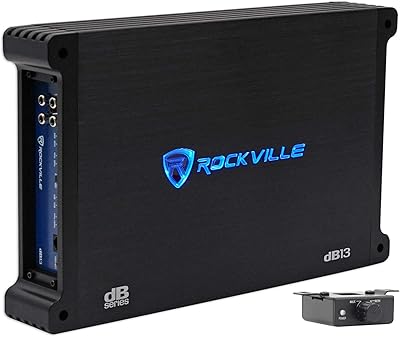
Rockville dB13 Mono Car Amplifier
75%
83%
Value for Money
54%
Power Output Accuracy
61%
Thermal Management
88%
Ease of Installation
79%
Onboard Sound Controls
More

FAQ

RMS is the number that reflects real, continuous power output — what the amp sustains while music is actually playing. The 4000W peak figure describes a very brief burst capacity under ideal conditions and is not a reliable measure of everyday performance. For practical purposes, treat 1000W RMS as the spec that matters when matching this amp to a subwoofer.

Yes, as long as your head unit has RCA preamp outputs. Many factory units do not, so if yours lacks them, you will need either a head unit with RCA outputs or a line output converter to step the speaker-level signal down to RCA level before it reaches the amp.

For an amplifier drawing up to 100 amps, most installers recommend 4-gauge or 2-gauge power and ground wire depending on the cable run length. Longer runs from battery to amp benefit from thicker wire to minimize voltage drop. No wiring kit is included in the box, so budget for that separately.

Yes, you can run two subwoofers as long as the combined impedance presented to the amp is at or above the minimum stable load. Wiring two 4-ohm subs in parallel gives you a 2-ohm load, which is right in the Rockville dB14 Mono Class-D Car Amplifier's sweet spot for rated output.

The subsonic filter cuts frequencies below a threshold you set — in this case anywhere from 15Hz to 55Hz. If you have a ported subwoofer enclosure, using it is strongly recommended because ported boxes can unload at very low frequencies, causing the woofer to over-excur and potentially blow the voice coil. For sealed enclosures it is less critical but still a useful protection measure.

Class-D amps run considerably cooler than older Class-AB designs, but sustained high volume in a poorly ventilated space can still raise the temperature meaningfully. A handful of user reports mention thermal shutdowns during extended listening sessions in warm climates. Mounting the amp in a location with at least some airflow around the chassis is a good precaution.

It works fine out of the box, but this is one area where user feedback gets mixed. Several owners have noted that the knob feels lightweight in construction and a small number reported it becoming inconsistent after a year or more of use. It is functional for everyday adjustments but is not the most robust component in the package.

This is a mono amplifier, so traditional bridging as you would do with a two-channel amp does not apply here. It operates as a single-channel unit by design. If you need more output, the RCA preamp line output does allow you to add a second amplifier to the system rather than trying to modify this one.

This mono amp pairs well with 10-inch and 12-inch subwoofers in the 500W to 1000W RMS handling range. Matching the amp's output closely to the sub's power handling gives you the best combination of output and component longevity. Running an underpowered sub at high gain settings is actually more damaging than giving it a properly matched signal.

Rockville typically offers a one-year warranty on their amplifiers, though you should verify current terms directly with the manufacturer or retailer at the time of purchase. User experiences with warranty service have been inconsistent based on community feedback, so keeping your purchase receipt and registering the product if that option is available is worth the effort.

Where to Buy