Overview

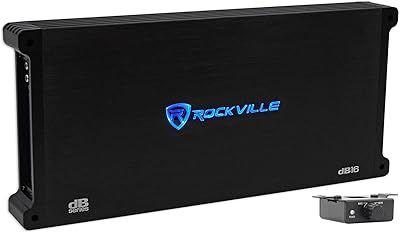
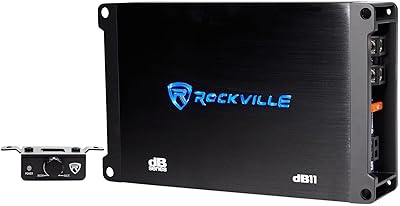
The Rockville RXD-M3 Mono Car Amplifier has been quietly holding its own in the budget car audio market since 2015 — a decade-long run that says something real about its staying power. This mono amp is built around 1-ohm stable operation, which matters a lot when you're driving a low-impedance subwoofer that would choke a less capable unit. Rockville sits firmly in value-brand territory, so you shouldn't expect boutique construction or premium internals. What you do get is a purpose-built amplifier that punches at a price point most competing brands can't touch for dedicated bass duty.
Features & Benefits

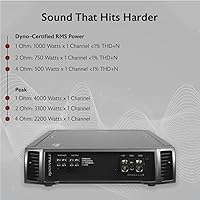
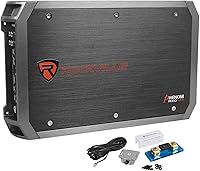
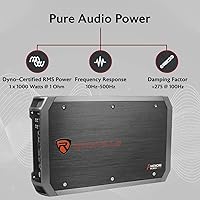
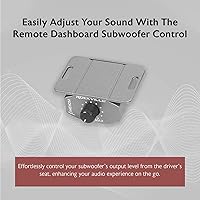
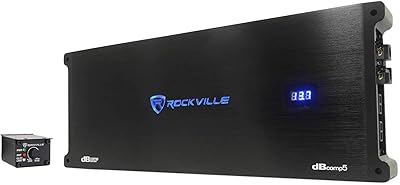
The headline number here is 2000W RMS at 1 ohm — that's the figure that actually matters, not the 4000W peak rating you'll see splashed across the box. Peak wattage is a momentary burst under ideal lab conditions; RMS is the sustained power your subwoofer will live on. The high-speed MOSFET power supply keeps heat in check under that load, helping the amp run efficiently rather than throttling output when things get warm. Onboard controls cover a fully adjustable 12dB crossover, a subsonic filter that sweeps from 15Hz to 55Hz, and a 12dB bass boost — enough tuning range that you rarely need to touch the head unit once dialed in. A wired remote lets you adjust sub level from the dash without reaching under the seat.

Best For

This Rockville amplifier is a natural fit for someone doing their first serious subwoofer build in a daily driver — the kind of install where you're running a single 12-inch or 15-inch sub and want a dedicated mono channel rather than bridging a two-channel amp. It's also a strong option for builders who want real onboard tuning control without adding a separate DSP or processor to the chain. If you're already running a capable head unit and just need an amp that can handle a low-impedance load without drama, this mono amp fits that bill cleanly. It's not the choice for a high-end competition build, but for a capable, budget-conscious street setup, it covers the bases.

User Feedback

Owners who picked up the RXD-M3 for a budget build tend to come away satisfied with the output — most agree it moves serious air at a price where alternatives offer noticeably less. Installation ease comes up repeatedly as a genuine strong point, with the straightforward wiring layout making DIY installs approachable even for first-timers. The criticism that surfaces most often centers on long-term durability; a subset of buyers report units failing after a year or two of regular use, and some mention frustration with Rockville's customer service when replacements were needed. There's also an ongoing debate in the reviews about whether the amplifier actually delivers its rated output under real-world load conditions. The LED logo and wired remote draw mixed responses — functional enough, but not exactly confidence-inspiring in feel.

Pros

  • Stable 1-ohm operation lets you squeeze maximum power from a demanding subwoofer load.
  • 2000W RMS is a genuinely usable output figure for a single subwoofer build at this price.
  • Onboard crossover and subsonic filter eliminate the need for a separate signal processor.
  • The wired remote subwoofer control makes daily bass adjustments easy without reaching under the seat.
  • MOSFET power supply helps manage heat and maintain efficiency during normal driving sessions.
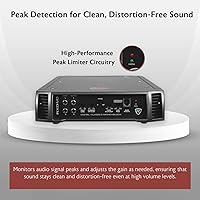
  • IC protection circuitry adds a real safety net against common electrical issues during install or use.
  • RCA pass-through output makes it easy to chain additional amplifiers without extra adapters.
  • CEA-compliant rating means the power specs follow an industry standard rather than being purely marketing numbers.
  • Straightforward wiring layout is consistently praised by DIY installers as easy to work with.
  • Has maintained a market presence since 2015, which suggests at least baseline reliability for a value-tier product.

Cons

  • Long-term durability is a legitimate concern, with a notable share of buyers reporting failures after one to two years.
  • Real-world output under sustained load may fall short of the rated RMS figure for some users.
  • Customer service experiences have been a recurring frustration when units need warranty replacement.
  • The wired remote control feels cheap in hand and has drawn complaints about build quality.
  • Peak wattage marketing can mislead buyers who do not know to focus on the RMS rating instead.
  • The LED logo illumination is cosmetic and adds no functional value, yet it is a visible cost trade-off.
  • At nearly 10 pounds and 19 inches long, finding a clean mounting spot in smaller vehicles can be tricky.
  • Not well suited for sustained high-volume use in hot climates where thermal stress is a consistent factor.
  • No wireless remote option limits install flexibility compared to some competing amplifiers in the same price range.

Ratings

The scores below for the Rockville RXD-M3 Mono Car Amplifier were generated by our AI engine after analyzing verified buyer reviews from multiple global sources, with spam, bot-generated, and incentivized feedback actively filtered out. The ratings reflect the full spectrum of real ownership experiences — including where this mono amp genuinely delivers and where it falls short — so you can make a clear-eyed decision before buying.
Value for Money
83%
For buyers building their first serious subwoofer setup on a tight budget, the RXD-M3 consistently over-delivers relative to its price. Most owners feel they got more usable bass output per dollar than competing options at the same tier, and that perception drives strong satisfaction among entry-level builders.
A small but notable segment of buyers who experienced early unit failure feel the value equation collapses once you factor in replacement costs. If the amp lasts only a year, the savings over a slightly more expensive alternative become difficult to justify.
Power Output
76%
24%
At 1 ohm, most users report the amp moves real air and produces the kind of low-end pressure they expected from a 2000W RMS-rated unit. Daily drivers running a single 12-inch or 15-inch subwoofer in a sedan tend to report strong, satisfying bass with headroom to spare.
There is a persistent undercurrent of skepticism in the reviews about whether the amp truly delivers its full rated RMS under sustained real-world load. Some technically inclined users who measured output with proper equipment found it fell short of the stated figures, which tempers confidence in the spec sheet.
Build Quality
58%
42%
The chassis feels reasonably solid for a value-tier amplifier, and the heatsink construction appears adequate for moderate use. Most users who install it carefully and run it within its limits report no structural complaints during the first months of ownership.
The overall fit and finish does not inspire confidence up close — internal components, terminal quality, and the remote knob all reflect the price tier clearly. Several long-term owners noted visible signs of component stress or corrosion after extended use, which aligns with the durability concerns surfacing in reviews.
Long-Term Reliability
52%
48%
A portion of the user base has run this Rockville amplifier for two or more years without incident, particularly those who installed it carefully, used adequate wiring gauge, and gave the unit proper ventilation. Those owners tend to be vocal advocates for the brand.
The failure rate reported in reviews is higher than typical for even budget-tier amplifiers, with a meaningful number of units dying between the 12- and 24-month mark. This is the single biggest concern for buyers considering this amp as a long-term investment rather than a short-term build.
Thermal Management
67%
33%
Under normal daily driving conditions — moderate volume, good airflow, reasonable ambient temperatures — the amp runs warm but not dangerously so. The MOSFET power supply does contribute to more efficient operation compared to older transformer-based designs at this price point.
Extended high-volume use in hot climates or poorly ventilated trunk spaces pushes the unit into territory where the protection circuitry kicks in frequently, causing audio cutouts. Users in warm regions report noticeably more thermal issues than those in cooler climates.
Installation Ease
84%
DIY installers consistently praise the straightforward terminal layout and clearly labeled control panel, making this one of the less frustrating amps to wire up at home without professional help. First-time builders particularly appreciate the logical signal flow from RCA input through to speaker output.
The amp's physical size — nearly 19 inches long — catches some buyers off guard and makes clean installation in compact vehicles genuinely difficult. A few users also noted that the terminal screws strip more easily than expected, requiring careful handling during initial setup.
Sound Tuning Controls
79%
21%
Having an adjustable crossover, a sweepable subsonic filter, and a bass boost all in one unit removes the need for external processors in a basic build. Users running ported subwoofer boxes especially appreciate the subsonic filter for protecting their drivers without needing extra gear.
The control knobs lack the tactile precision of higher-end amps, making fine adjustments somewhat hit-or-miss without test equipment. A few users noted that the bass boost interacts with the crossover in ways that require careful tuning to avoid muddiness at higher boost settings.
Remote Subwoofer Control
63%
37%
The wired dash-mounted remote is a genuinely useful feature for daily drivers who adjust bass levels regularly — switching between bass-heavy music and podcasts or calls without reaching into the trunk is a real everyday convenience most users come to rely on.
The physical quality of the remote unit is the most common cosmetic complaint in user feedback — it feels noticeably cheap, with a knob that wobbles and a build that does not inspire confidence. A handful of users reported the remote failing or producing crackling audio before the amp itself had any issues.
Protection Circuitry
74%
26%
The IC-controlled protection system has saved installations from short circuit damage during wiring errors, which is genuinely valuable for DIY builders who may make mistakes during a first install. Several users credited the protection circuitry with preventing what could have been a fire risk.
The protection circuit is also prone to nuisance triggering under conditions that should not be problematic, such as moderate bass transients at moderate volume. When it activates unnecessarily, the amp cuts out and requires a power cycle, which becomes an annoying pattern in some installations.
Signal Clarity
66%
34%
For bass reproduction — which is this amp's sole job — most users find the output clean enough at moderate gain levels to satisfy daily listening without obvious distortion artifacts. Running a single quality subwoofer in a well-tuned box, the RXD-M3 produces acceptably tight low-end for a budget unit.
Push the gain higher and distortion becomes audible to most listeners before the amp reaches its rated output ceiling. Buyers coming from mid-tier amplifiers will notice the difference in low-level noise floor and gain structure, particularly at high volume in quiet musical passages.
RCA Connectivity
77%
23%
The inclusion of both RCA inputs and pass-through outputs is a practical feature that makes signal daisy-chaining straightforward, particularly for builders running a separate amplifier for door speakers alongside this dedicated sub amp. The connection points are solidly constructed and hold RCA plugs securely.
The RCA jacks are functional but not premium — users with high-quality RCA cables sometimes find the fit slightly loose, which can introduce intermittent noise in some installations. This is a minor issue but worth noting for builders who prioritize a clean signal path.
Wattage Transparency
44%
56%
The CEA-2006 compliance designation is a meaningful differentiator from brands that publish completely unverified peak figures, giving buyers at least a framework for understanding the power ratings with some industry backing.
Despite the CEA compliance label, the gap between the prominent 4000W peak marketing and the actual 2000W RMS delivery confuses a large number of buyers, and real-world measurements by informed users suggest even the RMS figure may be optimistic under sustained load. This erodes trust across the review base significantly.
Aesthetics & Finish
61%
39%
The LED-illuminated logo gives the amp a visually polished look in a trunk build, and the overall silhouette is clean enough that most users are satisfied with how it looks mounted on a board alongside other equipment.
Up close, the finish quality — paint uniformity, label adhesion, and overall material feel — reflects the budget price tier clearly. Several users noted the LED illumination dims or becomes uneven over time, which is a minor but noticeable cosmetic regression.
Customer Support
39%
61%
A small number of buyers report that Rockville did honor warranty claims without significant dispute, and the brand does maintain accessible contact channels for support inquiries, which puts it ahead of some no-name competitors.
The majority of warranty-related reviews are negative, with buyers describing slow response times, replacement delays, and in some cases, requests for proof-of-purchase documentation that was difficult to retrieve. For a product with documented reliability concerns, weak post-purchase support is a compounding frustration.

Suitable for:

The Rockville RXD-M3 Mono Car Amplifier is a solid match for budget-conscious car audio enthusiasts who want real, usable bass output without committing to a high-end amplifier budget. It works especially well for someone building their first dedicated subwoofer setup — think a single 12-inch or 15-inch sub wired to 1 ohm in a daily driver sedan or SUV. The onboard crossover and subsonic filter mean you can dial in your sound without needing a separate processor, which saves both money and wiring complexity. DIY installers will appreciate the straightforward layout, and anyone who adjusts their bass levels frequently will find the wired dash remote genuinely useful. If your priority is maximizing output per dollar spent on a single-channel bass build, this mono amp competes well within its price tier.
Not suitable for:

The Rockville RXD-M3 Mono Car Amplifier is not the right tool for buyers who prioritize long-term durability above all else or who plan to run a demanding system at full tilt for extended periods. Audiophiles chasing accurate, low-distortion bass reproduction for critical listening will likely find the build quality and component tolerances underwhelming compared to mid-to-high-tier brands. It is also a poor fit for competition car audio builds where verified, measurable output and consistent power under sustained load are non-negotiable. Buyers who have had poor experiences with budget-brand customer service should factor in that Rockville's support has drawn criticism when warranty issues arise. If you are looking to bridge this amp or run multiple subwoofers at higher impedances, there are better-suited and more predictable options available at a similar price.
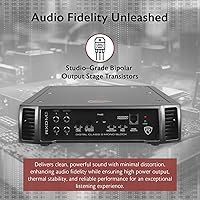
Specifications

  • Output Power: Delivers 2000W RMS at 1 ohm, which is the sustained power figure relevant to real-world subwoofer performance.
  • Peak Power: Rated at 4000W peak, a momentary burst figure measured under ideal lab conditions rather than typical driving use.
  • Channels: Single mono channel configuration, purpose-built for dedicated subwoofer duty rather than full-range speaker use.
  • Power Supply: High-speed MOSFET power supply design helps maintain thermal efficiency and stable output under varying electrical loads.
  • Crossover: Fully adjustable 12dB per octave crossover allows precise frequency filtering without requiring an external signal processor.
  • Subsonic Filter: Built-in subsonic filter sweeps from 15Hz to 55Hz, protecting subwoofers from damaging ultra-low frequencies.
  • Bass EQ: Onboard bass equalizer provides up to 12dB of boost for additional low-frequency emphasis during tuning.
  • Remote Control: Includes a wired remote subwoofer level control for convenient dashboard-mounted bass adjustments while driving.
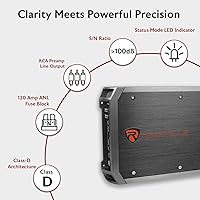
  • Connectivity: Features RCA line-level inputs and outputs, enabling flexible signal routing and daisy-chaining with additional amplifiers.
  • Protection: IC-controlled protection circuitry guards against overheating, short circuits, and voltage fluctuations automatically.
  • Voltage Range: Operates within a supply voltage range of 12V to 16.67V, compatible with standard 12V automotive electrical systems.
  • Dimensions: Measures 4″ x 19″ x 10.5″, requiring adequate trunk or under-seat space for a secure car mount installation.
  • Weight: Weighs 9.68 pounds, which is typical for a mono amplifier of this power class and should be factored into mounting decisions.
  • Compliance: CEA-2006 compliant rating indicates the power specifications follow an industry-standard measurement methodology.
  • Illumination: LED-illuminated logo provides a visual indicator that the unit is powered on, with no functional audio role.
  • Model Number: Officially designated as model RXD-M3 by manufacturer Rockville, first made available in July 2015.
  • Mounting Type: Designed for car mount installation, compatible with standard amplifier mounting hardware in trunk or cabin locations.
  • Wireless Remote: No wireless remote is included; the subwoofer level control operates via a wired connection to the amplifier.

Related Reviews
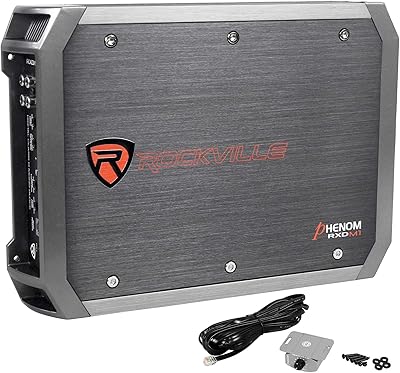
Rockville RXD-M1 2000W Mono Car Amplifier
86%
88%
Sound Quality
91%
Power Output
85%
Ease of Installation
87%
Durability & Build Quality
89%
User Control & Adjustments
More
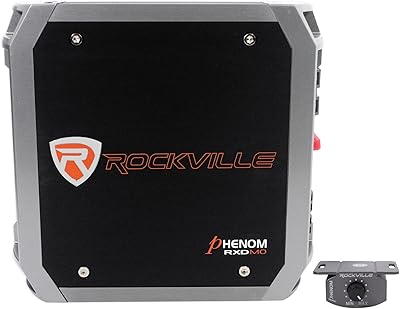
Rockville RXD-M0 Mono Car Amplifier
75%
88%
Value for Money
83%
Power Accuracy
91%
Ease of Installation
79%
Bass Performance
61%
Thermal Management
More
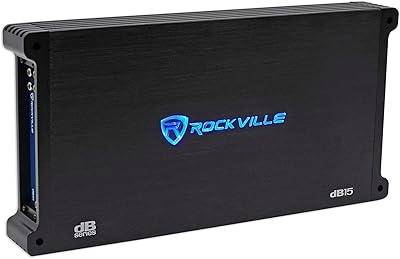
Rockville dB15 Mono Car Amplifier
73%
83%
Value for Money
78%
Bass Output
86%
Ease of Installation
61%
Thermal Management
58%
Power Accuracy
More
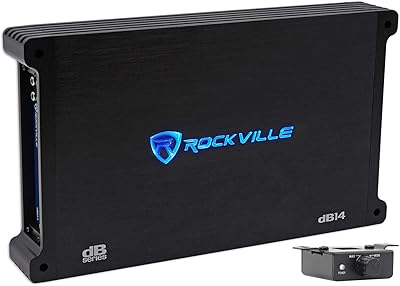
Rockville dB14 Mono Class-D Car Amplifier
74%
83%
Value for Money
78%
Power Accuracy
67%
Build Quality
54%
Long-Term Reliability
86%
Ease of Installation
More
Rockville dBcomp5 Mono Car Amplifier
75%
88%
Verified Power Output
82%
Build Quality
91%
Onboard Tuning Flexibility
87%
1-Ohm Stability
79%
Remote Sub Control
More
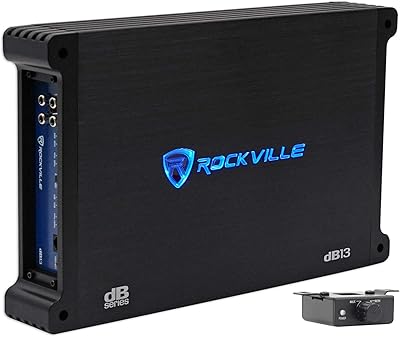
Rockville dB13 Mono Car Amplifier
75%
83%
Value for Money
54%
Power Output Accuracy
61%
Thermal Management
88%
Ease of Installation
79%
Onboard Sound Controls
More
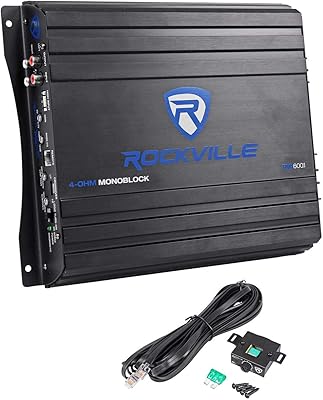
Rockville RVA600.1 Mono Car Amplifier
74%
83%
Value for Money
74%
Sound Quality
88%
Ease of Installation
52%
Power Accuracy
67%
Build Quality
More
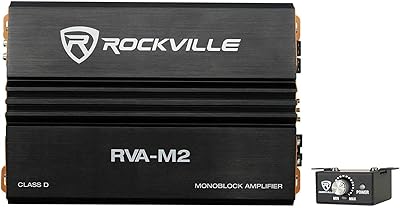
Rockville RVA-M2 Mono Car Amplifier
78%
83%
Value for Money
88%
Power Accuracy
71%
Build Quality
79%
Thermal Management
84%
Filter & Tuning Controls
More
Rockville dBcomp4 3000W Mono Car Amplifier
85%
94%
Power Output
91%
Bass Performance
87%
Ease of Installation
89%
Build Quality
67%
Thermal Management
More
Rockville dB11 1400W Mono Car Amplifier
85%
93%
Bass Performance
70%
Ease of Installation
89%
Compact Design
91%
Sound Clarity
85%
Build Quality
More

FAQ

The 4000W figure is peak power, which is a momentary burst measured under perfect lab conditions and not something your subwoofer will actually see in normal use. The 2000W RMS rating is the continuous, sustained output the amp delivers at 1 ohm — that is the number that actually matters when matching the amp to your subwoofer. Always shop by RMS when comparing amplifiers.

Yes, the amp will drive a 2-ohm load, but your output power will be lower than the rated 2000W RMS, which is specified at 1 ohm. Many single subwoofers wired in dual-voice-coil configurations can be set to either 1 or 2 ohms, so check your sub's wiring options before deciding. Running at 1 ohm maximizes the amp's output but also puts more thermal stress on the unit.

No, a wiring kit is not included in the box. You will need to source your own power cable, ground cable, remote turn-on wire, RCA cables, and speaker wire separately. For an amp drawing this much power, a quality 4-gauge or even 0-gauge wiring kit is worth investing in.

The crossover is adjustable directly on the amplifier's control panel, and it operates at 12dB per octave slope. You simply turn the crossover frequency knob to roll off high frequencies before they reach your subwoofer — typically somewhere between 80Hz and 120Hz is a common starting point for most builds. From there, adjust by ear or use a multimeter and tone generator for a more precise setup.

At 19 inches long and just over 10 inches wide, it is on the larger side for under-seat mounting and will be a tight fit in most compact cars. Trunk mounting on a flat board is a more practical approach for most installs. Make sure to leave airflow clearance around the unit to prevent heat buildup.

Given the power draw at 2000W RMS, a 4-gauge wiring kit is the minimum recommended, and a 1/0-gauge or 0-gauge setup is safer for longer wire runs or if you plan to push the amp hard. Running undersized wire is one of the most common causes of overheating and premature amplifier failure in budget installs, so do not cut corners here.

It is functional and genuinely useful for day-to-day driving — being able to turn your bass up or down from the dash without touching the amp is a real convenience. That said, the build quality of the remote knob is basic and some users have noted it feels flimsy compared to remotes on higher-end amps. It does the job, but handle it accordingly.

Yes, and the subsonic filter is particularly helpful here. Ported boxes can produce large cone excursions at frequencies below the port tuning point, which can damage your subwoofer over time. Setting the subsonic filter appropriately — usually within 5Hz to 10Hz below the box tuning frequency — helps protect the driver without affecting audible bass output.

The MOSFET power supply and onboard protection circuitry help manage thermal load under normal conditions. That said, like most amps in this class, it can run warm during extended high-volume use, especially in hot climates or if airflow around the unit is restricted. Make sure it is mounted with space to breathe, and avoid direct sunlight exposure when possible.

Technically no — this is a mono amplifier designed specifically for subwoofer use, not full-range speaker reproduction. It lacks the frequency response and stereo output channels needed to drive door or component speakers properly. For those speakers, you would want a separate multichannel amplifier better suited for full-range audio.

Where to Buy