Overview

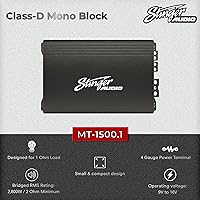
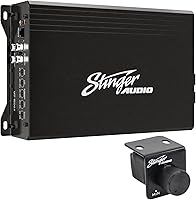
The Stinger MT-1500.1 Monoblock Car Amplifier sits in a comfortable middle ground within Stinger's catalog — a brand that built its reputation on wiring kits and accessories before expanding into amplification. This is a dedicated subwoofer amp, not a versatile multi-channel unit, so expectations should be set accordingly. Its Class D monoblock design keeps the chassis surprisingly compact at 10x10 inches, which genuinely matters when trunk real estate is tight. Having launched in late 2022, the Stinger monoblock has accumulated enough owner feedback to paint a clear picture of where it delivers and where it falls short.
Features & Benefits

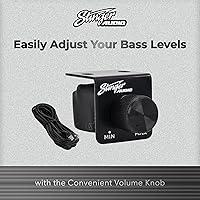
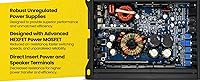
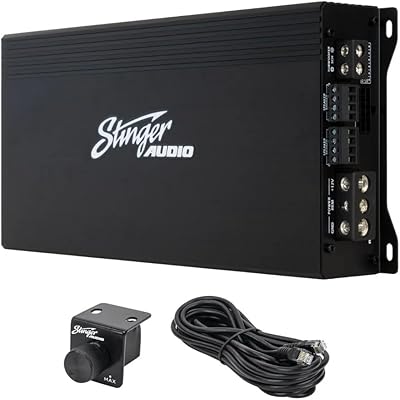
Class D topology is the right call for a sub amp — it runs cooler and draws less from your electrical system than older Class AB designs. The HEXFET MOSFET supply enables fast switching and low on-resistance, which translates to tighter, cleaner bass rather than muddy low-end. One honest caveat: this uses an unregulated power supply, meaning output can fluctuate with voltage changes — something regulated supplies handle more consistently. For most daily drivers that difference is negligible, but competition builders should note it. High and low-level inputs let you connect directly to a factory radio, and the included bass remote lets you dial things in from the driver's seat without crawling into the trunk.

Best For

This sub amplifier is well-matched for daily drivers stepping up from a factory system for the first time. If you're running a single subwoofer and want remote bass control without a complicated install, this mono amp is built for exactly that scenario. The compact chassis is a real advantage for smaller trunks and hatchbacks where space is limited. It also works cleanly as part of a two-amp setup — pairing it with a separate 4-channel for mids and highs is a straightforward way to build a complete system. Buyers still rocking a stock head unit will especially appreciate the high-level input support, which removes the need to swap out the factory radio just to power a sub.

User Feedback

Owners consistently praise the bass output for the price — most feel this mono amp punches well relative to its cost, and installation feedback is largely positive, with buyers noting the terminal layout is straightforward. The bass remote knob earns a more mixed reception; some find it solid, others feel it's a bit plasticky for an otherwise metal-built unit. Where opinions split most is on rated wattage. The 1500W figure is a peak number, not RMS, and real-world continuous output sits lower — a common industry practice, but one worth knowing before you buy. Heat during extended use draws occasional complaints. Its ranking among top-selling car mono amps reflects solid sales volume, though that signals popularity rather than a quality verdict.

Pros

  • Class D topology runs notably cooler and draws less from your car's electrical system than older amp designs.
  • High and low-level inputs mean you can connect directly to a factory radio without replacing your head unit.
  • The 10x10-inch square footprint fits mounting locations that most full-size mono amps simply cannot reach.
  • Bass output for the price genuinely surprises first-time upgraders coming from a stock system.
  • The included flush-mount bass remote is a practical convenience that lets you tune sub level on the fly.
  • Metal construction gives the chassis a solid, confidence-inspiring feel at this price point.
  • Bridgeable design leaves room to reconfigure the system later without buying a new amplifier.
  • Stinger's established brand means warranty and support channels actually exist if something goes wrong.
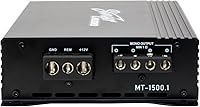
  • Clean, logical terminal layout makes the wiring process straightforward even for first-time installers.

Cons

  • The 1500W power claim is peak-rated — real continuous RMS output is considerably lower and rarely disclosed upfront.
  • The unregulated power supply can cause output to dip when the vehicle electrical system is under load.
  • The remote bass knob feels noticeably cheaper than the amplifier body and has a hollow, plasticky action.
  • Thermal protection can kick in during extended high-volume listening sessions, especially in poorly ventilated installs.
  • No subsonic filter adjustment makes this mono amp a less precise match for ported subwoofer enclosures.
  • The included documentation is thin, leaving first-time buyers to figure out gain and crossover settings on their own.
  • Alternator whine has been reported by some users connecting via high-level inputs, requiring additional noise isolation.
  • No RCA cables or power wiring are included, adding to the total setup cost beyond the sticker price.
  • Gain and crossover controls feel coarse for buyers who want precise tuning rather than rough ballpark adjustments.

Ratings

Our scores for the Stinger MT-1500.1 Monoblock Car Amplifier were built by processing verified owner reviews from global markets, with spam, incentivized posts, and bot activity actively filtered out before analysis. The result is a transparent look at where this sub amp genuinely earns its place on the shelf — and where real buyers have run into friction. Both the wins and the frustrations are reflected honestly in every category below.
Bass Output Performance
83%
Owners running a single 10-inch or 12-inch subwoofer in a daily driver setup consistently report satisfying, room-filling low end that punches harder than the price tag suggests. For commuters who just want to feel their music without building a competition rig, this mono amp delivers the impact they were looking for.
A handful of more experienced buyers noted the bass can sound slightly loose at higher gain settings, particularly with ported enclosures. The unregulated power supply means output can soften slightly when the vehicle electrical system is under load, such as when the AC and headlights are running simultaneously.
Rated vs Real-World Power
57%
43%
At moderate listening volumes, the amp moves enough air to satisfy most casual listeners and first-time sub installers. Buyers who matched it with a reasonably efficient subwoofer and a sealed box tended to report the most consistent satisfaction.
The 1500W figure is a peak rating, not continuous RMS output, and real-world delivery sits noticeably lower. Buyers who came in expecting competition-level power were frequently disappointed, and several noted that the actual RMS spec should be front and center in the product listing to avoid confusion.
Build Quality
74%
26%
The metal chassis feels solid in hand and holds up well to the heat cycles of daily use. At this price tier, the construction quality is competitive, and installers appreciated that the terminal blocks and input connectors feel secure once wired up.
Closer inspection reveals some inconsistency in fit and finish, particularly around the input panel and gain controls. The precision potentiometers feel acceptable but not premium, and a few buyers reported the gain knob having a slightly loose feel out of the box.
Heat Management
62%
38%
For daily driving at moderate volume, thermal performance is generally adequate. Buyers using the amp in well-ventilated trunk installs with proper airflow reported no significant heat issues during normal commutes.
Extended high-volume sessions — road trips, parking lot listening — pushed the chassis temperature to uncomfortable levels for several owners. Class D efficiency helps, but the lack of a visible heatsink fin structure limits passive cooling, and a few buyers reported the amp going into thermal protection during prolonged hard use.
Ease of Installation
88%
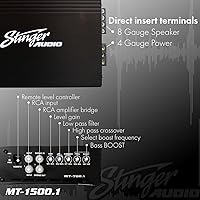
The terminal layout is logically organized, and both high-level and low-level inputs are clearly labeled, which first-time installers found genuinely helpful. Connecting directly to a factory head unit via the high-level inputs removed what is often the most frustrating barrier for beginners.
The included documentation is minimal, and buyers without prior car audio experience sometimes struggled to identify the correct gain and crossover settings without researching externally. A more detailed quick-start guide would meaningfully reduce install time for newcomers.
Remote Bass Controller
67%
33%
The flush-mount knob design looks clean in a center console or door panel cutout, and being able to adjust sub level from the driver's seat without touching the amp is a convenience most owners genuinely appreciated after their first week of use.
The build quality of the remote itself drew consistent criticism — it feels noticeably cheaper than the amplifier body, with a hollow plastic feel that contrasts with the otherwise metal construction. A few buyers reported the knob becoming intermittently unresponsive within the first few months.
Value for Money
79%
21%
Positioned between bargain-bin no-name amps and premium competition units, this sub amplifier offers a recognizable brand with real after-sale support at a price that does not require a second thought for most buyers upgrading a factory system.
Once buyers factor in the peak-versus-RMS wattage reality and the unregulated power supply, the value calculation tightens. Shoppers who compare it directly against similarly priced rivals with regulated supplies and published RMS specs sometimes feel the Stinger monoblock is priced slightly optimistically.
Compatibility & Input Flexibility
86%
High and low-level inputs are a genuine feature at this price point, not a given. Buyers keeping their factory radio — a common scenario in daily driver upgrades — found the high-level input worked cleanly without introducing significant noise or signal degradation.
A small number of buyers with certain OEM head units reported a faint alternator whine when using the high-level input, which required additional ground loop isolation to resolve. The amp itself was rarely the root cause, but the issue surfaced often enough to be worth flagging.
Compact Footprint
91%
The 10x10-inch square chassis is genuinely one of this amp's most practical attributes. Installers working in hatchbacks, sedans with shallow trunk wells, or under rear seats found the form factor opened up mounting options that larger rectangular amps simply would not allow.
The near-cubic shape, while compact in surface area, has enough height that truly flush under-seat installs can be tight in lower-profile vehicles. Measuring carefully before purchase is worth the extra five minutes to avoid surprises during the install.
Signal-to-Noise Ratio
71%
29%
Under normal operating conditions with a clean power and ground setup, the amp runs quietly and does not introduce distracting background noise into the subwoofer channel. Buyers who grounded correctly and used quality RCA cables reported a clean, quiet noise floor.
Improper grounding — one of the most common install mistakes — surfaces more noticeably with this amp than some competitors. Owners who skipped a dedicated chassis ground or used an insufficient gauge wire were more likely to report audible noise, suggesting the amp has less tolerance for sloppy wiring.
Crossover & Tuning Controls
69%
31%
The onboard low-pass crossover gives enough range to dial in a single subwoofer across most enclosure types. For a standard daily driver setup, the available adjustment range is sufficient to get clean, well-integrated bass without external processing.
Audiophiles and builders who prefer surgical crossover control found the onboard controls coarse by comparison to amps with more granular frequency and phase adjustment options. There is no subsonic filter adjustment, which would have been useful for ported box users trying to protect their woofer.
Brand Reputation & Support
77%
23%
Stinger has been a recognizable name in car audio accessories for decades, and buyers take comfort in knowing the brand has an established support structure. Warranty claims, while not always fast, are generally handled without the complete radio silence common with lesser-known brands.
Stinger's reputation is built most strongly on its wiring and accessory products rather than on amplifiers specifically. A subset of buyers felt the amplifier division has not yet earned the same level of trust as its cable and installation accessory lines.
Long-Term Reliability
66%
34%
The majority of buyers reporting back after six or more months of daily use found the amp still functioning as expected, with no significant performance degradation. For normal daily driving use cases, the hardware appears durable enough for multi-year service.
A recurring thread in longer-term reviews involves the amp entering protection mode more frequently over time, often tied back to marginal electrical systems or suboptimal grounding rather than outright component failure. Units pushed hard regularly showed a higher incidence of early issues than those used conservatively.
Packaging & Accessories Included
72%
28%
The bass remote and necessary hardware are included in the box, which means buyers are not hunting down accessories separately before they can complete the install. The packaging itself protects the unit adequately for transit and arrived undamaged for the clear majority of buyers.
Beyond the bass remote and basic hardware, the package is fairly bare. No RCA cables, no wiring, and a minimal instruction sheet means first-time buyers will still need a separate shopping trip for consumables, which feels like a missed opportunity at this price point.

Suitable for:

The Stinger MT-1500.1 Monoblock Car Amplifier is a strong fit for everyday drivers who are done tolerating a flat, bass-free factory sound system and want a meaningful upgrade without diving into competition-level complexity or cost. If you are keeping your stock head unit — which most first-time upgraders do — the high-level inputs on this mono amp remove what is usually the biggest installation headache, letting you tap into the factory speaker signal directly. Installers working with compact trunks, shallow cargo areas, or hatch vehicles will appreciate the near-square footprint, which opens up mounting positions that longer rectangular amps simply cannot fit. This sub amplifier also makes sense as one half of a two-amp system, where it handles dedicated subwoofer duty while a separate 4-channel takes care of the front and rear speakers. Buyers who prioritize a recognizable brand with real customer support — rather than gambling on an unbranded import — will find the Stinger name offers a reasonable degree of confidence at this price tier.
Not suitable for:

Buyers chasing serious output numbers should look elsewhere before committing to the Stinger MT-1500.1 Monoblock Car Amplifier, because the 1500W rating on the box is a peak figure, and the actual continuous RMS delivery is meaningfully lower — a gap that matters a great deal once you start matching it to a demanding subwoofer in a ported enclosure. The unregulated power supply is another consideration for performance-focused builds: unlike regulated designs, output can fluctuate with changes in vehicle voltage, which becomes noticeable under load in systems running large alternators and multiple accessories simultaneously. This sub amplifier is not the right tool for anyone building a competition SPL setup or looking for the kind of surgical tuning control — adjustable subsonic filters, precise phase control, granular crossover slopes — that dedicated competition amps provide at a higher price. Buyers with marginal vehicle electrical systems or aging batteries may also find the amp's thermal protection triggers earlier than they would like during extended high-volume sessions, which points to a sensitivity to less-than-ideal installation conditions.

Specifications

  • Model Number: The amplifier is manufactured under model designation MT-1500.1 by Stinger.
  • Amplifier Class: Uses Class D topology, which prioritizes high efficiency and low heat generation compared to Class AB designs.
  • Configuration: Single-channel monoblock design, purpose-built for driving subwoofers rather than full-range speaker systems.
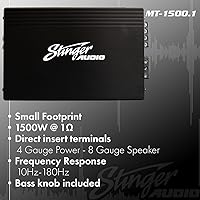
  • Peak Power Output: Rated at 1500W peak output — note this is a peak figure, not a continuous RMS rating.
  • Power Supply Type: Unregulated MOSFET power supply using pulse width modulator circuitry, meaning output can vary with changes in vehicle voltage.
  • MOSFET Technology: Incorporates HEXFET power MOSFETs, which enable low on-resistance and fast switching for improved bass clarity.
  • Input Options: Accepts both high-level speaker inputs and low-level RCA inputs, enabling connection to factory or aftermarket head units.
  • Bridgeable: The amplifier supports a bridged configuration, allowing system flexibility if the installer reconfigures the setup later.
  • Bass Remote: Includes a flush-mount remote bass level controller for adjusting subwoofer output from the driver's seat.
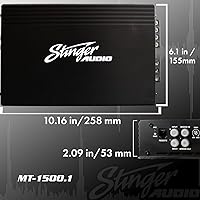
  • Dimensions: Chassis measures 10″ x 10″ x 10″, providing a compact near-cubic footprint suited to tight trunk installs.
  • Weight: The unit weighs 6.03 pounds, making it manageable for single-person installation without additional assistance.
  • Construction Material: Enclosure is built from metal, contributing to structural rigidity and passive heat dissipation during operation.
  • Mounting Type: Designed for surface or wall-mount installation using standard amp rack or direct-mount hardware.
  • Compatibility: Compatible with both aftermarket and factory OEM head units when using the high-level input connection.
  • Date Introduced: First made available for purchase in December 2022, giving it over two years of real-world owner feedback.
  • Brand: Manufactured by Stinger, a brand established primarily in car audio wiring, accessories, and installation products.
  • UPC: The product carries UPC code 609098902076 for retail identification purposes.
  • Sales Rank: Holds a ranking of number 36 in the Car Mono Amplifiers category on Amazon at time of publication, reflecting significant sales volume.

Related Reviews

Stinger MT-1000.5 5-Channel Car Amplifier
75%
81%
Value for Money
84%
Ease of Installation
58%
Real-World Power Output
63%
Thermal Management
88%
Built-in Crossover Filters
More
MB Quart FA1-1500.1 Mono Channel Car Audio Amplifier
84%
91%
Sound Quality
88%
Power Delivery
87%
Durability & Build Quality
85%
Ease of Setup & Installation
65%
Thermals (Heat Management)
More
Taramp's MD 1200.1 1-Channel 1200W RMS Car Audio Amplifier
86%
93%
Power Output
89%
Sound Quality
91%
Installation Ease
85%
Build Quality
65%
Thermal Performance
More
Belva BB200ABv2 500W Monoblock Car Amplifier
85%
88%
Bass Performance
91%
Installation Ease
85%
Sound Clarity
89%
2-Ohm Stability
82%
Build Quality
More
Audiozerone ZE1000.1 Monoblock Car Amplifier
75%
91%
Value for Money
88%
Bass Output
74%
Thermal Management
83%
1-Ohm Stability
63%
Build Quality
More
Rockville RVA600.1 Mono Car Amplifier
74%
83%
Value for Money
74%
Sound Quality
88%
Ease of Installation
52%
Power Accuracy
67%
Build Quality
More
LKC PHF450D Car Audio Monoblock Amplifier
88%
91%
Power Output (2 Ohms)
87%
Power Output (4 Ohms)
93%
Heat Dissipation
88%
Build Quality
85%
Ease of Integration
More
Planet Audio AC2500.1M Monoblock Car Amplifier
85%
92%
Performance
95%
Bass Output
85%
Ease of Installation
65%
Thermal Performance
88%
Build Quality
More
Planet Audio TR1500.1M Monoblock Car Amplifier
70%
88%
Value for Money
79%
Bass Output & Performance
83%
Ease of Installation
63%
Build Quality
57%
Thermal Management
More
Planet Audio AC1500.1M Monoblock Car Amplifier
75%
91%
Value for Money
78%
Bass Output Quality
86%
Ease of Installation
61%
Thermal Management
67%
Build Quality
More

FAQ

Yes, and this is actually one of the more practical things about this mono amp. The high-level inputs let you tap into the factory speaker output signal, so you can skip the head unit swap entirely. Just make sure your ground connection is solid to avoid noise issues.

The Stinger MT-1500.1 Monoblock Car Amplifier is rated at 1500W peak, which is the absolute maximum under ideal conditions for a very brief moment. The continuous RMS output — the number that actually matters for matching to a subwoofer — is lower, and Stinger does not prominently publish that figure. When shopping for a compatible subwoofer, focus on matching RMS ratings rather than peak numbers.
It will work, but there is one thing to keep in mind: this amp does not have an adjustable subsonic filter. Ported boxes benefit from a subsonic filter to block frequencies below the port's tuning point, which can otherwise stress the woofer. If you are using a ported box, consider adding an external processor or DSP that includes subsonic filtering.

The remote uses a standard flush-mount design and connects to the amp via a small cable — typically a 3.5mm or similar connector depending on the exact wiring harness included. You cut a hole in a convenient location like the center console, feed the cable through, and snap the knob into place. The included hardware handles the rest.

At everyday listening volumes in a well-ventilated install, heat is not a major issue. Class D amps are inherently more efficient than older designs, so they generate less waste heat. That said, if the amp is tucked into a fully enclosed space with no airflow and you are pushing it hard for extended periods, it can reach temperatures that trigger the built-in thermal protection circuit. Leave some breathing room around the chassis when mounting.

For an amp in this power class, most experienced installers recommend a minimum of 4-gauge power and ground wire for a clean, efficient install. If you are running a longer cable distance from the battery, stepping up to 1/0-gauge is worth considering to minimize voltage drop. Stinger actually sells quality wiring kits that are sized appropriately for this type of build.

Some buyers have reported alternator whine, particularly when using the high-level inputs with certain factory head units. This is usually a grounding issue rather than a defect in the amp itself. Make sure your ground wire is bolted to bare metal on the chassis — not a painted surface — and that the ground point is as short and direct as possible. If noise persists, a ground loop isolator on the input signal line usually resolves it.

Yes, the amp supports bridged operation. In a monoblock context, bridging is less relevant than with multi-channel amps, but the bridgeable design means if you reconfigure your system later — for example, adding a second subwoofer channel — there is some flexibility built in. For most single-subwoofer daily driver setups, you will not need to use this feature.

The chassis is 10 inches on all three sides, so it is a near-perfect cube. That square footprint is actually an advantage in many trunks and cargo areas, but the height means truly flush under-seat installs can be tight in lower-profile vehicles. Measure your available clearance before committing to an under-seat location.

No — the box includes the bass remote controller and basic mounting hardware, but no RCA interconnects or power wiring. You will need to purchase those separately. Given that Stinger is well known for its wiring products, pairing this sub amplifier with one of their wiring kits is a natural and convenient option.

Where to Buy