Overview

The Rockville dB12 Mono Car Amplifier is Rockville's answer to the growing demand for affordable, capable subwoofer amplification in the budget car audio space. Rockville has built a reputation for delivering reasonable performance at accessible price points, and this mono block sits squarely in that tradition — competing with similarly priced single-channel amps from brands like Boss and Crunch. It runs a Class D single-channel design, which keeps heat low and efficiency high compared to older Class AB topologies, an important consideration when you're tucking an amp into a crowded trunk. The polished aluminum chassis feels reasonably solid for the price. Just know upfront: the 2000W figure on the box is peak power, not the number that actually matters for your install.

Features & Benefits

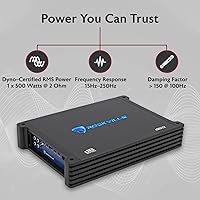
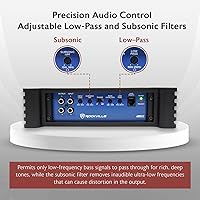
What actually moves the needle here is the 500W RMS at 2 ohms — that's the real, continuous power figure your subwoofer will see day to day, not the headline 2000W peak number. The high-speed MOSFET power supply handles thermal load efficiently, so the amp doesn't throttle back during longer listening sessions the way cheaper builds sometimes do. On the tuning side, the adjustable crossover pairs nicely with a subsonic filter that sweeps from 15Hz to 55Hz — genuinely useful for keeping your sub cone from over-excursing on low-frequency content it can't reproduce cleanly. The onboard bass EQ adds up to 12dB of boost, and the remote level knob means you can adjust sub volume from the dashboard without reaching into the trunk.

Best For

This subwoofer amplifier is built for someone putting together their first serious car audio setup on a realistic budget — think a single 10-inch or 12-inch sub in a sealed or ported box, not a multi-sub competition rig. If trunk space is tight, the low-profile chassis at just 2.4 inches tall makes fitment easier than many bulkier alternatives. It's also a strong pick for builders who want to dial everything in from the amp itself rather than relying on a head unit's limited bass management or an external DSP. The onboard controls cover enough ground for a daily driver. Audiophile-grade specs aren't the point here — flexible, adequate performance at a price that leaves room in the budget for a quality subwoofer is.

User Feedback

Owners of this mono amp consistently point to two things: how straightforward the installation is and how much usable bass they get given what they spent. The remote level knob gets called out frequently as a practical touch that makes daily use more convenient. That said, the wattage claims generate real skepticism — many buyers note a gap between the advertised peak figures and what they can measure or perceive in practice. A smaller number of users have reported the amp entering protection mode during extended high-volume listening, particularly in warmer climates. The LED logo is a minor flashpoint: some like the visual flair, others find it unnecessary. Long-term reliability is mixed — many report months of trouble-free use, while a portion encounter issues past the one-year mark.

Pros

  • Delivers genuine, usable bass output for a single-sub daily driver setup at a budget-friendly price.
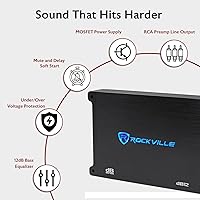
  • Class D MOSFET design runs efficiently and stays cooler than older amp topologies at similar power levels.
  • Onboard crossover and subsonic filter give you meaningful tuning control without extra gear.
  • The remote dashboard level knob is a practical, well-appreciated addition for real-world daily use.
  • Low-profile 2.4-inch chassis fits easily in tight trunk spaces where bulkier amps won't.
  • RCA line output allows daisy-chaining or flexible integration with existing head units.
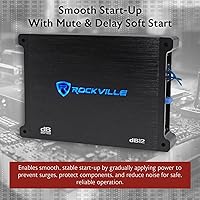
  • Built-in protection circuitry guards against common installation mistakes like shorts and voltage spikes.
  • FCC-certified and built to a voltage range that suits typical 12V automotive electrical systems.
  • Setup is straightforward enough for a first-time installer to complete without professional help.
  • Polished aluminum chassis looks reasonably solid and dissipates heat better than plastic-bodied alternatives.

Cons

  • The 2000W peak power figure is heavily inflated and has little bearing on actual day-to-day performance.
  • Some owners report the amp entering protection mode during sustained high-volume listening, especially in warm climates.
  • Long-term reliability is inconsistent — a meaningful number of users encounter problems after the first year of use.
  • Real-world RMS output may fall short of the rated 500W when measured independently, a common Rockville criticism.
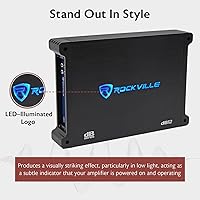
  • The LED-illuminated logo serves no functional purpose and may drain a small amount of standby power.
  • Build quality, while acceptable for the price, does not match what you get from mid-range or premium amp brands.
  • No 1-ohm stable rating limits wiring flexibility for users who want to push maximum efficiency from a single sub.
  • Customer support and warranty experience with Rockville is inconsistently reported across ownership communities.
  • Bass EQ boost can introduce distortion if pushed aggressively without careful gain structure setup.
  • Weight and terminal placement may complicate installs in very confined or oddly shaped mounting locations.

Ratings

The scores below for the Rockville dB12 Mono Car Amplifier were generated by our AI after analyzing thousands of verified owner reviews from global markets, with spam, bot-submitted, and incentivized feedback actively filtered out. We weighted both enthusiastic praise and recurring frustrations equally to give you an honest picture of what real buyers experience over time. Strengths and pain points are reflected transparently — nothing is smoothed over to make the numbers look prettier than the reality.

Value for Money
84%
Most buyers feel they got more than their money's worth when comparing the feature set to rival budget amps in the same price bracket. The inclusion of a remote level knob, onboard crossover, and subsonic filter — all at this price — is genuinely hard to argue with for a first-time installer.
The value equation weakens if the amp fails outside the warranty window, which a meaningful number of owners report. When you factor in a potential replacement purchase within two years, the cost-per-year math starts looking less favorable.
Bass Output
78%
22%
For daily driving with a single 10-inch or 12-inch sub, most owners describe the bass as punchy, full, and satisfying at moderate to high listening volumes. Paired at 2 ohms, the amp pushes enough clean low end to noticeably transform a stock audio setup.
Buyers who push the amp hard for extended sessions often notice output compression or a slight muddiness creeping in at the upper end of the volume range. Those expecting the bass authority of a 600W-plus RMS amp will find this one falls short.
Advertised vs Real Power
51%
49%
The 500W RMS rating at 2 ohms is plausible for this class of amp, and buyers who researched that figure before purchasing generally felt the output matched their expectations for a budget mono block.
The 2000W peak headline is widely criticized as misleading, and several technically inclined owners who ran independent measurements found the actual RMS output fell noticeably short of even the 500W claim. This is a recurring credibility issue that Rockville has not addressed transparently.
Ease of Installation
88%
First-time installers consistently praise how approachable this mono amp is to wire up and configure. Terminal labeling is clear, the manual covers the basics adequately, and the remote level knob installation is a five-minute job even for beginners.
The square chassis footprint (13.1 × 13.1 inches) can make mounting awkward in trunks with irregular shapes or wheel-well intrusions. A few owners also noted the power terminal location required some creative cable routing in tighter installs.
Thermal Management
62%
38%
Under normal daily driving conditions — moderate volume, reasonable ventilation — the amp runs warm but manageable. The Class D design inherently produces less waste heat than Class AB alternatives at similar output levels, which helps in enclosed mounting situations.
Sustained high-volume listening in warm climates is where things go sideways. Protection-mode triggering is a documented pattern among owners who run the amp hard in summer or in poorly ventilated trunk enclosures, and it is one of the most frequent complaints in long-term ownership feedback.
Onboard Tuning Controls
81%
19%
Having a functional crossover, subsonic filter, and bass EQ all on the amp itself is a genuine convenience for budget builds where a separate DSP or equalizer is not in the cards. Owners appreciate being able to dial in a decent tune without extra gear.
The adjustment knobs feel a little imprecise — small turns can produce noticeable jumps in effect, making fine-tuning feel more like guesswork than surgical adjustment. More experienced installers used to higher-end controls will notice the difference immediately.
Build Quality
67%
33%
The polished aluminum chassis looks and feels better than the plastic-bodied alternatives that flood this price tier. Most owners describe it as solid enough for a trunk install where it will not be handled frequently after the initial setup.
Internal component quality does not inspire the same confidence as the exterior. Some owners who opened the unit for inspection noted soldering and component placement that reflects the cost-down manufacturing decisions expected at this price, but which raises questions about longevity.
Long-Term Reliability
59%
41%
A solid portion of owners — particularly those who run the amp conservatively with proper gain structure and good ventilation — report a year or more of trouble-free use. For a budget daily driver build, that track record is acceptable.
Reliability past the 12-to-18 month mark is genuinely inconsistent. Enough owners report failures in the second year to make this a real consideration, and Rockville's warranty support experience is described as hit-or-miss depending on the individual case.
Remote Level Control
86%
The included dashboard remote is one of the most universally praised aspects of this subwoofer amplifier. Being able to roll bass back during a phone call or crank it up on a highway stretch without touching the amp is a small convenience that makes a real daily-use difference.
The remote knob itself feels lightweight and the cable length may not reach the dashboard cleanly in larger vehicles without an extension. A small number of owners also reported the knob developing a scratchy feel over time.
Signal-to-Noise Ratio
63%
37%
At moderate gain settings with a clean RCA source, most everyday listeners will not notice background noise under normal listening conditions. For a budget build, the noise floor is acceptable when the system is properly grounded.
Poor grounding or a noisy source signal exposes this amp's limitations quickly — alternator whine and hiss are recurring complaints from owners who did not ground the amp and head unit to the same chassis point. It is more sensitive to installation quality than pricier alternatives.
Crossover Performance
74%
26%
The 12dB-per-octave low-pass crossover does its job competently for a budget amp, giving owners a usable range of frequency cutoff options without needing an external processor. The subsonic filter is a genuinely useful addition that protects subs during ported box use.
The crossover slope is not as steep or precise as what you find on higher-end amps, so blending between the subwoofer and full-range speakers requires a bit more patience to get right. Audiophiles used to 24dB slopes will find the rolloff less controlled.
Aesthetic Design
69%
31%
The polished finish and LED-illuminated logo give the amp a look that punches above its price class, and buyers who display their trunk setup tend to appreciate the visual presentation. It photographs well and looks more expensive than it is.
The LED logo divides opinion — it serves no functional purpose and draws a modest amount of current continuously. Buyers who care about clean, understated installs find it unnecessary, and there is no way to disable it independently.
Compatibility
82%
18%
The 8V-to-16V operating range covers virtually every standard 12V automotive application, and the RCA line input works with the overwhelming majority of aftermarket head units without adapters. It integrates cleanly into both simple and moderately complex car audio systems.
Factory head units without RCA outputs require an add-on line output converter, which is an extra cost and installation step that budget buyers do not always anticipate. This amp also does not support 1-ohm loads, which limits wiring flexibility for certain subwoofer configurations.

Suitable for:

The Rockville dB12 Mono Car Amplifier is a strong fit for first-time car audio builders who want to add real bass to their daily driver without committing to a high-end budget. If you're pairing a single 10-inch or 12-inch subwoofer with a modest head unit and want enough onboard controls to tune the setup without buying a separate equalizer or DSP, this amp covers that ground well. Its low-profile chassis makes it practical for smaller trunks where space is genuinely at a premium. The included remote level knob is a thoughtful addition for anyone who adjusts bass frequently on the road. Buyers who understand that 500W RMS — not the peak figure on the box — is the real working power will set accurate expectations and likely come away satisfied with what this mono amp delivers for the price.

Not suitable for:

The Rockville dB12 Mono Car Amplifier is not the right choice for builders chasing serious output — if you're running dual subwoofers, high-demand 1-ohm loads, or building anything competition-adjacent, this amp will hit its ceiling quickly. Audiophiles who prioritize measured accuracy, low noise floors, and verifiable power ratings should look at more established names with transparent lab-tested specs. Users in hot climates or who regularly push volume at high levels for extended periods have reported protection-mode triggering, which makes this subwoofer amplifier a less reliable option for those environments. It also won't suit anyone expecting the 2000W peak claim to reflect actual usable power — that number is a marketing ceiling, not a realistic operating figure. If long-term reliability beyond the first year is a priority, the mixed ownership reports at that stage are worth factoring into your decision.

Specifications

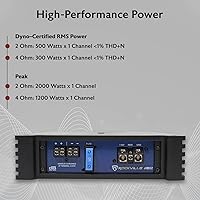
  • RMS Power (2Ω): This mono amp delivers 500W RMS at a 2-ohm load, which is the continuous, real-world power figure that actually matters for subwoofer performance.
  • RMS Power (4Ω): At a 4-ohm load, the amplifier produces 300W RMS, suitable for single 4-ohm subwoofers in standard sealed or ported enclosures.
  • Peak Power: The advertised 2000W peak figure represents a momentary maximum under ideal conditions and should not be used as a guide for matching subwoofers.
  • Channels: Single-channel (mono) design, purpose-built for powering one subwoofer or a pair of subwoofers wired to a combined impedance load.
  • Topology: Class D MOSFET design provides high switching efficiency, reducing heat output and current draw compared to traditional Class AB amplifier circuits.
  • Crossover: Onboard fully adjustable 12dB-per-octave low-pass crossover allows users to set the frequency cutoff point to match their specific subwoofer and enclosure combination.
  • Subsonic Filter: Adjustable subsonic filter sweeps from 15Hz to 55Hz to block infrasonic frequencies that can cause subwoofer over-excursion without producing audible sound.
  • Bass EQ: Onboard bass equalizer provides up to 12dB of boost, allowing low-end tuning without the need for an external equalizer unit.
  • Dimensions: The chassis measures 13.1 × 13.1 × 2.4 inches, offering a notably low profile that aids installation in tight trunk or under-seat spaces.
  • Weight: The amplifier weighs 9.88 pounds, which is typical for an aluminum-chassis mono block at this output class.
  • Material: The outer enclosure is constructed from polished aluminum, which aids passive heat dissipation and provides a more durable finish than plastic alternatives.
  • Operating Voltage: Designed to operate within a voltage range of 8V to 16V, covering the full spectrum of standard automotive 12V electrical systems under load and at idle.
  • Connectivity: Includes RCA line-level inputs and outputs, enabling signal pass-through and flexible integration with most aftermarket and factory head units.
  • Remote Control: A wired remote subwoofer level control is included in the box, allowing dashboard adjustment of bass volume without physically accessing the amplifier.
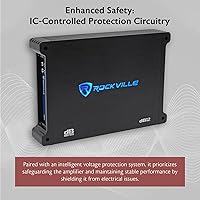
  • Protection: IC-controlled protection circuitry guards against overheating, short circuits, and under- or over-voltage conditions to help prevent damage during abnormal operating events.
  • LED Feature: An LED-illuminated Rockville logo is integrated into the chassis top panel — a cosmetic detail with no impact on audio performance.
  • Compliance: The amplifier carries FCC certification, confirming it meets U.S. federal standards for electromagnetic interference and radio frequency emissions.
  • Configuration: Surface-mount installation type; the amplifier is designed to be secured flat to a mounting surface such as a trunk floor or amp rack board.

Related Reviews
Rockville dB14 Mono Class-D Car Amplifier
74%
83%
Value for Money
78%
Power Accuracy
67%
Build Quality
54%
Long-Term Reliability
86%
Ease of Installation
More
Rockville dB15 Mono Car Amplifier
73%
83%
Value for Money
78%
Bass Output
86%
Ease of Installation
61%
Thermal Management
58%
Power Accuracy
More
Rockville RVA600.1 Mono Car Amplifier
74%
83%
Value for Money
74%
Sound Quality
88%
Ease of Installation
52%
Power Accuracy
67%
Build Quality
More
Rockville dBcomp5 Mono Car Amplifier
75%
88%
Verified Power Output
82%
Build Quality
91%
Onboard Tuning Flexibility
87%
1-Ohm Stability
79%
Remote Sub Control
More
Rockville dB11 1400W Mono Car Amplifier
85%
93%
Bass Performance
70%
Ease of Installation
89%
Compact Design
91%
Sound Clarity
85%
Build Quality
More
Rockville dB16 Mono Car Amplifier
73%
83%
Bass Output
78%
Value for Money
81%
Ease of Installation
59%
Thermal Management
62%
Power Accuracy
More
Rockville RVA-M2 Mono Car Amplifier
78%
83%
Value for Money
88%
Power Accuracy
71%
Build Quality
79%
Thermal Management
84%
Filter & Tuning Controls
More
Rockville dB13 Mono Car Amplifier
75%
83%
Value for Money
54%
Power Output Accuracy
61%
Thermal Management
88%
Ease of Installation
79%
Onboard Sound Controls
More
Rockville dBcomp4 3000W Mono Car Amplifier
85%
94%
Power Output
91%
Bass Performance
87%
Ease of Installation
89%
Build Quality
67%
Thermal Management
More
Rockville RXD-M3 Mono Car Amplifier
66%
83%
Value for Money
76%
Power Output
58%
Build Quality
52%
Long-Term Reliability
67%
Thermal Management
More

FAQ

Running your subwoofer at 2 ohms will get the most out of this mono amp, since that is where it puts out its full 500W RMS. A 4-ohm load is still perfectly usable at 300W RMS, but if your sub supports dual voice coil wiring, connecting it in parallel to hit 2 ohms is the better option for maximum output.

No — that 2000W figure is a peak rating, which is essentially a momentary ceiling under perfect laboratory conditions. The number you should focus on is 500W RMS at 2 ohms, which is the continuous, real-world power this amp actually delivers. When shopping for a matching subwoofer, pair it to that RMS figure, not the peak.

It depends on whether your factory head unit has RCA preamp outputs. If it does, you are good to go. If it only has speaker-level outputs, you will need an add-on line output converter to feed a proper RCA signal into the amp — those are inexpensive and easy to install.

Start with the low-pass crossover set somewhere between 80Hz and 100Hz, which suits most 10-inch and 12-inch subwoofers. Set the subsonic filter based on your enclosure type — a ported box typically needs the filter higher (around 35Hz–45Hz) to prevent over-excursion at tuning frequencies, while a sealed box can go lower. Make these adjustments with music playing at a moderate volume so you can hear the effect in real time.

Yes, the remote dashboard subwoofer control comes bundled with the amplifier. It connects via a small cable and mounts in a convenient spot on your dash or center console, letting you turn bass up or down without touching the amp itself — genuinely useful for everyday driving.

Protection mode is usually triggered by one of three things: a wiring short, impedance dropping too low, or the amp overheating. First check that your subwoofer wiring is clean and that the final impedance presented to the amp is not below 2 ohms. If heat is the culprit, make sure the amp has at least a few inches of clearance around it for airflow, and consider whether it is mounted somewhere that traps heat. Some owners of the Rockville dB12 Mono Car Amplifier in hot climates have reported this issue under sustained high-volume use, so ventilation is worth taking seriously.

Yes, as long as the combined impedance stays at 2 ohms or higher. For example, two 4-ohm subwoofers wired in parallel present a 2-ohm load, which works well. Avoid wiring configurations that drop below 2 ohms — this amp is not rated for 1-ohm operation, and pushing it there is likely to trigger protection mode or cause premature failure.

For an amp in this power class, a 4-gauge power and ground wire run is typically appropriate. You will want an inline fuse near the battery — something in the 60A to 80A range is a common recommendation for a 500W RMS mono amp. If you are unsure, err on the side of slightly larger wire gauge, since undersized wire creates resistance and can limit performance or create heat.

Honestly, it is a mixed picture. Many owners use this subwoofer amplifier for a year or more without issues, particularly those who keep the gain set sensibly and give it adequate ventilation. A smaller proportion report problems cropping up past the one-year mark. For a budget amp at this price point, the track record is reasonable — just do not expect the longevity of something twice the price.

A single 10-inch or 12-inch subwoofer rated for around 400W to 600W RMS is the sweet spot. Pairing it with a sub rated well below or above that range is less ideal — an underpowered sub may be pushed too hard, while a subwoofer rated for 1000W RMS will never reach its potential with this amp driving it. Stick to single-sub builds and you will get the best results.

Where to Buy