Overview

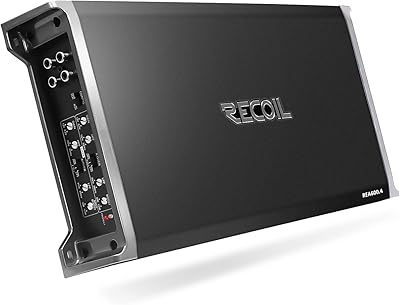
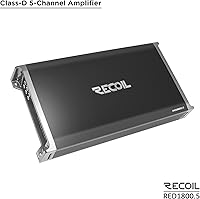
The Recoil RED1800.5 5-Channel Car Amplifier makes a compelling case for anyone tired of juggling two separate amps in a cramped trunk. By combining a four-channel full-range section with a dedicated mono subwoofer channel into one chassis, this 5-channel amp keeps wiring tidy and installation straightforward. Running Class-D topology, it draws less current and generates less heat than older designs — which matters on long drives or in hot enclosures. The 1-ohm mono stability is a genuine standout at this price point; most budget amps stop at 2 ohms. Just know going in: this Recoil unit competes on value, not boutique craftsmanship.
Features & Benefits

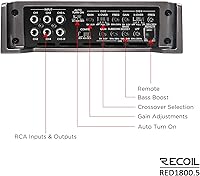
The mono channel is where the RED1800.5 really earns attention — pushing 1,280 watts RMS into 1 ohm means your subwoofer gets substantial, authoritative low-end rather than the tepid output that inflated max-power specs often hide. The four full-range channels deliver 140 watts RMS each into 4 ohms, which is plenty for a solid set of component speakers or quality coaxials. A remote bass knob ships in the box, a convenience many rival amps charge extra for. The onboard panel handles gain, low-pass filtering from 40 to 260Hz, a subsonic filter, and up to 12dB of bass boost — meaning most users can skip a standalone processor entirely.

Best For

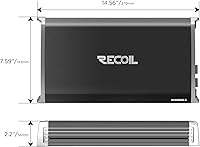
This 5-channel amp is purpose-built for the installer who wants a clean, single-amp solution powering a full speaker system and a subwoofer. It especially suits anyone running a dual-voice-coil sub or two subs wired to a combined 1-ohm load — a configuration that squeezes the most from the mono channel. Daily drivers who want simple, accessible bass tuning without reading a DSP manual will appreciate the straightforward onboard controls. Space-conscious installs benefit too; at roughly 14.6 by 7.6 inches, this Recoil unit fits comfortably where two separate amps simply would not. Factory head unit upgrades are another natural sweet spot here.

User Feedback

Buyers consistently highlight how straightforward the install process is, and the included remote knob gets specific praise for being genuinely useful day-to-day — not an afterthought. Most report the power output as honest and consistent, which stands out in a segment full of inflated claims. That said, a handful of users note that gain calibration requires patience; push the settings carelessly and distortion creeps in at high volume. Thermal complaints are rare, though a few who mounted the amp in fully sealed enclosures reported occasional warmth. The overall satisfaction trend leans clearly positive, with long-term durability comments encouraging, though the market history is still relatively short.

Pros

  • Combines a full 4-channel and a mono subwoofer amp into one compact unit, simplifying installs considerably.
  • The mono channel is genuinely 1-ohm stable, a rare and useful spec at this price tier.
  • Honest RMS power output on the mono channel translates to real, authoritative bass in practice.
  • Remote bass knob is included at no extra cost, unlike many competing amps that sell it separately.
  • Onboard low-pass, subsonic filter, and bass EQ reduce the need for an external signal processor.
  • Class-D design runs efficiently, drawing less current and producing less heat than older amp topologies.
  • 4-way protection circuitry adds meaningful peace of mind for daily-driver use in warm climates.
  • Compact footprint makes trunk or under-seat placement realistic without sacrificing cargo space.
  • Straightforward installation process praised consistently by real buyers across varying skill levels.
  • Operating voltage range of 9V to 16V gives it flexibility across different vehicle electrical systems.

Cons

  • Gain calibration demands patience — careless setup leads to audible distortion at higher volumes.
  • 89dB signal-to-noise ratio on full-range channels falls short of dedicated audiophile-grade amplifiers.
  • Passive heatsink cooling can struggle in sealed, airflow-restricted mounting locations.
  • 140W RMS per full-range channel may leave power-hungry, high-end component speakers underserved.
  • The brand carries limited market history compared to established names, making long-term reliability harder to gauge.
  • No built-in crossover flexibility for the full-range channels beyond the onboard controls, limiting advanced tuning.
  • Fuse rating of 200 amps requires properly sized power wiring that budget installers sometimes overlook.
  • Heavier than it looks at over 9 pounds, which can be a factor for under-seat or custom-fabricated mounts.

Ratings

The scores below were generated by AI after analyzing verified buyer reviews for the Recoil RED1800.5 5-Channel Car Amplifier from multiple global marketplaces, with spam, bot activity, and incentivized submissions actively filtered out. Each category reflects the honest consensus of real-world installers and daily drivers — strengths and frustrations alike — so you can make a genuinely informed decision before buying.
Value for Money
91%
For buyers who want to consolidate a full speaker amp and a subwoofer amp into one unit without breaking the budget, the RED1800.5 consistently over-delivers. The inclusion of the remote bass knob and onboard signal processing at this price tier makes the overall package feel notably generous compared to similarly priced competitors.
Buyers comparing it against premium single-brand 5-channel amps from established names will notice differences in fit, finish, and measurable audio performance. The value proposition is strong, but only if your expectations are calibrated to the mid-range market rather than enthusiast-grade hardware.
Mono Channel Power
88%
The mono channel's 1-ohm stability is what sets this Recoil unit apart at its price point, giving builders the freedom to wire dual subs or dual-voice-coil drivers in parallel for maximum output. Users running demanding subwoofer setups report genuinely satisfying low-end impact that feels honest relative to the rated RMS figures.
Achieving peak output requires careful gain calibration and properly rated wiring — buyers who skip this step often report underwhelming bass or distortion creeping in at higher volumes. The mono channel's performance is real, but it is conditional on correct setup.
Installation Experience
86%
Consolidating everything into one chassis simplifies wiring runs significantly, and most buyers with moderate DIY experience report clean, manageable installs. The clearly labeled input and output terminals reduce guesswork, and the compact footprint fits comfortably in trunk corners or under rear seats.
The 200-amp fuse requirement means proper 1/0 AWG power wiring is non-negotiable, which can add unexpected cost and complexity for first-time installers. A few buyers noted the included documentation could be clearer on recommended wire gauges and remote turn-on wiring.
Gain Calibration Ease
63%
37%
For experienced installers who already own a multimeter or oscilloscope, getting the gain structure dialed in is a routine task. The onboard controls are logically arranged and respond predictably once the user understands the relationship between source output and amplifier sensitivity.
This is where less experienced buyers consistently run into trouble — the gain controls are sensitive enough that minor miscalibration introduces audible distortion at moderate volumes. Several reviewers attributed what they initially suspected was a hardware fault to gain settings that were simply too high for their head unit's output level.
Full-Range Channel Performance
74%
26%
For everyday coaxial speakers or entry-level component sets, the four full-range channels deliver clean, adequate power that noticeably improves on typical factory output. Daily commuters powering a set of 6.5-inch door speakers report a satisfying step up in clarity and dynamic range.
Power-hungry mid-range or high-sensitivity component speakers can expose the ceiling of 140W RMS per channel faster than expected in larger cabins. There are also no onboard high-pass filter controls for the full-range channels, which limits tuning precision for more discerning setups.
Thermal Management
71%
29%
Under normal operating conditions with reasonable airflow around the heatsink, the Class-D design keeps temperatures manageable even during extended listening sessions. Users who mount this 5-channel amp in open trunk locations or on ported enclosure surfaces rarely report heat-related shutdowns.
Sealed or heavily enclosed mounting positions are where thermal complaints surface — the passive heatsink depends on ambient airflow, and without it, the protection circuitry begins throttling output or shutting down during longer high-volume sessions. This is a design reality rather than a defect, but it requires thoughtful placement.
Build Quality
69%
31%
The chassis feels solid enough for a daily-driver install, and the heatsink construction is substantial relative to the price tier. Most buyers report no cosmetic or structural issues out of the box, and the overall fit of the terminal covers and control panel is acceptable.
Side-by-side with amplifiers from more established brands, the materials and finishing reveal the cost compromises — the chassis flex under pressure and the control knobs feel less precise. It is not a build quality concern that affects function, but audiophiles accustomed to premium hardware will notice it immediately.
Onboard Signal Processing
83%
Having a variable low-pass filter, subsonic filter, and bass boost all onboard is a meaningful convenience that lets most users skip adding a standalone equalizer or signal processor. The subsonic filter in particular is an underappreciated inclusion — it protects subwoofers from infrasonic frequencies that can cause damage over time without adding audible bass.
The full-range channels lack onboard high-pass filtering, which is a genuine omission for builders who want to relieve their door speakers of low-frequency strain. Users who want complete crossover control over every channel will still need an external processor to fill that gap.
Remote Bass Knob
89%
Buyers consistently single out the included remote knob as one of the most appreciated touches in everyday use — being able to dial back bass during phone calls or late-night driving without touching the amp is a genuine quality-of-life improvement. The control responds smoothly and the cable length is practical for most dash-mounting locations.
The knob controls bass level only, not overall volume or crossover points, which is standard but worth noting for buyers expecting broader control. A small number of users reported the knob connection feeling slightly loose over time with repeated adjustment, though this appears to be an edge case.
Compatibility & Versatility
77%
23%
The wide 9V to 16V operating voltage range makes this Recoil unit broadly compatible with standard automotive electrical systems, including older vehicles with less stable charging output. The 1-ohm mono stability also opens up subwoofer wiring configurations that most budget 5-channel amps simply cannot support.
Buyers using factory head units without RCA outputs need a line output converter, which is an additional purchase and install step that some first-timers overlook. The amp also lacks high-level speaker inputs natively, narrowing its out-of-box compatibility with OEM source units.
Protection Circuitry
84%
The 4-way protection system covering thermal, voltage, speaker, and DC conditions is a meaningful safety net for daily-driver installs where conditions are not always perfectly controlled. Users who accidentally clipped a speaker wire during install reported the amp protecting itself and resuming normal operation once the fault was cleared.
When the protection circuitry triggers in poorly ventilated installs, the amp cuts out without any indicator light or audible warning beyond silence — making initial troubleshooting somewhat ambiguous for less experienced users. A status LED system would make diagnostics considerably more straightforward.
Long-Term Reliability
67%
33%
Among buyers who installed the amp correctly with properly rated wiring and adequate ventilation, the majority report consistent, trouble-free operation over months of regular use. The MOSFET power supply design is inherently more resilient to brief voltage spikes than older bipolar designs.
The product's relatively short market history makes definitive long-term reliability conclusions difficult to draw. A subset of reviews mentions units failing after several months of use, though it is not always clear whether installation conditions or component quality were the contributing factor.
Footprint & Dimensions
82%
18%
At 14.6″ by 7.6″ with a 2.2″ profile, this amp fits comfortably in spaces where running two separate amps simply would not be practical — under rear seats in many sedans and SUVs, or in shallow trunk sidewall recesses. For space-constrained builds, the compact single-chassis solution is a legitimate advantage.
While the footprint is reasonable for a 5-channel unit, it is not the smallest option on the market and may still require mounting bracket fabrication for very tight under-seat placements in compact vehicles. The 9.35-pound weight is also worth factoring in for custom enclosure or rack-mount designs.
Brand Support & Documentation
58%
42%
The basic product documentation covers the essential connection and setup steps well enough for a competent installer to get the amp running without outside resources. Recoil's product page provides the core specifications buyers need for pre-install planning.
Compared to legacy car audio brands with decades of community support, detailed wiring diagrams, and active installer forums, Recoil's ecosystem is noticeably thin. Buyers who run into edge-case setup issues may find limited manufacturer support resources and a smaller body of community troubleshooting content to draw from.

Suitable for:

The Recoil RED1800.5 5-Channel Car Amplifier is purpose-built for the practical builder who wants to power a complete audio system — door speakers, tweeters, and a subwoofer — without running two separate amps and twice the wiring. It suits enthusiasts who wire their subwoofer load down to 1 ohm, whether through a dual-voice-coil driver or two subs in parallel, and want genuinely strong mono output without spending significantly more. Daily drivers who prefer adjusting bass from the driver's seat will find real value in the included remote knob, which handles those on-the-fly tuning moments without pulling over. Installers working with tight trunk configurations or under-seat placement will appreciate the compact single-chassis footprint this Recoil unit offers. It is also a strong match for anyone upgrading from a stock head unit setup who wants a meaningful, all-in-one performance step-up without overcomplicating the build.
Not suitable for:

The Recoil RED1800.5 5-Channel Car Amplifier is not the right choice for serious audiophiles chasing reference-grade sound quality or ultra-low noise floors — at this price point, the signal-to-noise ratio on the full-range channels (89dB) trails what dedicated high-end 4-channel amps deliver. Buyers planning to run high-impedance, power-hungry speakers like certain high-end component sets may find the 140W RMS per channel ceiling limiting over time. This Recoil unit is also not ideal for competition-level builds where output headroom, channel separation, and tuning precision matter above all else. Installers who plan to mount the amp in a sealed, poorly ventilated enclosure should think carefully — while thermal protection exists, passive cooling works best with reasonable airflow. Lastly, anyone expecting plug-and-play convenience without any calibration work should be aware that gain settings require deliberate setup to avoid distortion.
Specifications

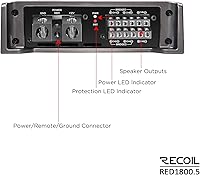
  • Amplifier Class: Class-D topology delivers high efficiency, reducing heat output and current draw compared to traditional Class-AB designs.
  • Channels: Five total channels — four full-range channels for speakers and one dedicated mono channel for subwoofer output.
  • Max Power: Total maximum power output is rated at 1,800 watts across all five channels combined.
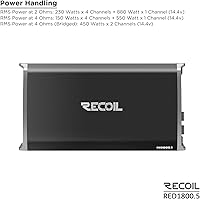
  • Mono RMS Output: The mono channel produces 1,280W RMS at 1 ohm, 980W RMS at 2 ohms, and 600W RMS at 4 ohms (all at 14.4V).
  • 4-Channel RMS: Each full-range channel delivers 220W RMS at 2 ohms or 140W RMS at 4 ohms (at 14.4V).
  • Mono Stability: The mono subwoofer channel is stable down to 1 ohm, supporting dual-voice-coil and multi-subwoofer parallel wiring configurations.
  • Frequency Response: Full-range channels cover 10Hz to 25kHz; the mono channel is bandlimited to 10Hz–300Hz to optimize subwoofer performance.
  • Signal-to-Noise: Signal-to-noise ratio is rated at 89dB for the four full-range channels and 94dB for the mono channel.
  • Low-Pass Filter: Variable low-pass filter on the mono channel is adjustable between 40Hz and 260Hz to match a wide range of subwoofer and enclosure types.
  • Subsonic Filter: Built-in subsonic filter is variable from 12Hz to 55Hz, protecting subwoofers from damaging infrasonic frequencies.
  • Bass Boost: Onboard bass EQ provides up to 12dB of boost on the mono channel for added low-frequency impact when needed.
  • Protection: 4-way protection circuitry guards against thermal overload, voltage irregularities, speaker faults, and DC offset conditions.
  • Operating Voltage: The amplifier operates within a 9V to 16V DC range, making it compatible with standard 12V automotive electrical systems.
  • Fuse Rating: Total fuse rating is 200 amps, requiring appropriately gauged power and ground wiring for safe, full-output operation.
  • Dimensions: The amplifier measures 14.6″ long by 7.6″ wide by 2.2″ tall (370mm x 193mm x 56mm).
  • Weight: Unit weight is 9.35 pounds, which should be factored into mounting bracket and surface-mount planning.
  • Remote Knob: A wired remote bass level knob is included in the package, allowing driver-seat adjustment of subwoofer output without accessing the amp.
  • Power Supply: High-speed MOSFET power supply provides stable rail voltage under dynamic load conditions during high-output listening sessions.
  • Mounting Type: Designed for surface mounting, with a low-profile 2.2″ height that suits under-seat or shallow trunk installations.
  • Heatsink Design: Integrated aluminum heatsink spans the full length of the chassis to passively dissipate heat generated during extended operation.

Related Reviews
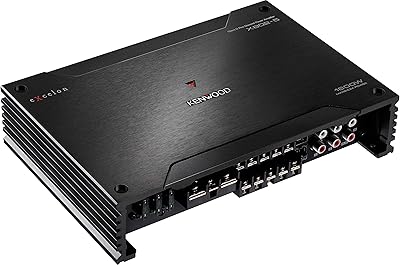
Kenwood X802-5 eXcelon 5 Channel Car Audio Amplifier
88%
92%
Sound Quality
85%
Installation Ease
88%
Build Quality
90%
Performance at High Volume
87%
Bass Enhancement
More
Stinger MT-1000.5 5-Channel Car Amplifier
75%
81%
Value for Money
84%
Ease of Installation
58%
Real-World Power Output
63%
Thermal Management
88%
Built-in Crossover Filters
More
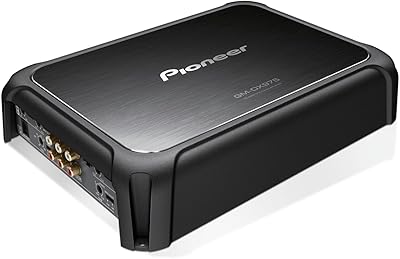
Pioneer GM-DX975 5-Channel Car Amplifier
81%
88%
Sound Quality
83%
Power Delivery
81%
Build Quality
71%
Thermal Management
74%
Ease of Installation
More
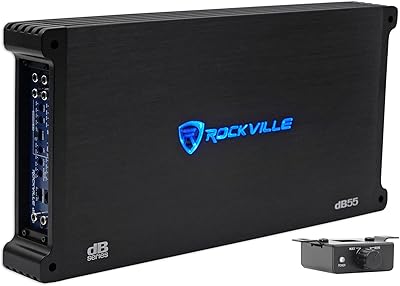
Rockville dB55 5-Channel Car Amplifier
75%
91%
Value for Money
83%
Sound Quality at Moderate Volumes
78%
Bass Output & Subwoofer Performance
62%
Power Accuracy & Transparency
58%
Thermal Management & Heat
More
Recoil REA600.4 4-Channel Car Audio Amplifier
84%
89%
Audio Performance
91%
Ease of Installation
85%
Sound Quality at High Volumes
62%
Heat Management
90%
Power Output
More
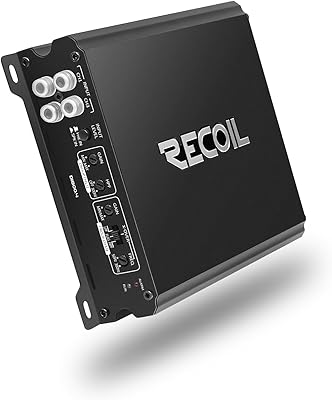
Recoil DI550.4 4-Channel Car Audio Amplifier
74%
91%
Value for Money
78%
Power Output
86%
Ease of Installation
74%
Sound Quality
67%
Build Quality
More
Recoil DI800.4 4-Channel Car Audio Amplifier
83%
88%
Sound Quality
92%
Power Output
65%
Thermal Management
84%
Build Quality
91%
Ease of Installation
More
Planet Audio MB2200.5D 5-Channel Car Amplifier
71%
83%
Value for Money
81%
Ease of Installation
86%
Channel Configuration
54%
Power Output (Real-World)
77%
Thermal Management
More
Rockville RXH-F5 5-Channel Car Amplifier

74%
88%
Value for Money
74%
Power Accuracy
83%
Installation Ease
79%
Sound Quality
68%
Subwoofer Performance
More
NVX VADM5 v2 5-Channel Car Amplifier
79%
93%
Compact Form Factor
88%
Installation Ease
67%
Power Output (RMS)
81%
Sound Clarity
62%
Thermal Management
More

FAQ

You can absolutely run a 4-ohm sub and still get solid output — the mono channel delivers 600W RMS at 4 ohms, which is plenty for most single-sub setups. Wiring to 1 ohm gives you the full 1,280W RMS, but that level of power really only makes sense if your subwoofer is rated to handle it. Match the load to your driver's RMS power handling, not just the amp's maximum capability.

It comes included in the box — no separate purchase needed. This is one of the more practical inclusions on this Recoil unit, since a lot of amps at this price either omit the knob entirely or bundle it as an add-on.

You will need either an aftermarket head unit with RCA preamp outputs or a line output converter (LOC) to interface a factory head unit with this amp. The amp itself does not include a built-in high-level speaker input, so a LOC is the most common workaround for OEM setups. This is a standard requirement for most aftermarket amplifiers, not unique to this one.

For a 200-amp fuse rating, you should use 1/0 AWG (zero gauge) power and ground cable as a baseline, especially for runs over 10 feet. Using undersized wire is one of the most common mistakes in amp installs and can cause voltage drop, heat buildup, and tripped fuses. Always fuse the power wire within 18 inches of the battery with an inline fuse rated to match your wire's ampacity.

Mounting it upside down with the heatsink facing down is generally fine and actually preferred in some under-seat installs since heat rises away from the chassis. Avoid mounting it flat against a surface with no airflow clearance on the heatsink side. Sidewall mounting is also workable as long as the fins have room to breathe.

The onboard crossover controls — including the low-pass filter, subsonic filter, and bass boost — apply specifically to the mono subwoofer channel. The four full-range channels do not have individual onboard high-pass crossover controls, so if you want to high-pass your speakers, you would either use the high-pass setting on your head unit or add an external processor.

Under normal conditions with reasonable airflow around the heatsink, most users report it stays warm but manageable. Mounting it in a sealed compartment with no ventilation is where problems tend to surface — the 4-way protection circuitry will shut the amp down before it damages itself, but that also means your music cuts out. Give the heatsink at least a couple of inches of clearance on all sides if possible.

Bridging capability on the full-range channels is not explicitly confirmed in the published specifications for this amp. If stereo bridging is a priority for your build, verify directly with Recoil before purchasing, as forcing an unbridgeable amp into a bridged configuration can cause permanent damage.

At 1 ohm, the amp puts out 1,280W RMS, so ideally your subwoofer's RMS power handling should fall within about 75–100% of that figure to avoid underpowering or overpowering it. Running a sub rated at 500W RMS at 1 ohm is not a disaster, but you would be underutilizing the channel. A dual-voice-coil sub rated around 1,000–1,200W RMS wired to 1 ohm is a well-matched pairing.

Gain is not a volume control — it sets the sensitivity of the amp's input to match the output level of your head unit. Setting it too high relative to your source introduces clipping and distortion that can damage speakers over time, even if it does not sound obviously bad at first. The right approach is to use a multimeter or oscilloscope to set gains by matching the amp's clipping point to the head unit's maximum clean output. A few buyers have flagged distortion issues with this amp that were ultimately traced back to improper gain setup rather than a fault with the unit itself.