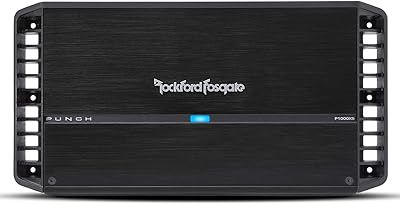
Overview

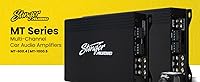
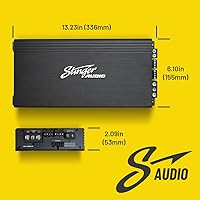
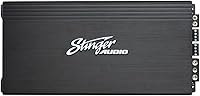
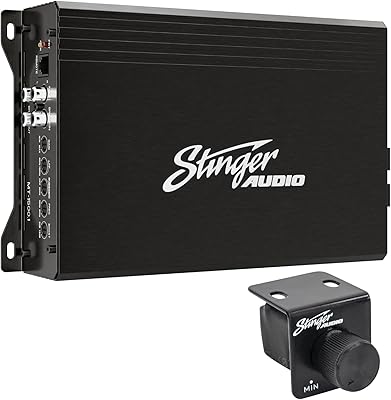
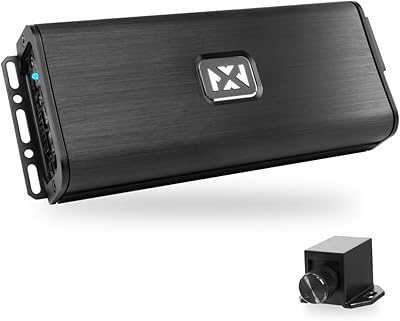
The Stinger MT-1000.5 5-Channel Car Amplifier enters a competitive space — the bracket where most builders are trying to avoid running two separate amps. Stinger has long been the brand you reach for when buying wiring kits and install accessories, so this amplifier represents a real push into audio hardware territory. The Class D topology keeps heat manageable enough to tuck the unit under a seat or into a tight trunk corner, which matters when space is at a premium. At 13.23 x 6.1 x 2.09 inches, the footprint is genuinely compact for what it promises. One honest caveat upfront: it runs an unregulated power supply, so the 1200W RMS figure is a ceiling tied to your vehicle's actual voltage.
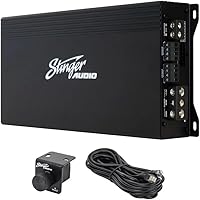
Features & Benefits

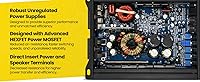
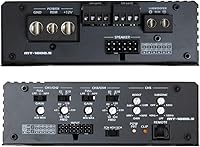
What sets this 5-channel amp apart from cheaper alternatives starts under the hood. The HEXFET MOSFET design delivers lower on-resistance and faster switching, which translates to less wasted energy as heat — a practical win in enclosed installs. The built-in high-pass and low-pass crossover filters are a genuine time-saver; you can run tweeters, mid-range speakers, and a subwoofer without wiring in a separate crossover. A subsonic filter adds protection for your sub, particularly important with ported boxes where cone excursion can get out of control at very low frequencies. The Bass Boost Q lets you target a specific frequency rather than just cranking global bass, and the remote bass knob — included, not an add-on — sits flush-mount for clean driver-seat control.

Best For

This Stinger amplifier makes the most sense for builders who are space-constrained and want a single-amp solution. If your trunk is already tight or you are working an under-seat install, having everything — four speaker channels and a dedicated sub channel — consolidated into one chassis simplifies the wiring run considerably. It is also a solid pick for someone stepping up from a factory system for the first time, where budget is a real constraint and managing two separate amplifiers feels like overkill. The integrated crossover management is a particular draw for anyone running a component speaker set, since you avoid the cost and complexity of a standalone crossover unit. The remote bass knob is a nice bonus for daily drivers who like hands-on bass control without touching the head unit.

User Feedback

Buyer sentiment around the MT-1000.5 skews positive for installation experience — people appreciate that the built-in filters reduce the parts count and the remote knob works as advertised right out of the box. Where opinions diverge is on real-world power output. Buyers with a meter consistently report that actual wattage falls short of the 1200W RMS claim, which is expected behavior for an unregulated design but still frustrating when you have planned your build around those numbers. A handful of users report the amp entering protection mode under prolonged high-volume use, suggesting thermal headroom is limited. Feedback on the remote knob cable length is mixed — adequate for some installs, too short for others. Overall, satisfaction aligns with the price tier: decent value, not a powerhouse.

Pros

  • Five channels in one compact box eliminates the need to mount, wire, and tune two separate amplifiers.
  • Built-in high-pass and low-pass crossover filters save money and simplify wiring for tweeters, mids, and a sub.
  • The included flush-mount remote bass knob is a genuine value add that rivals often charge extra for.
  • Class D design runs cooler than older AB-class units, which is a real advantage in confined install spaces.
  • HEXFET MOSFET technology improves efficiency under load, reducing strain on your vehicle's electrical system.
  • The subsonic filter protects subwoofers in ported enclosures from damaging ultra-low frequency excursion.
  • Bass Boost Q lets you target a specific frequency band, giving far more tuning precision than a simple bass knob.
  • Direct-insert terminals make wiring connections more secure and reduce contact resistance over time.
  • The compact footprint — just over 13 inches long — fits under seats and in shallow trunk spaces where most amps will not.

Cons

  • Unregulated power supply means real-world output often falls noticeably short of the advertised 1200W RMS rating.
  • The amp can enter protection mode under prolonged high-volume use, suggesting thermal headroom is limited.
  • Stinger has minimal track record as an amplifier manufacturer, which gives some buyers reasonable pause.
  • The remote bass knob cable length may be too short for larger vehicles or installs with the amp in a rear location.
  • Not a strong match for subwoofers that genuinely demand high, sustained wattage to perform correctly.
  • No regulated power supply means output consistency varies with battery health and alternator load.
  • Buyers accustomed to established amp brands may find the MT-1000.5 harder to benchmark against proven competitors.
  • Limited long-term reliability data available given the product launched in early 2024.

Ratings

Our AI rating engine analyzed verified global buyer reviews for the Stinger MT-1000.5 5-Channel Car Amplifier, actively filtering out incentivized, bot-generated, and unverified submissions to surface what real installers actually experienced. The scores below reflect a transparent synthesis of both what this amp does well and where it falls short — no padding, no spin. Enthusiasts who matched it to the right use case rated it notably higher than those who pushed it beyond its intended operating range.

Value for Money
81%
19%
For builders trying to complete a full five-speaker-plus-sub system without a second amp purchase, the price-to-feature ratio is hard to argue with. Getting built-in crossovers, a subsonic filter, a Bass Boost Q control, and a remote bass knob all bundled in makes the effective cost per feature quite competitive in this tier.
Buyers who bench-tested the amp and compared measured output against the claimed RMS figure felt the value proposition weakened considerably. If you are paying for 1200 watts and getting meaningfully less due to the unregulated supply, the math starts to feel less generous.
Ease of Installation
84%
The direct-insert terminals accept wiring cleanly without requiring special ferrules or adapters, and the labeled control panel is laid out logically enough that experienced installers get it wired and tuned quickly. Multiple buyers noted completing the full install, including crossover configuration, in a single afternoon session.
First-time installers occasionally struggled with setting the crossover frequency points correctly without a manual on hand, and a few reported the gain structure was not immediately intuitive coming from other brands. The remote knob cable length was also a friction point for larger vehicle installs.
Real-World Power Output
58%
42%
At healthy battery voltages — close to the rated 14.4V — the amp moves real air and drives a subwoofer with noticeable authority for daily listening. Buyers who set realistic expectations going in and tuned accordingly reported being satisfied with the loudness level in compact and mid-size vehicles.
This is the single most divisive category in buyer feedback. The unregulated power supply means output drops with voltage, and measured wattage on a dedicated test bench regularly came in well below the advertised 1200W total RMS. Buyers who planned their build around the rated figure felt misled.
Thermal Management
63%
37%
For normal daily driving — commutes, moderate listening levels, typical urban stop-and-go — the Class D design keeps temperatures well within acceptable range. Buyers who mounted it under a seat with a few inches of clearance reported no thermal issues across months of regular use.
Extended high-volume sessions are where the MT-1000.5 showed its limits. A recurring thread in buyer feedback involved the amp clipping into protection mode during long highway drives at loud levels, particularly in warmer climates or when airflow around the chassis was restricted by carpeting or tight enclosures.
Built-in Crossover Filters
88%
The high-pass and low-pass filters were consistently praised as one of the strongest practical reasons to choose this amp. Installers running a component speaker set alongside a subwoofer appreciated being able to hand off frequency management entirely to the amp without adding an external crossover to the parts list or signal chain.
The crossover controls are functional but basic — there is no parametric adjustment or multi-slope selection, so demanding tuners who want precise 24dB-per-octave rolloffs or specific crossover points may find the onboard options limiting. For the average install they are perfectly adequate; for enthusiast-level tuning, less so.
Build Quality
71%
29%
The chassis feels solid for the price tier — no flexing panels or cheap plastic end caps that rattle loose after a few months in a vibrating vehicle. The heatsink design is substantial enough to inspire confidence, and the overall assembly tolerance is tighter than some competing amps at this price point.
Stinger is not yet a name that carries the same hardware reputation as dedicated amplifier manufacturers, and a subset of buyers expressed doubt about long-term durability beyond the one or two year mark. The limited production history means there is simply not enough long-run field data to score this category higher with confidence.
Remote Bass Knob
76%
24%
The fact that this knob is included in the box at all — rather than sold separately as many competitors do — generated consistent goodwill among buyers. The flush-mount design looks clean in a dash or center console cutout, and the control itself is smooth and responsive without feeling cheap under the finger.
The included cable length was a recurring complaint from buyers with longer runs, particularly in trucks and full-size SUVs where the amp sits in a rear cargo area. A longer cable or a modular extension option would resolve this entirely, but as shipped it is a limitation some builders have to work around.
Subsonic Filter
83%
Buyers running ported subwoofer enclosures specifically called out the subsonic filter as a feature that gave them peace of mind — particularly those who had previously blown a woofer by driving it too hard below its usable bandwidth. Having it onboard removes one more external component from the signal path.
The filter is a fixed-function control rather than a fully adjustable parametric option, so users who want to dial in a very specific rolloff frequency for a tuned port enclosure may find it less precise than a dedicated processor. It does its job for the majority of installs, but enthusiasts may want more granularity.
Bass Boost Q Control
79%
21%
Unlike a simple flat bass boost, the Q control lets you target a frequency band, which translates into tighter, more musical bass rather than a muddy low-frequency swell. Daily drivers who just want their sub to hit with some extra weight without wrecking the midrange found this genuinely useful and easy to set by ear.
At higher boost settings — pushing past 9dB or so — some buyers noted audible distortion creeping in, especially with the gain set aggressively. The control is best treated as a moderate tuning tool rather than a loudness maximizer, and users who cranked it expecting clean output at 12dB were sometimes disappointed.
Channel Configuration Flexibility
74%
26%
Having four full-range channels alongside a dedicated sub channel covers the most common vehicle audio layouts — front and rear speakers with a single subwoofer — without any compromise. Installers building out a straightforward full-system upgrade from a stock setup found the channel layout matched their needs almost exactly.
Buyers with more complex system goals — running multiple subwoofers, bi-amping component speakers, or building a multi-amp system where this unit contributes only part of the channels — found the fixed 5-channel layout limiting. There is also no 4-channel mode if you want to repurpose the sub channel for a different use.
Compact Form Factor
86%
At just over 13 inches long and barely 2 inches tall, this is one of the slimmer 5-channel options available for its claimed power output. Installers in vehicles with tight under-seat cavities — compact sedans, sport coupes, smaller hatchbacks — praised the footprint repeatedly as a primary reason for choosing it over larger alternatives.
The slim profile is an advantage in placement but does constrain the internal heatsinking area, which is part of why sustained high-output sessions can push it toward protection mode. There is a genuine engineering trade-off between compact size and thermal capacity that this amp does not fully escape.
Signal-to-Noise Performance
67%
33%
Under normal operating conditions with a clean input signal and proper grounding, the noise floor is acceptable for daily listening, and most buyers reported no audible hiss or interference during quiet passages. For the price tier, the signal cleanliness is broadly in line with competing units.
A subset of buyers reported ground loop hum or interference noise, particularly when the gain was set high or the amp was mounted near other electronics. Ground loop sensitivity is not unique to this amp, but the chassis does not appear to include any advanced shielding that might make it more forgiving of imperfect installs.
Brand Confidence
61%
39%
Stinger carries genuine credibility in the car audio installation community through their wiring and accessory products, which gives buyers some comfort that the brand understands the environment this amp operates in. Several buyers cited trust in the Stinger name from positive experiences with their wiring kits as the deciding factor.
Stinger is still a relatively new entrant in the amplifier hardware space, and buyers accustomed to brands with decades of amp-specific engineering history were noticeably more skeptical. The limited track record makes it harder to assess long-term reliability, and warranty support experiences in the buyer community were inconsistently reported.

Suitable for:

The Stinger MT-1000.5 5-Channel Car Amplifier is built for the practical installer who wants a complete audio solution without the complexity and cost of running separate full-range and mono amplifiers. If your install space is tight — a compact sedan trunk, an under-seat cavity in a truck, or any build where mounting real estate is scarce — the slim profile makes placement far less of a headache than most competing units at this power level. It suits enthusiasts who are upgrading from a stock head unit for the first time and want tweeters, mid-range speakers, and a subwoofer all driven from a single chassis without buying a standalone crossover on top. Daily drivers who want convenient bass control from the front seat will also appreciate the included remote knob, which many rivals treat as a paid accessory. In short, this amp rewards builders who prioritize simplicity, space efficiency, and a clean one-amp install over chasing maximum measured wattage.
Not suitable for:

Buyers who bench-test their equipment or plan around rated RMS figures will likely be disappointed — the MT-1000.5 runs an unregulated power supply, meaning real output tracks your vehicle's battery voltage and will consistently fall short of the 1200W headline number on a meter. If you are pushing a power-hungry subwoofer that genuinely needs 500 or more clean watts on its own, this 5-channel amp is not the right tool; a dedicated regulated mono block will serve you better. Audiophiles chasing low noise floors and high signal fidelity at reference listening levels may also find the MT-1000.5 lacking, as its thermal headroom becomes a limiting factor under sustained, high-volume conditions. Builders with large vehicles — full-size SUVs, vans, or trucks with significant cabin volume to fill — will likely need more amplifier than this unit can reliably deliver. And anyone who needs a remote knob cable run longer than a few feet across the cabin should verify the included cable length against their specific install before committing.

Specifications

  • Model Number: The unit carries the official model designation MT-1000.5.
  • Channels: This is a 5-channel amplifier, providing four full-range channels plus one dedicated subwoofer channel.
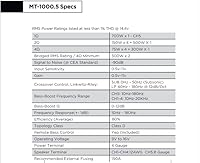
  • Claimed RMS Power: Total claimed RMS output is 1200W across all five channels at 14.4V DC, though real-world output will vary with supply voltage.
  • Amplifier Class: Class D topology is used throughout, prioritizing switching efficiency and reduced heat generation over pure analog fidelity.
  • MOSFET Type: Advanced HEXFET power MOSFETs are used in the output stage, offering lower on-resistance and faster switching than standard MOSFET designs.
  • Power Supply: The internal power supply is unregulated, meaning output power tracks directly with the vehicle battery voltage rather than holding a fixed rail.
  • Operating Voltage: Rated operating voltage is 14.4V DC, which corresponds to a healthy, alternator-charged automotive electrical system.
  • Dimensions: The chassis measures 13.23 x 6.1 x 2.09 inches (L x W x H), making it one of the more compact units available at this power rating.
  • Weight: The amplifier weighs 7.56 pounds, which is manageable for single-person installs in most mounting locations.
  • Mounting Type: Surface mount installation is required; no rack-mount or recessed-mount options are supported by the chassis design.
  • Crossover Filters: Built-in switchable high-pass and low-pass crossover filters are included on the full-range and subwoofer channels respectively, eliminating the need for an external crossover unit.
  • Subsonic Filter: An onboard subsonic filter is included to block damaging ultra-low frequencies from reaching the subwoofer, particularly useful with ported enclosures.
  • Bass Boost Q: The Bass Boost Q control allows a frequency-selective boost of 0 to 12dB, letting the user target a specific bass frequency rather than applying a broadband boost.
  • Remote Bass Knob: A flush-mount remote subwoofer level control knob is included in the box, allowing bass adjustment from the driver seat without accessing the amplifier directly.
  • Speaker Terminals: Direct-insert speaker and power terminals are used throughout, designed to minimize contact resistance under sustained high-current draw conditions.
  • Manufacturer: The MT-1000.5 is manufactured by Stinger, a company with an established background in car audio wiring, installation accessories, and signal cables.
  • Availability Date: The product was first made available in March 2024, making long-term reliability data still limited at the time of this review.

Related Reviews
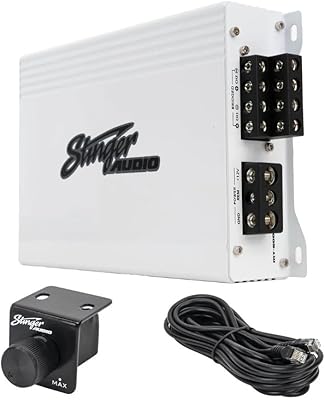
Stinger Audio MT-600.4M Marine Amplifier
76%
83%
Sound Output & Power Delivery
78%
Build Quality & Durability
76%
Water Resistance
67%
Thermal Management & Heat Dissipation
79%
Installation Ease
More
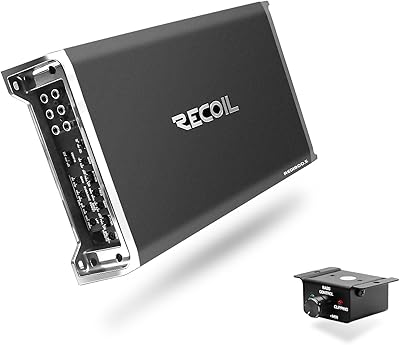
Recoil RED1800.5 5-Channel Car Amplifier
77%
91%
Value for Money
88%
Mono Channel Power
86%
Installation Experience
63%
Gain Calibration Ease
74%
Full-Range Channel Performance
More
Kenwood X802-5 eXcelon 5 Channel Car Audio Amplifier
88%
92%
Sound Quality
85%
Installation Ease
88%
Build Quality
90%
Performance at High Volume
87%
Bass Enhancement
More
Rockville dB55 5-Channel Car Amplifier
75%
91%
Value for Money
83%
Sound Quality at Moderate Volumes
78%
Bass Output & Subwoofer Performance
62%
Power Accuracy & Transparency
58%
Thermal Management & Heat
More
Pioneer GM-DX975 5-Channel Car Amplifier
81%
88%
Sound Quality
83%
Power Delivery
81%
Build Quality
71%
Thermal Management
74%
Ease of Installation
More
Rockville RXH-F5 5-Channel Car Amplifier
74%
88%
Value for Money
74%
Power Accuracy
83%
Installation Ease
79%
Sound Quality
68%
Subwoofer Performance
More
Planet Audio MB2200.5D 5-Channel Car Amplifier
71%
83%
Value for Money
81%
Ease of Installation
86%
Channel Configuration
54%
Power Output (Real-World)
77%
Thermal Management
More
NVX VADM5 v2 5-Channel Car Amplifier
79%
93%
Compact Form Factor
88%
Installation Ease
67%
Power Output (RMS)
81%
Sound Clarity
62%
Thermal Management
More
Rockford Fosgate P1000X5 5-Channel Car Amplifier
82%
91%
Sound Quality
88%
Bass Performance
93%
Build Quality
86%
Power Output Accuracy
67%
Installation Experience
More
Stinger MT-1500.1 Monoblock Car Amplifier
74%
83%
Bass Output Performance
57%
Rated vs Real-World Power
74%
Build Quality
62%
Heat Management
88%
Ease of Installation
More

FAQ

Realistically, no — not in most vehicles. The MT-1000.5 uses an unregulated power supply, which means its output is directly tied to your battery and alternator voltage. At a true 14.4V with a healthy electrical system you will get close to rated figures, but in a typical idling or older vehicle, expect measurably less. If you are planning a build around specific power targets, factor in a conservative buffer.

Yes, that is exactly what this 5-channel amp is designed for. Four channels handle your full-range speakers — tweeters and mids in a component setup — while the fifth channel feeds your subwoofer. The built-in crossover filters let you split frequencies at the amp itself, so you do not need a separate crossover unit in the signal chain.

No external crossover is needed for a standard setup. The amp provides high-pass filtering for the full-range channels and low-pass filtering for the sub channel. You set the crossover frequency at the amp using the onboard controls. For more complex multi-way active crossover setups, you might still want a dedicated processor, but for the vast majority of builds this covers everything you need.

It depends on where you mount the amp. For under-seat installs or short trunk runs to the dash, buyers generally find the included cable adequate. For longer runs — say, a full-size truck or SUV where the amp is in the rear cargo area — the cable length has come up as a common complaint. Measure your planned run before assuming the included cable will reach.

Class D amplifiers run cooler than older Class AB designs as a rule, and the HEXFET MOSFET design helps here too. Under normal daily listening levels the thermal performance is fine. Where some buyers have reported the amp entering protection mode is under sustained, high-volume use for extended periods, which suggests the thermal headroom has limits. Make sure the mounting location has reasonable airflow and is not sealed in an airtight space.

For a 1200W-rated amplifier, a 4-gauge power wire run is the standard recommendation for runs up to roughly 15 feet, with a main fuse of around 100A located close to the battery. Always match the fuse to the wire gauge, not just the amp rating. If your run is longer, consider stepping up to 2-gauge to compensate for voltage drop.

You can, but you will need a line output converter (LOC) to convert the speaker-level signal from the factory head unit into an RCA signal the amp can accept. Some LOCs also handle signal sensing for the remote turn-on wire, which simplifies the wiring further. It is a common and inexpensive addition to this type of install.

The subsonic filter blocks frequencies below a set point — typically below 20-30Hz — from reaching the subwoofer. Human hearing barely perceives these frequencies, but they force the woofer cone to move aggressively, wasting power and risking damage. If you are running a ported subwoofer enclosure especially, turning the subsonic filter on is a smart habit that protects the driver and keeps your amp working more efficiently.

Stinger built their reputation on wiring kits, RCA cables, and install accessories — that side of their product line is well-regarded in the installer community. Their amplifier line is newer territory for the brand, so there is less long-term data compared to established amp-focused manufacturers. The MT-1000.5 has performed adequately for most buyers in its price tier, but it is fair to say Stinger is still proving itself on the amplifier side of the business.

5-channel amplifiers in this class typically allow the front or rear channel pairs to be bridged down to two channels, combining their output into a single higher-powered signal. Check the product manual for the specific bridging configuration and minimum impedance the amp can handle in bridged mode — running too low an impedance while bridged is a common cause of overheating and protection mode triggering.

Where to Buy