Overview

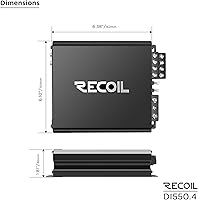
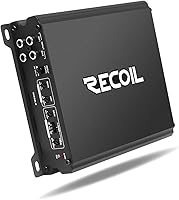
The Recoil DI550.4 4-Channel Car Audio Amplifier is a practical, no-frills upgrade for anyone tired of the thin, lifeless sound that factory head units deliver. Recoil isn't a name you'll find in boutique audio circles, but this 4-channel amp punches well above its price bracket — and that's genuinely the point. Class-D efficiency means it produces more usable power while running significantly cooler than older Class-AB designs, which matters when you're tucking an amp under a seat or into a crowded trunk. At 7.48″ x 5.90″ x 1.77″, the footprint is compact enough to disappear into most installs without a major rework of your cargo space.
Features & Benefits

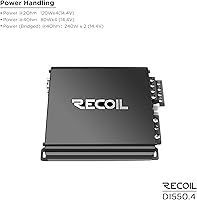
The MOSFET power supply is one of the more practical inclusions here — it keeps output stable even as your vehicle's electrical system fluctuates under load, which cheaper amps often handle poorly. The honest power numbers matter: you're looking at 130 watts RMS per channel at 2 ohms, or 80 watts per channel at 4 ohms. Ignore the 1,040-watt max figure on the box; RMS is what you'll actually hear. This Class-D amplifier is also bridgeable, letting you push 260 watts RMS into a subwoofer while the remaining two channels handle your speakers. Onboard gain, HPF, LPF, bass EQ and crossover controls mean you can dial in your system without needing a separate signal processor.

Best For

This 4-channel amp is squarely aimed at DIY car audio builders who want meaningful results without emptying their wallet. If you're upgrading a compact or mid-size car — a sedan, hatchback, or small SUV — the slim profile makes under-seat mounting genuinely feasible. It's also a smart pick for anyone wanting to run four speakers and a sub from a single unit, using the bridged output for bass duties. That said, if you're building a system around passive crossovers and high-impedance drivers, look elsewhere. Audiophiles with demanding signal routing needs will want more specialized gear. This is a capable everyday amp, not a competition-build component.

User Feedback

With a 4.5-out-of-5 rating across over 218 reviews, the Recoil DI550.4 earns its marks honestly. Buyers consistently praise straightforward installation and the immediate, audible jump in volume and clarity compared to running speakers directly off a head unit. Several users report solid results bridging two channels into a subwoofer while the other pair handles front or rear speakers. On the downside, some buyers flag that the included documentation is sparse, leaving first-time installers searching for wiring guidance online. A handful also note confusion between peak and RMS power claims on the packaging — a fair criticism. Long-term reliability feedback skews positive, though meaningful multi-year ownership data is still building.

Pros

  • Genuine RMS output of 130 watts per channel at 2 ohms gives you real, usable power beyond what any head unit can deliver.
  • Class-D design runs cooler and draws less current than older amp topologies, which is kinder to your vehicle's electrical system.
  • Bridgeable channels let you power four speakers and redirect two channels to a subwoofer without buying a second amp.
  • Onboard HPF, LPF, bass EQ, and crossover controls cover most tuning needs right out of the box.
  • The compact chassis fits under most front seats or in tight trunk corners without requiring custom mounting solutions.
  • MOSFET power supply handles voltage fluctuations in a car environment better than budget alternatives typically do.
  • 4-way protection circuitry adds a layer of reliability that protects both the amp and your speakers during unexpected electrical events.
  • At its price, the power-to-dollar ratio is genuinely competitive against better-known mid-range brands.
  • User-reported installation experience is consistently positive, with most buyers completing the setup without professional help.

Cons

  • Included documentation is thin — first-time installers will likely need to supplement with online guides or forum support.
  • Peak and max power figures on the packaging are inflated; the honest RMS numbers tell a more modest story.
  • Recoil has limited brand history and community support compared to established names like Rockford Fosgate or Alpine.
  • Long-term reliability data beyond a year or two of ownership is still limited given the product's relatively recent launch.
  • No remote bass control knob is included, which is a noticeable omission for buyers planning to bridge channels to a subwoofer.
  • Build quality feels functional rather than premium, with a fit and finish that reflects the budget-oriented price point.
  • At 4 ohms, RMS output drops to 80 watts per channel, which may underperform expectations for buyers with efficient 4-ohm speakers.
  • Customer service responsiveness from Recoil is not well-documented, leaving warranty claims an open question for some buyers.

Ratings

The scores below reflect an AI-driven analysis of verified buyer feedback for the Recoil DI550.4 4-Channel Car Audio Amplifier, drawn from hundreds of real-world reviews with spam, bot-submitted, and incentivized responses actively filtered out. The model evaluates both what users love and where frustrations consistently surface, so the ratings tell the full story — not just the highlights. Strengths and shortcomings are weighted equally to give you an honest picture before you buy.

Value for Money
91%
Buyers repeatedly point out that the power output and feature set at this price point are hard to match. For someone building their first real car audio system on a tight budget, the combination of four driven channels, onboard crossover controls, and bridging capability feels like significantly more amp than the price suggests.
A small number of buyers who compared it directly against established mid-range brands felt the cost savings came with trade-offs in polish and documentation. If you factor in purchasing a line output converter or sourcing your own wiring kit, the total install cost climbs noticeably.
Power Output
78%
22%
Users running 2-ohm speaker loads consistently report a strong, satisfying jump in volume and headroom compared to head-unit-powered systems. The bridged output driving a subwoofer gets particular praise — buyers note tight, controlled bass response at moderate listening levels on daily commutes.
The inflated peak power marketing creates real disappointment when buyers realize the continuous RMS figures are considerably more modest. At 4 ohms, 80 watts per channel left some users underwhelmed, especially those who expected performance closer to the advertised maximum.
Ease of Installation
86%
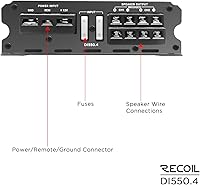
The compact chassis and clearly labeled input/output terminals make physical installation accessible for DIY beginners. Multiple buyers in compact vehicles — hatchbacks and small sedans in particular — reported successful under-seat installs without any modifications to the mounting surface.
The included instruction manual is widely criticized as insufficient, especially for first-timers trying to configure the onboard crossover and gain settings correctly. Several users had to rely on third-party YouTube guides or forum threads to complete a proper setup, which adds friction to what should be a straightforward process.
Sound Quality
74%
26%
For everyday listening — streaming music during a commute, weekend road trips — most users describe a clean, noticeably improved soundstage over factory amplification. The onboard HPF and LPF filters help reduce low-end muddiness from full-range speakers when tuned carefully.
Audiophiles and more experienced listeners flag that the noise floor is detectable at higher gain settings, and the overall sonic character lacks the refinement of purpose-built, higher-priced amplifiers. This Class-D amplifier is clearly voiced for impact and volume rather than critical listening accuracy.
Build Quality
67%
33%
The heatsink feels solid and well-attached, and the chassis holds up fine under normal mounting conditions. Users who have had the amp installed for six months to a year without issues generally describe it as durable enough for its intended use case.
The overall fit and finish reads as budget-tier — the casing has visible seam gaps and the control knobs feel plasticky compared to higher-end competitors. A handful of longer-term owners have noted that the finish around the controls shows wear after extended use in warm environments.
Thermal Management
83%
Class-D efficiency means this 4-channel amp generates significantly less waste heat than Class-AB equivalents at similar power levels, and the integrated heatsink keeps temperatures manageable during long listening sessions. Users in warmer climates report that the amp runs warm but never alarmingly hot under normal conditions.
In fully enclosed installs with zero airflow — such as inside a sealed trunk compartment or under a seat with no ventilation gap — a few buyers report thermal protection activating during extended high-volume use. Leaving even a small air gap around the heatsink fins resolves this in most cases.
Onboard Controls
79%
21%
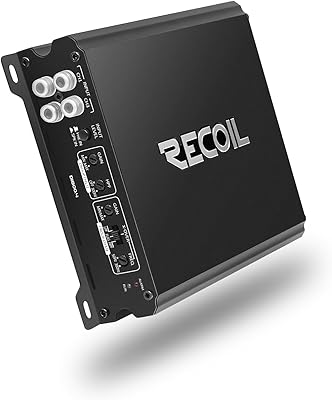
Having gain, LPF, HPF, bass EQ, and a crossover selector all accessible on the amp itself is genuinely useful — it means most common tuning adjustments can be made without purchasing a separate line driver or digital signal processor. Users building simple systems appreciate not needing extra equipment.
The control range and precision are limited compared to even entry-level external processors. The bass EQ in particular is described by some users as too blunt, offering a broad boost rather than a surgically adjustable curve, which makes fine-tuning bass-heavy setups more guesswork than science.
Bridging Performance
81%
19%
Buyers using the bridged output to power a subwoofer alongside two full-range channels report a well-integrated result with good low-end punch for the price. The 260-watt RMS bridged output is enough to satisfyingly drive an 8-inch or 10-inch sub in a modest ported enclosure.
The requirement to run a 4-ohm minimum load in bridged mode catches some buyers off guard, particularly those pairing the amp with dual-voice-coil subs wired to 2 ohms. Running below the rated impedance in bridged mode risks triggering protection circuits or causing premature wear.
Protection Circuitry
84%
The 4-way protection system — covering thermal cutoff, short circuits, electrical overload, and turn-on thump — has saved more than a few buyers from speaker damage during wiring errors on their first install. Users appreciate that the amp recovers cleanly after a protection event rather than requiring a hard reset.
A small number of buyers report the protection circuit tripping too aggressively at moderate volume levels, particularly in bridged mode with lower-impedance loads. In those cases it was usually a wiring issue rather than a true product fault, but the lack of documentation made diagnosing the root cause frustrating.
Compact Footprint
88%
At under 7.5 inches long and under 2 inches tall, this is one of the more practical 4-channel amp sizes available at this power level. Owners of compact cars — Civics, Golfs, Corollas — consistently call out the small footprint as a deciding factor, fitting it cleanly under the front passenger seat.
While the body is compact, the connectors and wiring harness add meaningful length once everything is plugged in, so the effective installation clearance needed is larger than the chassis measurements suggest. A few buyers discovered this only after cutting their power and ground cables to length.
Documentation Quality
41%
59%
The included quick-start sheet does cover the most essential wiring connections — power, ground, remote turn-on, and RCA inputs — at a basic level. For experienced installers who already know how to wire an amp, it is sufficient to get up and running.
For anyone without prior car audio experience, the manual is widely considered inadequate. There are no detailed tuning guidelines, no wiring diagrams for bridged configurations, and no guidance on matching gain settings to head unit output voltage — all of which are common sources of confusion for first-time buyers.
Long-Term Reliability
72%
28%
Users who have owned the amp for one to two years without issues describe it as a solid performer that holds its own over time with a proper install. The protection circuitry appears to do its job in preventing damage during minor electrical events, which contributes to a reasonably positive long-term track record.
The product is still relatively new to market and meaningful multi-year reliability data is limited. A small but notable share of reviews mention unit failures within the first few months, though it is difficult to distinguish between product defects and installation errors from review text alone.
Brand Credibility
63%
37%
The strong review count and above-average rating suggest that real buyers are satisfied at a rate that compares favorably with some better-known budget brands. There is enough community feedback at this point to make an informed judgment rather than taking a blind leap on an unknown label.
Recoil lacks the installer community presence, decades of track record, and widely documented warranty support that brands like Rockford Fosgate or Kenwood carry. Buyers who factor brand reputation and service reliability into their purchasing decision will find Recoil an unknown quantity by comparison.
Power Labeling Transparency
44%
56%
The product listing does include RMS figures in the technical specifications for buyers who look closely, and the actual measured performance appears to align with the stated RMS numbers according to users who tested output with a multimeter during install.
Leading with a 1,040-watt max claim is a common industry practice that genuinely misleads budget-conscious buyers who are not yet familiar with the RMS versus peak distinction. Multiple reviewers specifically call this out as frustrating, and it undermines trust in the brand even among buyers who are ultimately satisfied with the performance.

Suitable for:

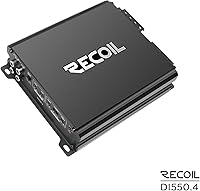
The Recoil DI550.4 4-Channel Car Audio Amplifier is a strong match for drivers who are done tolerating the weak, distortion-prone output of a factory head unit and want a real upgrade without commissioning a full custom install. It works especially well in compact and mid-size vehicles — sedans, hatchbacks, crossovers — where trunk or under-seat real estate is limited and a smaller amp footprint is a practical necessity. DIY installers building their first aftermarket system will appreciate the onboard gain, crossover, and EQ controls, which reduce the need to buy additional signal processing equipment. Anyone wanting to run four speakers and a dedicated subwoofer from a single amplifier will find the bridgeable design genuinely useful. It also makes sense as a cost-effective replacement for an aging amp, bringing modern Class-D efficiency to a system that previously ran on older, hotter-running hardware.
Not suitable for:

The Recoil DI550.4 4-Channel Car Audio Amplifier is not the right tool for audiophiles who prioritize signal purity and low noise floor above all else — at this price point and brand tier, it simply isn't built to that standard. Builders working with complex passive crossover networks or high-impedance speaker configurations may find the amp's flexibility insufficient for their specific wiring requirements. If you're planning a competition-level sound quality build where every component is scrutinized, this Class-D amplifier will feel out of its depth next to purpose-built, premium alternatives. The sparse documentation is also a real friction point for complete beginners who need step-by-step guidance through the wiring and tuning process. And buyers who tend to stick with established, widely supported audio brands for warranty peace of mind may find Recoil's lower profile in the market a cause for hesitation.
Specifications

  • Amplifier Type: Class-D 4-channel full-range car amplifier designed for efficient, low-heat operation in automotive environments.
  • Max Power: Total peak power output is rated at 1,040 watts across all four channels under optimal burst conditions.
  • RMS at 2 Ohm: Continuous RMS output is 130 watts per channel when driving 2-ohm speaker loads, representing real-world listening power.
  • RMS at 4 Ohm: Continuous RMS output is 80 watts per channel when driving standard 4-ohm speaker loads.
  • Bridged RMS: When bridged to 2 channels, the amplifier delivers 260 watts RMS per channel into a 4-ohm load, suitable for a subwoofer.
  • Impedance: Stable operation is rated across 2 to 4 ohm loads, providing compatibility with a wide range of aftermarket speakers.
  • Power Supply: High-speed MOSFET power supply regulates voltage delivery and maintains consistent output despite fluctuations in the vehicle's electrical system.
  • Input Voltage: Designed to operate on a standard 12-volt DC automotive electrical system.
  • Dimensions: The amplifier body measures 7.48″ long by 5.90″ wide by 1.77″ tall, enabling under-seat or compact trunk mounting.
  • Weight: The unit weighs 3.42 lbs, making handling and repositioning during installation straightforward.
  • Channels: Four independent channels can be run full-range or bridged down to two channels for higher-power subwoofer applications.
  • Onboard Controls: User-accessible controls include gain, low-pass filter (LPF), high-pass filter (HPF), bass EQ, and a crossover selector.
  • Protection: 4-way protection circuitry guards against thermal overload, short circuits, electrical overload, and turn-on thump to protect both the amplifier and connected speakers.
  • Cooling: An integrated aluminum heatsink dissipates heat generated during high-output operation, reducing thermal throttling during extended listening sessions.
  • Mounting Type: Designed for surface mounting, compatible with standard amplifier mounting brackets and flush-mount installations.
  • Model Number: Manufacturer model designation is DI550.4, used to identify this specific variant within the Recoil amplifier lineup.
  • Brand: Manufactured and sold under the RECOIL brand, a car audio-focused label offering amplifiers across multiple power and channel configurations.

Related Reviews

Recoil REA600.4 4-Channel Car Audio Amplifier
84%
89%
Audio Performance
91%
Ease of Installation
85%
Sound Quality at High Volumes
62%
Heat Management
90%
Power Output
More
Recoil DI800.4 4-Channel Car Audio Amplifier
83%
88%
Sound Quality
92%
Power Output
65%
Thermal Management
84%
Build Quality
91%
Ease of Installation
More
Planet Audio PL1600.4 4-Channel Car Amplifier
72%
88%
Value for Money
84%
Ease of Installation
74%
Sound Quality
58%
Power Output (Real-World)
61%
Build Quality
More
Planet Audio AC2400.4 4-Channel Car Amplifier
84%
95%
Power Output
89%
Sound Clarity
87%
Bass Performance
82%
Ease of Installation
65%
Thermals/Heat Management
More
Soundfy SA 400.4 4-Channel Car Amplifier
71%
78%
Value for Money
72%
Sound Quality
63%
Power Output
58%
Build Quality
81%
Thermal Management
More
Planet Audio AC1200.4 4-Channel Car Amplifier
73%
88%
Value for Money
67%
Power Output
83%
Installation Ease
74%
Sound Quality
61%
Build Quality
More
Planet Audio AC1600.4 Anarchy Series 4-Channel Car Amplifier
82%
94%
Power Output
88%
Sound Quality
70%
Ease of Installation
92%
Value for Money
85%
Build Quality
More
Stetsom HL 2000.4 2-Ohm 4-Channel Car Audio Amplifier
87%
93%
Power Output
85%
Cooling System Efficiency
88%
Sound Quality
91%
Ease of Installation
82%
Durability
More
Hifonics BXX800.4 Brutus 800W RMS 4-Channel Car Audio Amplifier
86%
88%
Sound Quality
92%
Power Output
85%
Build Quality
72%
Heat Management
89%
Ease of Installation
More
BOSS Audio R2504 4-Channel Car Amplifier
70%
82%
Value for Money
86%
Ease of Installation
51%
Power Output (Real-World)
58%
Thermal Management
62%
Build Quality
More

FAQ

The 1,040-watt figure is a peak or max rating, which represents brief burst conditions rather than sustained output. The numbers that actually matter for day-to-day listening are the RMS figures: 130 watts per channel at 2 ohms, or 80 watts per channel at 4 ohms. Those are the continuous, reliable power levels you can count on.

Yes, and this is actually one of the more practical things about this 4-channel amp. You run two channels to your front or rear speakers, then bridge the other two channels together to send 260 watts RMS into a subwoofer at 4 ohms. Just make sure your sub is wired to present a 4-ohm load when bridged — running a 2-ohm load in bridged mode is outside the rated spec and risks damage.

In most cases, yes. At 7.48″ x 5.90″ x 1.77″, the Recoil DI550.4 4-Channel Car Audio Amplifier is genuinely compact by 4-channel standards. That said, clearance varies a lot by vehicle — measure the space under your seat carefully before committing, and account for wiring connectors adding an inch or two to the length.
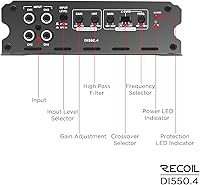
Not necessarily. The onboard controls cover gain adjustment, high-pass and low-pass filters, a bass EQ, and a crossover — which handles the tuning needs of most straightforward installs. If you're building a more complex multi-zone system or want precise parametric EQ control, you'd want an external DSP, but for the typical 4-speaker-plus-sub setup, the built-in controls are enough to get a clean, balanced sound.

It works with both. Many buyers use this Class-D amplifier behind a factory head unit by using an adjustable gain setting to match the lower output voltage from OEM decks. If your factory radio has no preamp outputs, you'll need a line output converter (LOC) to get a signal into the amp — that's a cheap, common accessory available at any car audio shop.

For a 4-channel amp in this power class, 4-gauge power and ground wire is typically recommended for runs up to about 15 feet from the battery, with 8-gauge being acceptable for very short runs. For the main fuse near the battery, a 40 to 60 amp fuse is a reasonable starting point — consult the amp's wiring diagram if included, or use an online amp wiring calculator to match your specific setup.

This is a fair concern that several buyers have flagged. The included paperwork covers the basics but doesn't walk you through the full install process. Your best resources are car audio forums like the ones on Reddit's r/caraudio community, YouTube install walkthroughs for similarly powered 4-channel amps, and manufacturer support channels if you hit a specific technical wall.

Class-D amplifiers run noticeably cooler than Class-AB designs at similar power levels, and the integrated heatsink helps manage heat during sustained high-volume listening. Under normal conditions with adequate airflow, the amp should stay comfortably warm rather than hot to the touch. If you're mounting it in a fully enclosed space with no ventilation, you should plan for some airflow — even a small gap helps the heatsink do its job.

Recoil isn't a legacy brand with decades of installer reviews behind it, but the DI550.4 has accumulated over 218 user ratings with a 4.5-out-of-5 average, which suggests it delivers on its core promises for most buyers. The 4-way protection circuitry is a meaningful inclusion at this price point, offering some insurance against common install mistakes or electrical faults. It's a reasonable bet for a budget-to-mid-range build, though buyers who want the backing of a long-established brand with well-documented warranty support may prefer names like Kenwood, Rockford Fosgate, or JL Audio.

Yes, the amp is rated as 2-ohm stable across all four channels, which is where it reaches its peak RMS output of 130 watts per channel. Running all four channels at 2 ohms simultaneously is the most demanding load scenario, so make sure your vehicle's charging system and wiring are up to the current draw. A strong ground connection and a healthy alternator go a long way toward keeping performance stable under those conditions.