Overview

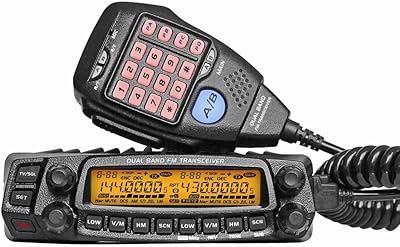
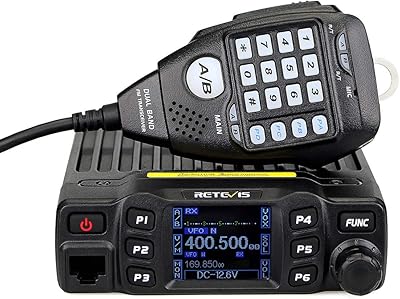
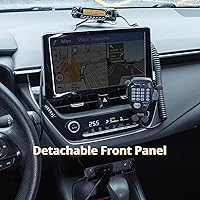
The Radioddity DB50 Dual Band Mobile Radio Transceiver sits comfortably in the serious hobbyist and working professional tier — not a beginner's first radio, and not trying to be. It competes with established mobile rigs while bringing its own angle: a detachable front panel that gives vehicle installers genuine flexibility in tight cabins where a fixed-mount head unit simply won't work. FCC certified and fully compatible with Chirp, the DB50 earns credibility with licensed operators right out of the box. Just be clear about what it is — a vehicle-mounted or shack radio, not a handheld. Set your expectations accordingly and it's hard to find fault with the basics.

Features & Benefits

The DB50's power output is genuinely competitive — running at full output on VHF puts it on par with radios costing considerably more, and the UHF side isn't far behind. Channel storage is deep enough that operators managing multiple repeater systems, simplex frequencies, and weather channels won't run short. The wide receiver coverage is a real bonus: pulling in airband, 220MHz, and 350MHz signals beyond the standard ham bands adds practical utility. Squelch options are thorough, covering CTCSS, DCS, and multiple tone-based systems for virtually any repeater you'll encounter. And Chirp compatibility matters more than it might seem — loading a full channel list takes minutes, not an afternoon of button-pressing.

Best For

This dual-band mobile radio is built for operators who already hold their license and want something they can install in a truck, SUV, or emergency vehicle without compromising on power or flexibility. It's a strong pick for EMCOMM volunteers and public service event operators who need reliable dual-band access and the ability to quickly reprogram for different nets. Overlanders and off-road groups will appreciate the range headroom when repeaters are scarce. It's also a solid upgrade path for someone stepping up from a basic entry-level rig who wants more channel space and receiver coverage without jumping to a premium-brand price point. Operators who prefer proprietary software may find the Chirp-first approach a slight adjustment.

User Feedback

Across its reviews, this ham radio transceiver holds a respectable score that reflects genuine buyer satisfaction rather than padding. Operators consistently praise the audio clarity on both receive and transmit, and the Chirp setup process draws repeated compliments — even from users who dreaded programming a new radio. Build quality earns mostly positive remarks at this tier, though some buyers note the detachable panel connection feels slightly less solid than the rest of the unit. The menu system is deep, and the manual doesn't always explain it well; new hams should budget time for experimentation. On the upside, the 18-month warranty outlasts most competitors in this class, which adds real peace of mind for a vehicle or shack install.

Pros

  • High VHF output power delivers real-world range that budget mobile radios simply cannot match.
  • Receiver coverage extends well beyond standard ham bands, pulling in airband and additional frequency ranges.
  • Chirp compatibility makes mass channel programming fast and straightforward for operators with existing channel files.
  • The detachable front panel solves genuine installation headaches in tight vehicle cabins.
  • Comprehensive squelch options — including 5Tone, 2Tone, and DTMF — cover virtually every repeater access scenario.
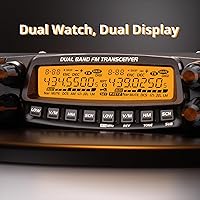
  • Dual watch and dual display let operators monitor two frequencies simultaneously without manual switching.
  • The 18-month warranty offers meaningfully longer coverage than most competitors at this price tier.
  • Included accessories are practical and complete: programming cable, DTMF microphone, and mounting hardware are all in the box.
  • Audio clarity on both transmit and receive earns consistent praise from operators across varied conditions.
  • FCC certification provides confidence for licensed operators who need a compliant, legal installation.

Cons

  • The owner's manual is thin on detail for a radio with this many menu layers and configuration options.
  • Menu navigation has a steep learning curve that will frustrate operators new to mid-tier mobile rigs.
  • The detachable front panel connection feels less robust than the rest of the unit's construction.
  • Advertised talking range figures are theoretical maximums — real-world performance depends heavily on terrain, antenna, and local RF conditions.
  • No water or weather resistance means installation locations must be carefully chosen to avoid moisture exposure.
  • The radio requires a stable 13.8V DC power source, which adds installation complexity for users without an existing vehicle power setup.
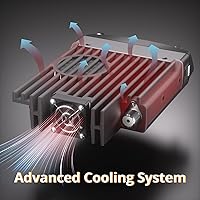
  • At full output power, heat management and fusing need attention during extended transmissions.
  • Operators preferring proprietary brand software will find Chirp-only support a less integrated experience.

Ratings

The scores below reflect our AI-driven analysis of verified global user reviews for the Radioddity DB50 Dual Band Mobile Radio Transceiver, with spam, bot-generated, and incentivized feedback actively filtered out before scoring. Each category is weighted against real operator experiences — from daily vehicle commutes to emergency communications deployments — so both the strengths and the friction points are represented honestly. No score has been softened to protect the product's image.

Transmit Power & Range
88%
Operators consistently report that the output headroom makes a noticeable difference when working through distant or marginally accessible repeaters, particularly in hilly or rural terrain. For EMCOMM volunteers and overlanders, having selectable power steps rather than a fixed output gives useful flexibility in the field.
Real-world range still depends almost entirely on antenna quality and local topology — users in dense urban environments or heavily wooded areas report that the power advantage shrinks fast. A handful of reviewers noted that advertised distance figures set unrealistic expectations for new operators.
Receiver Coverage
91%
The wide receive capability — spanning airband, 220MHz, 350MHz, and UHF beyond standard ham bands — is one of the most frequently praised aspects, particularly by operators who like to monitor aviation traffic or unconventional frequencies alongside their regular nets. It genuinely adds utility without requiring a separate scanner.
Some users note that airband reception sensitivity is adequate rather than exceptional compared to dedicated scanners, and reception of weaker signals in the 350MHz range can be inconsistent depending on local RF conditions. A small number of reviewers wished the receive audio could be better separated per band during dual-watch.
Audio Clarity
86%
Both transmit and receive audio quality draw consistent praise — contacts regularly report that the DB50 sounds cleaner and louder on air than comparable radios in this class. For operators running nets or coordinating in noisy vehicle environments, the speaker output holds up well without distorting at higher volumes.
A few users running the radio in very loud cab environments — diesel trucks, off-road vehicles — noted that the speaker struggles slightly to cut through ambient noise at its maximum output. External speaker compatibility resolves this, but it does add cost and installation complexity.
Channel Management
84%
The ability to store a large number of memory channels means operators can organize repeaters, simplex frequencies, weather channels, and NOAA alerts without compromise. Switching between VFO and channel mode mid-operation is fluid once the workflow is learned.
Navigating and editing channels through the front panel alone is genuinely cumbersome — most users settle on Chirp for anything beyond a few channels, which makes the radio effectively dependent on a computer for serious setup. The channel naming character limit also frustrates operators who want descriptive labels.
Chirp Compatibility
89%
Chirp integration is one of the DB50's clearest strengths — operators with existing channel files from other radios often have a new setup loaded within minutes. The inclusion of a programming cable in the box removes a common frustration point right from the start.
Users on certain Linux distributions or older macOS versions have reported driver issues with the included cable, requiring workarounds to establish a connection. Chirp support also depends on the open-source community maintaining the DB50 definition file, which could become a concern if the radio exits active production.
Detachable Front Panel
77%
23%
For vehicle installers working with limited dash space, the ability to separate the control head from the radio body opens up mounting options that a fixed-head unit simply cannot offer. Operators in commercial vehicles and camper vans particularly value this for positioning the display within natural sightlines while tucking the main unit away.
The panel connector has a noticeably less solid feel than the rest of the unit, and users who remount the head frequently report some loosening of the connection over time. A few buyers also noted the cable between the body and panel could be longer for more ambitious mounting configurations.
Menu Depth & Usability
61%
39%
Once an operator has invested time learning the menu structure, the depth of configurability is genuinely impressive — covering squelch tuning, tone settings, scan behavior, and display options in ways that entry-level radios do not allow. Experienced ham operators tend to navigate it comfortably after a few sessions.
For anyone new to mid-tier mobile radios, the menu system is a real friction point — layers of sub-menus with inconsistent labeling make even basic tasks confusing without external guidance. The included manual is widely criticized for not adequately explaining the menu logic, and many users resort to community forums or YouTube walkthroughs to fill the gap.
Build Quality
79%
21%
The main radio body feels solid and well-constructed for the price tier — the chassis does not flex or creak, and the connectors feel secure. Users who have compared it side by side with entry-level mobile radios consistently rate the physical construction as a step above.
The microphone housing and front panel buttons feel slightly less premium than the radio body itself, which creates an inconsistency in perceived quality. Several reviewers noted that the panel detach mechanism, while functional, introduces some doubt about long-term durability under frequent use.
Ease of Installation
74%
26%
The included mounting bracket and hardware cover a standard vehicle install without requiring additional purchases for most setups. The power cable comes pre-terminated with fuses, which removes one of the more tedious steps for operators doing their first mobile install.
The wiring and mounting process still requires a basic understanding of 12V vehicle electrical systems — complete beginners may find the setup more involved than expected. The detachable panel also introduces an additional cable run that needs to be managed cleanly, adding time to what might otherwise be a straightforward job.
Squelch & Tone Options
83%
The breadth of squelch modes — covering CTCSS, DCS, 5Tone, 2Tone, and DTMF in addition to carrier squelch — means operators rarely encounter a repeater access scheme this radio cannot handle. EMCOMM operators working across mixed regional systems particularly benefit from not having to reconfigure squelch type per location.
Configuring the less common tone modes through the panel interface is unintuitive, and the manual does not walk through real-world examples of when and how to use each mode. Operators unfamiliar with tone-based squelch systems may configure settings incorrectly and assume the radio is malfunctioning.
Documentation & Support
53%
47%
Radioddity does maintain an active online presence and responds to support requests through email channels, which is more than some competing brands at this tier offer. Community-generated resources — forum threads, YouTube guides — partially compensate for the official documentation gaps.
The printed manual is widely regarded as insufficient for a radio of this complexity, with vague descriptions and missing context for many features. Users consistently note that the documentation reads as if translated hastily, with phrasing that obscures rather than clarifies the intended function.
Warranty & After-Sales
82%
18%
The 18-month warranty is a genuine differentiator at this price point — most competitors in this class offer 12 months or less, and the extended coverage gives buyers more confidence in a radio that will live through the vibration and temperature swings of vehicle use. Several users specifically cited the warranty as a deciding factor.
Warranty claim experiences vary — some users report smooth resolution while others describe slow response times for replacement or repair processing. The warranty also does not cover damage resulting from installation errors, which can be a grey area given how many buyers self-install.
Value for Money
81%
19%
Measured against what the radio actually delivers — high transmit power, wide receive coverage, a deep feature set, Chirp support, and an above-average warranty — the DB50 offers a compelling package for operators who know what they are buying. It consistently outperforms cheaper radios in meaningful ways.
Buyers who underestimate the learning curve or installation complexity sometimes feel the value proposition shifts once they factor in the time investment. A few users also noted that stepping up to an established Japanese-brand mobile radio does not cost dramatically more and brings a noticeably more polished experience overall.

Suitable for:

The Radioddity DB50 Dual Band Mobile Radio Transceiver is a strong match for licensed amateur operators — Technician class and above — who want a capable, high-power mobile rig without paying flagship prices. Emergency communications volunteers will find it particularly well-suited: the high output power, broad squelch options, and dual-watch capability cover the kind of multi-net monitoring that EMCOMM work demands. Overlanders, off-road convoy groups, and backcountry campers who coordinate over repeater networks will appreciate having genuine power headroom when terrain starts eating signal. It also makes a compelling upgrade for anyone running a basic entry-level mobile radio who has outgrown its channel limits or receiver coverage. If you are already comfortable with Chirp and want a shack or vehicle radio that punches above its price class, this dual-band mobile radio deserves a serious look.
Not suitable for:

The Radioddity DB50 Dual Band Mobile Radio Transceiver is not the right tool for every buyer, and it is worth being honest about that. Newcomers to amateur radio who have not yet sat with a complex menu system will likely find the learning curve steep — the documentation does not always keep pace with the depth of the feature set, and fumbling through submenus on a road trip is nobody's idea of fun. This is also purely a fixed-mount or shack radio; anyone expecting a handheld or portable unit needs to look elsewhere entirely. Buyers who prefer the tight integration of proprietary programming software over Chirp's open ecosystem may find the workflow less polished than they are used to with other brands. And if waterproofing or ruggedization is a hard requirement — say, for maritime use or heavy outdoor exposure — this radio offers no water resistance rating, which is a real limitation worth weighing carefully.
Specifications

  • Power Output: The radio transmits at up to 50W on VHF and up to 40W on UHF, with selectable lower power steps of 25W, 10W, and 5W on both bands for situations where reduced output is preferred.
  • TX Frequency: Transmission covers the standard VHF and UHF amateur bands, making it fully compliant for licensed ham radio operation on those frequencies.
  • RX Frequency: The receiver spans a wide range including Airband in both AM and FM modes, 220MHz, 350MHz, and UHF, giving operators broad monitoring capability beyond basic ham bands.
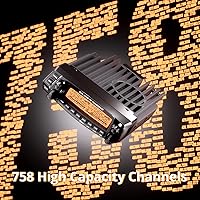
  • Channel Capacity: Up to 758 memory channels can be stored, accessible via both VFO free-tune mode and a structured memory channel mode for organized frequency management.
  • Channel Spacing: Supports wideband spacing at 25kHz, mid-band at 20kHz, and narrowband at 12.5kHz to accommodate a broad range of repeater and simplex configurations.
  • Squelch Types: Six squelch modes are available: Carrier, CTCSS, DCS, 5Tone, 2Tone, and DTMF, covering virtually all repeater access methods in common use.
  • Operating Voltage: The radio operates on 13.8V DC with a tolerance of plus or minus 15%, making it compatible with standard vehicle and regulated bench power supplies.
  • Receiver Sensitivity: Sensitivity is rated at or below 0.25μV in wideband mode and 0.35μV in narrowband mode at 12dB SINAD, reflecting solid receive performance for a mobile-class radio.
  • Frequency Stability: Frequency stability is rated at ±2.5ppm, ensuring consistent and accurate operation across normal operating temperature ranges.
  • Audio Output: The internal speaker delivers over 2W of audio power at 10% distortion, and audio distortion on both transmit and receive is held to 5% or less.
  • Front Panel: The control head is fully detachable from the radio body, allowing flexible mounting in vehicle cabins where a fixed-mount configuration would not be practical.
  • Display: Dual displays allow simultaneous monitoring of two frequencies or channels, supporting dual-watch operation without requiring manual toggling between bands.
  • Programming: The radio is compatible with Chirp open-source programming software; users select DB50 under the Radioddity section within Chirp to begin channel configuration.
  • Dimensions: The packaged unit measures 12.4 × 8.31 × 2.48 inches and weighs approximately 4.09 pounds, consistent with standard mobile transceiver form factors.
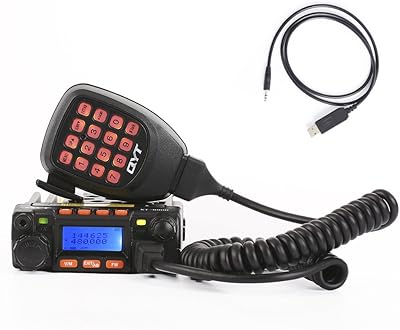
  • In The Box: Package includes the DB50 main unit, a microphone with DTMF keyboard, microphone hanger, mounting bracket, programming cable, power cable with spare fuses, and a set of installation screws and pads.
  • Warranty: Radioddity covers the DB50 with an 18-month manufacturer warranty, which is above average for this class of mobile radio.
  • Certification: The radio holds FCC certification under ID 2AN62-DB50, confirming it meets U.S. regulatory requirements for licensed amateur radio operation.
  • Water Resistance: The DB50 carries no water or weather resistance rating and should be installed in protected locations away from direct moisture exposure.

Related Reviews
AnyTone AT-778UV Dual Band Mobile Radio
79%
83%
Build Quality
88%
Audio Clarity
86%
Dual-Band Coverage
79%
Display & Interface
51%
Programming Software
More
Radioddity DB25 Pro Dual Band Mini Mobile Radio
88%
91%
Value for Money
87%
Signal Reception
89%
Ease of Use
92%
Display Quality
84%
Durability
More
AnyTone AT-779UV Mini Size Dual Band Transceiver Mobile Radio
85%
88%
Performance
85%
Build Quality
90%
Ease of Setup
65%
Software Compatibility
87%
Power Output
More
AnyTone AT-5888UV Dual Band Mobile Radio
69%
83%
RF Performance
78%
Build Quality
86%
Value for Money
81%
Cross-Band Repeat
74%
Display & Interface
More
Radioddity CB-500 CB Radio Mobile Transceiver
79%
88%
Audio Clarity
86%
Noise Reduction Performance
67%
Transmission Range
83%
Ease of Installation
63%
Menu Navigation & Usability
More
Radioddity GD-88 DMR Dual Band Ham Radio
75%
93%
Feature Depth
88%
GPS and APRS Performance
51%
Programming Experience
82%
Build Quality
63%
Audio Quality
More
Retevis RT95 Dual Band Mobile Ham Radio
77%
88%
Audio Clarity
67%
Ease of Programming
91%
Display & Readability
86%
Value for Money
74%
Build Quality
More
BTECH UV-50X2 Second Gen Mobile Radio
73%
88%
Transmission Performance
84%
Audio Clarity
79%
Build Quality
51%
Ease of Setup
47%
User Interface & Menu
More
TYT TH-8600 Dual Band Mobile Transceiver
76%
88%
Waterproof Protection
79%
RF Performance
83%
Build Quality
81%
Audio Clarity
61%
Ease of Programming
More
QYT KT-8900 Dual Band Mobile Radio
74%
91%
Value for Money
83%
Audio Clarity
78%
Ease of Programming
63%
Build Quality
74%
RF Performance
More

FAQ

Yes, absolutely. Transmitting on amateur radio frequencies requires a valid FCC amateur license — at minimum a Technician class. You can use the radio in receive-only mode without a license, but to actually get on the air and talk, you need to be licensed. If you are not yet licensed, the ARRL website is a good starting point for exam resources.

Yes, Chirp runs on Mac, Windows, and Linux, and the DB50 is listed in Chirp's supported radio directory under the Radioddity section. You will need the included programming cable and to install the appropriate USB driver for your operating system before Chirp can communicate with the radio.

That depends heavily on your antenna, terrain, and whether you are hitting a repeater or going simplex. Manufacturer range figures represent ideal, line-of-sight conditions — in real-world use, expect much more modest direct distances, though a well-placed repeater can dramatically extend your effective coverage. For emergency or convoy use, a good external antenna matters far more than the radio's raw power output.

Yes, that is one of the DB50's more practical design choices. The control head detaches from the main unit so you can mount the body out of the way — under a seat, in a trunk, or tucked into a dash — and run the panel to wherever it is most visible and accessible. Radioddity sells a dedicated panel bracket separately if you need a specific mounting solution.

The DB50 uses a standard mobile antenna connection, so any quality dual-band VHF/UHF mobile antenna with the appropriate connector will work. For vehicle installs, a mag-mount or lip-mount dual-band antenna is the most practical option. Antenna quality will have a bigger impact on your range than almost any other variable, so do not cut corners there.

Honestly, programming it manually through the front panel is doable but tedious if you are loading more than a handful of channels. The menu system is deep, and the manual does not always explain it clearly. For anyone managing a real channel list — repeaters, weather, simplex, NOAA — Chirp is the practical choice and makes the whole process take minutes rather than hours.

Yes. The receiver covers Airband frequencies in both AM and FM modes, so you can monitor aviation traffic. Keep in mind this is receive-only on those frequencies — transmitting on airband is strictly prohibited for amateur operators — but it is a genuinely useful capability if you are near an airport or flying area.

You will need a regulated DC power supply outputting 13.8V, which is the standard voltage for mobile ham radios used in a shack. At full output, this radio can draw significant current, so make sure your power supply is rated to handle the load — a 20A or 30A supply gives you comfortable headroom and clean voltage under transmit.

Most users report it functions reliably, but the connection interface is not quite as solid-feeling as the rest of the radio's construction. If you are remounting the panel frequently, handle the connector with care. For a fixed install where you set it once and leave it, it should not be a concern in normal use.

Largely yes — the box includes a mounting bracket, power cable with spare fuses, microphone with DTMF keypad, and the programming cable. You will still need an external antenna and antenna cable, and possibly additional mounting hardware depending on your specific vehicle setup, but the essentials for a straightforward install are covered right out of the box.