Overview

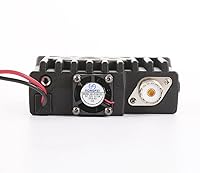
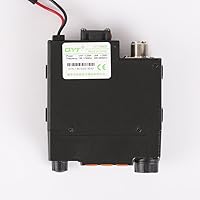
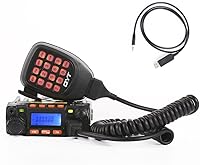
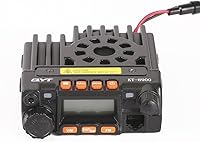
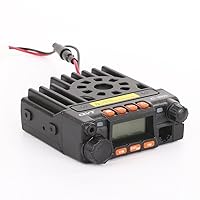
The QYT KT-8900 Dual Band Mobile Radio has quietly built a loyal following since its 2017 debut, and it's not hard to see why. This mini mobile radio covers both VHF (144–148 MHz) and UHF (430–450 MHz) with a 20W output — respectable punch for a unit this size. The chassis measures just 5.7 x 1.9 x 7.5 inches and weighs under two pounds, which makes tucking it under a dash or onto a center console genuinely easy. It's backed by CHIRP software support and a well-stocked MIKLOR reference page, so you're never left completely on your own when setting it up. For the price, the core functionality is hard to argue with.
Features & Benefits

The KT-8900 packs a surprising amount of radio into a small box. Its quad-watch capability means you can keep an ear on up to four channels at once — useful if you're monitoring a local repeater while keeping a simplex frequency open. Memory capacity tops out at 200 channels, and the signaling suite — CTCSS, DCS, DTMF, MSK, 2-Tone, and 5-Tone — covers virtually every repeater access method you're likely to encounter. Narrow and wide band modes let the radio adapt to different frequency plans without hassle. The remote stun and kill functions are genuinely practical for anyone running a shared or fleet setup. A programming cable is included, though the driver situation on non-FTDI hardware can trip people up — more on that later.

Best For

This dual-band transceiver is a natural fit for new Technician-class licensees who want mobile capability without overcommitting their budget on a first rig. It's equally useful as a backup radio in a second vehicle for hams who already own a flagship mobile. ARES and RACES volunteers will appreciate solid dual-band coverage at a price that doesn't strain a tight operational budget. Off-road and overlanding crowds have adopted it too — reaching a local repeater from a trail is well within reach with a decent antenna swap. You do need a valid ham radio license to transmit legally, which goes without saying. If you already use CHIRP regularly, programming is fast and familiar from the start.

User Feedback

Across more than 300 reviews, the KT-8900 holds a 4.2-star average — solid for a budget mobile radio. Audio clarity and compact size earn consistent praise, and most buyers find CHIRP programming manageable once the cable driver issue is resolved. That driver situation is the most common complaint: the included cable uses a non-FTDI chipset that Windows, macOS, and Linux each handle differently, and the documentation leaves something to be desired. Antenna choice matters a lot here too — swapping in a Nagoya UT-72 makes a real difference in range compared to a generic alternative. A small number of buyers report durability concerns after sustained daily use, so this may not be the right pick if you need a radio that takes heavy punishment long-term.

Pros

  • Covers both VHF and UHF bands in a chassis small enough to mount almost anywhere in a vehicle.
  • 20W output is genuinely useful for hitting local repeaters without needing a high-gain antenna.
  • 200 memory channels give you plenty of room to store repeaters across multiple regions or states.
  • CHIRP compatibility makes programming fast and familiar for anyone who has used it before.
  • Quad-watch mode lets you keep tabs on multiple frequencies simultaneously without switching back and forth.
  • The full signaling suite — CTCSS, DCS, DTMF, 2-Tone, 5-Tone — handles virtually any repeater access requirement.
  • Remote stun and kill functions are a thoughtful inclusion, especially for club or shared-vehicle setups.
  • Mounting hardware is included in the box, so you are not hunting for brackets before the first install.
  • A dedicated MIKLOR reference page and active CHIRP community mean finding answers to setup questions is straightforward.
  • Water-resistant construction adds a small but meaningful layer of protection for trail or outdoor installs.

Cons

  • The included programming cable uses a non-FTDI chipset, which causes driver headaches on certain OS versions.
  • No antenna is included, and performance noticeably suffers until you upgrade to something like the Nagoya UT-72.
  • Long-term durability is a legitimate concern — some users report issues after sustained daily use.
  • The user manual is thin and assumes more baseline radio knowledge than many beginners actually have.
  • Range claims in the listing are optimistic; real-world distances depend heavily on terrain, antenna, and repeater access.
  • Strictly analog FM only — no support for D-STAR, Fusion, DMR, or any digital voice mode.
  • The front-panel menu system is not intuitive, and navigating settings without CHIRP can be tedious.
  • Operating voltage is 13.8V DC, so running it off a non-vehicle power source requires a proper regulated supply.

Ratings

Our AI rating engine analyzed verified global user reviews for the QYT KT-8900 Dual Band Mobile Radio, actively filtering out incentivized, bot-generated, and low-credibility submissions to surface what real operators actually experienced. The scores below reflect a balanced synthesis of both the genuine strengths and the recurring frustrations that owners report after real-world installation and daily use. Nothing has been smoothed over — where the KT-8900 earns praise, the scores show it; where it falls short, that is reflected just as honestly.

Value for Money
91%
For budget-conscious buyers — especially newly licensed hams equipping their first vehicle — the price-to-capability ratio is hard to fault. Dual-band coverage, 200 channels, and a full signaling suite at this price point consistently surprises buyers who expected to compromise on features.
A handful of users who experienced unit failures after extended use felt the long-term value equation shifts unfavorably if a replacement is needed within the first year or two. At that point, the upfront savings start to look thinner.
Audio Clarity
83%
Received audio comes through clean and crisp on both bands, which operators on net check-ins and daily commutes specifically call out as a strength. The transmitted audio is equally well-regarded, with contacts frequently commenting that the KT-8900 sounds cleaner than its price suggests.
At higher squelch settings some users report that weak signals get clipped harder than expected, and a few note slight distortion at maximum speaker volume in noisy vehicle environments. It is not a dealbreaker, but it is noticeable.
Ease of Programming
78%
22%
For anyone already familiar with CHIRP, getting the KT-8900 loaded up with local repeaters is a genuinely quick process. The radio's CHIRP image downloads cleanly, and bulk programming dozens of channels takes only a few minutes once the software is running.
The non-FTDI programming cable is a consistent friction point — on certain Windows builds and macOS versions, finding and installing the correct driver requires more troubleshooting than most buyers anticipate. Front-panel manual programming is technically possible but the menu logic is counterintuitive enough that most users abandon it quickly.
Build Quality
63%
37%
The chassis feels solid enough for everyday vehicle use, and the controls have a reasonable tactile response. Most users report no issues through months of regular operation, and the water-resistant construction adds a useful margin of protection for trail-mounted installs.
A visible minority of long-term owners report functional failures — intermittent power issues, mic connector loosening, or display faults — after a year or more of sustained daily use. The build does not inspire the same confidence as mid-range radios from more established brands.
RF Performance
74%
26%
With 20W output and a quality external antenna like the Nagoya UT-72, the KT-8900 hits local repeaters reliably and holds its own on simplex contacts across reasonable distances. Operators in suburban and rural areas with good repeater infrastructure report solid, dependable performance.
Real-world range falls well short of the advertised 15 km figure in anything but flat, open terrain with an upgraded antenna. The stock antenna situation — none included in the box — means buyers are already at a disadvantage until they source a proper replacement.
Installation & Fit
86%
The compact chassis is a genuine strength for vehicle installs. Owners of small cars, compact SUVs, and crew-cab trucks all report that the KT-8900 tucks neatly under the dash or onto a center console without dominating the interior. The included bracket and screws make a basic mount straightforward.
The control head and main body are a single integrated unit rather than a detachable-face design, which limits mounting flexibility compared to more premium mobile radios. Routing the DC power cable neatly in tighter vehicles takes some patience.
Channel & Memory Management
81%
19%
Two hundred memory channels is more than most mobile operators will ever fill, leaving ample room for organizing frequencies by region, repeater group, or served agency. The quad-watch mode is particularly appreciated by ARES and RACES operators who need to monitor multiple nets at once.
Channel naming through the front panel is limited to a small number of characters and is cumbersome to enter without CHIRP. Users who frequently travel between regions and want to reorganize channel banks on the fly will find the process requires a laptop connection rather than quick in-vehicle edits.
Signaling Support
88%
The breadth of supported signaling modes — CTCSS, DCS, DTMF, MSK, 2-Tone, and 5-Tone — means users are unlikely to encounter a repeater or paging system the KT-8900 cannot access. EmComm volunteers in particular appreciate that virtually any served-agency repeater requirement is covered out of the box.
Configuring less common tone modes like MSK or 5-Tone through the menu alone is not well documented in the included manual, and users typically need to reference the MIKLOR site or community forums to get these working correctly.
Included Accessories
59%
41%
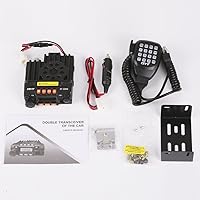
The package includes more than competing radios at this price — a microphone with hanger, DC power cable with cigarette plug adapter, mounting bracket, and programming cable all ship in the box. For a basic vehicle install, most buyers have what they need to get started.
The absence of any antenna is a meaningful gap, and the DC power cable terminating in a cigarette lighter plug is a limitation for operators who want a direct hardwire connection. The programming cable driver issue also somewhat undermines what should be a straightforward included accessory.
User Manual Quality
44%
56%
The manual covers the basic operational controls and channel programming process well enough for someone who already has some radio background. It serves as a functional reference for day-to-day operations once the radio is set up.
Beginners consistently find the manual inadequate — it assumes baseline familiarity with ham radio concepts and skips over setup steps that first-time mobile operators actually need. The programming cable driver situation, which trips up a large number of buyers, receives no meaningful guidance in the included documentation.
Durability Under Heavy Use
57%
43%
For light to moderate use — a few hours a day, weekend activations, or as a secondary rig — the KT-8900 generally holds up without issues for a reasonable ownership period. Users in this usage bracket report few hardware concerns.
Operators who rely on the radio heavily every day, such as those using it as a primary emergency communications tool, report a higher incidence of failures over time. The unit does not appear engineered for the kind of sustained duty cycle that more expensive mobile radios handle without issue.
Community & Support Resources
82%
18%
The KT-8900 has been on the market long enough to have accumulated a substantial community of users. The MIKLOR reference page, active Facebook groups, and a strong presence in CHIRP forums mean that almost any question a new owner has has already been answered somewhere accessible.
Official manufacturer support is limited, and QYT's direct customer service responsiveness gets mixed reviews. Users dealing with hardware failures outside of the return window generally rely on the community rather than the manufacturer for troubleshooting guidance.
Microphone Quality
71%
29%
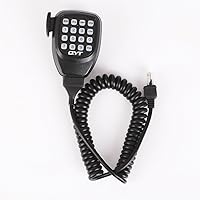
The included hand microphone delivers acceptable audio quality for standard voice contacts, and the ergonomics are comfortable enough for extended use during long drives or net operations. Most contacts report the transmitted audio as clear and adequately intelligible.
The mic feels plasticky and a step below the overall radio build, and some owners report the connector developing a slight looseness over time with repeated plug-in and removal cycles. Operators who do a lot of mobile operating often end up upgrading to an aftermarket mic.

Suitable for:

The QYT KT-8900 Dual Band Mobile Radio is a strong match for newly licensed Technician-class hams who want a capable first mobile rig without spending a lot upfront. Its compact footprint means it installs cleanly in smaller vehicles — compact cars, trucks, and SUVs alike — where a full-sized mobile radio would feel out of place. ARES and RACES volunteers operating on a restricted budget will find the dual-band coverage and broad signaling support (CTCSS, DCS, DTMF, and more) more than adequate for most emergency communication drills and activations. Off-road and overlanding enthusiasts who want reliable repeater or simplex access in remote areas will also get solid value here, particularly after pairing the KT-8900 with a quality external antenna. Experienced hams looking to outfit a second or third vehicle without revisiting their full radio budget will find it a practical, low-friction choice.
Not suitable for:

The QYT KT-8900 Dual Band Mobile Radio is not the right call for operators who need a workhorse radio that holds up under heavy daily use over several years. A minority of long-term users have reported reliability concerns, which matters if this is going to be your primary communications tool in demanding environments. Buyers who are not comfortable navigating driver installation quirks on Windows, macOS, or Linux — specifically around non-FTDI programming cables — may find the initial setup frustrating enough to sour the whole experience. This transceiver is also unlikely to satisfy operators who want advanced digital modes such as D-STAR, Fusion, or DMR, as it is strictly an analog FM radio. If you are after a radio for professional or commercial use, the build quality and support infrastructure of this unit simply are not scaled for that context.
Specifications

  • Frequency Bands: Covers VHF 144–148 MHz and UHF 430–450 MHz, providing access to the two most commonly used amateur radio bands for mobile operation.
  • Output Power: Transmits at up to 20W, which is sufficient for reaching most local repeaters and conducting simplex contacts under typical conditions.
  • Memory Channels: Stores up to 200 programmable memory channels, giving operators ample space for local, regional, and travel frequencies.
  • Signaling Modes: Supports CTCSS, DCS, DTMF, MSK, 2-Tone, and 5-Tone signaling, covering virtually all standard repeater access and paging protocols.
  • Watch Modes: Offers dual-band, quad-watch, and quad-standby modes, allowing simultaneous monitoring of up to four channels across both bands.
  • Bandwidth: Selectable narrow and wide band operation ensures compatibility with both legacy wide-band and modern narrow-band repeater systems.
  • Operating Voltage: Requires a regulated 13.8V DC power supply, making it directly compatible with standard 12V vehicle electrical systems.
  • Dimensions: The main chassis measures 5.7″ wide by 1.9″ deep by 7.5″ tall, allowing installation in tight dash or under-dash locations.
  • Weight: The unit weighs 1.83 pounds, keeping the load on mounting brackets minimal and simplifying installation in compact vehicles.
  • Programming: Fully compatible with CHIRP open-source software, which supports bulk channel programming via a connected PC, Mac, or Linux machine.
  • Programming Cable: A programming cable is included in the box; it uses a non-FTDI chipset, so driver installation steps vary depending on the computer operating system.
  • Special Functions: Includes remote stun, remote kill, PTT ID, and auto-lock features, which add operational security and convenience for both individual and shared-vehicle use.
  • Water Resistance: The unit carries a water-resistant rating, offering a basic degree of protection against moisture exposure during outdoor or trail use.
  • Mounting Hardware: A mounting bracket and screws are included in the package, so no additional hardware is needed for a standard vehicle installation.
  • Recommended Antenna: QYT recommends the Nagoya UT-72 external antenna for optimal performance, though it is sold separately and not included in the package.
  • Box Contents: The package includes the radio unit, microphone with hanger, DC power cable with cigarette plug connector, mounting bracket with screws, programming cable, and a user manual.

Related Reviews
QYT KT-7900D Quad Band Ham Radio
72%
83%
Value for Money
91%
Band Coverage
58%
Ease of Programming
77%
Receive Audio Quality
61%
Transmit Audio Quality
More
Radioddity DB50 Dual Band Mobile Radio Transceiver
79%
88%
Transmit Power & Range
91%
Receiver Coverage
86%
Audio Clarity
84%
Channel Management
89%
Chirp Compatibility
More
Retevis RT95 Dual Band Mobile Ham Radio
77%
88%
Audio Clarity
67%
Ease of Programming
91%
Display & Readability
86%
Value for Money
74%
Build Quality
More
AnyTone AT-778UV Dual Band Mobile Radio
79%
83%
Build Quality
88%
Audio Clarity
86%
Dual-Band Coverage
79%
Display & Interface
51%
Programming Software
More
BTECH UV-50X2 Second Gen Mobile Radio
73%
88%
Transmission Performance
84%
Audio Clarity
79%
Build Quality
51%
Ease of Setup
47%
User Interface & Menu
More
Radioddity DB25 Pro Dual Band Mini Mobile Radio
88%
91%
Value for Money
87%
Signal Reception
89%
Ease of Use
92%
Display Quality
84%
Durability
More
Icom IC-2730A Dual Band VHF/UHF Mobile Radio
78%
93%
Transmit Power
91%
Dual-Band Receive
88%
Build Quality
89%
Audio Clarity
54%
Menu Navigation
More
AnyTone AT-779UV Mini Size Dual Band Transceiver Mobile Radio
85%
88%
Performance
85%
Build Quality
90%
Ease of Setup
65%
Software Compatibility
87%
Power Output
More
AnyTone AT-5888UV Dual Band Mobile Radio
69%
83%
RF Performance
78%
Build Quality
86%
Value for Money
81%
Cross-Band Repeat
74%
Display & Interface
More
Baofeng UV-21R Dual Band Ham Radio
75%
91%
Value for Money
68%
Build Quality
54%
Transmission Range
83%
Display & Interface
88%
Charging Convenience
More

FAQ

Yes, a valid amateur radio license is required to legally transmit on the frequencies this radio covers. In the US, a Technician-class license from the FCC is the minimum needed to operate on VHF and UHF amateur bands. You can listen without a license, but transmitting without one is illegal.

It should, but expect to spend a few minutes sorting out the driver first. The included cable does not use an FTDI chip, so the standard FTDI driver will not work. You will need to find the correct driver for the specific chipset your cable uses — the MIKLOR website has a driver reference page that identifies which one to install for Windows, macOS, and Linux. Once that step is done, CHIRP takes over and the rest is straightforward.

That depends heavily on your antenna, terrain, and whether you are hitting a repeater. On simplex (direct radio-to-radio), expect anywhere from a couple of miles in hilly or urban areas up to 10 or more miles in flat, open terrain with a good antenna. Through a well-placed repeater, your effective range can extend much further. The advertised 15 km figure is possible under favorable conditions but should not be treated as a reliable baseline.

QYT specifically recommends the Nagoya UT-72 as a performance upgrade over a generic replacement antenna, and user feedback backs that up. The KT-8900 does not ship with an antenna, so you will need to purchase one separately. A magnetic-mount antenna with a PL-259 or NMO connector suited to the SO-239 jack on the radio is the standard choice for vehicle installations.

No, it is a strictly analog FM radio. If digital voice modes — DMR, D-STAR, System Fusion, or similar — are on your wish list, you will need to look at a different radio entirely. The KT-8900 does everything you need for standard analog repeater and simplex operation, but digital is outside its scope.

You can program channels manually through the front panel, but it is tedious and the menu navigation is not intuitive. CHIRP makes the process dramatically faster — you can import repeater data, assign tones, and write everything to the radio in minutes. If you plan on storing more than a handful of channels, setting up CHIRP once is absolutely worth the effort.

You will need a regulated 13.8V DC power supply capable of handling the current draw during transmit. A dedicated ham radio bench power supply in the 20–30 amp range works well. Do not use an unregulated wall adapter — voltage spikes can damage the radio.

For most ARES and RACES applications, this dual-band transceiver covers the bases. It handles the signaling modes and frequency ranges used by the vast majority of emergency communication groups, and the 200-channel memory is generous enough to store nets across multiple served agencies. The main caveat is that it is not the most rugged radio on the market, so consider that if your EmComm work involves harsh or high-use environments.

Yes, the compact dimensions are one of the KT-8900's genuine strengths. At under two pounds and with a relatively slim profile, it mounts cleanly under the dash, on a center console, or on a RAM-style mount without taking up significant space. The included bracket covers a standard installation; anything more elaborate will need aftermarket hardware.

Most users report no problems through regular use over months, and the radio has been available long enough to have a meaningful reliability track record. That said, a portion of reviewers have flagged concerns after sustained heavy daily use. If you need a primary radio that gets hard use every single day, it may be worth budgeting for a mid-range alternative with a stronger build reputation. As a secondary radio or for moderate-use applications, the failure rate reported is not alarming.

Where to Buy