Overview

The Pyle PMSA126BU Bluetooth PA Amplifier is a compact, versatile unit that bridges the gap between casual home audio and light commercial public address use. Manufactured by Sound Around under the Pyle brand since early 2019, it sits in the budget-to-mid-range tier — accessible for hobbyists yet capable enough for small venues. What stands out immediately is the speaker impedance flexibility: it handles 4, 8, and 16 ohm loads alongside 70V and 100V commercial outputs, which is uncommon at this price point. Bluetooth connectivity and a surprisingly wide range of inputs round out a feature set that genuinely punches above its weight for the money.

Features & Benefits

Where this PA amplifier earns its keep is in raw connectivity. Eight distinct inputs — Bluetooth, USB, SD card, AUX, RCA, mic jack, FM radio, and a 12V DC terminal — cover nearly every source a small venue or home user might need. Pairing with a smartphone or laptop is straightforward and requires no additional hardware. The built-in siren function is genuinely useful for public announcements or crowd attention during events, not just a novelty. A front-panel LCD display and independent rotary volume knob keep adjustments intuitive, while the included remote control lets you manage playback without staying anchored to the unit. The 70V and 100V outputs also open the door to distributed commercial speaker installations.

Best For

This Pyle unit hits a real sweet spot for buyers who need practical PA functionality without professional-grade pricing. Small churches, classrooms, and community halls are a natural fit — it handles a mic input alongside background music without requiring a separate mixer. Small business owners running a café or retail shop can pipe in audio from a phone and make announcements over the same system. Event organizers needing a portable, occasional setup will appreciate the all-in-one design. It also appeals to home audio users stepping up from a basic stereo receiver, especially those wanting to experiment with distributed speaker wiring using the 70V or 100V outputs.

User Feedback

Buyers consistently praise the ease of setup and the breadth of inputs, with many noting Bluetooth pairing takes under a minute. That said, the 500W rating draws skepticism — in practice, like most budget amplifiers, sustained real-world output falls well below the peak spec, so expectations should be calibrated accordingly. Heat management comes up occasionally, with some users recommending adequate ventilation during long sessions. The remote control draws mixed reactions — functional for basic tasks but not particularly responsive. LCD readability in bright environments has also been flagged as a minor frustration. Overall, most buyers view the PMSA126BU as a solid, practical workhorse rather than a high-fidelity investment.

Pros

  • Supports 70V and 100V outputs — a rare find at this price point for distributed speaker setups.
  • Eight input options cover virtually every source type a small venue would realistically need.
  • Bluetooth pairing is fast and simple, connecting to most devices in under a minute.
  • The built-in siren function is genuinely useful for public announcements and crowd management.
  • Handles 4, 8, and 16 ohm speaker loads, giving real flexibility for mixed speaker installations.
  • Front-panel LCD and independent volume knob make on-the-fly adjustments quick and intuitive.
  • At roughly nine pounds, this PA amplifier is light enough to move between locations without dedicated transport gear.
  • Includes a remote control out of the box — a useful addition for solo operators managing a room alone.
  • FM radio built in provides a convenient background music source with no devices required.

Cons

  • The 500W power rating is peak only — real-world sustained output is significantly lower than advertised.
  • Chassis feels lightweight and plastic-heavy, which raises concerns for anything beyond a fixed installation.
  • Rear speaker terminals can loosen after repeated cable changes, a frustration in any working setup.
  • Remote control range and reliability drop off noticeably beyond about 15 feet or without clear line of sight.
  • LCD display washes out in brightly lit rooms, making source and volume feedback hard to read at a glance.
  • Heat builds up during extended high-volume sessions, requiring deliberate ventilation planning.
  • The included manual is too thin to guide new users through 70V distributed wiring without outside help.
  • Bluetooth connection becomes unstable at longer distances or through solid walls, limiting placement flexibility.
  • Mic preamp produces audible background hiss at higher gain settings in quieter listening environments.

Ratings

The Pyle PMSA126BU Bluetooth PA Amplifier scores here are generated by AI after analyzing verified buyer reviews from multiple global sources, with spam, bot, and incentivized feedback actively filtered out. This unit attracted a wide range of buyers — from church AV volunteers and small-business owners to budget-conscious home audio hobbyists — and the scores reflect that diversity honestly. Both the genuine strengths and the real frustrations are factored in, so you get a transparent picture before you buy.

Value for Money
83%
For buyers setting up a PA system in a small church, classroom, or café on a tight budget, the sheer number of features packed into this price range is hard to argue with. The inclusion of 70V and 100V outputs alone — typically found on more expensive commercial units — makes it feel like an unusually practical buy for the cost.
A handful of buyers felt let down once they realized the 500W rating is a peak figure, not a continuous output spec. If you purchase expecting concert-hall power, the real-world performance can feel underwhelming relative to what the marketing implies.
Input Versatility
91%
Eight distinct input options genuinely set this PA amplifier apart from similarly priced competitors. Users running small events especially appreciated being able to switch between a smartphone via Bluetooth, a USB drive with pre-loaded tracks, and a live mic input without any rewiring or external mixer.
While the input count is impressive, a few users noted that rapidly switching between sources — say, from AUX to Bluetooth mid-event — can cause brief audio dropouts or require a manual reset. For live settings, that momentary interruption can be noticeable.
Bluetooth Performance
78%
22%
Most buyers reported that initial Bluetooth pairing is fast and straightforward, typically connecting to a smartphone or laptop in under a minute. For background music in a retail shop or casual event playback, the wireless range was considered more than adequate.
At longer distances or through walls, the connection becomes less stable, with some users reporting intermittent drops during extended sessions. The Bluetooth implementation feels adequate for light use rather than mission-critical live audio where a stable signal is non-negotiable.
Speaker Output Flexibility
88%
The ability to run 4, 8, and 16 ohm loads alongside 70V and 100V distributed outputs makes this Pyle unit genuinely useful in commercial installations. PA installers and small-venue technicians flagged this as the single biggest reason they chose it over standard home receivers at a similar price.
The manual documentation around wiring configurations for the 70V and 100V outputs is thin, and new users without prior PA experience can find it confusing. A few buyers reported incorrect speaker wiring on first setup due to the lack of clear guidance.
Build Quality
61%
39%
The unit feels reasonably solid for its price tier, and the front-panel buttons have a satisfying tactile response. For light-duty use in a fixed installation — mounted in a cabinet or on a shelf — it holds up well over time according to buyers who have used it for a year or more.
The chassis feels noticeably lightweight and plastic-forward, which raises durability questions for portable or touring use. A recurring complaint involves the rear terminals feeling loose after repeated cable connect and disconnect cycles, suggesting the build is optimized for set-and-forget installations rather than frequent handling.
Heat Management
58%
42%
Under normal light-to-moderate loads, the unit runs at an acceptable temperature and does not trigger any obvious thermal issues. Users running it for background music at low volumes in small shops reported no heat-related problems during typical business hours.
At higher volumes or during extended use — particularly in confined spaces without ventilation — the chassis gets noticeably warm. Several buyers recommended leaving open airspace around the unit, and at least a few reported performance throttling or shutdowns during prolonged high-demand sessions.
Remote Control
54%
46%
Having a remote included at this price is a genuine convenience, and for basic volume or source switching from across a small room, it works as intended. Users running the unit in a classroom or small meeting room found it useful for quick adjustments without walking to the unit.
The remote responsiveness is inconsistent — several buyers noted that it requires near line-of-sight and loses reliability beyond about 15 feet. The build quality of the remote itself feels noticeably cheaper than the main unit, and a few users reported it stopped functioning reliably within months of purchase.
LCD Display Readability
62%
38%
In typical indoor lighting conditions, the LCD display is functional and provides clear feedback on source selection, volume level, and FM frequency. Users operating the unit in dimly lit venues or at night found it particularly easy to read at a glance.
In brightly lit environments — near windows or under direct overhead lighting — the display washes out considerably. Multiple buyers flagged this as a frustration when the unit is installed in a well-lit retail or classroom setting where quick visual feedback matters.
Microphone Input Quality
72%
28%
For speech-focused PA use — announcements, classroom instruction, or basic event MC work — the mic input performs cleanly and with adequate gain. Users running wired dynamic microphones through it for public address purposes found the output clear and intelligible at moderate volumes.
The mic preamp lacks the refinement needed for musical performance or high-gain vocal applications. At higher mic gain settings, some buyers noted background hiss becoming audible through the speakers, which is noticeable in quieter environments during pauses in speech.
FM Radio Reception
67%
33%
The FM tuner is a handy addition for users who want to pipe in live radio as background audio without connecting an external device. Small cafes and waiting rooms found practical value in having this built in as a hassle-free background music source.
Reception quality depends heavily on antenna placement, and the included antenna is basic at best. In urban environments with interference or in buildings with thick walls, several users reported poor signal quality that made the FM function more of a novelty than a reliable feature.
Siren and Alarm Function
74%
26%
In real-world use, the siren function turned out to be more practically useful than buyers initially expected. Event coordinators and school PA users appreciated having a quick attention-grabbing alert button without needing a separate device or recording.
The siren tone itself is fixed and quite loud, with no volume or tone customization available. In quieter settings like small meeting rooms, triggering it by accident — which a few users reported — can be startling and disruptive.
Ease of Setup
81%
19%
Most buyers, including those with limited AV experience, reported getting the unit up and running within 20 to 30 minutes straight out of the box. The front-panel layout is logical, and basic connectivity like Bluetooth and AUX requires no technical background.
The instruction manual is minimal in detail, particularly for anything beyond basic hookup. Users attempting 70V distributed speaker wiring or multi-source switching configurations without prior PA experience often had to rely on third-party tutorials or online forums to get it right.
Audio Quality
66%
34%
For speech reinforcement and casual background music in small spaces, the audio output is clean and detailed enough to satisfy non-audiophile buyers. Church and classroom users consistently reported that spoken word clarity through connected PA speakers was strong at moderate volumes.
At higher output levels, the sound starts to thin out and loses low-end warmth, which disappoints buyers hoping for a full-range musical listening experience. This is not a unit for critical music listening — it prioritizes practical PA utility over sonic depth.
Portability
69%
31%
At just over nine pounds and with a reasonably compact footprint, this PA amplifier is manageable enough to carry between venues without dedicated transport gear. Occasional-use event organizers who needed to move it between a church hall and an outdoor event found it easy to transport.
The unit lacks a carrying handle or ruggedized casing, making transport slightly awkward for repeated use. There is no bag or case included, so buyers who move it frequently ended up needing to source their own protective solution to avoid cosmetic or functional damage.

Suitable for:

The Pyle PMSA126BU Bluetooth PA Amplifier is a strong fit for practical buyers who need a do-it-all audio hub without spending serious money. Small churches, community halls, and classrooms are the most natural home for this unit — it handles a live mic input, background music from a phone or USB drive, and PA speaker wiring all from one box. Small business owners running a café, retail shop, or waiting room will find the Bluetooth-plus-announcement combination particularly useful without needing a dedicated AV technician to set it up. Event organizers who occasionally run small outdoor or indoor gatherings will appreciate having a siren function, remote control, and multiple inputs available on demand. The 70V and 100V speaker outputs are a genuine differentiator, making it a realistic choice for anyone dabbling in commercial distributed audio systems on a hobbyist or small-installation budget.

Not suitable for:

Buyers expecting professional-grade power or audio fidelity should look elsewhere before committing to the Pyle PMSA126BU Bluetooth PA Amplifier. The 500W figure on the box is a peak rating, not a continuous output specification, which means in practice the unit delivers considerably less sustained power — a real concern for medium or large venue coverage. Audiophiles or musicians looking for clean, full-range sound reproduction will find the audio character thin at higher volumes, and the mic preamp lacks the headroom needed for live musical performance. The build quality, while acceptable in a fixed, low-traffic installation, does not hold up well to frequent transport or repeated cable changes, making it a poor choice for touring or rental inventory. Anyone who needs rock-solid remote control reliability or clear display visibility in a brightly lit environment may also find the day-to-day usability frustrating after the initial setup honeymoon ends.

Specifications

  • Model Number: The unit is manufactured by Sound Around and carries the model designation PMSA126BU under the Pyle brand.
  • Output Power: Rated at 500W peak output; real-world continuous power delivery is considerably lower, as is standard for budget-tier PA amplifiers.
  • Speaker Outputs: Supports 4 ohm, 8 ohm, and 16 ohm impedance loads, plus dedicated 70V and 100V outputs for commercial distributed speaker systems.
  • Dimensions: The unit measures 10.63 x 11.82 x 3.47 inches, making it compact enough for shelf or rack-adjacent placement in small installations.
  • Weight: The amplifier weighs 9.06 pounds, which is manageable for occasional transport but not optimized for frequent portability.
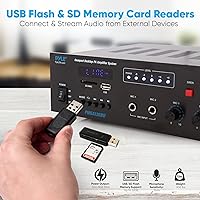
  • Inputs: Offers eight input options: Bluetooth, AUX (3.5mm jack), RCA, USB flash port, SD card slot, microphone jack, FM radio antenna input, and 12V DC power terminal.
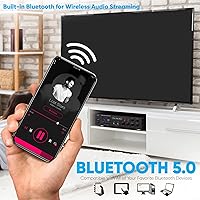
  • Bluetooth: Built-in Bluetooth wireless receiver enables cable-free audio streaming from smartphones, tablets, and laptops without requiring additional hardware.
  • Display: Features a front-panel digital LCD display that shows source selection, volume level, and FM frequency in real time.
  • Controls: Operated via front-panel buttons, an independent rotary volume knob, LED audio output indicators, and an included infrared remote control.
  • Siren Function: Includes a built-in button-activated siren and alarm function intended for attention-grabbing announcements or emergency alert scenarios.
  • Connector Type: Primary audio input connector is a 3.5mm jack, with additional RCA and dedicated mic input jacks on the rear panel.
  • Power Input: Accepts 12V DC power via a rear-panel terminal, designed for standard mains-connected power supply operation.
  • Channel Config: Supports up to 5.1 channel audio configuration for compatible source and speaker setups.
  • Color & Finish: Available in black with a predominantly plastic chassis construction suited to fixed, low-traffic installations.
  • FM Radio: Integrated FM tuner with antenna input allows live radio reception as a background audio source without any connected device.
  • Remote Control: An infrared remote control is included in the box, enabling basic source switching and volume adjustment from across a room.
  • Availability: First made available in January 2019 and has remained in active production under the Sound Around / Pyle product line since launch.

Related Reviews
Pyle PMX3500PH
Pyle PMX3500PH
72%
83%
Value for Money
51%
Power Output Accuracy
88%
Input Versatility
67%
Bluetooth Performance
78%
Microphone Mixing & Echo
More
Pyle PDA5BU Bluetooth Stereo Amplifier
82%
88%
Audio Performance
82%
Bluetooth Connectivity
71%
Build Quality
85%
Ease of Setup
90%
Input Versatility
More
Pyle PTAU23 Stereo Amplifier
74%
83%
Value for Money
89%
Input Versatility
91%
Ease of Setup
61%
Audio Quality
74%
Microphone Performance
More
Pyle PDA69BU Stereo Amplifier Receiver
75%
83%
Bluetooth Connectivity
74%
Sound Quality
79%
Build Quality
86%
Value for Money
88%
Input Versatility
More
Pyle PVTA20 Bluetooth Tube Amplifier
81%
88%
Sound Quality
85%
Bluetooth Connectivity
90%
Build Quality
82%
Power Output
87%
Ease of Setup
More
Pyle PDA8BU
Pyle PDA8BU
72%
83%
Value for Money
81%
Karaoke Performance
72%
Bluetooth Connectivity
61%
Power Output & Volume
58%
Build Quality
More
Pyle PVTA90 Bluetooth Tube Amplifier
85%
89%
Sound Quality
84%
Bluetooth Connectivity
87%
Ease of Setup
91%
Power & Performance
82%
Build Quality
More
Pyle PDA20BT Bluetooth Mini Audio Amplifier
83%
83%
Sound Quality
74%
Bluetooth Connectivity
89%
Build Quality
88%
Ease of Setup
80%
Versatility
More
Pyle PT110
Pyle PT110
76%
91%
Ease of Setup
72%
Build Quality
74%
Audio Clarity
61%
Power Output & Headroom
83%
70V Line Performance
More
Pyle PFA600BU Bluetooth Karaoke PA Amplifier
70%
81%
Value for Money
88%
Ease of Setup
62%
Audio Output Quality
58%
Microphone Performance
79%
Bluetooth Connectivity
More

FAQ

Not quite. The 500W figure is a peak rating, not a continuous or RMS output spec, which is common practice for budget PA amplifiers. In real use, the sustained power is considerably lower. It is well-suited for small rooms up to around 1,500 square feet with efficient speakers, but a large hall would likely push it beyond its comfort zone.

Yes, provided your ceiling speakers are wired for 70V or 100V distributed audio systems — which most commercial ceiling speakers are. This is actually one of the strongest use cases for this PA amplifier, and one of the features that sets it apart from standard home receivers at a similar price.

No app needed. Pairing is straightforward — put the unit into Bluetooth mode, find it on your phone or laptop, and connect. Most users report the whole process takes under a minute. One caveat: the connection can get spotty if you move too far away or put walls between your device and the unit.

The unit has a wired microphone input jack, but it does not have a built-in wireless mic receiver. If you want to use a wireless mic, you would need a separate wireless mic system with its own receiver, then run the receiver output into the mic jack on this amplifier.

It can work for small outdoor gatherings, but it was not designed for outdoor use and has no weather resistance. You would need to keep it sheltered and powered from a stable source. For very occasional outdoor use with a small crowd, it is manageable — just do not leave it exposed to moisture or direct sun.

It can. Several users have noted the chassis gets noticeably warm during extended sessions at moderate to high volumes. The unit does not have an active cooling fan, so it relies on passive ventilation. Leaving clear space around all sides — especially the top and rear — is a good idea if you plan to run it for more than a couple of hours at a stretch.

Yes. The unit handles simultaneous inputs, so you can have background music playing from a USB drive while a microphone is connected and active. The independent volume controls let you balance both sources. This is a common setup for small event hosts and church sound volunteers.

It works, but it has limitations. Line-of-sight is important — the remote loses reliability beyond roughly 15 feet or if there are obstructions between you and the unit. It covers basic functions like source switching and volume, but do not expect the responsiveness of a premium remote. A few buyers replaced it with a universal remote after theirs stopped working reliably.

This is a known weak point. In dim or normally lit rooms it is perfectly readable, but in brightly lit environments or near windows, the display washes out and becomes difficult to read quickly. If your installation is in a sunny classroom or near a large window, this is worth keeping in mind.

Yes, 8 ohm speakers are fully supported and are actually one of the most common configurations used with this Pyle unit. If you have a set of bookshelf or floor-standing speakers at home with an 8 ohm rating, they will connect and work without any adapters or additional equipment.