Overview

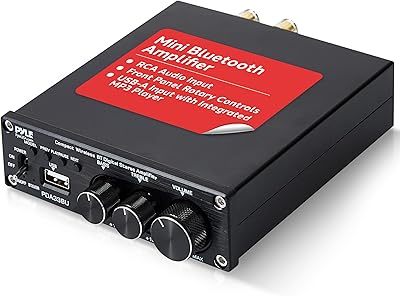
The Pyle PDA99BU Wireless Bluetooth Stereo Amplifier is best understood as a multi-source audio hub rather than a stripped-down amp — it brings legacy and modern connectivity together under one compact metal roof. RCA, coaxial, and optical inputs sit alongside Bluetooth with a claimed 45-plus-foot range, and you even get a built-in FM/AM tuner, which most competitors at this price skip entirely. The chassis is solid for the money — a 2U-style metal build that stays cool under load. One caveat worth stating upfront: the 300W rating is peak, not continuous. Real-world output runs noticeably lower, so calibrate your speaker pairing expectations before buying.
Features & Benefits

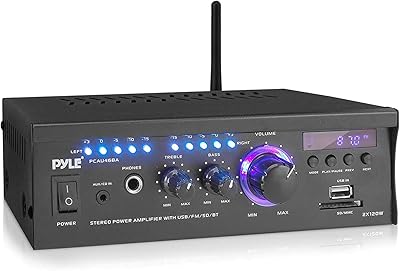
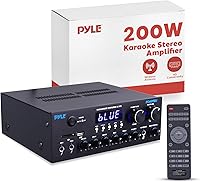
Bluetooth range is one of the stronger selling points here — 45-plus feet means you can stream from a phone in an adjacent room without frequent dropouts in most home layouts. The optical and coaxial digital inputs are a real practical win: connect your TV directly without needing a separate DAC. Eight DSP presets and physical bass/treble knobs offer quick tone adjustments; they won't satisfy a critical listener, but for casual everyday use they're handy. The dedicated mic input (6.35mm) is a thoughtful addition for anyone who wants karaoke-ready capability without extra gear. USB and SD card slots let you play music with no phone in the loop, and the front LED display stays readable from across the room.

Best For

This home audio amp is a strong fit for first-time system builders who need one box to handle a TV, a turntable, a gaming console, and a phone — without spending on a full-size AV receiver. It works particularly well in smaller spaces: apartments, dens, or spare rooms where a towering receiver would be out of proportion. The mic input also opens it up to casual karaoke nights without adding a mixer to the chain. That said, it is not the right choice for audiophiles, anyone driving high-impedance speakers, or large rooms that need sustained high-power output. Think of the PDA99BU as a capable starter receiver — practical, versatile, and honest about what it is.

User Feedback

Buyers tend to highlight two things quickly: easy setup and the sheer number of inputs available at this price. Most people have their system running within minutes. Where opinions get divided is Bluetooth — some users report rock-solid pairing, while others mention occasional dropouts depending on the device and environment. The power rating draws consistent skepticism; buyers who expected concert-level volume from bookshelf speakers came away disappointed. The remote has drawn mild criticism for feeling lightweight, and the long-term reliability picture is mixed, with some units logging months of use without issue and others showing quality concerns sooner than expected. Overall, satisfaction tracks closely with how realistic the buyer's expectations were going in.

Pros

  • Packs optical, coaxial, RCA, AUX, Bluetooth, USB, SD, and mic inputs into one affordable unit.
  • Built-in FM/AM tuner is a rare inclusion at this price tier that many competing amps have dropped.
  • Bluetooth range of 45-plus feet holds up well in open-plan apartments and living rooms.
  • Optical and coaxial digital inputs let you connect a TV directly without buying a separate DAC.
  • Metal chassis feels noticeably more solid than plastic-bodied rivals in the same price range.
  • Setup is fast and approachable — most users have this home audio amp running within 20 minutes.
  • Dedicated 6.35mm mic input enables casual karaoke without adding a mixer to the chain.
  • USB and SD card playback lets you run background music with no phone or network required.
  • Front LED display is large and readable from a seated position across a standard room.
  • Physical bass and treble knobs offer quick, intuitive tone adjustments during everyday listening.

Cons

  • The 300W power rating is peak-only — real continuous output is noticeably lower and misleads buyers.
  • Bluetooth reliability is inconsistent, with dropout reports common in dense wireless environments.
  • Remote control feels cheap and loses reliable range beyond roughly 15 to 20 feet.
  • Display brightness cannot be dimmed, which becomes distracting during late-night TV viewing.
  • USB playback has limited format support, with FLAC and some less common file types failing to load.
  • Long-term component reliability is a genuine concern based on a notable share of owner reports.
  • The included manual lacks detail for non-standard configurations, leaving some users to troubleshoot online.
  • No HDMI ARC support, which is a real gap for TV-centric setups that depend on that audio return channel.
  • DSP presets tend toward heavy-handed processing — many users end up bypassing them entirely.
  • Mic volume control is basic, with no dedicated reverb depth or independent mic EQ adjustment available.

Ratings

The Pyle PDA99BU Wireless Bluetooth Stereo Amplifier was scored by our AI engine after processing verified global buyer reviews, with spam, bot submissions, and incentivized feedback actively filtered out. Ratings reflect the full picture — what this home audio amp genuinely does well and where real users ran into friction. Both strengths and recurring pain points are represented transparently across every category below.
Value for Money
83%
For buyers building their first dedicated speaker system on a tight budget, the sheer number of inputs and built-in features packed into this price tier is hard to argue with. Getting optical, coaxial, Bluetooth, FM tuner, and mic input in one box typically costs significantly more from competing brands.
Value perception drops sharply for buyers who expected near-full rated power output and got noticeably less. When the unit underdelivers on its headline spec, some owners feel the deal was less straightforward than it appeared on the product page.
Connectivity & Input Range
89%
This is arguably where the PDA99BU earns its keep most convincingly. Optical and coaxial digital inputs, RCA, AUX, USB, SD card, mic, and Bluetooth together cover almost every source a typical living room setup would throw at it — TV, turntable, phone, and gaming console included.
A few users noted the input switching process could be more intuitive, particularly when toggling between digital and analog sources quickly. There is no HDMI ARC support, which matters if your TV workflow depends on it.
Bluetooth Performance
71%
29%
In straightforward line-of-sight conditions, Bluetooth held a stable connection from across an average-sized room, which covers most apartment and den scenarios. Pairing on first connect was consistently described as quick and painless by the majority of buyers.
Reports of intermittent dropouts are frequent enough to flag, especially with Android devices in homes with crowded wireless environments. Some users found the connection required a manual re-pair after the amplifier powered off, which gets old quickly in daily use.
Power Output & Volume
58%
42%
For smaller rooms and standard 8-ohm bookshelf speakers, the actual output is sufficient to fill the space comfortably without pushing the amp hard. Casual listeners watching TV or streaming music at moderate levels rarely had complaints.
The 300W peak claim has generated consistent skepticism and frustration. Real-world continuous output is considerably lower, and buyers who paired this unit with larger floor-standing speakers or expected high-volume headroom were frequently disappointed. This is the single most polarizing spec on the product.
Sound Quality
67%
33%
At this price point, the audio output is clean enough for TV watching, background music, and casual listening sessions. The manual bass and treble controls give users a practical way to compensate for room acoustics or speaker characteristics without diving into a menu.
The 8 DSP presets are serviceable but not subtle — critical listeners found several of them over-processed and ended up leaving the unit in a flat or minimal setting. This is not a receiver for anyone who cares about high-fidelity stereo imaging or low-noise floor performance.
Build Quality & Chassis
74%
26%
The all-metal chassis feels noticeably more substantial than plastic-bodied rivals in the same price range. It sits solidly on a shelf, runs reasonably cool during extended use, and several long-term owners reported no physical deterioration after months of regular operation.
Internal component quality appears to be the weak link despite the solid exterior. A subset of users reported unit failures or performance degradation within the first year, suggesting the metal shell is more reassuring than the electronics inside it.
Ease of Setup
88%
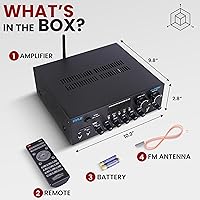
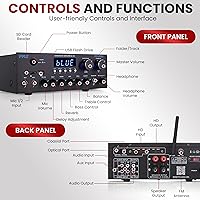
First-time receiver owners consistently praised how quickly they got everything running. The front panel layout is logical, labeled inputs are clearly marked, and the included antennas for Bluetooth and FM attach without tools. Most setups were complete within 15 to 20 minutes.
The included manual is thin on detail for less common configurations, like integrating a turntable with a phono preamp or routing optical audio from a specific TV brand. Users with non-standard setups sometimes had to rely on online forums to resolve small wiring questions.
Remote Control
62%
38%
Having a remote at this price is genuinely useful — being able to adjust volume or switch inputs from the couch without getting up is something users appreciate once they have it. The button layout covers the core functions without overcrowding.
The remote itself feels noticeably lightweight and cheap, and range reliability drew complaints from buyers trying to use it from more than 15 to 20 feet away or at an angle. A handful of users reported the remote stopped responding reliably within a few months.
FM/AM Tuner
79%
21%
Having a built-in AM/FM tuner is a genuine differentiator that buyers upgrading from a basic Bluetooth speaker or soundbar genuinely appreciated. With the included FM antenna connected, reception was described as clear and reliable for local stations in most suburban and urban environments.
In areas with weaker broadcast signals, performance dropped off noticeably even with the antenna fully extended. Preset memory and station scanning work, but the interface for managing saved stations feels dated and slightly clunky compared to modern smart speaker alternatives.
USB & SD Card Playback
76%
24%
Being able to load a USB drive with MP3s and hit play without a phone, app, or network connection is a feature that gets overlooked until you need it. Users running background music for gatherings found this particularly practical and reliable.
Format support is limited — users with FLAC or less common audio file types reported compatibility issues. The file navigation interface via the front display is functional but slow, making it impractical for browsing large collections track by track.
Microphone Input & Karaoke Use
72%
28%
The 6.35mm mic input works as advertised for casual karaoke nights or basic voice amplification without needing a separate mixer in the chain. Families and small gathering hosts found real utility in having this built in at no extra cost.
Mic volume and echo controls are rudimentary, and serious karaoke enthusiasts will notice the absence of independent mic EQ or dedicated reverb depth adjustment. It covers the basics but leaves a gap for anyone wanting even modest performance-level control.
LED Display & Interface
77%
23%
The front LED display is large enough to read from a seated position across a typical room, showing input source and volume level clearly. The physical knob controls respond well and give the unit a tactile, no-nonsense feel during daily use.
The display brightness is fixed, which a number of users found distracting in dark rooms during late-night viewing. There is no dimmer or auto-off option for the display, a small but recurring complaint in user feedback.
Long-Term Reliability
61%
39%
A solid portion of buyers reported using the unit daily for six months or more without any significant issues. The metal chassis appears to contribute to heat management, and units used within their realistic power limits tended to hold up better over time.
The reliability picture is inconsistent enough to be a genuine concern. Reports of channel dropouts, Bluetooth module failures, and power issues appearing after several months of use are not rare outliers — they represent a meaningful share of long-term owner feedback.
Optical & Coaxial Digital Inputs
82%
18%
Having both optical and coaxial digital inputs on a receiver at this price removes the need for an external DAC when connecting a TV, Blu-ray player, or cable box. Users who upgraded from a soundbar specifically cited these inputs as a key reason for choosing this unit.
A small number of users noted slight compatibility issues with specific TV brands when using optical input, requiring format adjustments on the TV side rather than the amp. Not a widespread problem, but worth flagging for buyers with older source devices.

Suitable for:

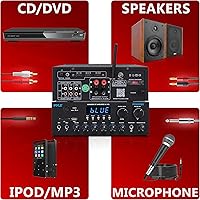
The Pyle PDA99BU Wireless Bluetooth Stereo Amplifier is a practical fit for anyone building their first real speaker-based audio system without wanting to spend heavily upfront. If your living room, den, or apartment currently relies on a soundbar or a Bluetooth speaker and you want a genuine step up — real speakers, real inputs, real control — this home audio amp gives you that path at an accessible price. It works especially well for users who need a single box to handle multiple source types simultaneously: a TV via optical, a turntable via RCA, a phone via Bluetooth, and a gaming console via AUX, all without swapping cables constantly. The built-in FM/AM tuner is a quiet bonus that fans of local radio will genuinely appreciate, since most competing units at this price dropped tuner support years ago. Casual karaoke households also get real value here — the 6.35mm mic input removes the need for a separate mixer or PA system for home use.
Not suitable for:

The Pyle PDA99BU Wireless Bluetooth Stereo Amplifier is not the right receiver for buyers who care about high-fidelity sound reproduction or plan to drive demanding speakers. The advertised 300W is a peak figure — continuous real-world output is considerably lower, which means anyone pairing this with large floor-standing speakers or expecting to fill a big room with volume will likely be let down. Audiophiles who rely on low noise floor, wide stereo imaging, or lossless source chains should look elsewhere entirely; the DSP presets and basic tone controls are practical tools, not precision tuning instruments. The PDA99BU is also not a strong fit for buyers with long-term reliability as a top priority, since a meaningful share of user reports flag component-level issues appearing within the first year of use. If your home theater setup is in a dedicated room or demands sustained high-power output, the investment in a mid-range receiver from an established AV brand will serve you better in the long run.
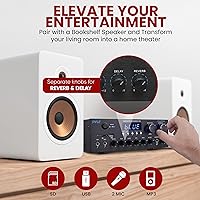
Specifications

  • Brand & Model: Manufactured by Sound Around under the Pyle brand, model number PDA99BU.
  • Peak Power: Rated at 300W maximum (peak) power output across a 2-channel stereo configuration.
  • Channels: 2-channel stereo output suitable for driving a standard left/right speaker pair.
  • Digital Inputs: Includes one optical (TOSLINK) and one coaxial digital audio input for connecting TVs or disc players.
  • Analog Inputs: Accepts audio via RCA stereo input, a 3.5mm AUX jack, and a 6.35mm microphone jack.
  • Bluetooth: Built-in Bluetooth supports wireless audio streaming with a stated range of 45-plus feet from compatible devices.
  • Media Playback: Onboard USB port and SD card slot allow direct playback of audio files stored on external media.
  • Tuner: Integrated AM and FM tuner with included FM dipole antenna for over-the-air radio reception.
  • DSP Presets: Eight selectable DSP sound effect modes plus manual bass and treble tone controls accessible from the front panel.
  • Display: Large front-panel LED display shows active input source, volume level, and tuner frequency at a glance.
  • Remote Control: Includes an infrared remote control for adjusting volume, switching inputs, and navigating playback from a distance.
  • Dimensions: Unit measures 10.2 x 9.8 x 2.8 inches, following a compact 2U-style rack-compatible form factor.
  • Weight: Weighs 8.14 pounds, reflecting the all-metal chassis construction used for the enclosure.
  • Chassis Material: Enclosure is built from metal for structural rigidity and passive heat dissipation during extended use.
  • Antennas Included: Ships with a dedicated Bluetooth antenna and a separate FM dipole antenna, both connecting to rear-panel ports.
  • Connector Types: Rear panel includes 6.35mm jack, coaxial, RCA, and optical connector types across its various input and output ports.
  • Output Mode: Audio output mode is stereo surround sound with a 2-channel configuration, not a true surround or multi-zone setup.
  • Availability Date: This model was first made available for purchase in November 2023.

Related Reviews
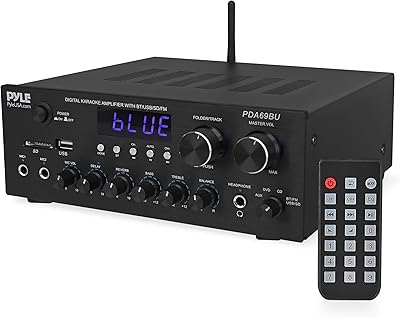
Pyle PDA5BU Bluetooth Stereo Amplifier
82%
88%
Audio Performance
82%
Bluetooth Connectivity
71%
Build Quality
85%
Ease of Setup
90%
Input Versatility
More
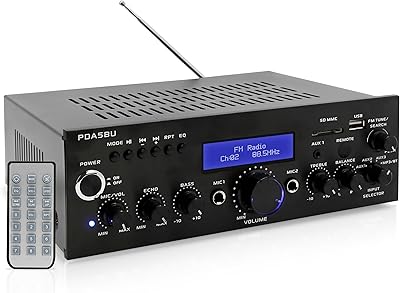
Pyle PDA69BU Stereo Amplifier Receiver
75%
83%
Bluetooth Connectivity
74%
Sound Quality
79%
Build Quality
86%
Value for Money
88%
Input Versatility
More
Pyle PFA600BU Bluetooth Karaoke PA Amplifier
70%
81%
Value for Money
88%
Ease of Setup
62%
Audio Output Quality
58%
Microphone Performance
79%
Bluetooth Connectivity
More
Pyle PCAU46BA Bluetooth Stereo Amplifier
73%
83%
Value for Money
67%
Sound Quality
91%
Ease of Setup
68%
Bluetooth Performance
54%
Build Quality
More
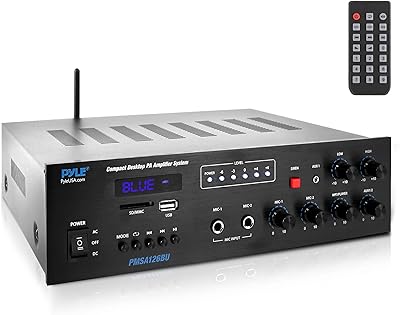
Pyle PMSA126BU Bluetooth PA Amplifier
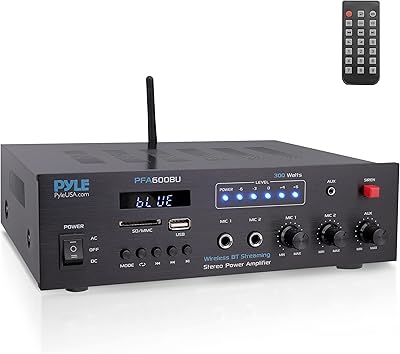
72%
83%
Value for Money
91%
Input Versatility
78%
Bluetooth Performance
88%
Speaker Output Flexibility
61%
Build Quality
More
Pyle PTA42BT Wireless Karaoke Bluetooth Stereo Receiver
81%
85%
Sound Quality
91%
Bluetooth Connectivity
92%
Value for Money
88%
Ease of Use
63%
Microphone Performance
More
Pyle PFA330BT
Pyle PFA330BT
73%
88%
Value for Money
71%
Sound Quality
52%
Rated Power Accuracy
74%
Bluetooth Connectivity
67%
Build Quality
More
Pyle PDA33BU 2.1 CH Wireless Stereo Power Amplifier
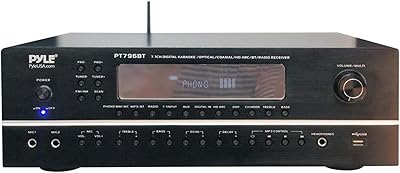
81%
82%
Sound Quality
88%
Ease of Setup
75%
Bluetooth Connectivity
67%
Bass Performance
92%
Value for Money
More
Pyle PT796BT 7.1-Channel AV Receiver
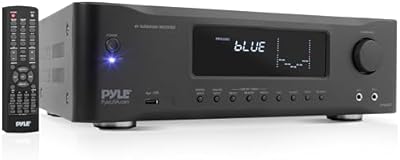
64%
67%
Value for Money
58%
Audio Performance
83%
Connectivity & Inputs
74%
Bluetooth Performance
52%
Build Quality
More
Pyle PT588AB 5.1 Channel Home Theater Receiver
70%
74%
Value for Money
52%
Build Quality
61%
Audio Performance
83%
Karaoke Functionality
78%
HDMI Connectivity
More

FAQ

Yes, and it is actually one of the more practical features on this unit. If your TV has an optical or coaxial digital audio output — which most modern TVs do — you can run a cable straight from the TV into the corresponding input on the Pyle PDA99BU Wireless Bluetooth Stereo Amplifier. No external DAC or converter box needed.

The 300W figure is a peak rating, not a continuous one, and that distinction matters a lot in practice. Real-world continuous output is meaningfully lower than that number implies. For a small room with standard 8-ohm bookshelf speakers, the volume range is perfectly adequate. If you're hoping to fill a large open-plan space or drive bigger floor-standing speakers, this home audio amp will likely feel underpowered.

In most typical home setups with clear line of sight or one wall between the device and the amp, the connection holds well. That said, buyers in apartments with crowded wireless environments or using older Android devices have reported occasional dropouts. It is not a universal problem, but it comes up often enough that it is worth knowing about before you buy.

You can connect a turntable via the RCA inputs, but there is an important caveat: this Pyle receiver does not have a built-in phono preamp. If your turntable has a built-in preamp (many modern budget turntables do), you are fine. If your turntable outputs a raw phono-level signal, you will need a separate phono preamp between the turntable and this amp.

The mic input uses a standard 6.35mm (quarter-inch) jack, which is the same connector found on most dynamic microphones used for karaoke or PA systems. If your microphone has an XLR connector, you will need a simple XLR-to-6.35mm adapter cable. Condenser microphones that require phantom power will not work here, as this amp does not supply it.

It is genuinely well-suited to that scenario. The compact footprint, wide range of inputs, and moderate power output hit a sweet spot for smaller spaces where a full-size AV receiver would be overkill. If your room is roughly 150 to 250 square feet and you want to unify your TV, phone, and maybe a turntable into one system, this home audio amp covers that setup without much fuss.

The USB and SD card slots support common formats like MP3 and WMA, which covers the vast majority of downloaded and ripped music files. FLAC and other lossless or less common formats are not reliably supported, so if your music library uses those formats you may run into playback errors. Sticking to MP3 files gives the most consistent results.

Unfortunately, no — the front LED display runs at a fixed brightness with no dimmer setting or auto-off option. For most daytime or ambient-light use it is fine, but several buyers have mentioned it being distracting in a dark room during late-night TV watching. It is a small but real inconvenience if you use this amp in a bedroom or home theater with controlled lighting.

The PDA99BU ships with the Bluetooth antenna, FM antenna, and remote control, but no speaker wire or audio cables are included. You will need to purchase speaker wire appropriate for your speaker connections and any input cables (RCA, optical, or AUX) depending on what you plan to connect. This is standard practice for receivers at every price tier.

It is genuinely one of the more approachable setups at this level. The front panel is clearly labeled, inputs are logically organized, and attaching the antennas is straightforward. Most first-time receiver owners report having everything connected and working within 15 to 20 minutes. The included manual is fairly basic, so if you run into a less common configuration — like integrating a specific TV brand over optical — a quick search online usually fills the gap.