
Overview

The Pyle PDA8BU is a 5-channel home stereo receiver built for buyers who want a capable, do-it-all audio hub without spending a fortune. Made by Sound Around — the manufacturer behind the Pyle brand — this home stereo receiver sits firmly in the entry-level tier, where expectations need to be calibrated accordingly. It pulls double duty as both a home theater amplifier and a karaoke-ready system, with front-panel mic inputs that make it genuinely useful for parties and casual entertaining. Pyle has carved out a niche in affordable audio gear, and this unit reflects that ethos: accessible features, approachable pricing, and a setup that doesn't require a technical background.

Features & Benefits

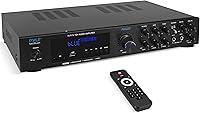
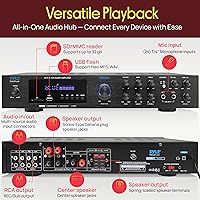
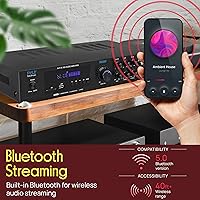
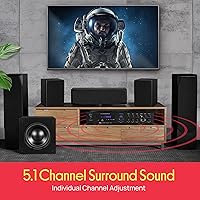
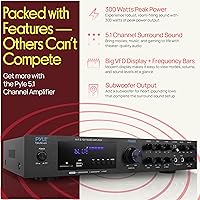
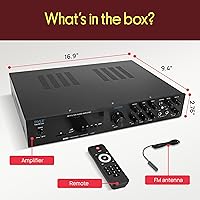
At the core of this Pyle amplifier is Bluetooth 5.0 connectivity, offering a stable wireless link from up to 40 feet away — handy when your phone is across the room. The 5-channel layout covers front, center, and rear speakers, plus a dedicated subwoofer output, giving you a proper multi-channel setup without a separate processor. Connectivity is genuinely broad: USB, SD card, two RCA line inputs, AUX, and FM radio all live on one unit. Up front, rotary bass and treble knobs let you tune the sound on the fly, and a VFD display keeps things readable. A remote control rounds out the package.

Best For

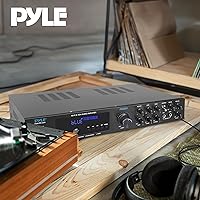
This karaoke-ready amp shines in casual home entertainment settings — a living room movie night, a basement karaoke session, or a small gathering where you want real sound without a complicated install. It suits first-time home theater builders who want multi-channel audio without committing to a high-end system. The physical knob controls make it approachable for users who'd rather turn a dial than navigate a smartphone app. Keep room size in mind: this unit is best matched to small to medium spaces. If you want audiophile-grade precision, look elsewhere — but for fun, flexible everyday use, it covers the bases well.

User Feedback

Owners consistently praise the quick setup experience and karaoke functionality, with many noting strong value given everything packed into one box — five channels, Bluetooth, and dual mic inputs at an accessible price point. That said, the 300W power rating draws reasonable skepticism; like most budget receivers, that figure likely reflects peak or PMPO output rather than continuous RMS wattage. Build quality earns mixed marks, with some buyers finding the chassis feels lighter than expected. Bluetooth range also falls short of the 40-foot spec in certain real-world conditions. Long-term durability data is sparse, which is a fair thing to weigh before committing.

Pros

  • Dual front-panel mic inputs make karaoke setups genuinely fast and hassle-free.
  • Bluetooth 5.0 pairs reliably for wireless streaming from phones and tablets.
  • Five output channels plus a subwoofer out offer real multi-channel audio at a budget price.
  • Wide input selection — USB, SD, AUX, RCA, and FM radio — covers nearly every common source.
  • Physical rotary knobs for bass and treble make on-the-fly sound adjustments quick and intuitive.
  • VFD display is easy to read in low-light rooms during evening entertainment sessions.
  • Compatible with 4, 8, and 16 ohm speakers, giving flexibility across different speaker setups.
  • Unboxing to first audio output typically takes under 20 minutes with no technical background needed.
  • Remote control handles core functions without requiring users to leave their seat.
  • Solid value for buyers who need karaoke functionality and multi-channel audio in a single unit.

Cons

  • Advertised 300W power is almost certainly peak wattage, not usable continuous RMS output.
  • Bluetooth range falls short of the 40-foot claim in real homes with walls or wireless congestion.
  • Chassis feels lightweight and hollow, which undermines confidence in long-term durability.
  • Remote control requires a direct line of sight and close range to register commands consistently.
  • No optical or digital input limits direct connectivity with modern televisions.
  • Two-band EQ offers very limited tonal control for users with specific acoustic needs.
  • Echo effect sounds artificial at higher settings and lacks the nuance of dedicated karaoke hardware.
  • Longer-term reliability reports are mixed, with limited repair or replacement part options after warranty.
  • No auto-calibration or channel-level balancing requires full manual speaker adjustment.
  • Customer support experiences are inconsistent, which adds risk for buyers planning extended use.

Ratings

The Pyle PDA8BU has been evaluated by our AI rating system after deep analysis of verified global buyer reviews, with spam, bot-generated, and incentivized submissions actively filtered out. Scores reflect real-world performance across a range of home entertainment and karaoke use cases, with both strengths and recurring pain points weighted transparently. The result is a balanced snapshot of what buyers actually experience — not what the spec sheet promises.

Value for Money
83%
For buyers setting up a first home theater or karaoke corner on a tight budget, the sheer feature count here is hard to beat. Five channels, dual mic inputs, Bluetooth, and multiple source inputs in a single unit would typically cost considerably more from established audio brands.
The value equation weakens slightly once you factor in concerns about long-term durability. Buyers who expect this unit to anchor a serious setup for years may find the build quality insufficient to justify even the modest outlay.
Karaoke Performance
81%
19%
The dual front-panel mic inputs are genuinely convenient — plug in two microphones, dial up the echo, and you have a functional karaoke system in minutes. Users hosting casual parties consistently highlight this as the unit's strongest real-world selling point.
The echo effect, while fun, has a limited adjustment range and can sound artificial at higher settings. Serious karaoke enthusiasts who have used dedicated KTV equipment will notice the difference in mic separation and audio finesse.
Bluetooth Connectivity
72%
28%
Bluetooth 5.0 pairs quickly with phones and tablets, and in an open room with a clear line of sight, the connection holds up reasonably well. Streaming music from a couch or kitchen counter works without interruption in most standard home setups.
The advertised 40-plus-foot range is optimistic in practice. Users report dropouts and signal degradation through walls or in homes with a lot of wireless interference, which is fairly typical for budget receivers but still worth flagging.
Power Output & Volume
61%
39%
For small to medium rooms, the unit delivers enough volume to fill the space without straining. Background listening, casual movie nights, and karaoke in a living room setting are all manageable at moderate volume levels.
The 300W rating is almost certainly a peak or PMPO figure, not continuous RMS output — a common practice among budget audio brands. Real-world power feels noticeably lower, and pushing the unit hard in larger rooms reveals its limitations quickly.
Build Quality
58%
42%
The front panel layout is organized and functional, with knobs and buttons that feel tactile enough for everyday use. The VFD display is readable in low-light conditions, which users appreciate during evening entertainment sessions.
The chassis feels lightweight and somewhat hollow, which gives a less-than-premium impression when handling the unit. Several buyers noted that the plastic housing and overall construction feel inconsistent with even the modest price point.
Ease of Setup
88%
Most users report having the unit running within 15 to 20 minutes of unboxing, with no technical background required. Speaker terminals, input labeling, and the front-panel layout are all straightforward enough that the manual rarely needs to be consulted.
The included documentation is basic and lacks detail for less common configurations, such as setting up all five channels simultaneously or integrating an external subwoofer. Users attempting more complex installs may need to rely on online forums.
Input Versatility
86%
Having USB, SD card, AUX, dual RCA, and FM radio all on one unit is genuinely useful. Buyers who rotate between streaming, playing files from a flash drive, and catching the radio report that this flexibility is one of the most practical aspects of daily use.
The RCA inputs are limited to two channels, which restricts options for users wanting to connect multiple stereo sources simultaneously. There is no optical or digital input, which rules out direct connection to modern TVs without an analog adapter.
Remote Control
69%
31%
The included remote handles the basics — volume, source switching, and playback controls — without requiring the user to get up constantly. For couch-based listening or movie watching, it covers the most frequently needed functions.
Range and angle sensitivity are inconsistent, with some users reporting the remote needs to be pointed directly at the unit from close range to register. The button layout is also somewhat cramped, making accidental presses easy in dim lighting.
EQ & Sound Tuning
67%
33%
The physical bass and treble rotary knobs are responsive and easy to adjust on the fly, which casual users appreciate far more than navigating digital menus. A quick twist during a movie or playlist session is intuitive and immediate.
Two-band EQ is quite limited for anyone who wants real tonal control. There is no mid-range adjustment, no parametric option, and no app-based tuning, so users with specific acoustic needs in their space will hit a ceiling quickly.
FM Radio Reception
71%
29%
FM radio works reliably in areas with decent signal strength, and users in suburban or urban settings report clear reception across most local stations. It is a useful fallback source that many budget competitors omit entirely.
Reception depends heavily on antenna placement and local signal quality. In areas with weaker FM coverage or in basement rooms, users note noticeable static and difficulty locking onto stations, with no DAB or internet radio as an alternative.
VFD Display
74%
26%
The vacuum fluorescent display is bright enough to read from several feet away and gives the unit a more polished look than a basic LED readout. It clearly shows the active input source and volume level, which is practical during quick adjustments.
The display brightness is fixed with no dimming option, which some users find intrusive in dark home theater rooms during late-night viewing. Font size for certain metadata, such as track info from USB, can also be difficult to read at a distance.
Multi-Channel Audio
66%
34%
Having a dedicated center channel and rear outputs in this price range is uncommon and appreciated by buyers building out a 5.1-style setup on a budget. For casual movie watching, the added spatial effect is noticeable compared to basic stereo setups.
Channel separation and surround staging lack the precision found in even mid-range AV receivers. The surround effect can feel diffuse rather than directional, and fine-tuning individual channel levels requires manual adjustment with no auto-calibration available.
Long-Term Durability
54%
46%
A meaningful number of users report the unit functioning without issue for a year or more in light everyday use — karaoke nights, background music, and occasional movie sessions. For low-intensity use, it appears adequately reliable.
Patterns in longer-term feedback point to concerns about component longevity under heavier or continuous use. Customer support experiences are inconsistent, and replacement parts are not readily available, which makes repairs difficult if something fails out of warranty.

Suitable for:

The Pyle PDA8BU is a strong match for casual home entertainers who want a versatile, all-in-one audio hub without a steep learning curve or a hefty price tag. It works particularly well for families or friend groups who host regular karaoke nights, since the two front-panel mic inputs and adjustable echo effect remove the need for a separate karaoke machine. First-time home theater builders looking to step up from basic stereo to a proper multi-channel setup will find the five-channel layout and subwoofer output genuinely useful at this price point. It also suits buyers who juggle multiple audio sources — someone who streams music via Bluetooth in the morning, plays files from a USB drive in the afternoon, and catches FM radio in the evening will feel right at home with the broad input selection. Renters or anyone furnishing a small to medium room on a budget will get the most out of it, especially in spaces where a modest, practical amplifier beats an expensive, over-engineered one.

Not suitable for:

Buyers chasing accurate, high-fidelity audio should look elsewhere — the Pyle PDA8BU is not designed for critical listening, and the two-band EQ and compressed build quality reflect its entry-level positioning. Anyone planning to power a large room or a serious home cinema setup will likely find the real-world output underwhelming, since the 300W rating almost certainly represents peak or PMPO wattage rather than continuous RMS power. Audiophiles, home theater enthusiasts who already own mid-range AV receivers, or anyone comparing this against brands like Yamaha, Denon, or even Onkyo at a similar stretch budget will find the gap in audio refinement and build durability hard to ignore. If long-term reliability is a priority — say, for a bar, a small venue, or a daily-use entertainment room — the inconsistent feedback around component longevity and limited customer support options makes this a risky foundation. Users who need optical digital inputs, advanced room calibration, or app-based control will hit a wall with this unit almost immediately.

Specifications

  • Brand: Manufactured by Sound Around and sold under the Pyle brand, a label known for accessible, budget-oriented consumer audio equipment.
  • Model Number: The exact model designation is PDA8BU, used to identify this specific 5-channel receiver within the Pyle product lineup.
  • Channels: Supports 5-channel audio output covering front left and right, center, rear left and right, plus a dedicated subwoofer output.
  • Power Output: Advertised at 300W total, which reflects peak or PMPO figures rather than continuous RMS output — typical for receivers in this price tier.
  • Bluetooth: Equipped with Bluetooth 5.0, with a manufacturer-stated wireless range of over 40 feet under optimal line-of-sight conditions.
  • Mic Inputs: Features two front-panel 1/4-inch (6.35mm) microphone inputs with independently adjustable echo effect for karaoke use.
  • Audio Inputs: Connectivity includes USB, SD card slot, one 3.5mm AUX input, two RCA stereo line inputs, and a built-in FM radio tuner.
  • EQ Controls: Offers manual bass and treble adjustment via dedicated rotary knobs located on the front control panel.
  • Speaker Impedance: Compatible with speakers rated at 4, 8, or 16 ohms, providing flexibility across a wide range of passive speaker types.
  • Display: Uses a VFD (Vacuum Fluorescent Display) on the front panel to show active input source, volume level, and basic playback information.
  • Remote Control: Includes an infrared remote control for managing volume, input selection, and playback functions from a distance.
  • Item Weight: The unit weighs 10.31 pounds, making it manageable for single-person installation on a shelf or AV rack.
  • Color: Available in Black, with a front panel design centered around functional knobs, buttons, and the VFD readout.
  • Controller Type: Primary user controls use mechanical rotary knobs and push buttons — no touchscreen or app-based interface is included.
  • Compatible Devices: Works with smartphones, tablets, personal computers, game consoles, headphones, and passive speaker systems.
  • Subwoofer Output: Includes a dedicated subwoofer output (RCA) for connecting a powered subwoofer to extend low-frequency reproduction.
  • FM Radio: Built-in FM radio tuner allows reception of local broadcast stations without requiring an external tuner or additional hardware.
  • Media Playback: Onboard MP3 player reads audio files directly from USB flash drives and SD memory cards inserted into the front panel.

Related Reviews
Pyle PLATV65BT Bluetooth Speakers
86%
88%
Sound Quality
91%
LED Light Features
85%
Water Resistance
89%
Ease of Installation
87%
Build Quality
More
Pyle PLMR57W Marine Speakers
85%
84%
Sound Quality
91%
Durability
89%
Ease of Installation
90%
Weather Resistance
75%
Bass Performance
More
Pyle PLMRMB2CW Marine Amplifier
86%
85%
Sound Quality
92%
Waterproof Durability
88%
Bluetooth Connectivity
80%
Power Output
87%
Installation Ease
More
Pyle PLMR692 Marine Speakers
85%
88%
Sound Clarity
91%
Build Quality & Durability
94%
Waterproof Performance
85%
Installation Ease
73%
Bass Response
More
Pyle PLMRA400 Marine Amplifier
82%
85%
Overall Performance
88%
Sound Quality
90%
Durability (Waterproofing & Corrosion Resistance)
75%
Installation Ease
80%
Build Quality
More
Pyle PLMR91UB Marine Stereo
82%
89%
Waterproof Performance
76%
Bluetooth Connectivity
83%
Sound Quality
90%
Ease of Installation
85%
Durability in Marine Environments
More
Pyle PDWR30B Outdoor Speakers
85%
88%
Sound Quality
94%
Weatherproof Durability
85%
Ease of Installation
78%
Design and Aesthetics
91%
Build Quality
More
Pyle PVTC320U Step Up and Down Converter
84%
87%
Value for Money
85%
Performance
90%
Ease of Use
65%
Portability
91%
Safety Features
More
Pyle PLMRS4W Marine Speakers
84%
80%
Sound Quality
90%
Build Quality
88%
Durability in Harsh Weather
85%
Installation Ease
65%
Bass Response
More
Pyle PLMRA200 Marine Amplifier
86%
94%
Waterproof Performance
88%
Ease of Installation
83%
Power Output
85%
Build Quality
90%
Size and Space Efficiency
More

FAQ

Karaoke is genuinely one of this unit's stronger suits. The two front-panel mic inputs are easy to access, the echo effect adds a real performance feel, and getting set up takes only a few minutes. It is not going to match a dedicated karaoke machine in audio finesse, but for a living room or basement setup, it does the job well.

Realistically, the 300W figure is almost certainly a peak or PMPO rating, not a continuous RMS measurement. In plain terms, it means the actual usable power is lower than that number suggests. For a small to medium room with reasonably sensitive speakers, the output is adequate, but do not expect it to fill a large space or power demanding, low-sensitivity speakers.

Yes, but with one limitation — there is no optical or HDMI input, so you will need to use an analog connection. Most modern TVs have a 3.5mm headphone output or RCA audio output that can connect directly to the AUX or RCA inputs on this Pyle amplifier. It works, but the lack of a digital input is a genuine constraint for newer TV setups.

In an open room with a direct line of sight, the Bluetooth 5.0 connection is generally solid. Through walls or in homes with a lot of competing wireless devices, range drops noticeably from the advertised 40-plus feet. Most users find it perfectly usable within a normal living room but should not expect the full claimed range in a multi-room scenario.

Very likely yes. This karaoke-ready amp supports 4, 8, and 16 ohm speakers, which covers the vast majority of passive home speakers on the market. If your existing speakers fall within that impedance range and are reasonably sensitive, they should work without issue.

Yes — most first-time users report having it up and running within 15 to 20 minutes. Speaker terminals are clearly labeled, the input options are straightforward, and the front panel controls are intuitive enough that you rarely need the manual for basic operation. More complex configurations, like wiring all five channels at once, may require a bit more patience.

Yes, there is a dedicated subwoofer output on the unit, but it is a line-level RCA output. That means you need a powered (active) subwoofer — one with its own built-in amplifier. A passive subwoofer without its own power source will not work with this output.

For a small to medium room, it can get loud enough to be the center of a casual gathering. At higher volume levels, some users notice the sound starts to lose clarity, which is common for receivers in this category. It is not built for large open spaces or outdoor use, so manage expectations if your venue is bigger than a standard living room.

The remote works, but it has quirks. It functions best with a clear, direct line of sight to the front panel receiver. At wider angles or distances beyond around 15 to 20 feet, commands can become unreliable. It is fine for basic couch-to-unit control, but it is not the most responsive remote in its class.

This is the area where buyer experiences vary the most. For light, occasional use — weekly karaoke nights or background music — many users report no issues after a year or more. Under heavier or near-continuous use, some report concerns about longevity. Customer support and repair options are limited, so it is worth treating this as a medium-term rather than a permanent fixture in your setup.