Overview

The Pyle PCA3 Dual Channel Stereo Power Amplifier has been quietly holding its own in the budget audio market since 2009 — a lifespan that speaks to its staying power among entry-level buyers. It's a compact, no-frills box weighing just one pound, small enough to slip onto a shelf without rearranging everything around it. Pyle positions it for home theater and small studio use, and at its accessible price point, it's primarily aimed at first-timers who need a straightforward way to power a pair of passive speakers. Don't expect audiophile refinement here — but for what it is, it makes a reasonable case for itself.
Features & Benefits

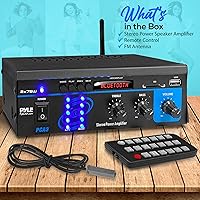
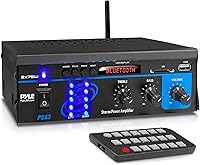
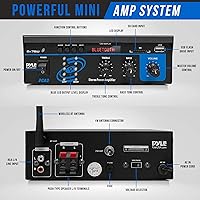
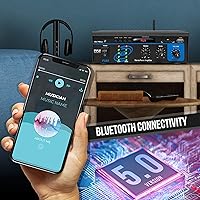
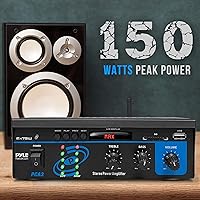
The connectivity setup here is simple and analog — you get RCA and 3.5mm inputs for hooking up a CD player, tape deck, tuner, or even a phone. There's no Bluetooth, despite what some listings might imply, so manage those expectations upfront. The tone controls are physical rotary knobs for volume, bass, and treble, which feels more intuitive than digital menus for casual listeners. A blue LED output display and a power indicator light give you a basic at-a-glance read on the unit's status. Speaker connections use spring-clip terminals — fine for bare wire, quick to set up, and compatible with most 4 to 8 ohm passive speakers.

Best For

This mini stereo amp punches above its weight in specific scenarios. It's a natural fit for small room setups — think a home office with a pair of bookshelf speakers, a dorm room, or a compact living room where a full receiver would be overkill. Vintage audio fans who have a CD player or tape deck collecting dust will find it a sensible companion for breathing life back into those sources. It's also a reasonable pick for a small rehearsal space that just needs basic monitoring without a complicated signal chain. If you want plug-and-play simplicity, this compact power amplifier delivers that without demanding much from you.

User Feedback

Across nearly 950 ratings, the Pyle PCA3 holds a 4.0 out of 5 — respectable for a budget amp that's been on shelves for over 15 years. Buyers tend to praise the easy setup and the compact footprint, and many note it performs well enough for casual listening in smaller spaces. The criticism that comes up most often involves the gap between the advertised peak power figures and actual real-world output — peak wattage numbers on budget amps rarely tell the full story. A few users also flag heat buildup during longer listening sessions, and some feel the plastic chassis reflects the price. Worth comparing against sibling models if your needs are slightly different.

Pros

  • Extremely easy to set up — connect speakers, plug in a source, and you're listening in minutes.
  • The compact footprint means it fits on a shelf, desk, or AV rack without taking over the space.
  • Analog RCA and 3.5mm inputs make it compatible with a wide range of legacy and modern sources.
  • Physical knobs for volume, bass, and treble are intuitive and more satisfying than button-driven menus.
  • At its price point, it offers genuine amplification for passive speakers that most people can afford without hesitation.
  • Spring-clip speaker terminals accept bare wire directly, so no banana plugs or adapters are needed.
  • A long market history since 2009 means real user data is abundant and reliability patterns are well documented.
  • The blue LED output display gives a quick visual cue on signal activity, which is handy in dim setups.
  • Works reliably for light, casual listening sessions in small to medium rooms.
  • Nearly 950 user ratings averaging 4.0 out of 5 reflects consistent satisfaction among its target audience.

Cons

  • Peak power figures are misleading — actual continuous output is much lower than the advertised numbers suggest.
  • No Bluetooth connectivity, despite some listings implying otherwise, which can catch buyers off guard.
  • The lightweight plastic chassis feels noticeably cheap and does not inspire confidence in long-term durability.
  • Heat management is a real concern during extended listening sessions, which may shorten the unit's lifespan.
  • Limited to stereo two-channel output — no surround sound, no subwoofer channel, no expansion options.
  • Spring-clip terminals, while convenient, are not ideal for thicker gauge speaker wire or high-quality terminations.
  • Bass and treble controls offer only basic tone shaping — do not expect precise or musical EQ adjustments.
  • Not well-suited for larger rooms or less-sensitive speakers that demand more headroom and sustained power.
  • No remote control or digital display, which may frustrate users accustomed to modern receiver conveniences.
  • Build quality and component tolerances reflect the entry-level price, making it a risky long-term investment for heavy daily use.

Ratings

The Pyle PCA3 Dual Channel Stereo Power Amplifier has accumulated nearly 950 verified ratings over its long market life, and our AI scoring system has analyzed that feedback globally — filtering out incentivized reviews, spam, and outlier noise — to produce the category scores below. The results honestly reflect where this compact power amplifier earns genuine praise and where real buyers have run into frustration, so you can make a clear-eyed decision before purchasing.
Value for Money
83%
For buyers on a tight budget who simply need to power a pair of passive bookshelf speakers, this mini stereo amp delivers a working stereo system at a price that's hard to argue with. Users frequently note that the functionality-to-cost ratio feels fair, especially for first-time amp owners who don't want to over-invest before they know what they need.
The value equation starts to wobble if you push the unit harder than casual listening or expect it to last years under heavy use. A few buyers feel the price savings come at a noticeable cost in component quality, and some report needing a replacement sooner than expected.
Ease of Setup
91%
Setup is genuinely straightforward — connect bare speaker wires to the spring-clip terminals, plug a source into the RCA or 3.5mm input, and you're listening within minutes. Buyers with no prior amp experience consistently report having everything running without consulting a manual, which is a meaningful advantage for newcomers.
The spring-clip terminals, while convenient for thin gauge wire, can be fiddly with thicker cables, and a small number of users report the clips feeling loose over time. The lack of any labeling clarity around input selection has also occasionally confused buyers switching between sources.
Sound Quality
67%
33%
For background listening, casual music playback, or powering a basic desktop speaker setup, the audio output is clean enough and free of obvious distortion at moderate volume levels. Users pairing it with efficient bookshelf speakers in small rooms generally report a satisfying listening experience for everyday use.
Critical listeners notice a lack of depth and warmth at the low end, and the treble can feel slightly harsh when pushed toward higher volumes. The tone controls offer only coarse adjustment, so if your speakers have significant frequency imbalances, this amp's EQ range won't fully compensate.
Power Output
58%
42%
For small, efficient speakers in compact rooms, the amp provides enough output to reach comfortable listening volumes without obvious strain. Users with sensitive bookshelf speakers in dorm rooms or home offices tend to find the available headroom adequate for their needs.
The advertised peak wattage figures significantly overstate what you get in continuous real-world use, which is a consistent point of frustration in critical reviews. Buyers who connected the amp to less sensitive or larger speakers were often disappointed by how quickly it ran out of usable power at higher volumes.
Build Quality
53%
47%
The unit is functional and gets the job done for light daily use. Its low weight makes it easy to reposition, and the physical knobs have enough tactile resistance to feel usable during normal listening sessions in a fixed desk or shelf setup.
The plastic chassis feels noticeably cheap when handled, and several users describe the overall construction as flimsy for anything beyond gentle stationary use. Knob wobble and housing creaks have been flagged in multiple reviews, and confidence in long-term durability is low at this price point.
Heat Management
51%
49%
During short listening sessions of an hour or less, the amp stays at a manageable temperature and does not cause immediate concern. Users running it intermittently for background music report no heat-related issues in day-to-day use.
Extended continuous operation causes the chassis to get noticeably warm, and a subset of buyers report thermal issues contributing to performance degradation or failure over time. The unit has no fan and minimal ventilation design, which limits its suitability for all-day or high-volume use scenarios.
Connectivity Options
61%
39%
Having both a 3.5mm aux input and RCA left/right inputs gives this compact power amplifier a useful degree of flexibility for analog sources. Users connecting CD players, tape decks, or portable music players find the input selection covers their needs without any adapters.
The complete absence of Bluetooth or any digital input is a real limitation that some buyers only discover after purchase — particularly those misled by product listing titles referencing wireless features. There is also no optical or coaxial digital input, which rules out direct connection to modern TVs or streaming devices without an external DAC.
Size & Portability
88%
At just one pound and a compact footprint, this mini stereo amp tucks into tight spaces with ease — on a bookshelf alongside media equipment, on a desk beside a monitor, or inside a small AV cabinet. Its lightweight nature also makes it easy to move between rooms or take to a rehearsal space.
The same small size that makes it convenient also limits its thermal mass and internal component space, which directly contributes to the heat management and build quality concerns noted elsewhere. It is not a unit you'd want to stack other equipment on top of.
Tone Controls
62%
38%
Having physical rotary knobs for volume, bass, and treble is more intuitive and tactile than digital menu-based controls, and users appreciate the ability to make quick adjustments without navigating settings. For casual listeners who just want a touch more warmth or brightness, the controls are sufficient.
The adjustment range and precision are limited — the bass and treble controls affect broad frequency bands rather than providing surgical correction. Users with acoustically challenging rooms or speakers that need significant tonal compensation will find these controls too blunt to solve the problem.
Visual Indicators
74%
26%
The blue LED output level display is a practical touch that lets you glance over and confirm the amp is receiving and passing signal, which is genuinely useful during initial setup or troubleshooting. The power indicator LED is clear and visible even from across a small room.
The LED display is fairly basic and provides limited granularity — it confirms signal presence more than it gives you meaningful level metering. In brighter room conditions some users find the display hard to read at a distance.
Speaker Compatibility
77%
23%
Supporting 4 to 8 ohm speaker impedance covers the overwhelming majority of passive bookshelf and small floor-standing speakers that budget buyers are likely to own or purchase. Users pairing it with common brands in the entry-level passive speaker market report clean, stable operation.
The amp offers no flexibility for speakers outside the 4 to 8 ohm range, and its real-world power output limits how well it can drive speakers on the less-sensitive end of that compatibility window. It is not a suitable match for demanding or large-format passive speakers.
Long-term Reliability
49%
51%
Many buyers who use the unit lightly — a few hours per week at modest volumes — report it holding up adequately over a year or more. For seasonal or occasional use, the longevity concerns are less acute.
Reliability under sustained daily use is a documented weak point, with heat accumulation being the primary failure mechanism cited in critical long-term reviews. Given its age as a product line, there are enough multi-year ownership reports to suggest that intensive use shortens its practical lifespan noticeably.
Input Source Versatility
72%
28%
The combination of RCA and 3.5mm inputs makes the Pyle PCA3 a flexible hub for legacy audio sources — CD players, tape decks, VCRs, and camcorders all connect without adapters. Vintage audio enthusiasts specifically appreciate this analog-first approach.
There is no way to switch between two simultaneously connected sources without physically unplugging cables, as the unit has no input selector switch. This becomes genuinely inconvenient if you regularly alternate between two different source devices.
Noise Floor
64%
36%
At low to moderate volumes with an average source signal, the background noise level is acceptable for casual listening and does not distract from music playback in typical home environments. Users with efficient speakers and a clean source report no noticeable hiss during normal use.
At higher volume settings with no audio signal playing, some users detect a low-level hiss or hum, which is common for budget Class AB amplifiers but still frustrating. Pairing this amp with high-sensitivity speakers tends to make the noise floor more audible, particularly in quiet listening environments.

Suitable for:

The Pyle PCA3 Dual Channel Stereo Power Amplifier is a solid pick for casual listeners who need a no-fuss way to drive a pair of passive bookshelf speakers in a small space. If you're setting up a home office audio system, outfitting a dorm room, or just want background music in a bedroom without spending much, this compact power amplifier fits the bill without overcomplicating things. It's also a natural companion for anyone dusting off legacy audio gear — a CD player, a tape deck, or an old tuner — since its analog RCA and 3.5mm inputs cover those sources without any adapters. First-time amp buyers who feel intimidated by receiver setups with a dozen inputs and a thick manual will appreciate how quickly this mini stereo amp gets up and running. Small rehearsal rooms or practice spaces that just need a basic monitoring signal, not a full mixing chain, are another scenario where it earns its place.
Not suitable for:

Buyers expecting performance comparable to a mid-range or high-end stereo receiver will find the Pyle PCA3 Dual Channel Stereo Power Amplifier falls well short of that bar. The advertised peak wattage figures are best treated with skepticism — like most budget amps, the real-world continuous output is considerably more modest, which means it can struggle to fill larger rooms or push less-sensitive speakers to satisfying volumes. Anyone hoping for Bluetooth streaming will be disappointed, as this unit is entirely analog despite some product listings muddying that point. If you plan to run it for hours at a stretch, heat buildup is a documented concern that can affect reliability over time. Audiophiles, home theater enthusiasts who want Dolby or surround processing, or anyone building a serious listening room should look at more capable options — this amp is simply not built for those demands.
Specifications

  • Model Number: This unit is manufactured by Pyle-Home under the model designation PCA3.
  • Channels: The amplifier operates in dual-channel stereo mode, delivering independent left and right audio output.
  • Peak Power Output: Rated at 2x75W peak power, though real-world continuous output will be notably lower than this peak figure.
  • Speaker Impedance: Compatible with passive speakers rated between 4 and 8 ohms, covering the vast majority of common home bookshelf and subwoofer speakers.
  • Audio Inputs: Accepts analog audio via a 3.5mm stereo aux input and a pair of RCA left/right line-level inputs.
  • Speaker Terminals: Uses push-type spring-clip terminals that accept bare speaker wire directly, requiring no specialized connectors or tools.
  • Tone Controls: Features three physical rotary knobs for independent adjustment of master volume, bass, and treble.
  • Display: Equipped with a blue LED output level display and a separate LED power indicator light above the power switch.
  • Dimensions: The unit measures 7.7 x 4.1 x 8.9 inches, making it compact enough to fit on most shelves or inside AV furniture.
  • Weight: Weighs approximately 1 pound, making it one of the lightest amplifiers in its category.
  • Wireless Connectivity: This amplifier has no wireless connectivity — there is no Bluetooth, Wi-Fi, or any other wireless audio input.
  • Source Compatibility: Designed for use with passive speakers, CD players, tuners, tape decks, VCRs, and camcorders via its analog inputs.
  • Power Indicator: An LED indicator light positioned above the power switch illuminates to confirm the unit is powered on.
  • Market Category: Ranks among the top 430 products in the Audio Component Amplifiers category on Amazon, reflecting steady and sustained sales.
  • Availability Since: This model has been commercially available since January 2009, giving it over 15 years of real-world consumer use history.
  • Manufacturer: Produced by Pyle-Home, a brand known for offering accessible entry-level audio and home theater equipment.

Related Reviews

Pyle PT8000CH
Pyle PT8000CH
70%
84%
Ease of Installation
78%
Multi-Zone Audio Performance
51%
Rated Power Accuracy
62%
Build Quality
57%
Thermal Management & Fan Noise
More
Pyle PLA2378 2-Channel Car Amplifier
72%
83%
Value for Money
51%
Power Output Accuracy
67%
Build Quality
88%
Ease of Installation
58%
Heat Management
More
Pyle PT12050CH 12-Channel Rack Amplifier
71%
83%
Value for Money
79%
Channel Flexibility
72%
Bluetooth Performance
81%
Mic Talk-Over Function
57%
Build Quality
More
Pyle PTA1000BT 2-Channel Bluetooth Power Amplifier
73%
82%
Value for Money
51%
Power Output Accuracy
58%
Build Quality
89%
Ease of Setup
71%
Bluetooth Performance
More
Pyle PLA2678 2-Channel Car Stereo Amplifier 4000W
85%
91%
Power Output
87%
Sound Clarity
84%
Build Quality
90%
Compact Design
67%
Thermal Management
More
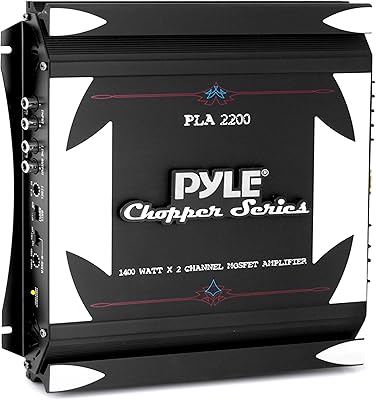
Pyle PLA2200 2-Channel Car Amplifier
67%
78%
Value for Money
83%
Ease of Installation
69%
Sound Clarity
54%
Power Output (Real-World)
61%
Build Quality
More
Pyle PHA40 4-Channel Headphone Amplifier
74%
86%
Value for Money
93%
Ease of Setup
57%
Output Volume & Headphone Drive
71%
Signal Clarity & Noise Floor
62%
Build Quality
More
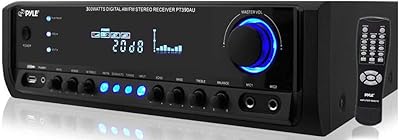
Pyle PT390AU 4-Channel Home Audio Amplifier
70%
83%
Value for Money
67%
Sound Quality
78%
Microphone Performance
86%
Ease of Setup
58%
Build Quality
More
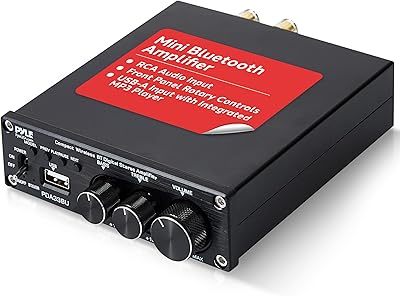
Pyle PDA33BU 2.1 CH Wireless Stereo Power Amplifier
81%
82%
Sound Quality
88%
Ease of Setup
75%
Bluetooth Connectivity
67%
Bass Performance
92%
Value for Money
More
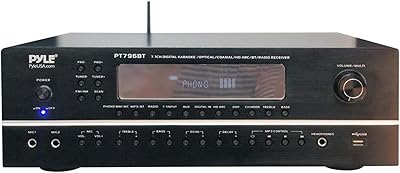
Pyle PT796BT 7.1-Channel AV Receiver
64%
67%
Value for Money
58%
Audio Performance
83%
Connectivity & Inputs
74%
Bluetooth Performance
52%
Build Quality
More
Power Acoustik RE4-2000D 2000 Watt 4-Channel Car Stereo Amplifier
86%
89%
Sound Quality
92%
Power Output
84%
Thermal Protection
88%
Ease of Installation
80%
Durability
More

FAQ

No, it does not. The Pyle PCA3 Dual Channel Stereo Power Amplifier is a fully analog unit with no wireless capability of any kind. If you see Bluetooth mentioned in a listing title or description, that appears to be a labeling error. You will need a physical cable connection to use it.
Yes, easily. There is a 3.5mm aux input on the unit, which is the standard headphone-style connector found on most phones, tablets, and laptops. Just run a 3.5mm cable from your device's headphone or audio output into the amp, and you are good to go.

Any passive speakers — meaning speakers without their own built-in power supply — rated between 4 and 8 ohms will work. Most common bookshelf speakers fall into this range. Active or powered speakers, which have their own amplifier inside, should not be connected to this unit.

Realistically, it delivers enough volume to comfortably fill a small to medium room — think a home office, dorm room, or compact living space. The peak wattage figure on the spec sheet is not the same as continuous usable power, so manage expectations accordingly. It won't shake walls, but for background listening or casual enjoyment it performs well at moderate volumes.

Not at all. Connect your speaker wires to the spring-clip terminals on the back, plug your audio source into one of the inputs, power the unit on, and adjust the volume knob. Most people have it up and running within a few minutes. No configuration menus or apps are involved.

You can connect a passive subwoofer to it, provided the subwoofer's impedance falls within the 4 to 8 ohm range. However, this compact power amplifier does not have a dedicated subwoofer output channel or a crossover, so it would simply drive the sub as a standard speaker channel, which is not ideal for serious bass management.

It does generate some heat during operation, which is normal for Class AB amplifiers. During short listening sessions this is generally not a problem, but if you run it for extended periods — several hours continuously — some users report it gets warm enough to be a concern. Make sure there is some open space around it for airflow and avoid enclosing it in a sealed cabinet.

Only if your turntable has a built-in phono preamp, which many modern entry-level turntables do. A standard turntable cartridge outputs a very low-level signal that requires a phono preamp stage to boost and equalize it before the amp can handle it. This mini stereo amp has no built-in phono stage, so a raw cartridge signal will sound thin and quiet.

It is functional but clearly reflects its budget price bracket. The chassis is lightweight plastic, and the knobs and buttons feel utilitarian rather than premium. For the price, that is a reasonable trade-off, but do not expect the heft or finish quality of a mid-range receiver. Treat it gently and it should hold up fine for casual home use.

The PCA2 is a step down in rated output, while the PCA4 steps up slightly in power and sometimes adds additional features depending on the version. If your speakers are fairly efficient and your room is small, the Pyle PCA3 is typically sufficient. If you want more headroom or plan to push larger or less sensitive speakers, the PCA4 might be worth the incremental cost difference.

Where to Buy