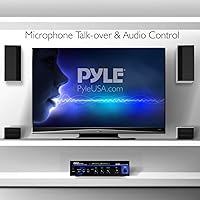
Overview

The Pyle PT110 is a mono PA amplifier that has quietly built a reputation in small commercial settings since its introduction in 2006 — and that kind of staying power says something real. Built by Sound Around, this compact PA amp runs a 70V line output, the standard topology used in distributed speaker systems across restaurants, offices, and retail spaces. It won't compete with high-end commercial gear, and it's not meant to. The mono design keeps things focused: clear background audio and dependable paging, without the cost or complexity of a full mixing console.

Features & Benefits

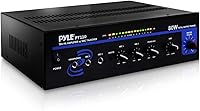
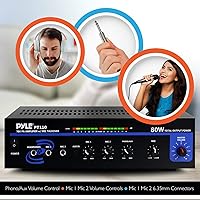
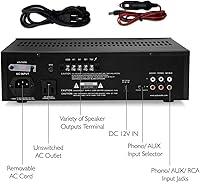
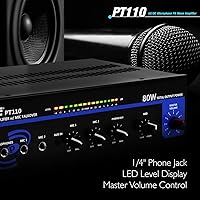
The front panel of this compact PA amp is laid out with practical clarity — input selector, master volume, tone control, and an LED power indicator all sit within easy reach. Two quarter-inch mic inputs each carry their own volume knob, and both support a talkover function that ducks background music automatically when someone speaks. A 3.5mm AUX port handles phones or media players, and a headphone jack allows private monitoring without cutting the main feed. The 70V output is where this mono amplifier earns its keep in commercial installs: it supports long cable runs to multiple ceiling or wall speakers with minimal signal degradation.

Best For

Picture a neighborhood café playing background music all day while a manager occasionally needs to make a quick announcement — this compact PA amp handles exactly that scenario without any fuss. It works just as well in a small office where staff need to be paged across a few rooms, or in a community hall running on a tight audio budget. For DIY installers tackling their first 70V speaker network, the PT110 unit is approachable: the wiring conventions are standard, the controls are intuitive, and the learning curve is short. If you plan to drive more than a dozen ceiling speakers continuously, though, you will likely want something with a higher output ceiling.

User Feedback

Across verified buyer reviews, the PT110 unit earns consistent praise for its quick setup — most users report having a working system within minutes of unboxing. Long-term deployments in restaurants and retail environments come up often as proof of solid durability. The most common complaint centers on wattage headroom: buyers running larger speaker arrays sometimes find 80 watts peak falls short under sustained demand. The talkover ducking also gets called out for being fairly abrupt rather than smooth, which matters more in upscale hospitality venues than in a basic office. One practical note worth mentioning: the unit runs noticeably warm during extended sessions, so leaving adequate clearance around the chassis is a smart precaution.

Pros

  • Pyle PT110 has been a proven commercial product since 2006, signaling a dependable baseline reliability.
  • Gets up and running fast — most users report a fully working system within minutes of unboxing.
  • Two independent mic inputs with separate volume knobs let you balance sources without an external mixer.
  • The 70V output supports long cable runs to multiple ceiling speakers with minimal signal loss.
  • Compact chassis fits neatly on a shelf, behind a counter, or in a basic equipment rack.
  • Talkover function automatically ducks background music when the mic is used — genuinely handy for paging.
  • Headphone monitoring lets you check audio privately without interrupting the main speaker output.
  • Handles the daily grind of commercial use — restaurants and retail users report multi-year reliability.
  • AUX input accepts phones or media players directly, keeping music playback simple and cable-friendly.
  • Priced accessibly enough that small businesses can get a functional PA system without a major outlay.

Cons

  • 80 watts peak runs out of headroom quickly when driving larger speaker arrays or bigger room sizes.
  • The unit runs noticeably warm during extended sessions — ventilation clearance is a real requirement, not just a suggestion.
  • Talkover ducking is abrupt and non-adjustable, which feels jarring in quieter or upscale environments.
  • No phantom power means condenser microphones are simply not an option.
  • Control knob labeling is small and can fade over time, making the panel harder to read in dim back-room installations.
  • AUX connectivity is limited to 3.5mm only — RCA or XLR sources require separate adapters.
  • Rack mounting is not included out of the box; third-party ears are needed for a clean rack installation.
  • No Bluetooth input, which is an increasingly common expectation for small venue music playback.
  • Some units show performance degradation after a few years in high-heat or dusty environments.
  • The manual lacks detailed guidance for more complex wiring configurations, leaving some DIY installers to figure things out on their own.

Ratings

The Pyle PT110 has accumulated a meaningful body of verified buyer feedback since its debut in 2006, and our AI rating engine has analyzed that global data — actively filtering out incentivized, duplicate, and bot-generated reviews — to produce the scores below. The result is an honest picture of where this compact mono amplifier consistently delivers and where real-world users have run into friction. Both the strengths and the limitations are reflected without sugarcoating.

Ease of Setup
91%
Users across small business and DIY installs consistently report having the unit fully operational within minutes. The front panel is logically organized, and the input selector plus independent volume knobs make initial configuration intuitive even for first-timers with no audio background.
A small number of buyers who attempted integration with more complex speaker arrays found the manual lacking in detail for advanced wiring configurations. Those stepping into 70V distributed systems for the first time occasionally wished for a more thorough quick-start guide.
Build Quality
72%
28%
The iron chassis gives the unit a reassuringly solid feel for its price tier, and many long-term users report no structural issues after years of daily commercial use in restaurants and retail environments. It does not feel like a toy.
The plastic control knobs and selector switch feel noticeably cheaper than the chassis itself, and a handful of users report knobs becoming loose after extended use. Fit and finish does not match mid-range commercial brands, which may concern buyers expecting premium tactile feedback.
Audio Clarity
74%
26%
For background music in cafes, retail shops, or office hallways, the sound output is clean and consistent enough that most users report zero complaints from staff or customers. Vocal paging comes through intelligibly without distortion at moderate volume levels.
Audiophiles or anyone expecting hi-fi reproduction will be disappointed — this is a utility amplifier, not a performance one. At higher volume settings, some users notice a slight harshness in the upper midrange that becomes more apparent in acoustically live rooms.
Power Output & Headroom
61%
39%
For small installations of four to six ceiling speakers in a modest-sized room, 80 watts peak is generally sufficient and the unit handles sustained moderate loads without obvious strain. It covers the basic use case it was designed for.
This is arguably the most cited limitation in user reviews. Buyers running eight or more speakers simultaneously, or those covering larger floor areas, regularly report the amp running out of headroom and the overall system sounding compressed or thin at higher demands. Anyone planning to grow their speaker count should budget for a higher-wattage unit from the start.
70V Line Performance
83%
The 70V output works reliably across long cable runs, which is exactly what distributed commercial audio requires. Users installing ceiling speakers across multiple rooms in offices or retail stores report stable signal levels with minimal drop-off even at the end of longer runs.
The 70V implementation is functional but basic — there is no built-in impedance matching feedback or protection circuitry that more expensive commercial amplifiers include. Users who miscalculate their total speaker load can inadvertently stress the unit without any warning indicator.
Talkover Function
63%
37%
The talkover ducking works as advertised for basic paging needs — background music drops when a mic is activated, which is exactly what a café manager or office administrator needs for quick announcements without manually adjusting volume.
The ducking is abrupt rather than gradual, which creates an jarring audio cut that feels out of place in upscale hospitality settings. Several buyers noted the sensitivity threshold is not adjustable, meaning soft-spoken users sometimes struggle to reliably trigger the effect.
Value for Money
86%
Relative to purpose-built commercial PA amplifiers from better-known pro-audio brands, this mono amplifier delivers the core 70V functionality at a fraction of the cost. For small businesses on tight budgets, that trade-off is genuinely worthwhile and many buyers explicitly say so.
The value equation shifts if you need to replace it within a few years due to knob wear or thermal issues. A few buyers who compared it against slightly pricier competitors felt the long-term cost of ownership was less favorable than the upfront price suggests.
Thermal Management
58%
42%
Under light-to-moderate loads — a few hours of background music in a small café — the unit operates at an acceptable temperature and most users report no heat-related issues in typical daily use.
Extended sessions, especially in enclosed equipment cabinets or poorly ventilated back-of-house spaces, cause the unit to run notably warm. Several users flag this as a concern, and at least a handful attribute eventual performance degradation to heat buildup over time. Adequate ventilation clearance is not optional.
Input Flexibility
77%
23%
Having two independent mic inputs alongside a 3.5mm AUX port covers the most common small-venue scenarios without requiring an external mixer. A manager can plug in a phone for background music while keeping a mic ready for announcements — all in one tidy box.
The AUX input is limited to 3.5mm only, which means users with RCA or XLR sources need adapters. There is no Bluetooth input, which increasingly feels like an omission as more venues manage music from mobile devices without cables.
Microphone Input Quality
69%
31%
Both quarter-inch mic inputs accept dynamic microphones cleanly, and the independent volume control per channel is a practical touch that lets users balance two different mic sources without external gear. Works reliably for straightforward paging applications.
There is no phantom power, which rules out condenser microphones entirely. Users who expected studio-grade mic preamp performance — cleaner gain staging, lower noise floor — were consistently disappointed, though that expectation is arguably misplaced for this product category.
Front Panel Usability
88%
The control layout is genuinely well thought out for a unit at this price point. Power button, input selector, master volume, tone control, and individual input knobs are all accessible from the front without needing to reach around back mid-session — a real-world convenience that users notice and appreciate.
The labeling on some controls is small and fades over time with repeated handling, according to a few long-term users. In dim environments like bar back-rooms or equipment closets, reading the panel without a flashlight can be awkward.
Compact Form Factor
84%
The relatively slim chassis fits comfortably on a shelf, inside a basic equipment rack, or tucked behind a counter without dominating the space. For small business owners who don't have a dedicated equipment room, that physical footprint genuinely matters.
The unit is not rack-mountable out of the box — rack ears are not included — so users who want a clean rack installation need to source a third-party mounting solution separately, which adds minor cost and hassle.
Long-Term Reliability
76%
24%
The fact that this amplifier has remained a viable product since 2006 without major redesign is a quiet indicator of its durability baseline. Multiple buyers in restaurant and retail deployments report units running without incident for several years under daily use.
There is a visible pattern of units developing intermittent channel issues or output degradation after the two-to-three-year mark, particularly in environments with heat or dust exposure. Reliability at year four or five appears more variable than the early years suggest.

Suitable for:

The Pyle PT110 is a practical fit for small business owners and DIY installers who need a functional, no-nonsense distributed audio solution without a steep learning curve or a large equipment budget. A café owner who wants background music playing through four to six ceiling speakers while keeping a mic handy for occasional staff announcements will find this compact PA amp covers exactly that scenario reliably. The same applies to a small office manager setting up a basic paging system across a few rooms, or a community hall coordinator who needs to mic a speaker and play music from a phone without hiring an AV contractor. Houses of worship on tight budgets — where the goal is clear vocal reinforcement and ambient music rather than concert-grade fidelity — are another natural home for this mono amplifier. It particularly suits first-time installers tackling a 70V speaker network, since the front panel controls are intuitive enough to get a working system running quickly, and the 70V standard it supports is compatible with a wide range of commercial ceiling and wall speakers.

Not suitable for:

Buyers with larger or more demanding audio installations should think carefully before committing to the Pyle PT110, because the 80-watt peak output is a genuine ceiling that becomes noticeable when driving eight or more speakers or covering a large open floor area. If your venue — say, a mid-size gym, a warehouse retail space, or a full-sized restaurant dining room — needs sustained high-volume coverage, this mono amplifier will likely feel underpowered and may show stress during long operating hours. Anyone who needs smooth, gradual mic ducking for a polished hospitality experience will find the talkover function too abrupt for their standards. Users expecting condenser microphone support will also be out of luck, since there is no phantom power on either mic input. And if audio fidelity actually matters to your brand — a high-end lounge, a music-focused venue, or a retail environment where sound quality is part of the customer experience — this unit's utility-grade output quality is unlikely to meet expectations.

Specifications

  • Brand & Model: Manufactured by Sound Around and sold under the Pyle brand as model PT110.
  • Output Power: Delivers 80 watts peak output, suitable for small distributed speaker installations in commercial environments.
  • Output Voltage: Operates on the 70V line standard, enabling long cable runs to multiple commercial ceiling or wall speakers.
  • Channels: Single-channel mono amplifier, designed for uniform background audio and paging rather than stereo playback.
  • Mic Inputs: Features two quarter-inch microphone input jacks, each with its own independent rotary volume control.
  • Talkover Function: Both mic inputs support a talkover function that automatically reduces background music level when a microphone signal is detected.
  • AUX Input: Includes one 3.5mm stereo AUX input jack for connecting phones, tablets, or portable media players.
  • Headphone Output: A dedicated headphone jack allows private audio monitoring without interrupting or cutting the main speaker output.
  • Impedance: Compatible with 4-ohm, 8-ohm, and 70V speaker loads, covering standard commercial speaker configurations.
  • Power Supply: Accepts 120V to 240V AC mains input, making it compatible with standard North American and international power outlets.
  • Dimensions: The chassis measures approximately 12.6″ x 10″ x 3.75″, providing a compact footprint for shelf or surface mounting.
  • Weight: Weighs approximately 4.43 lbs, light enough to reposition easily during installation or maintenance.
  • Chassis Material: Constructed with an iron chassis that provides structural rigidity and basic electromagnetic shielding.
  • Mounting Type: Designed for surface mounting, though it can also be placed on a shelf or inside an open equipment rack with appropriate accessories.
  • Front Panel Controls: Includes a power on/off button, input selector switch, master volume knob, tone control knob, and LED power indicator, all accessible from the front.
  • Availability: First made available in September 2006 and remains an active, non-discontinued product as of current listings.
  • Certifications: Listed as certified frustration-free, indicating simplified packaging designed for easy unboxing.
  • UPC: Universal Product Code is 068888880220, used for standard retail and inventory identification.

Related Reviews
Pyle PLMR652W Marine Speakers
86%
88%
Sound Quality
91%
Ease of Installation
93%
Durability (Waterproof & Weather Resistance)
87%
Build Quality
75%
Performance at High Volumes
More
Pyle PLMR692 Marine Speakers
85%
88%
Sound Clarity
91%
Build Quality & Durability
94%
Waterproof Performance
85%
Installation Ease
73%
Bass Response
More
Pyle PLMR57W Marine Speakers
85%
84%
Sound Quality
91%
Durability
89%
Ease of Installation
90%
Weather Resistance
75%
Bass Performance
More
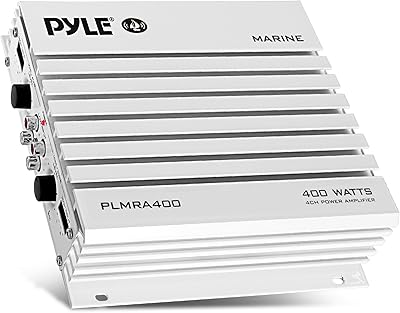
Pyle PLMRA400 Marine Amplifier
82%
85%
Overall Performance
88%
Sound Quality
90%
Durability (Waterproofing & Corrosion Resistance)
75%
Installation Ease
80%
Build Quality
More
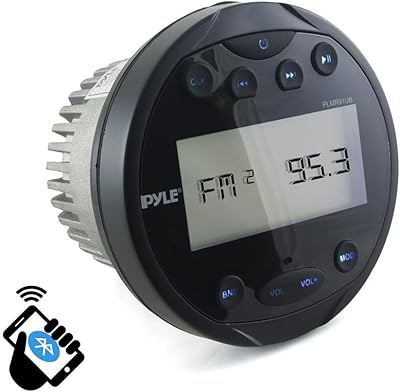
Pyle PLMR91UB Marine Stereo
82%
89%
Waterproof Performance
76%
Bluetooth Connectivity
83%
Sound Quality
90%
Ease of Installation
85%
Durability in Marine Environments
More
Pyle PLMRMB2CW Marine Amplifier
86%
85%
Sound Quality
92%
Waterproof Durability
88%
Bluetooth Connectivity
80%
Power Output
87%
Installation Ease
More
Pyle PDWR30B Outdoor Speakers
85%
88%
Sound Quality
94%
Weatherproof Durability
85%
Ease of Installation
78%
Design and Aesthetics
91%
Build Quality
More
Pyle PVTC320U Step Up and Down Converter
84%
87%
Value for Money
85%
Performance
90%
Ease of Use
65%
Portability
91%
Safety Features
More
Pyle PLATV65BT Bluetooth Speakers
86%
88%
Sound Quality
91%
LED Light Features
85%
Water Resistance
89%
Ease of Installation
87%
Build Quality
More
Pyle PLMRS4W Marine Speakers
84%
80%
Sound Quality
90%
Build Quality
88%
Durability in Harsh Weather
85%
Installation Ease
65%
Bass Response
More

FAQ

For a comfortable, reliable setup, most installers recommend keeping the total load to around four to six standard 70V ceiling speakers. You can technically connect more depending on each speaker's wattage tap setting, but pushing the total draw close to 80 watts peak leaves no headroom, and users report the sound starts to feel compressed. Calculate your total speaker wattage before wiring up to stay well within the safe operating range.

No — there is no phantom power on either mic input, so condenser microphones will not work here. You will need to stick to passive dynamic microphones, which are the standard choice for basic paging and announcement applications anyway.

Yes, that is exactly the kind of scenario the Pyle PT110 was built for. You can connect a phone or tablet directly via the 3.5mm AUX input for music, plug in a dynamic microphone for occasional announcements, and control each independently from the front panel — no external mixer needed.

Unfortunately, no. The talkover sensitivity is fixed and not user-adjustable, which means the music cuts fairly abruptly when a mic signal is detected rather than fading gracefully. For a basic office or café paging setup it gets the job done, but if you need smooth, broadcast-style ducking, you would want a more advanced unit.

Yes, this mono amplifier supports 4-ohm, 8-ohm, and 70V speaker configurations, so you can connect standard 8-ohm bookshelf or PA speakers directly. Just make sure you are not connecting too many speakers in parallel, as that can drop the combined impedance below the minimum and risk damaging the amp.

It is a known characteristic of this amp, and by itself warmth does not indicate a problem. What matters is airflow: do not install it inside a sealed cabinet or stack equipment directly on top of it. Leave at least a few inches of clearance on all sides, and if it is in a warm back-of-house environment, consider adding passive ventilation to the enclosure.

The chassis dimensions are compatible with rack installation in terms of depth, but rack mounting ears are not included in the box. You would need to source a universal rack-mount shelf or third-party ears separately to achieve a clean rack installation.

Yes, the power supply handles both 120V and 240V AC input, so it is compatible with standard mains power in most countries without needing a voltage converter.

It is actually a solid fit for that scenario. A single-zone office paging setup is one of the most common use cases for this compact PA amp, and the dual mic inputs mean you could have two desk stations connected simultaneously if needed. The compact size also means it tucks away neatly without taking up valuable counter or shelf space.

This amplifier has been available since September 2006 — nearly two decades — and is listed as an active, non-discontinued product. That kind of longevity in a budget commercial audio product is a reasonable indicator that it has proven durable and useful enough to maintain steady demand, and that replacement units are easy to find if needed.