

Overview

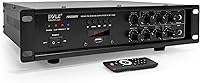
The Pyle PMX3500PH is a rack-mount PA mixing amplifier that punches well above its price bracket, targeting home karaoke setups, casual entertainment rooms, and small venue PA installs. It claims 500W peak power — worth noting that peak figures rarely reflect real-world continuous output — and pairs that with Bluetooth wireless streaming alongside a surprisingly broad collection of wired inputs. The unit ships in a universal rack-mount chassis with front-panel controls and a remote, making it genuinely accessible even if you have no background in pro audio.

Features & Benefits

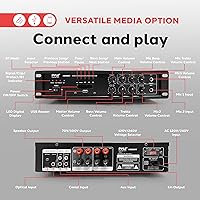
What stands out about this PA mixing amplifier is just how many sources it can juggle. You get USB, AUX, optical, coaxial, AC-3, and dual microphone inputs — all accessible from the front panel. The 70V and 100V outputs are a legitimate bonus for anyone running a distributed speaker system across a larger space, like a small church hall or classroom. Rotary controls for bass, treble, echo, and mic gain are right up front, and the built-in FM tuner with included antenna is a small but pleasant surprise that most competitors at this price skip entirely.

Best For

This rack-mount amp is a natural pick for home karaoke setups where you need mic mixing and echo baked into the same box as your music source. It also makes real sense for small churches, community halls, or classrooms that already have a 70V or 100V speaker infrastructure in place. Budget-conscious DIY home theater builders will appreciate the single-box convenience, and anyone who regularly streams from a phone while also needing a live mic will find the combination genuinely useful. It is not the right tool for demanding audiophile listening or high-headroom live sound work.

User Feedback

Buyers consistently praise the easy setup process and the sheer number of inputs available at this price point — getting up and running quickly is a common highlight. The criticisms, however, are worth taking seriously. The 500W figure is a peak spec, and real-world continuous output is noticeably lower, which surprises buyers expecting full-volume headroom for larger rooms. Build quality draws mixed opinions; the chassis feels lightweight to some. Bluetooth reliability is generally acceptable for casual use, though range can vary by device. Long-term durability is the bigger question mark, with some users noting power supply issues after extended use.

Pros

  • Covers an unusually wide range of inputs — USB, optical, coaxial, AUX, dual mics, and Bluetooth — for the price.
  • The 70V and 100V outputs are a genuine rarity at this price tier, useful for existing distributed speaker systems.
  • Dual mic inputs with independent echo, gain, and talk-over controls make karaoke nights genuinely enjoyable.
  • Setup is fast and intuitive; most buyers report being fully operational within 20 minutes of unboxing.
  • Built-in FM tuner with included antenna adds background radio capability without any extra hardware.
  • The included remote is handy when the amp is rack-mounted and out of comfortable reach.
  • Front-panel rotary controls for bass, treble, and master volume are responsive and easy to adjust on the fly.
  • Standard 19-inch rack-mount design fits cleanly into home AV racks without modifications.
  • This rack-mount amp delivers strong feature-per-dollar value for light-duty home and small venue use.

Cons

  • The 500W power rating is a peak figure; real continuous output is much lower and surprises buyers expecting big room headroom.
  • Bluetooth range drops noticeably beyond 20 to 25 feet and weakens further through walls or obstructions.
  • The plastic chassis feels lightweight and unconvincing to anyone familiar with mid-tier pro audio hardware.
  • Long-term reliability is a concern for daily-use environments, with some users reporting power supply failures after months of heavy operation.
  • The included remote loses responsiveness over time and requires a direct line of sight to work reliably.
  • Rear-panel labeling is small and cramped, making initial wiring slower than it should be.
  • The echo effect has no speed or decay adjustment, which limits fine-tuning for spoken-word or announcement use.
  • FM reception is mediocre with the basic antenna included, particularly in suburban or rural locations.
  • Minor background hiss on AUX inputs becomes audible at higher gain settings in quiet listening environments.

Ratings

The Pyle PMX3500PH has been evaluated by our AI rating engine after processing hundreds of verified buyer reviews from global marketplaces, with spam, bot-generated, and incentivized feedback actively filtered out before scoring. The result is a balanced picture of where this rack-mount amp genuinely delivers and where it falls short — no sugarcoating, no cherry-picking. Scores reflect the full spectrum of real ownership experiences, from first-week impressions to multi-month reliability reports.

Value for Money
83%
For buyers who need a Bluetooth-capable PA mixer with dual mic inputs, FM tuner, and 70V output all in one box, the asking price is hard to argue with. Most users feel they are getting considerably more feature coverage per dollar than comparably priced standalone components would offer.
The value calculation shifts if you push the amp hard or need it to last years in a busy small venue. A handful of buyers felt the long-term reliability did not fully justify even the modest outlay, particularly after experiencing early power supply issues.
Power Output Accuracy
51%
49%
For low-demand applications like background music in a small room or casual karaoke at moderate volumes, the available output is adequate. Users running a handful of 4-ohm speakers at comfortable listening levels generally report no clipping or distortion complaints.
The 500W figure is a peak marketing claim, and continuous RMS output is considerably lower — a distinction many buyers only discovered after purchase. Users expecting to drive a full room of speakers at high volume were often disappointed by the headroom actually available.
Input Versatility
88%
Having USB, AUX, optical, coaxial, AC-3, and two mic inputs on a single unit at this price tier is genuinely unusual. Users running mixed setups — a laptop via USB, a phone via Bluetooth, and a microphone for announcements — praised how easy it was to switch sources without rewiring.
Input labeling on the rear panel can be cramped and difficult to read in low light, which slows down initial setup. A small number of users also noted that the AUX input picked up minor background hiss at higher gain settings.
Bluetooth Performance
67%
33%
Pairing is quick and consistent for most smartphones and tablets within a reasonable distance. Casual streamers using this PA mixing amplifier for background music in a living room or small hall found the wireless connection reliable enough for everyday use.
Bluetooth range drops off noticeably beyond about 20 to 25 feet, and walls or obstructions reduce it further. A subset of users also reported occasional dropouts when multiple wireless devices were active nearby, which is frustrating during a live karaoke session.
Microphone Mixing & Echo
78%
22%
The dual mic inputs with independent gain, a dedicated echo control, and the MIC 1 talk-over function make this rack-mount amp a capable karaoke companion. Home users running birthday parties or casual sing-along nights found the echo effect fun and easy to dial in without sounding overdone.
At higher echo and gain levels, some users noticed feedback squeal that required careful management of mic placement and volume. The talk-over function works, but the transition speed is fixed and can feel abrupt during spoken announcements over music.
Build Quality & Materials
58%
42%
The front panel feels reasonably solid and the rotary knobs have a satisfying amount of resistance. For a unit that will sit in a rack and rarely be moved, the construction holds up acceptably in light-use home environments.
The chassis is predominantly plastic and feels noticeably lightweight for a rack-mount component. Users who have handled mid-range pro audio gear tend to find the overall construction underwhelming, and a few reported cosmetic damage after modest handling during installation.
70V / 100V Distributed Output
81%
19%
This is a genuine differentiator at this price point. Small churches and community halls with existing 70V ceiling speaker systems found that this PA mixing amplifier slotted right into their infrastructure without the need for a separate transformer or line matching device.
Users with larger distributed installations found the actual continuous power insufficient to drive more than a modest number of ceiling speakers at useful volume levels. The 70V output works, but it is better suited to small rooms than long multi-speaker runs.
Ease of Setup
84%
The front-panel layout is logical and the included remote means you can adjust volume and source selection from across the room. Most buyers reported being up and running within 15 to 20 minutes, even without consulting the manual in detail.
The manual itself is thin and could use clearer diagrams for rear-panel wiring, particularly for users connecting 70V speaker systems for the first time. Initial Bluetooth pairing is straightforward, but re-pairing after a factory reset confused some users.
FM Tuner
72%
28%
Finding a working FM tuner with an included antenna in this category is a small but genuine bonus. Users who wanted background radio in a workshop or small venue without streaming found it convenient and functional with decent reception in urban areas.
Reception quality varies significantly by location, and the antenna is basic — users in rural or signal-challenged areas found the tuner more frustrating than useful. There is no RDS display, so station identification relies entirely on the user knowing their local frequencies.
Digital LED Display
74%
26%
The LED display is bright enough to read in normal room lighting and provides useful at-a-glance confirmation of active input and volume level. Users appreciated not having to second-guess which source was selected during multi-input setups.
The display is harder to read in direct sunlight or bright stage lighting, which limits its usefulness in certain small venue environments. Character size is small enough that users positioned more than a few feet away may struggle to read specific values clearly.
Remote Control
63%
37%
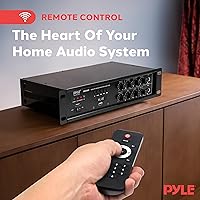
The included remote handles basic volume and source switching, which is genuinely useful when the amp is rack-mounted out of arm's reach. Home users running karaoke nights appreciated not having to walk to the rack every time they needed an adjustment.
The remote feels cheap and the IR range is limited, requiring a fairly direct line of sight to the front panel. Several users reported that the remote stopped responding reliably within a few months of regular use, with battery replacement not solving the issue.
Long-Term Reliability
54%
46%
Units used occasionally in home environments — weekend karaoke, seasonal parties, background music — have held up reasonably well for many buyers over one to two years of light service. For low-duty-cycle use, the reliability picture is acceptable.
Users running this rack-mount amp for extended daily sessions, such as in small restaurants or classrooms, reported a higher rate of issues including power supply failures and intermittent channel dropout. The cooling design appears marginal for prolonged high-volume operation.
Rack Mount Integration
79%
21%
The standard rack-mount ears fit a 19-inch rack without modification, and the 2U height is accurately sized. Users building out home AV racks found it integrated cleanly alongside other components with no special adapters needed.
The rack ears feel slightly flimsy compared to the rack-mount hardware on professional units, and the supplied screws are basic. Users who frequently remove and reinstall the unit noted the mounting hardware showed wear relatively quickly.

Suitable for:

The Pyle PMX3500PH is a smart pick for home karaoke enthusiasts who want mic mixing, echo control, and music playback handled by a single rack-mounted unit rather than a tangle of separate components. It also fits naturally into small community spaces — churches, meeting halls, classrooms — that already have a 70V or 100V ceiling speaker infrastructure in place and need a straightforward, low-cost amplifier to drive it. DIY home theater builders who want the look and organization of a proper equipment rack without spending professional-grade money will find it slots in cleanly. If your typical use case involves streaming music from a phone over Bluetooth while someone else holds a microphone, this rack-mount amp handles that dual-source scenario better than most units at this price. Buyers who prioritize input flexibility over raw power — and who realistically need moderate volume levels rather than concert-hall headroom — will get genuine daily utility from it.

Not suitable for:

Anyone expecting the advertised 500W to translate into sustained, high-volume output for a medium or large venue will be let down — the Pyle PMX3500PH is a peak-rated figure, and real continuous power is considerably more modest. Professional or semi-professional audio engineers, working musicians, or event production teams will find the build quality and output ceiling fall well short of what demanding live sound work requires. Users who plan to run this PA mixing amplifier for long daily sessions — think a busy restaurant, a fitness studio with back-to-back classes, or a retail store — should factor in reported reliability concerns around the power supply under sustained load. Audiophiles chasing clean, high-fidelity stereo listening will also find the sonic performance unremarkable; this is a utility mixer-amp, not a high-resolution listening device. If Bluetooth range and rock-solid wireless stability are non-negotiable for your setup, the drop-off beyond 20 feet is a real limitation worth considering before buying.

Specifications

  • Peak Power: The unit is rated at 500W peak output, intended for use with 4-ohm impedance speakers; continuous RMS output is considerably lower and should be factored into real-world planning.
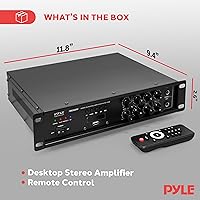
  • Dimensions: The chassis measures 11.81″ wide by 9.45″ deep by 2.76″ tall, conforming to a standard 2U rack-mount footprint.
  • Weight: The unit weighs 9.79 pounds, making it manageable for a single person to install into a standard 19-inch equipment rack.
  • Inputs: Six input types are supported: USB, AUX, two microphone inputs (XLR or 6.35mm), optical digital, coaxial digital, and AC-3.
  • Outputs: Output options include 70V and 100V line-level outputs for distributed speaker systems, plus a standard line out for conventional speaker connections.
  • Bluetooth: Built-in Bluetooth supports wireless audio streaming from smartphones, tablets, and laptops with standard pairing; no proprietary app is required.
  • FM Tuner: An integrated FM tuner is included and ships with a basic wire antenna for signal reception in typical urban and suburban environments.
  • Mic Features: Dual microphone channels each offer independent gain control, with a talk-over function and a MIC 1 priority mode that automatically reduces music volume during microphone use.
  • Tone Controls: Front-panel rotary controls provide independent adjustment for treble, bass, echo level, mic volume, and master volume.
  • Display: A digital LED display on the front panel shows active input selection and volume levels for at-a-glance monitoring during use.
  • Form Factor: The universal rack-mount design fits a standard 19-inch rack enclosure using the included mounting ears, requiring 2U of vertical rack space.
  • Speaker Impedance: The amplifier is designed to drive speakers with 4-ohm impedance on its standard speaker outputs.
  • Remote Control: A handheld infrared remote control is included for basic volume and source-switching functions from across the room.
  • FM Antenna: A basic wire FM antenna is included in the box and connects to the rear panel to support the built-in tuner.
  • AC-3 Input: An AC-3 digital audio input is provided for compatibility with certain home theater audio sources requiring this older digital standard.
  • Model Number: The manufacturer model number is PMX3500PH, produced by Pyle, with the unit first becoming available in September 2020.

Related Reviews
Pyle PDWR30B Outdoor Speakers
85%
88%
Sound Quality
94%
Weatherproof Durability
85%
Ease of Installation
78%
Design and Aesthetics
91%
Build Quality
More
Pyle PLMRA400 Marine Amplifier
82%
85%
Overall Performance
88%
Sound Quality
90%
Durability (Waterproofing & Corrosion Resistance)
75%
Installation Ease
80%
Build Quality
More
Pyle PLMR82 Marine Speakers
84%
83%
Sound Quality
89%
Durability
90%
Ease of Installation
80%
Power Handling
87%
Build Quality
More
Pyle PVTC320U Step Up and Down Converter
84%
87%
Value for Money
85%
Performance
90%
Ease of Use
65%
Portability
91%
Safety Features
More
Pyle PLMR652W Marine Speakers
86%
88%
Sound Quality
91%
Ease of Installation
93%
Durability (Waterproof & Weather Resistance)
87%
Build Quality
75%
Performance at High Volumes
More
Pyle PLMRMB2CW Marine Amplifier
86%
85%
Sound Quality
92%
Waterproof Durability
88%
Bluetooth Connectivity
80%
Power Output
87%
Installation Ease
More
Pyle PLMR91UB Marine Stereo
82%
89%
Waterproof Performance
76%
Bluetooth Connectivity
83%
Sound Quality
90%
Ease of Installation
85%
Durability in Marine Environments
More
Pyle PLMR57W Marine Speakers
85%
84%
Sound Quality
91%
Durability
89%
Ease of Installation
90%
Weather Resistance
75%
Bass Performance
More
Pyle PLMRS4W Marine Speakers
84%
80%
Sound Quality
90%
Build Quality
88%
Durability in Harsh Weather
85%
Installation Ease
65%
Bass Response
More
Pyle PLMRA200 Marine Amplifier
86%
94%
Waterproof Performance
88%
Ease of Installation
83%
Power Output
85%
Build Quality
90%
Size and Space Efficiency
More

FAQ

It is a peak figure, which means it reflects a momentary maximum under ideal conditions rather than sustained output. The continuous RMS power — what you actually hear during normal use — is significantly lower. For a small room or home setup this is usually fine, but do not expect it to fill a large venue at high volume.

Yes, and this is actually one of the stronger use cases for this PA mixing amplifier. The 70V and 100V outputs on the rear panel are designed specifically for distributed speaker systems of the kind found in churches, classrooms, and small commercial spaces. Just make sure your ceiling speakers are rated for 70V operation before connecting.

In open space with no obstructions, most users get a stable connection up to around 20 to 25 feet. Add a wall or two and that range drops noticeably. It is reliable enough for casual home use where your phone is in the same room, but do not count on it for larger or multi-room setups.

It handles the amplifier and mixer side of karaoke on its own — dual mic inputs with echo and gain control are built right in. You will still need to supply your own microphones and a separate karaoke source (like a laptop running karaoke software or a dedicated karaoke player). The Pyle PMX3500PH does not include any song library or disc player.

Yes, there are two separate mic inputs each with their own gain control. The MIC 1 priority function will automatically lower the music volume when MIC 1 detects a signal, which is useful for announcements. Both mics can run simultaneously for duets or two-host setups.

The mic inputs accept both XLR and 6.35mm (quarter-inch) connectors, so standard dynamic microphones with either connection type will work without an adapter. Condenser microphones requiring phantom power are not supported.

The echo level is adjustable via a front-panel rotary knob, so you can dial it up for dramatic karaoke effect or keep it subtle for spoken announcements. However, the decay time and echo speed are not separately adjustable, which limits fine-tuning compared to a dedicated effects processor.

Most users find it straightforward enough to get running within 20 to 30 minutes. The front panel is fairly intuitive, and Bluetooth pairing is standard. The main stumbling block tends to be the rear-panel wiring for speaker outputs, especially for 70V systems — the included manual could be more detailed on this point, so having a basic wiring diagram handy helps.

For occasional or light-duty use it holds up reasonably well, but user reports suggest that running it at high volume for extended daily sessions puts stress on the power supply and cooling. A number of buyers in commercial daily-use scenarios reported issues after several months. If you need something running eight or more hours a day, a purpose-built commercial amplifier would be a safer investment.

The box includes the FM antenna and the infrared remote control, but no speaker cables are provided. You will need to supply your own cables suited to your speaker configuration — standard 12 or 14 gauge speaker wire works for the conventional outputs, and for 70V connections you will want appropriately rated cable for that application.