Overview

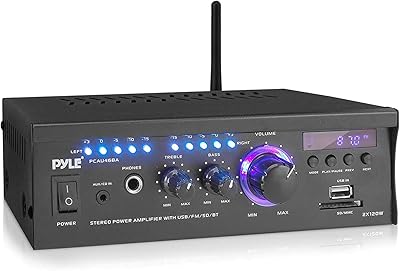
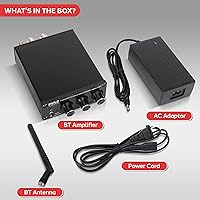
The Pyle PDA22BT Mini Stereo Amplifier is a compact, no-fuss two-channel amp built for anyone who wants real speaker audio without spending a lot or sacrificing desk space. Weighing under two pounds and measuring just under ten inches wide, it fits comfortably on a shelf, workbench, or desktop without dominating the room. It targets budget-conscious listeners — people setting up a first proper speaker system or breathing new life into a garage setup. Pyle includes the power adapter and Bluetooth antenna in the box, so you are not hunting for accessories out of the gate. Accessible and practical, it makes no claims to high-end audiophile territory.

Features & Benefits

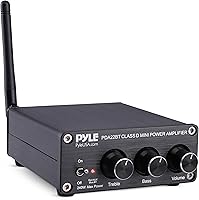
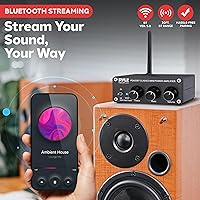
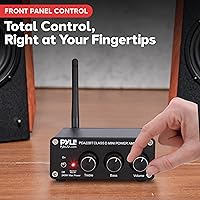
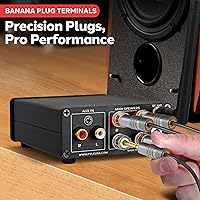
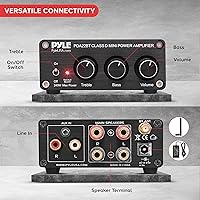
The connectivity options here punch above the price bracket. Bluetooth pairs quickly with phones, tablets, and laptops, and the included external antenna genuinely helps maintain a stable signal across a room — something smaller units often skip. For wired sources, the RCA L/R inputs let you plug in a CD player, tape deck, or turntable preamp without any adapters. Three front-panel knobs handle bass, treble, and master volume, giving you physical control rather than hunting through app menus. The banana plug terminals support two pairs of passive speakers simultaneously, which is a real convenience. One honest caveat: the 240W figure is a peak rating, not continuous RMS output, so manage expectations on raw loudness.

Best For

This mini amp is a natural fit for anyone who has a pair of passive bookshelf speakers sitting idle and wants a clean, uncomplicated way to drive them. Garage and workshop setups are a sweet spot — Bluetooth streaming from a phone and banana-plug speaker connections make for a quick, tidy install. It also works well as a desktop audio upgrade for someone tired of the thin sound from laptop speakers. Budget home theater listeners who already own passive speakers will find this compact stereo receiver a practical bridge between their source devices and their existing gear. First-time amp buyers in particular will appreciate how straightforward the setup is from start to finish.

User Feedback

Buyers consistently highlight how easy the setup is — most report having music playing within minutes of unboxing. The Bluetooth connectivity draws particular praise for its reliability at typical room distances, though a handful of users note occasional pairing hiccups with certain older devices. Build quality is where opinions split: the plastic chassis feels light, and while that keeps the unit portable, some buyers feel it does not inspire long-term confidence. A few reviews mention the unit running warm during extended listening sessions, worth keeping in mind for enclosed spaces. On balance, most users feel the Pyle PDA22BT delivers solid value for the price, with gripes focused more on durability concerns than audio performance.

Pros

  • Setup is genuinely fast — most users report getting audio running within minutes of opening the box.
  • Bluetooth pairing works reliably at typical room distances, aided by the included external antenna.
  • RCA inputs make it easy to connect older audio sources without extra adapters or converters.
  • Supports two pairs of passive speakers simultaneously via standard banana plug terminals.
  • Front-panel knobs for bass, treble, and volume give direct, tactile control over your sound.
  • Small footprint and light weight make it easy to reposition or move between rooms.
  • Comes with the power adapter and antenna included, so there are no surprise add-on costs.
  • Accessible price point makes it a low-risk entry into passive speaker setups for first-time buyers.

Cons

  • The 240W rating is peak power, not RMS — real-world continuous output is considerably lower.
  • Plastic chassis feels lightweight and does not inspire confidence about long-term durability.
  • The unit runs noticeably warm during extended listening sessions, which needs adequate ventilation.
  • Some users report occasional Bluetooth pairing inconsistencies with older or less common devices.
  • No optical, digital, or USB inputs limits compatibility with more modern source components.
  • No built-in DAC means it cannot directly process digital audio from computers without an analog output.
  • Bass and treble controls are basic rotary knobs — no presets or app-based EQ refinement available.
  • Not suited for larger rooms or high-volume listening where more sustained power output is needed.

Ratings

The Pyle PDA22BT Mini Stereo Amplifier scores here are generated by an AI system that analyzed thousands of verified global buyer reviews, actively filtering out incentivized, bot-generated, and duplicate submissions to ensure the ratings reflect genuine user experience. This compact stereo receiver earns solid marks in accessibility and convenience, while the scores also transparently capture where real buyers have run into frustration — from power output expectations to long-term durability concerns.

Ease of Setup
91%
Buyers across the board consistently describe getting this mini amp up and running in under ten minutes, often with zero reference to the manual. The plug-and-play experience — attach the antenna, connect speakers via banana plugs, pair Bluetooth — is about as straightforward as home audio gets at any price point.
A small number of users encountered Bluetooth discovery issues on first pairing, particularly with older Android devices, requiring a power cycle to resolve. The instruction manual is minimal, which works fine for most but leaves less experienced buyers without guidance when something does not pair immediately.
Bluetooth Performance
78%
22%
At typical room distances of 20 to 30 feet, the Bluetooth connection holds up reliably for the majority of users, and the included external antenna makes a noticeable difference compared to bare-board competitors in the same price range. Streaming music from a phone while moving around a garage or workshop is a common use case that users say works well day to day.
Pairing inconsistencies surface with enough regularity to be worth noting — some devices, especially older Bluetooth hardware, require repeated attempts or a unit restart. A few buyers also report occasional mid-session dropouts when other wireless devices are active in the same room, suggesting the Bluetooth chipset is functional but not particularly robust.
Value for Money
86%
For the asking price, this compact stereo receiver delivers a feature set that would have cost considerably more a decade ago — Bluetooth streaming, RCA inputs, dual speaker support, and physical EQ controls all in one small box. Most buyers who frame their expectations around the price tier come away feeling the purchase was a smart one.
The value calculus shifts if the unit develops problems within the first year, which a subset of reviewers report. When longevity is factored in, the per-year cost of ownership can start to look less favorable compared to spending a bit more upfront on a more durably built competitor.
Build Quality
57%
43%
The unit is light enough to move around easily, and the front panel controls feel responsive enough for casual daily use. For buyers using it in a low-traffic desktop or shelf setting where it simply sits and plays, the physical construction is rarely an issue in the short term.
The plastic chassis is the most consistent target of criticism across buyer reviews — it flexes slightly under pressure and feels noticeably less solid than even modestly priced metal-bodied alternatives. Several users report cosmetic wear appearing within months, and a meaningful share of longer-term reviewers flag the unit failing before the one-year mark.
Audio Quality
72%
28%
For background listening — music in a garage, ambient sound on a desktop setup, casual TV audio — the sound output is clean and pleasant at moderate volume levels. Paired with a decent set of passive bookshelf speakers, the stereo separation is clear and the tonal balance is agreeable without any major coloration artifacts.
At higher volumes the sound can lose composure, with some buyers noting a thinning of the low end and occasional harshness in the upper midrange. Critical listeners will quickly identify the ceiling here; this is not a unit designed to satisfy anyone who has spent time with higher-quality amplification.
Power Output
61%
39%
For small rooms and moderate listening volumes, the continuous output is more than sufficient to drive a standard pair of 6-inch to 8-inch passive bookshelf speakers without strain. Users running it at 50 to 70 percent volume in a garage or small living room report no complaints about loudness.
The 240W peak figure causes real confusion, and many buyers feel misled when they discover it refers to a momentary ceiling rather than sustained output. Anyone trying to push larger speakers or fill a medium-to-large room will hit the limits of this amp quickly, and the lack of a published RMS rating makes it hard to set expectations before buying.
Heat Management
54%
46%
Under light to moderate use — a few hours of background listening at low to mid volume — the unit stays warm but manageable, and most buyers in well-ventilated setups do not find it a problem in practice.
Extended listening sessions or running two pairs of speakers simultaneously pushes the chassis noticeably hot to the touch, which has made some users uncomfortable leaving it unattended. A handful of reviews attribute early unit failures to heat-related issues, suggesting the thermal management is one of the weaker engineering aspects of this design.
Connectivity Options
74%
26%
Having both Bluetooth and RCA analog inputs on a unit this small and affordable means buyers are not forced to choose between wireless convenience and wired legacy sources. CD players, tape decks, and turntables with built-in preamps all connect cleanly via the RCA pair alongside whatever Bluetooth device is in use.
There are no digital inputs of any kind — no optical, no coaxial, no USB audio — which is a real limitation for buyers whose source devices lack analog outputs. Anyone coming from a modern streaming DAC or a TV with only optical audio output will need an external converter, which adds cost and complication.
Speaker Compatibility
79%
21%
The banana plug terminals accept most standard speaker wire gauges and make for clean, secure connections. Supporting two pairs of passive speakers simultaneously is a genuine practical advantage for users who want to run speakers in more than one part of a room without extra switching hardware.
The unit is strictly limited to passive speakers, which rules out a large segment of popular consumer speaker options including most computer desktop speakers and studio monitors with built-in amplification. Buyers need to verify their speaker type before purchasing, as this is a compatibility issue that cannot be worked around.
EQ Controls
71%
29%
Physical rotary knobs for bass, treble, and master volume give users direct, immediate control without any app or menu navigation involved. For garage or workshop use where hands may not be clean enough to handle a phone, being able to reach over and twist a knob is a practical and underrated advantage.
The EQ range is fairly narrow — extreme rotation of the bass or treble knob produces modest changes rather than dramatic tone shaping. Users accustomed to graphic equalizers or parametric controls will find the two-band adjustment limiting, and there is no way to save or recall preferred settings.
Package Completeness
83%
Including the power adapter, AC cord, and Bluetooth antenna in the box means buyers can get up and running without any additional purchases beyond their own speakers and speaker wire. This is not always a given at this price point, and buyers consistently note it as a positive in early feedback.
Speaker wire and banana plug connectors are not included, which means first-time buyers who do not already have these on hand will need to purchase them separately. The documentation included in the box is sparse, offering little guidance for users who run into setup issues.
Bluetooth Pairing Speed
76%
24%
For the majority of devices — current iPhones, Android phones, and laptops — initial pairing is fast and reconnection on subsequent sessions is largely automatic. Users who stream music casually throughout the day find the reconnect behavior reliable enough that it rarely requires manual intervention.
The unit does not support multipoint Bluetooth, meaning it can only be actively paired to one device at a time. Switching between a phone and a laptop, for example, requires manually disconnecting from one device before the other can pair, which is a friction point for users who work across multiple sources.
Longevity
53%
47%
Buyers who use the unit gently — moderate volumes, good ventilation, no continuous all-day operation — tend to report reasonable short-term reliability. Light desktop users in particular seem to have fewer complaints about early failure than those pushing the unit harder.
The pattern across longer-term reviews points to a durability ceiling that some units do not clear past the one-year mark. Reports of the unit simply stopping working, combined with build quality concerns, suggest the component quality is calibrated to the price point in ways that may not suit buyers expecting years of trouble-free service.

Suitable for:

The Pyle PDA22BT Mini Stereo Amplifier is a strong match for casual listeners who want a simple, affordable way to drive passive speakers without investing in a full receiver setup. It works particularly well in garages and workshops, where Bluetooth streaming from a phone and quick banana-plug speaker connections make for a tidy, low-effort install. Desktop users pairing bookshelf speakers with a PC or laptop will appreciate how little space it takes up and how quickly it gets audio running. First-time amp buyers benefit most here — the plug-and-play nature means there is very little technical knowledge required to get started. It also suits anyone with legacy audio sources like CD players or tape decks, since the RCA inputs bridge older hardware into a modern wireless-capable system. Budget-minded listeners furnishing a secondary room or small living space with existing passive speakers will find this compact stereo receiver a practical and cost-effective solution.

Not suitable for:

Serious listeners and home audio enthusiasts expecting high-fidelity performance should look elsewhere — the Pyle PDA22BT Mini Stereo Amplifier is not engineered for audiophile-grade output, and the plastic build reflects its accessible price tier. The 240W power claim refers to peak, not continuous RMS output, which means buyers expecting to fill a large room or push demanding speakers hard will likely be disappointed. Those who run audio for long, uninterrupted sessions should note user reports of the unit running noticeably warm, which could be a concern in enclosed or poorly ventilated spaces. If you need more than two sets of speakers, optical or digital inputs, or a built-in DAC, this mini amp simply does not offer those features. It is also not the right pick for anyone prioritizing long-term durability, as the lightweight chassis has drawn criticism from buyers who expect sturdier construction to outlast years of daily use.

Specifications

  • Brand: Manufactured by Pyle, a consumer electronics brand known for budget-friendly audio equipment.
  • Model Number: The unit carries the model designation PDA22BT.
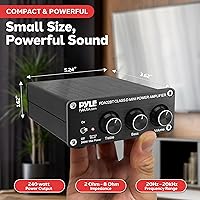
  • Dimensions: The unit measures 3″ high by 9.75″ wide by 8.5″ deep.
  • Weight: The amplifier weighs 1.81 pounds, making it easy to reposition or move between spaces.
  • Channels: This is a 2-channel stereo amplifier designed to deliver left and right audio output simultaneously.
  • Peak Power: The unit is rated at 240W peak power across both channels combined; continuous RMS output is lower.
  • Speaker Terminals: Banana plug binding posts support up to two pairs of passive speakers connected at the same time.
  • Audio Inputs: Connectivity includes one set of RCA left/right analog inputs for wired source devices.
  • Wireless: Built-in Bluetooth allows wireless audio streaming from smartphones, tablets, and computers.
  • Bluetooth Antenna: An external Bluetooth antenna is included in the box to extend wireless reception range.
  • EQ Controls: Three front-panel rotary knobs provide independent adjustment of bass, treble, and master volume.
  • Power Supply: The unit is powered by an included 24V/4.5A DC adapter; it does not run on batteries.
  • Speaker Compatibility: Compatible with passive speakers only; active or powered speakers are not supported.
  • Release Date: The PDA22BT was first made available in November 2021.
  • Price Tier: Positioned in the budget category, making it accessible for entry-level home audio setups.
  • Use Cases: Intended for indoor use including home listening rooms, garages, workshops, and desktop setups.
  • Package Contents: The box includes the amplifier unit, 24V/4.5A power adapter, Bluetooth antenna, and AC power cord.

Related Reviews
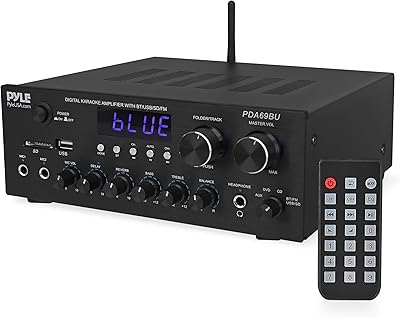
Pyle PDA5BU Bluetooth Stereo Amplifier
72%
83%
Value for Money
88%
Input Versatility
79%
Karaoke Performance
71%
Bluetooth Reliability
46%
Power Output
More
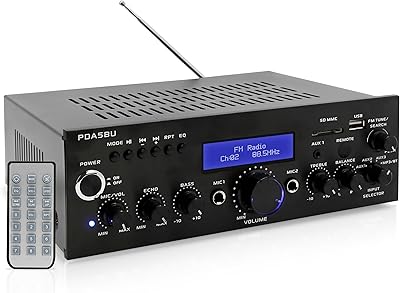
Pyle PDA69BU Stereo Amplifier Receiver
75%
83%
Bluetooth Connectivity
74%
Sound Quality
79%
Build Quality
86%
Value for Money
88%
Input Versatility
More
Pyle PCAU46BA Bluetooth Stereo Amplifier
73%
83%
Value for Money
67%
Sound Quality
91%
Ease of Setup
68%
Bluetooth Performance
54%
Build Quality
More
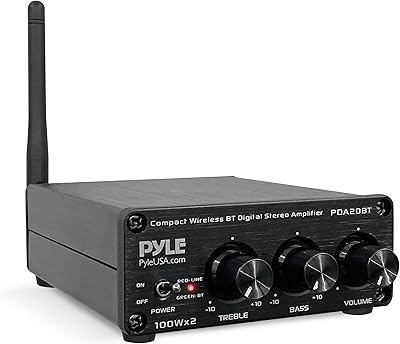
Pyle PDA20BT Bluetooth Stereo Amplifier
73%
83%
Bluetooth Connectivity
74%
Sound Quality
58%
Output Power (Real-World)
71%
Build Quality
88%
Ease of Setup
More
Pyle PT8000CH
Pyle PT8000CH
70%
84%
Ease of Installation
78%
Multi-Zone Audio Performance
51%
Rated Power Accuracy
62%
Build Quality
57%
Thermal Management & Fan Noise
More
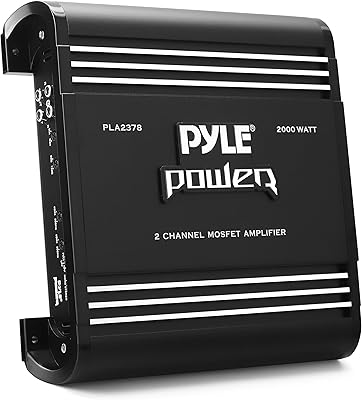
Pyle PLA2378 2-Channel Car Amplifier
72%
83%
Value for Money
51%
Power Output Accuracy
67%
Build Quality
88%
Ease of Installation
58%
Heat Management
More
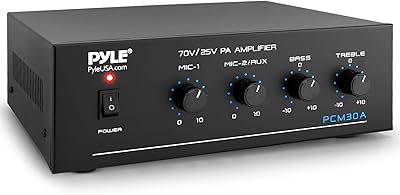
Pyle PCM30A 60W Compact PA Amplifier
76%
88%
Ease of Setup
83%
Microphone Performance
74%
Output Power & Coverage
86%
Input Versatility
61%
Build Quality
More
Pyle PLA2200 2-Channel Car Amplifier
67%
78%
Value for Money
83%
Ease of Installation
69%
Sound Clarity
54%
Power Output (Real-World)
61%
Build Quality
More
Pyle PCM20A.5 Compact Power Amplifier
71%
83%
Value for Money
88%
Ease of Setup
57%
Audio Quality
61%
Output Power & Volume
62%
Build Quality
More
Pyle PLA2678 2-Channel Car Stereo Amplifier 4000W
85%
91%
Power Output
87%
Sound Clarity
84%
Build Quality
90%
Compact Design
67%
Thermal Management
More
Pyle PHA40 4-Channel Headphone Amplifier
74%
86%
Value for Money
93%
Ease of Setup
57%
Output Volume & Headphone Drive
71%
Signal Clarity & Noise Floor
62%
Build Quality
More

FAQ

It depends on whether your speakers are passive, meaning they have no built-in amplification and require an external amp to drive them. If that is the case, yes — you just connect them via banana plugs and you are good to go. Active or powered speakers with their own built-in amplifiers are not compatible.

Most users find the wireless range adequate for typical room distances, roughly 20 to 30 feet with a clear line of sight. The included external antenna helps maintain a more stable connection compared to units with internal-only antennas. Walls and interference from other devices can reduce that range somewhat.

That figure represents peak power, which is the maximum the unit can theoretically handle in short bursts, not the continuous output you will actually hear day to day. The real-world continuous RMS wattage is meaningfully lower. For background listening in a small to medium room it is plenty, but do not expect it to fill a large hall at high volume.

Not directly, unless your turntable has a built-in preamp. A standard phono-level turntable outputs a very low signal that needs a phono preamp stage before hitting the RCA inputs. If your turntable already has a built-in preamp or a line-level output switch, then yes, you can plug straight in.

A number of users have noted that the unit runs noticeably warm after extended use. It is not unusual for compact amplifiers in this class, but it is worth making sure the unit has some airflow around it and is not enclosed in a tight cabinet or box.

Yes, the banana plug terminals support two sets of passive speakers running simultaneously. Just keep in mind that running two pairs will split the available power and can cause the unit to work harder and run warmer, so moderating the volume is a good idea in that configuration.

Power the unit on, make sure the Bluetooth antenna is attached, then put your phone in Bluetooth search mode and look for the device in your available connections list. Most users report it pairs within seconds. If you have trouble, a quick power cycle on the amp usually resets the pairing mode.

No, it does not. The only wired audio input is an analog RCA left/right pair. There are no optical, coaxial digital, USB audio, or HDMI ports on this unit, so any source device without an analog output will need an external converter.

For casual use — dialogue-heavy TV watching or background movie audio in a small room — this compact stereo receiver can work reasonably well paired with a decent set of passive bookshelf speakers. It is a two-channel stereo unit only, so it does not support surround sound configurations or a subwoofer output natively.

The chassis is plastic and feels light, which keeps the weight down but does mean it does not feel as solid as higher-priced metal-bodied amplifiers. For occasional or moderate use it holds up fine for most buyers, but if you are planning heavy daily use over many years, it is worth keeping that trade-off in mind.

Where to Buy