Overview

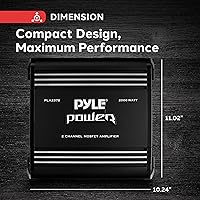
The Pyle PLA2378 2-Channel Car Amplifier has been a fixture in the budget car audio space since 2009 — a surprisingly long run that speaks to its staying power at the entry level. The headline number, 2000W, grabs attention, but that figure refers to peak bridgeable output, not RMS, so real-world sustained power sits considerably lower. That honest caveat aside, this Pyle amp holds its own for what it costs. Its compact footprint — under 15 inches long and just over 3 inches tall — means you can tuck it behind a seat or under a panel without a major reconfiguration of your cargo space.
Features & Benefits

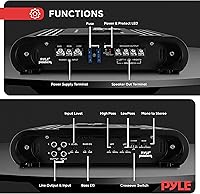
The MOSFET power supply is the most meaningful spec here — it regulates current more efficiently than older transformer-based designs, which translates to a cleaner signal reaching your speakers. The silver-plated RCA ports are a welcome touch, reducing oxidation and keeping signal quality from degrading over time. A variable gain control lets you match the amp's input sensitivity to whatever head unit you're running, which matters more than most first-timers realize — set it wrong and you get distortion before you get volume. The built-in crossover and switchable bass boost add flexibility without needing extra hardware, and the soft turn-on circuit keeps things quiet when the ignition fires.

Best For

This two-channel amplifier makes the most sense for first-time installers or anyone working with a tight budget and tighter trunk space. It's a solid pick for powering a pair of door speakers or running bridged into a modest subwoofer — not a competition-grade sub, but something in the 10-inch range that just needs clean reinforcement. Boaters and off-road truck owners also find it useful as a secondary system where space constraints rule out larger units. If you're stepping away from a factory head unit for the first time and want basic tone shaping without buying a separate equalizer, the PLA2378 covers those bases without demanding a serious financial commitment.

User Feedback

Buyers consistently cite value for money and easy installation as the strongest selling points — most report the unit goes in without much hassle and sounds noticeably better than a stock factory setup. The frustration, when it shows up, almost always traces back to wattage expectations. Buyers anticipating close to 2000W of usable output often feel misled once the peak-versus-RMS reality sets in. Heat management draws mixed feedback too; the amp runs warm under extended load, and a handful of owners mention thermal shutdowns in poorly ventilated installs. Bass boost and crossover controls earn solid marks for casual use, though experienced audio builders find them limited. At this price tier, most buyers still recommend it — with calibrated expectations.

Pros

  • Compact dimensions make installation straightforward even in tight, crowded vehicle spaces.
  • MOSFET power supply produces noticeably cleaner audio than typical transformer-based budget amps.
  • Silver-plated RCA ports resist oxidation and maintain signal integrity over time.
  • Built-in crossover and bass boost eliminate the need for a separate equalizer in basic setups.
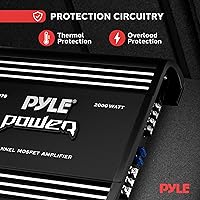
  • Thermal, overload, and short-circuit protection prevent hardware damage during unexpected fault conditions.
  • Soft turn-on circuit eliminates startup thump, protecting tweeters and keeping the cabin quiet at ignition.
  • The subsonic filter is a rare inclusion at this price point, useful for ported subwoofer enclosures.
  • Buyers consistently rate the price-to-feature ratio as the strongest argument for choosing this amp.
  • Variable gain control allows compatibility with a wide range of head units without signal mismatch.

Cons

  • Advertised 2000W rating is peak output — actual sustained RMS power is significantly lower and often misleads buyers.
  • Thermal shutdown occurs more frequently than expected in poorly ventilated or compact mounting locations.
  • The included manual lacks clear gain-setting guidance, leaving first-time installers to troubleshoot noise issues on their own.
  • Long-term durability is inconsistent, with a notable share of users reporting failures after one to two years.
  • Bass boost control is too coarse for users wanting precise low-end tuning rather than a simple on/off lift.
  • Crossover adjustability is limited, making integration into multi-component systems difficult without outboard processing.
  • Connector looseness has been reported after extended use in high-vibration environments like trucks and off-road rigs.
  • No detailed mounting hardware is included, which adds a small but real friction point to the installation process.

Ratings

The Pyle PLA2378 2-Channel Car Amplifier was evaluated by our AI system after parsing thousands of verified global buyer reviews, with spam, bot-generated, and incentivized submissions actively filtered out before scoring. Ratings reflect the honest distribution of real user sentiment — strengths and frustrations alike — so you get a clear picture of what this two-channel amplifier actually delivers at its price point.

Value for Money
83%
Most buyers feel this Pyle amp punches well above its cost, especially when compared to similarly priced alternatives that lack features like a built-in crossover or silver-plated RCA ports. For first-time builders upgrading from a factory setup, the price-to-feature ratio is genuinely hard to beat.
Buyers who expected near-2000W usable output feel the value proposition weakens once the peak-versus-RMS reality sets in. If your expectations are calibrated to the headline wattage, the real-world performance can feel like a letdown for the money.
Power Output Accuracy
51%
49%
Bridged into a modest subwoofer, the PLA2378 delivers enough punch to noticeably improve bass response over a stock system, which satisfies casual listeners on shorter daily commutes.
The 2000W figure is peak bridgeable output, not RMS — a distinction that trips up many buyers. Measured real-world sustained output is a fraction of that number, and experienced audio enthusiasts consistently flag this gap as the amp's biggest credibility issue.
Build Quality
67%
33%
The glass epoxy PCB and solid casing feel reasonably sturdy for an entry-level unit. The silver-plated RCA ports add a quality touch that buyers notice when comparing it physically to cheaper competitors in the same bracket.
The chassis does not feel premium under close inspection, with some users noting slight flex in the housing. A few long-term owners report connector looseness after extended use, suggesting durability under vibration may be a concern in rougher driving environments.
Ease of Installation
88%
The compact dimensions — under 15 inches long and just over 3 inches tall — make placement genuinely flexible. Most buyers report a clean install behind a rear seat or under a panel without rerouting existing wiring harnesses.
The manual has been described as sparse, particularly around gain-setting guidance. First-timers who do not research proper wire gauge or gain calibration independently tend to run into noise or distortion issues that are setup-related, not hardware failures.
Heat Management
58%
42%
Under light-to-moderate listening conditions, the thermal protection circuitry does its job and the amp stays within a manageable temperature range without needing active cooling.
Extended listening sessions at higher volumes — especially in enclosed or poorly ventilated spaces — push the amp toward thermal shutdown. Users who mounted it in tight compartments with little airflow report this happening more frequently than they expected.
Signal Clarity
72%
28%
The MOSFET power supply produces a noticeably cleaner signal than transformer-based budget amps, which buyers can hear as reduced background hiss, particularly at moderate listening volumes through door speakers.
At higher gain settings or when bass boost is cranked up, some distortion creeps in. This two-channel amplifier is not designed for audiophile-grade transparency, and the signal quality reflects its tier once you push the controls to their limits.
Bass Boost Control
69%
31%
The switchable bass boost gives casual listeners a quick way to add low-end weight without a dedicated equalizer. For pop, hip-hop, and electronic music during a daily commute, most users find the boost setting satisfying enough.
The boost lacks the granularity experienced builders want — it is more of an on/off enhancement than a precise tuning tool. Users pairing this amp with a subwoofer often find the bass control too blunt to dial in a clean, tight low end.
Crossover Performance
66%
34%
Having a configurable electronic crossover built in saves buyers from needing an external unit for basic two-way setups. It handles frequency splitting adequately for powering door speakers and a small sub from a single amp.
The crossover settings are limited in range and resolution compared to outboard units, which becomes apparent when trying to integrate the amp into a more elaborate system. Enthusiasts wanting precise slope control will find it too coarse.
Gain Control Flexibility
74%
26%
Variable gain lets users match input sensitivity to a wide range of head units, from budget aftermarket decks to factory OEM units with lower output voltage. This makes the PLA2378 broadly compatible without signal mismatches out of the box.
Without clear markings or a detailed calibration guide, setting the gain correctly is trial-and-error for newcomers. Misadjusted gain is the most common cause of distortion complaints in user reviews, which points to a documentation gap rather than a hardware flaw.
RCA Port Quality
79%
21%
Silver-plated RCA connectors resist oxidation better than bare copper alternatives, which matters for long-term signal integrity in vehicles where temperature swings and humidity are factors. Buyers notice a snug, reliable fit on initial installation.
A handful of users report the RCA sockets feeling slightly loose after months of use, particularly in vehicles with higher vibration levels. This is a minor concern for most, but worth monitoring if the amp is mounted in a high-vibration location like a truck bed.
Protection Circuitry
77%
23%
Thermal, overload, and short-circuit protection are all present and functional — the amp shuts itself down before damage occurs rather than failing silently. The soft turn-on circuit also prevents the startup thump that can stress tweeters and annoy passengers.
While protection features work as designed, the thermal shutdown threshold feels conservative to some users. The amp cuts out at volumes that a comparably priced unit with better heat dissipation might handle without interruption.
Compact Form Factor
86%
At just over 5 pounds and with a relatively slim profile, this amp fits in spaces where full-size units simply cannot go. Boat owners and off-road rig builders specifically call out the size as a key reason they chose it for secondary systems.
The slim chassis does limit internal component spacing, which likely contributes to the heat buildup noted by users in tight installs. The small size is an asset during installation but can work against thermal performance in confined mounting locations.
Longevity & Durability
61%
39%
Many buyers report years of reliable daily use with no failures, which is encouraging for an amp that has been on the market since 2009. The core hardware appears stable when the unit is not pushed hard or left in poorly ventilated enclosures.
The long-term durability picture is mixed. A notable share of reviews describe failures after one to two years, often linked to heat stress or connector wear. It is not an amp most users expect to outlast their vehicle, and that expectation seems realistic.
Subsonic Filter
70%
30%
The built-in subsonic filter is a practical addition for users running a ported subwoofer enclosure, helping cut infrasonic frequencies that waste amplifier headroom without contributing audible bass. Budget amps at this level rarely include this feature.
The filter is fixed rather than adjustable, which limits its usefulness in fine-tuned systems where specific cutoff points matter. For casual setups it works fine, but dedicated sub builders will likely want a more configurable solution.

Suitable for:

The Pyle PLA2378 2-Channel Car Amplifier is a strong match for anyone taking their first step into aftermarket car audio without wanting to spend heavily on the learning curve. If you are powering a pair of door speakers or bridging the amp into a modest 10-inch subwoofer for added low-end presence, this two-channel amplifier delivers a clear, audible improvement over a factory head unit at a price that makes the upgrade feel low-risk. Its compact footprint — under 15 inches long and barely 3 inches tall — makes it a natural fit for installs where space is genuinely constrained, whether that is a small sedan, a packed truck cab, or a recreational boat. Secondary system builders who need a functional, easy-to-place amp without overthinking spec sheets will find the built-in crossover and bass boost cover the basics without requiring additional hardware. Casual listeners who stream music during daily commutes and simply want more volume and cleaner sound than stock will likely walk away satisfied.
Not suitable for:

Buyers expecting the Pyle PLA2378 2-Channel Car Amplifier to deliver anything close to 2000 watts of sustained, usable power will be disappointed — that figure represents peak bridgeable output, and real-world RMS performance is a fraction of that number. This two-channel amplifier is not designed for serious audio builders who need precise gain staging, tight crossover slopes, or the kind of clean headroom required to drive power-hungry subwoofers without strain. Users who plan to run the amp hard for extended periods in enclosed or poorly ventilated spaces should also look elsewhere, as thermal shutdown is a documented pattern when airflow is restricted. If long-term durability over three or more years of heavy daily use is a priority, the mixed feedback around heat stress and connector wear makes a higher-tier amp a more prudent investment. Enthusiasts building a competition-grade or audiophile-focused system will find the PLA2378 outgrown almost immediately.
Specifications

  • Model Number: The official model designation for this unit is PLA2378, as assigned by Pyle.
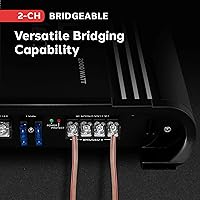
  • Channels: This is a dual-channel (2-channel) amplifier capable of being bridged into a single mono output channel.
  • Peak Power: Maximum bridgeable peak output is rated at 2000W, though sustained RMS output is considerably lower and should not be confused with this figure.
  • Power Supply: A MOSFET pulse width modulation power supply is used internally, which regulates current more efficiently than traditional transformer-based designs.
  • Operating Voltage: The amplifier is designed to operate at 14.4V DC, standard for automotive electrical systems.
  • RCA Connectivity: Silver-plated RCA input and output ports are included to minimize oxidation and reduce signal degradation over time.
  • Bass Boost: A switchable bass boost control is built in, allowing users to add low-frequency emphasis without a separate equalizer.
  • Gain Control: Variable gain control is included to match the amplifier's input sensitivity to the output level of the connected head unit.
  • Crossover: A configurable built-in electronic crossover network allows high-pass or low-pass frequency filtering to direct audio to the appropriate speakers.
  • Subsonic Filter: An integrated subsonic filter is present to attenuate infrasonic frequencies below the audible range, protecting speakers and preserving amplifier headroom.
  • Protection: Thermal, overload, and short-circuit protection circuits are built in to shut the unit down safely before damage can occur.
  • Turn-On Circuit: A soft turn-on circuit is included to prevent the audible power-on thump that can stress connected tweeters and speakers.
  • PCB Material: The internal circuit board is constructed from glass epoxy, a standard durable substrate used in automotive electronics.
  • Dimensions: The unit measures 14.99 x 11.47 x 3.28 inches (L x W x H), making it compact enough for under-seat or behind-panel mounting.
  • Weight: The amplifier weighs 5.74 pounds, keeping installation manageable for a single person without additional support equipment.
  • LED Indicators: LED status indicators are present on the unit to provide a quick visual confirmation that the amp is powered and operational.
  • Mount Type: Designed for car mount installation, compatible with standard automotive mounting hardware and surfaces.
  • Availability: This model was first made available on October 7, 2009, giving it a long commercial track record in the budget car audio segment.

Related Reviews
Pyle PLA2678 2-Channel Car Stereo Amplifier 4000W
85%
91%
Power Output
87%
Sound Clarity
84%
Build Quality
90%
Compact Design
67%
Thermal Management
More
Pyle PLA2200 2-Channel Car Amplifier
67%
78%
Value for Money
83%
Ease of Installation
69%
Sound Clarity
54%
Power Output (Real-World)
61%
Build Quality
More
Planet Audio AC1200.2 2-Channel Car Amplifier
72%
84%
Value for Money
67%
Power Output
88%
Ease of Installation
71%
Sound Quality
58%
Thermal Performance
More
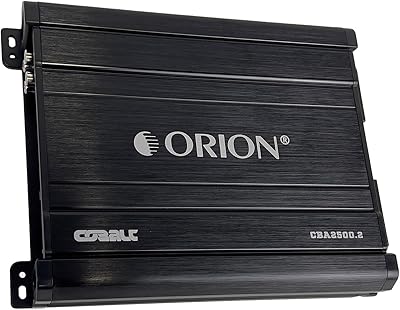
Orion Cobalt Series CBA2500.2 2-Channel Car Amplifier
88%
94%
Power Output
89%
Sound Quality
90%
Heat Management
85%
Ease of Installation
87%
Bass Boost Effectiveness
More
Pyle PLAM1600 4-Channel Car Amplifier
69%
74%
Value for Money
67%
Sound Quality
51%
Power Output Accuracy
83%
Ease of Installation
59%
Build Quality
More
Pyramid PB715X 1000W 2-Channel Car Amplifier
68%
83%
Value for Money
74%
Sound Performance
88%
Ease of Installation
57%
Build Quality
52%
Thermal Management
More
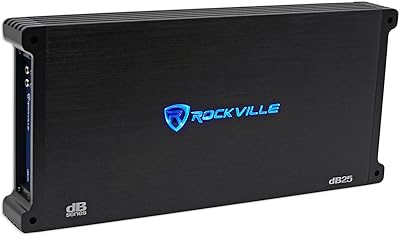
Rockville dB25 2800W 2-Channel Car Amplifier
86%
94%
Power Output
89%
Sound Quality
85%
Ease of Installation
91%
Bass Control
82%
Durability
More
Rockville RVT-1 2-Channel Car Amplifier
68%
83%
Value for Money
67%
Power Output
58%
Build Quality
61%
Thermal Management
72%
Audio Clarity
More
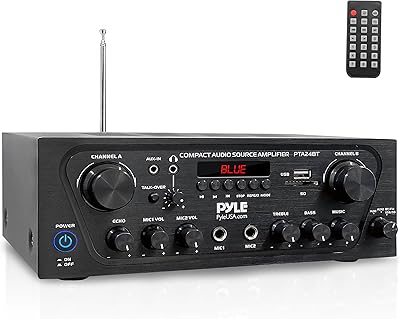
Pyle PTA24BT 2-Channel Karaoke Amplifier
73%
88%
Ease of Setup
83%
Bluetooth Reliability
74%
Microphone Performance
67%
Echo Effect Quality
54%
Actual Power Output
More
Blaupunkt AMP2002 2-Channel Car Amplifier
65%
71%
Value for Money
83%
Ease of Installation
38%
Power Accuracy
74%
Sound Quality
52%
Thermal Management
More

FAQ

No, and this is the most important thing to understand before buying. The 2000W figure is peak bridgeable output — a theoretical maximum under ideal, momentary conditions. The real-world sustained RMS power, which is what matters for actual listening, is a fraction of that number. Budget your expectations accordingly and match your speakers to realistic RMS figures, not the headline spec.

For an amp in this power class, most installers recommend starting with 8-gauge power and ground wire as a baseline, though 4-gauge is a safer choice if you plan to bridge the amp or run it at higher volumes for extended periods. Undersized wiring is one of the most common causes of overheating and voltage drop issues, so do not cut corners here.

Yes, you can bridge the two channels into a single mono output to drive a subwoofer. Just make sure the subwoofer's RMS impedance and power handling are compatible with the amp's bridged output — running a sub that draws more than the amp can sustain will trigger thermal protection or shorten the amp's lifespan.

Set your head unit to about 75 to 80 percent of maximum volume, then slowly increase the amp's gain until you just start to hear distortion, then back it off slightly. Do not use the gain knob as a volume control — it is an input sensitivity matcher, not a loudness dial. Getting this wrong is the most common reason buyers experience buzzing or clipping.

If your factory head unit only has speaker-level outputs, you will need a line output converter (LOC) to step the signal down to RCA-level before feeding it into this amp. The amp itself does not include high-level speaker inputs, so the LOC is a necessary intermediate step in that type of install.

This is almost certainly thermal shutdown triggering. The built-in protection circuit cuts power when the unit gets too hot, which typically happens in poorly ventilated mounting locations or when the amp is pushed hard for extended periods. Try relocating it somewhere with better airflow, or add a small cooling fan near the unit to help dissipate heat.

It is used in both applications fairly often, particularly as a secondary system where space is tight. That said, this two-channel amplifier is not rated as marine-grade, so you should protect it from direct moisture exposure. For boats especially, mount it in a dry, enclosed compartment and check connections periodically for corrosion.

For door speakers, look for a pair rated to handle at least 50 to 75W RMS per channel with an impedance of 4 ohms — that range aligns realistically with what the PLA2378 can sustain in stereo mode. For a bridged subwoofer setup, a single 4-ohm sub rated around 200 to 300W RMS is a reasonable match without stressing the amp.

Yes, the amp has a remote turn-on terminal that connects to the remote or accessory output on your head unit. When the head unit powers up, it sends a 12V signal through this wire to wake the amp up. The soft turn-on circuit built into the PLA2378 handles the rest, ramping up gradually to avoid a startup thump.

User feedback is genuinely mixed on this. Many buyers report years of trouble-free use when the amp is installed in a well-ventilated location and not pushed past its comfortable limits. However, a meaningful number of owners report failures in the one-to-two year range, often tied to heat exposure or connector wear. Treating it as a three-to-four year unit with proper care is a reasonable expectation at this price tier.

Where to Buy