

Overview

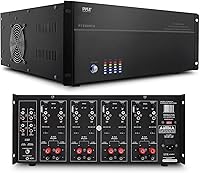
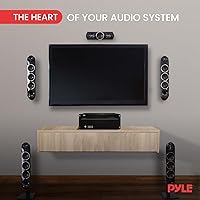
The Pyle PT8000CH is a rack-mount 8-channel amplifier built for homeowners and integrators who want to push music into multiple rooms from a single, centralized unit. It has been part of Pyle's catalog since 2009 — a long run that speaks to consistent demand rather than flashy reinvention. This rack-mount amp occupies 4U of rack space in a standard 19-inch bay and tips the scales at 48.5 lbs, so plan your installation accordingly. Priced in the prosumer middle ground, it sits between basic consumer receivers and serious commercial gear, making it a realistic option for DIY installers who need real infrastructure without a professional-grade budget.

Features & Benefits

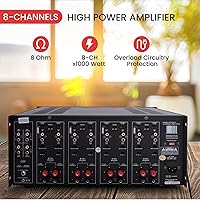
Each of the eight channels is rated at 100 watts RMS, which is the number that actually matters when sizing your speakers — the 8000W peak figure in the marketing copy represents a momentary maximum, not sustained output. Adjacent channel pairs can be bridged for higher-powered mono delivery to a single zone, handy when one room needs noticeably more punch. Individual volume knobs per channel give you direct, hands-on control without diving into any software. A front-panel LED level display lets you spot clipping at a glance, and the built-in low impedance protection isolates a misbehaving channel automatically rather than taking the whole system down.

Best For

This multi-room amplifier is a natural fit for homeowners running in-wall speaker wiring to four or more zones — think background music in the kitchen, living room, patio, and bedroom all sourced from one location. Small commercial spaces like a boutique gym or café can also get solid mileage here, as long as the environment does not demand concert-level volume. AV integrators on a tighter project budget will find it useful as a workhorse zone amp in a 19-inch rack alongside source selectors. Anyone expecting hands-on per-zone volume control rather than app-based management will feel right at home with the physical knobs.

User Feedback

Across nearly 330 ratings, this rack-mount amp holds a 4.0-star average, which tells a fairly honest story: most buyers are pleased, but few are blown away. Installation and setup consistently draw praise — people appreciate that zone wiring and signal routing are intuitive without specialized programming. On the flip side, longer-term owners occasionally flag heat buildup during extended use and note that fan noise can become noticeable in quieter environments. A handful of reviewers also question the durability of the binding posts and volume knobs over time. None of these are dealbreakers for background music duty, but worth factoring in if you plan on continuous high-volume use.

Pros

  • Eight independent zones in one rack unit keeps installations clean and cabling manageable.
  • Physical per-channel volume knobs make zone adjustments fast and intuitive for any household member.
  • Channel bridging unlocks more output for larger rooms without adding a second amplifier.
  • Low impedance protection isolates a faulty channel automatically, keeping the rest of the system running.
  • Standard 19-inch, 4U rack format fits into any compatible equipment rack without modification.
  • Pass-through output allows expansion to a second amp if your installation grows beyond eight zones.
  • Long catalog history since 2009 means parts knowledge, forum support, and user experience are widely available.
  • Front-panel LED level display helps catch clipping during initial setup without extra metering gear.
  • Multi-year reliability reports from background music users suggest solid longevity under light-to-moderate loads.

Cons

  • The 8000W peak power claim is misleading — real continuous output is 100W RMS per channel.
  • Fan noise becomes genuinely disruptive during extended high-load use in open living spaces.
  • The 3.5mm-only input is a significant limitation for racks using RCA or balanced XLR source gear.
  • Volume knob and binding post quality feels inconsistent for a unit at this price and weight.
  • At 48.5 lbs, safe rack installation requires two people and a deep enough enclosure to fit the unit.
  • Some buyers report channel failures within the first year, suggesting unit-to-unit consistency is not guaranteed.
  • No gain control on the pass-through output makes fine-tuning a chained second amp unnecessarily difficult.
  • Bridging is restricted to adjacent channel pairs, limiting zone layout flexibility in complex installations.

Ratings

The Pyle PT8000CH has been scored by our AI system after analyzing hundreds of verified global buyer reviews, with spam, bot-generated, and incentivized submissions actively filtered out before any score was calculated. This multi-room amplifier earns solid marks in several areas but carries real weaknesses that any serious buyer should weigh before committing. The ratings below reflect both where this rack-mount amp genuinely delivers and where it falls short of expectations.

Ease of Installation
84%
A recurring theme across reviewer feedback is how straightforward the initial setup is. DIYers with basic wiring knowledge report getting all eight zones running without needing a manual beyond the quick-start sheet. Binding post labeling and input layout are logical enough that even first-time rack installers rarely report confusion.
A small number of users encountered grounding issues or hum on certain channel pairs that took troubleshooting to resolve. Those daisy-chaining a second amp via the pass-through output noted the documentation on that feature was thinner than expected, requiring some trial and error.
Multi-Zone Audio Performance
78%
22%
For background music across four to eight rooms simultaneously, this rack-mount amp handles the job reliably. Volume separation between zones is clean enough that raising the kitchen level does not noticeably bleed into adjacent zones, which is the core requirement for whole-home audio at this price tier.
Audiophiles pushing higher-end bookshelf speakers will notice a ceiling on dynamics and soundstage compared to dedicated stereo amplifiers. At higher volumes across multiple zones simultaneously, some channel crosstalk becomes audible, which is acceptable for background listening but less so for critical listening environments.
Rated Power Accuracy
51%
49%
The 100W RMS per channel figure is realistic for moderate-impedance speakers in typical room sizes, and buyers who understand the RMS versus peak distinction find the actual output sufficient for background and medium-volume use. A few users powering 8-ohm ceiling speakers in standard rooms report no complaints about volume headroom.
The 8000W peak marketing claim is a significant source of frustration. Multiple reviewers explicitly flag it as misleading, and buyers who sized their speaker systems expecting anywhere near that figure were disappointed. This kind of spec inflation erodes trust, and it surfaces repeatedly in critical reviews as the top reason for docked stars.
Build Quality
62%
38%
The chassis itself feels appropriately dense for rack-mount gear at this price point, and the front panel has a clean, functional layout that does not feel cheap at first handling. Several long-term owners report the unit has run for two or more years without electrical failure in light commercial and home background music installations.
The mechanical volume knobs and speaker binding posts draw the most criticism in this category. Some users report knobs that feel loose or develop inconsistent resistance over time, and a few banana plug connections that do not grip as firmly as expected. For a unit this heavy and this price, the control hardware could be more robust.
Thermal Management & Fan Noise
57%
43%
Under light-to-moderate loads — running four or fewer zones at background volume — the unit manages heat adequately without becoming a noise concern. Buyers using it in utility closets or dedicated equipment rooms rarely bring up fan noise as a problem in those conditions.
Extended high-load sessions across all eight channels generate noticeable heat buildup, and the cooling fan audibly ramps up in response. In open living spaces or home offices where the rack is within earshot, this fan noise is a genuine nuisance. It is the single most-cited long-term ownership complaint in the review pool.
Value for Money
73%
27%
Compared to buying multiple stereo amplifiers to cover the same number of zones, consolidating everything into one rack unit at this price makes financial sense for budget-conscious whole-home installations. AV integrators report using it as a cost-effective backbone in entry-level distributed audio projects where clients want function over finesse.
When stacked against comparably priced competitors, some buyers feel the compromises in power accuracy and build finishing tip the value equation in the wrong direction. You are paying for zone count and rack convenience, and if those are not your primary priorities, the money might be better spent elsewhere.
Channel Bridging Flexibility
76%
24%
The ability to bridge adjacent channel pairs is genuinely useful for installations where one room — say a large open-plan living area — needs more output than a single channel provides. Users who have applied bridging to their main listening zone report a noticeable improvement in headroom without adding another amp to the rack.
Bridging is limited to adjacent pairs, which constrains how you lay out your zone assignments if you want multiple bridged channels in the same installation. The implementation is functional but not especially flexible, and a few users wished for more configuration options without having to restructure their entire wiring plan.
Low Impedance Protection
81%
19%
The per-channel protection circuit earns genuine praise from installers who have accidentally wired mismatched speaker loads. Rather than shutting the entire unit down, the affected channel mutes while the rest of the system keeps running — a practical safeguard in multi-room setups where one faulty connection should not silence the whole house.
A small number of users report the protection circuit triggering on speaker combinations that should theoretically be within spec, suggesting the threshold may be set conservatively. Resetting a tripped channel requires cycling the power on that channel, which is a minor inconvenience but not a serious flaw.
LED Level Display Usefulness
69%
31%
Having a front-panel level display on a distributed amp is a convenience that buyers genuinely appreciate, especially during initial setup when calibrating zone volumes. It removes the need for a separate meter when you are just trying to confirm signal is reaching a zone and roughly how hot the output is running.
The LED resolution is coarse — it gives a ballpark reading rather than precision metering. Users accustomed to VU meters or finer-grained level indicators find it useful mainly as a clipping warning rather than a mixing or calibration tool. For the target audience it works, but it is not a substitute for real metering in any professional context.
Pass-Through & Expandability
72%
28%
The pass-through output is a practical feature for installations that may grow beyond eight zones, allowing a second amplifier to be linked without re-routing source connections. A handful of integrators describe using this in staged installations where the client started with four zones and later expanded.
Documentation on the pass-through implementation is sparse, and a few users report signal level inconsistencies when chaining two units together. It works, but it requires some experimentation to dial in correctly, and there is no gain control on the pass-through output, which limits fine-tuning options.
Rack Integration & Form Factor
83%
The standard 19-inch, 4U form factor drops into any compatible rack without modification, and the front panel aesthetics are neutral enough to sit alongside other AV gear without looking out of place. Buyers building dedicated equipment racks appreciate that the unit does not demand custom mounting hardware or adapters.
At 48.5 lbs, this is a two-person rack installation — not something you want to wrestle into a high rack shelf alone. A few users also note that the depth of nearly 20 inches means shallower rack enclosures will not accommodate it, so measuring your rack before ordering is non-negotiable.
Long-Term Reliability
74%
26%
A meaningful segment of buyers has owned this rack-mount amp for three or more years in continuous background music duty, and multi-year reliability testimonials appear consistently enough to carry weight. For low-to-moderate-demand installations, the unit appears to hold up without significant component failures.
There is a smaller but notable cluster of buyers who report channel failures or power issues within the first year of ownership, which introduces some reliability variance. Whether this reflects unit-to-unit consistency issues or misuse is hard to determine from reviews alone, but it is worth factoring into any purchase decision.
Input Connectivity
55%
45%
The 3.5mm input connector keeps source connection simple for users feeding audio from a phone, media player, or basic preamp output. For the target audience running a single central source to multiple zones, this straightforward input design removes unnecessary complexity.
Limiting input to a 3.5mm jack is a real constraint for installations using professional-grade source equipment with balanced XLR or RCA outputs, which is standard in any semi-serious AV rack. An RCA input option would have made this far more versatile without adding meaningful cost. It is a notable omission that surfaces in professional installer feedback.

Suitable for:

The Pyle PT8000CH is purpose-built for homeowners and DIY installers who want to distribute background music across multiple rooms from a single centralized rack without spending professional-grade money to do it. If you are wiring a house with in-ceiling or in-wall speakers in four to eight zones — kitchen, living room, patio, bedroom, home office — this rack-mount amp gives you all those channels in one manageable unit with physical volume knobs for each zone. Small commercial operators running constant background audio in a café, gym, or retail space will also find it practical, especially where simplicity and easy staff control matter more than sonic perfection. AV integrators working on entry-level whole-home projects with tight client budgets use this as a reliable backbone amp, particularly when paired with a separate source selector. Anyone who prefers hands-on, hardware-based zone control over app-dependent digital systems will appreciate the no-nonsense mechanical approach.

Not suitable for:

Buyers expecting true high-fidelity performance across all eight zones will likely be underwhelmed — this multi-room amplifier is engineered for reliable coverage and convenience, not audiophile-grade dynamics or precise stereo imaging. The 8000W total power claim is a peak marketing figure, and anyone sizing a speaker system based on that number will be disappointed once they understand the realistic 100W RMS per channel output. People sensitive to fan noise should think twice, particularly if the rack will sit in a living space or home office rather than a dedicated utility closet, since the cooling fan becomes audible under sustained load. The sole 3.5mm input connector is a genuine limitation for integrators working with professional source gear that outputs via balanced XLR or standard RCA connections, making the this rack-mount amp a poor fit for semi-pro AV environments. Buyers who need rock-solid build quality on every component — especially knobs and binding posts under daily heavy use — may find the hardware finishing does not hold up to the expectations set by the price tag over multi-year ownership.

Specifications

  • Channels: The unit provides 8 independent amplifier channels, each independently controlled and protected.
  • Power Output: Each channel delivers 100W RMS continuous power, with a manufacturer-stated peak maximum of 1000W per channel.
  • Total Peak Power: Combined peak power across all 8 channels is rated at 8000W MAX under burst conditions, not sustained output.
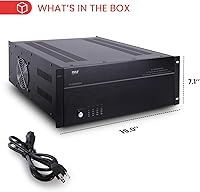
  • Form Factor: Designed for standard 19″ rack enclosures, occupying 4U of vertical rack space.
  • Dimensions: The unit measures 19.0″ wide by 19.3″ deep by 7.1″ tall when measured at the rack panel.
  • Weight: Fully assembled unit weighs 48.5 lbs, requiring two-person handling for safe rack installation.
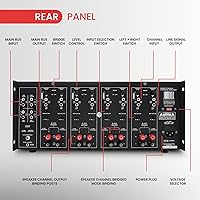
  • Speaker Outputs: Each channel terminates via 5-way binding posts that accept bare wire, spade connectors, and banana plugs.
  • Input Connector: Audio input is accepted via a single 3.5mm stereo jack, one per channel pair or shared source configuration.
  • Volume Control: Each channel has a dedicated mechanical rotary knob for independent zone-level adjustment directly on the front panel.
  • Level Display: A front-panel LED array provides a visual audio level indicator to monitor output signal strength per zone.
  • Channel Bridging: Adjacent channel pairs can be bridged into a single higher-powered mono output for demanding zones.
  • Pass-Through Output: A dedicated pass-through output allows the unit to feed signal to a secondary external amplifier for system expansion.
  • Impedance Protection: Each channel includes independent low impedance protection that automatically disables only the affected channel without disrupting others.
  • Rack Compatibility: Standard 19″ EIA rack-mount format ensures compatibility with most consumer and light-commercial rack enclosures.
  • Color & Finish: The unit ships in a matte black finish consistent with standard AV rack equipment aesthetics.
  • Model Number: The manufacturer model designation is PT8000CH, produced by Sound Around under the Pyle brand.
  • Product Vintage: This model was first made available in October 2009 and remains an active, non-discontinued product in the Pyle lineup.

Related Reviews
Pyle PLMR692 Marine Speakers
85%
88%
Sound Clarity
91%
Build Quality & Durability
94%
Waterproof Performance
85%
Installation Ease
73%
Bass Response
More
Pyle PVTC320U Step Up and Down Converter
84%
87%
Value for Money
85%
Performance
90%
Ease of Use
65%
Portability
91%
Safety Features
More
Pyle PDWR30B Outdoor Speakers
85%
88%
Sound Quality
94%
Weatherproof Durability
85%
Ease of Installation
78%
Design and Aesthetics
91%
Build Quality
More
Pyle PLMR652W Marine Speakers
86%
88%
Sound Quality
91%
Ease of Installation
93%
Durability (Waterproof & Weather Resistance)
87%
Build Quality
75%
Performance at High Volumes
More
Pyle PLMR91UB Marine Stereo
82%
89%
Waterproof Performance
76%
Bluetooth Connectivity
83%
Sound Quality
90%
Ease of Installation
85%
Durability in Marine Environments
More
Pyle PLMRA400 Marine Amplifier
82%
85%
Overall Performance
88%
Sound Quality
90%
Durability (Waterproofing & Corrosion Resistance)
75%
Installation Ease
80%
Build Quality
More
Pyle PLMR57W Marine Speakers
85%
84%
Sound Quality
91%
Durability
89%
Ease of Installation
90%
Weather Resistance
75%
Bass Performance
More
Pyle PLATV65BT Bluetooth Speakers
86%
88%
Sound Quality
91%
LED Light Features
85%
Water Resistance
89%
Ease of Installation
87%
Build Quality
More
Pyle PLMRA200 Marine Amplifier
86%
94%
Waterproof Performance
88%
Ease of Installation
83%
Power Output
85%
Build Quality
90%
Size and Space Efficiency
More
Pyle PLMR82 Marine Speakers
84%
83%
Sound Quality
89%
Durability
90%
Ease of Installation
80%
Power Handling
87%
Build Quality
More

FAQ

It is a peak burst figure, not a number you will see in real-world sustained use. The honest spec to plan around is 100W RMS per channel, which is the continuous output the amp can reliably deliver. That is perfectly adequate for ceiling speakers in standard-sized rooms, but sizing your installation around the 8000W claim will lead to disappointment.

You can, but with caveats. Running all channels at moderate background-music levels is generally fine for extended periods. Pushing multiple channels hard simultaneously for hours is where thermal stress builds up and the cooling fan becomes noticeably loud. If your rack is in an open living area, plan for that fan noise.

Standard 8-ohm passive speakers are the safest match — in-ceiling and in-wall speakers designed for distributed audio are exactly what this rack-mount amp is built around. Avoid dipping below 4 ohms per channel, as the low impedance protection will likely trip and mute that channel. High-sensitivity speakers will give you more usable volume headroom from the available wattage.

Yes, as long as your streaming device has a 3.5mm analog output or you use an inexpensive RCA-to-3.5mm adapter. The amp itself is purely analog — it does not have any wireless, network, or digital audio input capability. Feed it a line-level analog signal from any source and it will do its job.

Yes, adjacent channel pairs can be bridged to combine their output into a single higher-powered mono channel. This is useful if you have one large open-plan room that needs noticeably more headroom than the other zones. Just keep in mind bridging reduces your total zone count, so plan your room assignments accordingly before committing to a wiring layout.

Most DIYers with basic speaker wiring experience find the setup fairly intuitive. The binding posts are clearly labeled, the input layout is logical, and getting signal to each zone does not require any programming or software. The main challenge is physical — the unit is heavy, the rack depth is nearly 20 inches, and you will want a helper for the actual rack mounting.

It can be, especially during warmer months or longer listening sessions. The fan is not constantly running at full speed, but when it ramps up under load it is audible in a quiet room. If your rack is in a dedicated closet, basement, or utility room, you will likely never notice it. In an open living space it is worth considering before buying.

No, and that is actually one of the more practical features on this multi-room amplifier. The per-channel low impedance protection isolates only the affected channel and mutes it, while all remaining zones keep playing without interruption. You then have time to troubleshoot the problem zone without disrupting the rest of the house.

Yes, the pass-through output lets you feed signal from this unit into a second external amplifier, effectively extending your zone count without replacing the original unit. The implementation is a bit bare-bones — there is no gain control on the pass-through — so expect some trial and error to balance levels between the two amps.

Light commercial environments are a reasonable use case, particularly for constant background music at moderate volume levels in spaces like cafés, small gyms, or boutique retail. It is not commercial-grade hardware in terms of build or duty cycle, so if your space demands high volume running eight or more hours a day continuously, a purpose-built commercial amp would be a more durable long-term investment.