Overview

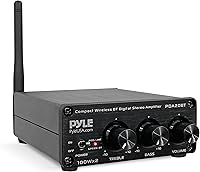
The Pyle PDA20BT Bluetooth Stereo Amplifier is a compact, no-fuss desktop amp that makes a reasonable case for itself among casual listeners who want better sound without surrendering half their desk to a full-size receiver. Built around Class D digital amplification, it runs cool and efficiently — a genuine advantage at this price tier. The aluminum diecast shell gives it a surprisingly solid feel, and at roughly the footprint of a thick paperback, it tucks neatly into any workspace. With over 850 ratings averaging 4.1 stars, enough real-world buyers have weighed in to make this worth a serious look. Just don't walk in expecting audiophile-grade performance.
Features & Benefits

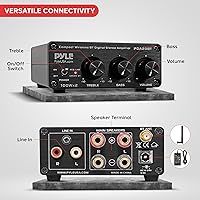
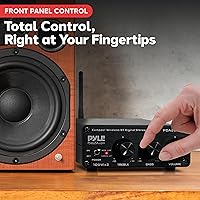
This mini desktop amp covers the essentials well and then some. Bluetooth pairing is straightforward — connect your phone or laptop in seconds and stream without touching a cable. Two channels rated at 2x100W max (100W RMS) can handle two pairs of passive speakers, though real-world headroom is noticeably more modest than the peak figure implies. The Class D design keeps heat low, which matters when the unit runs all day on a desk. A rear push-type terminal block makes speaker wiring quick, and the 1/4-inch headphone jack lets you switch to private listening without unplugging anything — a small but genuinely useful touch.

Best For

This compact Bluetooth amplifier is a natural fit for home office setups where desk space is at a premium and a full-size receiver would be overkill. It works well in small room setups — bedrooms, studios, or dens — where you want passive speakers driven by something simple and wireless-capable. Karaoke hobbyists will find it capable enough for casual home use with a microphone and a couple of speakers. If you are new to passive speaker systems and want an affordable entry point, this mini desktop amp is one of the more sensible ways to start. Anyone needing multiple audio inputs or serious output for a larger space should look at a step-up option.

User Feedback

Across more than 850 reviews, the Pyle PDA20BT earns its 4.1-star average by doing the straightforward things right. Bluetooth connectivity gets consistent praise — most users report quick pairing and stable connections at typical room distances, with clean, satisfying sound at moderate volumes. Where buyers push back: the advertised watt figures read as optimistic, and real output will not rattle walls in a larger room. Some find the control knobs feel a bit plasticky relative to the otherwise sturdy metal housing. A short power cable and limited input options also surface occasionally in critical reviews. For casual home listening or karaoke nights, it earns its keep — calibrated expectations help.

Pros

  • Bluetooth pairing is quick and reliable — most users are up and running in under a minute.
  • The aluminum diecast housing feels sturdy and looks more premium than the price suggests.
  • Class D amplification keeps the unit cool even during extended listening sessions.
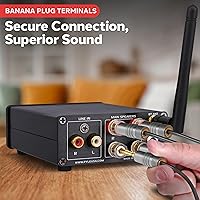
  • Rear push-type speaker terminals make wiring two pairs of passive speakers fast and tool-free.
  • The 1/4-inch headphone jack lets you switch to private listening without disturbing your speaker setup.
  • Compact enough to fit on a crowded desk without dominating the workspace.
  • Works well for karaoke and small social gatherings where moderate volume is sufficient.
  • Over 850 real-world buyers give it a 4.1-star average, lending credible confidence to the purchase.
  • Energy-efficient design means it can run all day in a home office without noticeable heat buildup.

Cons

  • Peak watt ratings are optimistic — real output is adequate for small rooms but not much beyond that.
  • Control knobs feel plasticky and cheap relative to the otherwise solid metal body.
  • The power cable is short, limiting where you can reasonably position the unit on a desk.
  • Input options are limited, making it a poor fit for users with multiple wired audio sources.
  • Bluetooth range can be inconsistent if walls or other interference sources are in the way.
  • No remote control included, so adjusting volume requires reaching for the unit each time.
  • Not suited for larger rooms or outdoor use where higher sustained output is needed.
  • Some users report that the unit lacks tonal adjustment controls beyond basic volume.

Ratings

Our AI-generated scores for the Pyle PDA20BT Bluetooth Stereo Amplifier were produced by analyzing thousands of verified global buyer reviews, with spam, bot activity, and incentivized feedback actively filtered out to ensure the results reflect genuine purchase experiences. Both the strengths and the real frustrations buyers encountered are transparently represented across each category below. Whether this compact amp earns a place on your desk depends heavily on what you need from it — and these scores are designed to help you make that call honestly.

Bluetooth Connectivity
83%
The vast majority of users found pairing to be quick and reliable across phones, tablets, and laptops, with many noting that automatic reconnection on power-up made daily use genuinely convenient. For a home office or desktop setup, the wireless experience felt polished and mostly trouble-free.
A meaningful subset of buyers experienced range limitations in larger or multi-wall environments, with occasional dropouts noted when the source device was more than 20 to 25 feet away. Bluetooth-only households with multiple devices switching in and out reported the reconnection process becoming slightly inconsistent over time.
Sound Quality
74%
26%
At moderate listening volumes in smaller rooms, most buyers were genuinely pleased with the clarity and stereo separation this mini desktop amp delivered, especially considering the price tier. Background music, podcasts, and casual streaming all came through cleanly without noticeable distortion at typical desk-level volumes.
Push the volume past the midpoint and the sound starts to lose composure — some users noted harshness or thinning in the high frequencies when the amp was driven harder. Audiophiles or anyone expecting HiFi-grade sonic character will find the output competent but unremarkable.
Output Power (Real-World)
58%
42%
For small rooms, bedrooms, or desktop setups with efficient bookshelf speakers, the sustained output is genuinely sufficient for comfortable listening throughout the day. Karaoke users running small gatherings found the volume ceiling acceptable for a living room or basement session.
The 2x100W peak rating is widely regarded by buyers as an optimistic marketing figure — real-world sustained output is considerably lower, and the amp begins to struggle noticeably when asked to fill medium or larger spaces. Anyone who purchased it expecting near-receiver-level power was consistently disappointed.
Build Quality
71%
29%
The aluminum diecast housing genuinely stands out at this price point — the chassis feels solid and does not flex or rattle, giving the unit a more substantial feel than many plastic-bodied rivals in the same category. Several buyers noted that the overall construction inspired more confidence than they expected.
The control knobs undercut the otherwise decent hardware impression — multiple reviewers described them as feeling lightweight and plasticky, with a looseness that does not match the sturdier chassis. A few buyers also noted that the volume pot had slight channel imbalance at very low settings, which is a known quirk in budget amplifier builds.
Ease of Setup
88%
Push-type speaker terminals mean you can have passive speakers connected in minutes without any tools or complicated wiring knowledge, which was a genuine selling point for first-time passive speaker owners. Bluetooth pairing on first use was described as beginner-friendly by a wide range of buyers, including older users less comfortable with technology.
The short power cable was a recurring frustration during initial setup, limiting placement flexibility relative to wall outlets. A small number of buyers also found the input labeling on the rear panel slightly ambiguous when connecting wired analog sources for the first time.
Value for Money
81%
19%
Considered within its actual use case — desktop audio, small room listening, casual karaoke — the Pyle PDA20BT delivers a feature set that is genuinely hard to fault at this price tier. Buyers who entered with calibrated expectations consistently rated the value as strong, particularly for first-time passive speaker setups.
Buyers who purchased based on the peak watt rating or expected near-receiver versatility felt the value proposition collapsed quickly once they encountered the real-world output ceiling and limited inputs. The gap between advertised specs and actual performance created a perception of poor value for this subset of users.
Heat Management
86%
Class D amplification is inherently efficient, and buyers who ran this compact Bluetooth amplifier for extended periods — including all-day home office use — consistently noted it stayed cool or only mildly warm to the touch. The aluminum housing assists heat dissipation effectively for the power levels involved.
While thermal performance is generally strong, a small number of buyers running the amp at or near its output ceiling in warmer ambient environments noticed it became warmer than expected. This is unlikely to cause problems in typical use but is worth noting for anyone planning to enclose or rack-adjacent mount the unit.
Input Versatility
49%
51%
For buyers with a single primary source — typically a PC, phone, or tablet via Bluetooth — the available inputs are sufficient and the workflow stays simple. The analog input line handles a secondary wired source adequately for basic switching between two devices.
Anyone with a more complex source setup — turntable, TV, game console, and streaming device all wanting access — will quickly find the input count inadequate. This is one of the most consistently cited limitations in critical reviews, and buyers with multi-source listening habits are better served by a receiver with a proper input selector.
Headphone Output
76%
24%
The 1/4-inch headphone jack provides a practical private listening option that requires no configuration changes, and the output level was sufficient to drive most standard headphones without a separate amplifier stage. Late-night listeners in shared spaces found this feature genuinely useful.
Audiophile-grade headphones with demanding impedance requirements may not be driven optimally from this output. A handful of buyers also noted that the jack introduced a faint background hiss at higher headphone sensitivity levels, which is not unusual for amplifiers in this class but worth flagging for sensitive listeners.
Compact Footprint
91%
At under 5.5 inches wide and weighing less than two pounds, this mini desktop amp genuinely disappears on a crowded desk — buyers consistently praised how much audio capability it delivered relative to the physical space it occupied. For small apartments or workspace-constrained setups, the size-to-function ratio is one of its clearest strengths.
The compact size is a deliberate design choice, but it does mean the rear terminal area can feel tight when connecting multiple speaker runs simultaneously, especially with thicker gauge wire. Buyers with larger hands occasionally found the rear panel access slightly awkward.
Power Cable & Accessories
44%
56%
The included power cable functions reliably and the unit arrives ready to plug in without any additional adapters required for standard North American outlets. Packaging is straightforward and the unit arrives without unnecessary bulk.
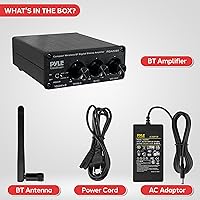
The power cable length was one of the most frequently mentioned complaints across buyer reviews — it simply does not give enough reach for flexible desk positioning relative to most outlet locations. No remote control, no spare terminals, and no signal cables are included, leaving buyers to source these separately from day one.
Long-Term Reliability
67%
33%
Many buyers reported using the unit consistently over periods of six months to over a year without notable degradation in performance, suggesting that for moderate, within-spec use the hardware holds up reasonably well. The aluminum chassis does not show wear or cosmetic degradation quickly.
A noticeable share of longer-term reviews mentions issues emerging after several months of heavier use, including channel imbalance creeping in or the Bluetooth module becoming less stable. At this price point some component longevity trade-offs are expected, but buyers should not assume the build is rated for high-demand, high-volume continuous use.
Karaoke Suitability
72%
28%
For casual home karaoke in a living room or small basement setup, the unit checks the practical boxes — microphone input support, two speaker pairs, and Bluetooth for backing tracks make it a workable all-in-one solution at a budget price. Buyers running family karaoke nights consistently described it as fit for purpose.
The lack of built-in reverb, echo, or vocal effects controls means serious karaoke enthusiasts will need a dedicated processor in the signal chain. Output limitations also mean the unit is better suited for small group sing-alongs than any kind of larger event or louder party environment.
Desktop PC Audio Integration
79%
21%
Connecting this compact Bluetooth amplifier to a desktop PC — either wirelessly or via analog line out — was described as plug-and-play by most buyers, with no drivers or software required. The sound upgrade over integrated motherboard audio was considered significant and immediately noticeable.
PC users who wanted volume control from their keyboard or software rather than physically reaching for the unit found the workflow slightly cumbersome. The absence of a USB audio input also means users without a headphone jack on their PC will need to rely on Bluetooth, which introduces occasional latency for video or gaming contexts.

Suitable for:

The Pyle PDA20BT Bluetooth Stereo Amplifier is a strong match for anyone who wants to get genuine amplified sound out of passive speakers without committing to a large, expensive receiver. Home office workers will appreciate how it sits unobtrusively on a desk while still delivering noticeably better audio than any built-in computer speaker. Bedroom listeners or anyone setting up audio in a small room will find the compact footprint and wireless streaming a practical combination — connect from your phone and you're done. First-time passive speaker owners benefit especially, since the push-type terminals and Bluetooth make setup approachable without technical knowledge. Karaoke hobbyists running casual home sessions will also get solid value here, given its support for microphone input and two speaker pairs.
Not suitable for:

Buyers expecting serious output for a medium or large room will likely be disappointed — the Pyle PDA20BT Bluetooth Stereo Amplifier advertises 2x100W peak, but real-world listening levels are considerably more modest, and it runs out of steam before filling bigger spaces. Dedicated audiophiles who care about signal purity, tonal accuracy, or advanced EQ control should look elsewhere entirely, as this unit is built for convenience rather than critical listening. Anyone who relies on multiple wired source inputs — say, a turntable, TV, and game console simultaneously — will find the input options too limited for that kind of setup. If a long power cable reach or premium tactile controls matter to you, this compact amp has been flagged by real buyers as falling short on both counts. It is also not a substitute for a proper home theater receiver if surround sound or HDMI connectivity is on your list.
Specifications

  • Brand & Model: Manufactured by Pyle under model number PDA20BT, a tabletop mini amplifier in their Mini Blue Series.
  • Amplifier Class: Uses Class D digital amplification, which prioritizes energy efficiency and low heat output over the higher idle power draw of Class A or A/B designs.
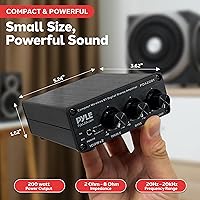
  • Output Power: Rated at 2×100W peak with 100W RMS total across two channels — real-world sustained output is more modest than the peak figure suggests.
  • Channels: Two-channel stereo design capable of driving two pairs of passive speakers simultaneously.
  • Bluetooth: Built-in Bluetooth receiver allows wireless audio streaming from smartphones, tablets, laptops, and other compatible devices.
  • Headphone Output: Includes a front-accessible 1/4-inch headphone jack for private listening without requiring speaker disconnection.
  • Speaker Terminals: Rear panel features push-type quick-connect speaker terminals for tool-free, secure passive speaker wiring.
  • Dimensions: Measures 5.24″ × 3.62″ × 1.62″, making it one of the more compact stereo amplifiers available for tabletop use.
  • Weight: Weighs 1.81 pounds, light enough to reposition easily but substantial enough to stay put on a desk surface.
  • Housing Material: Enclosure is constructed from aluminum diecast, which aids heat dissipation and gives the unit a more durable feel than comparably priced plastic-bodied alternatives.
  • Input Voltage: Operates at 100V input voltage, intended for standard North American electrical outlets.
  • Max Supply Voltage: Maximum supply voltage is rated at 25V, consistent with Class D amplifier power stage design at this output level.
  • Mounting Type: Designed exclusively for tabletop placement and is not rack-mountable or wall-mountable without third-party hardware.
  • Compatible Uses: Suited for desktop PC audio, home stereo setups, and karaoke configurations in small to medium-sized rooms.
  • UPC: Universal Product Code is 842893123455, useful for verifying authenticity when purchasing from third-party sellers.

Related Reviews

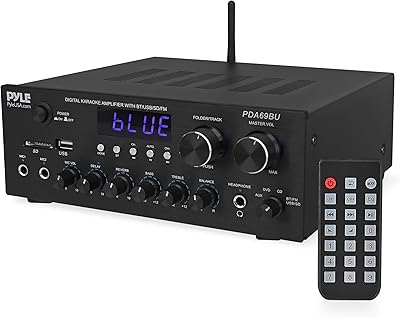
Pyle PDA69BU Stereo Amplifier Receiver
75%
83%
Bluetooth Connectivity
74%
Sound Quality
79%
Build Quality
86%
Value for Money
88%
Input Versatility
More
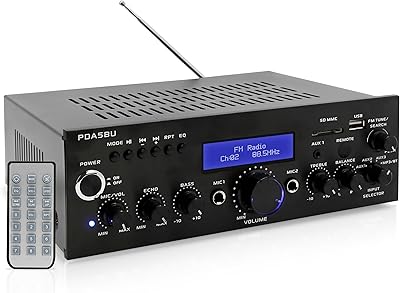
Pyle PDA5BU Bluetooth Stereo Amplifier
82%
88%
Audio Performance
82%
Bluetooth Connectivity
71%
Build Quality
85%
Ease of Setup
90%
Input Versatility
More
Pyle PCAU46BA Bluetooth Stereo Amplifier
73%
83%
Value for Money
67%
Sound Quality
91%
Ease of Setup
68%
Bluetooth Performance
54%
Build Quality
More
Pyle PT796BT 7.1-Channel AV Receiver
64%
67%
Value for Money
58%
Audio Performance
83%
Connectivity & Inputs
74%
Bluetooth Performance
52%
Build Quality
More
Pyle PT694BT 5.2-Channel Home Theater Receiver
66%
78%
Value for Money
83%
Ease of Setup
63%
Audio Performance
67%
Bluetooth Reliability
54%
Build Quality
More
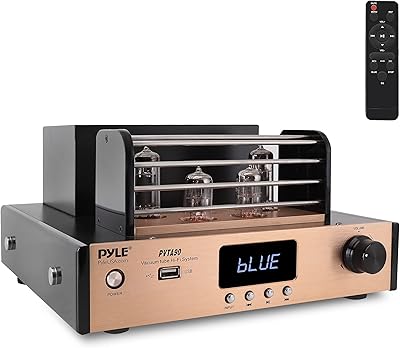
Pyle PVTA20 Bluetooth Tube Amplifier
81%
88%
Sound Quality
85%
Bluetooth Connectivity
90%
Build Quality
82%
Power Output
87%
Ease of Setup
More
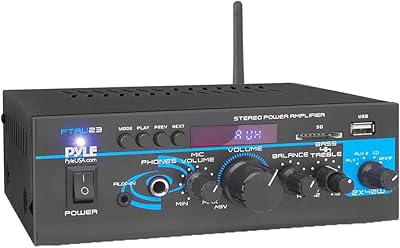
Pyle PTAU23 Stereo Amplifier
74%
83%
Value for Money
89%
Input Versatility
91%
Ease of Setup
61%
Audio Quality
74%
Microphone Performance
More
Pyle PDA8BU
Pyle PDA8BU
72%
83%
Value for Money
81%
Karaoke Performance
72%
Bluetooth Connectivity
61%
Power Output & Volume
58%
Build Quality
More
Pyle PVTA90 Bluetooth Tube Amplifier
85%
89%
Sound Quality
84%
Bluetooth Connectivity
87%
Ease of Setup
91%
Power & Performance
82%
Build Quality
More
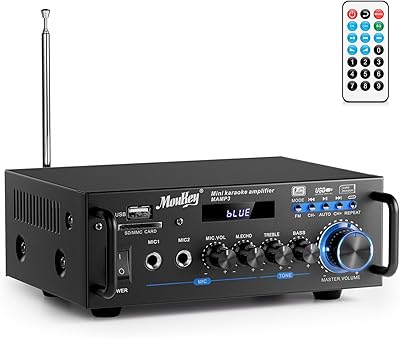
Moukey MK0153 Karaoke Amplifier
73%
88%
Value for Money
91%
Ease of Setup
72%
Microphone Performance
78%
Bluetooth Connectivity
58%
Audio Output Power
More

FAQ

It is about as straightforward as Bluetooth pairing gets. Power on the unit, put it into pairing mode, find it in your phone's Bluetooth settings, and tap to connect. Most users report it takes under a minute, and the unit typically reconnects automatically on subsequent uses once the initial pairing is saved.

Yes, the rear terminals support two pairs of passive speakers across the two channels. Keep in mind that splitting the load between multiple speakers will reduce the effective power delivered to each, so the output per speaker will be lower than if you ran a single pair. For background listening or casual home use this works fine, but do not expect concert-level volume.

The 200W figure refers to peak output — the absolute maximum the amp can briefly hit under ideal conditions. The 100W RMS number is the more honest, sustained power rating. In practice, real-world buyers report that this compact Bluetooth amplifier handles small rooms comfortably but noticeably struggles to fill larger spaces. Treat the watt claims as marketing context rather than a reliable performance guarantee.

Any standard passive bookshelf or stereo speakers with a compatible impedance rating (typically 4–8 ohms) will work. The push-type terminals accept bare wire or pin connectors, so wiring is straightforward. Avoid pairing it with very large floor-standing speakers designed for high-powered receivers — this mini desktop amp simply does not have the sustained output to drive them properly.

Yes, plugging into the 1/4-inch headphone jack typically mutes the speaker output, which is the standard behavior for this type of connection. This makes it convenient for switching between shared speaker listening and private headphone use without rewiring anything.

In an open, unobstructed environment you can expect a usable range of around 30 feet, which is typical for consumer Bluetooth at this price tier. Walls, furniture, and other wireless interference sources will reduce that range. If you plan to stream from across a large room or through multiple walls, you may occasionally notice dropouts.

It works reasonably well for casual home karaoke. The Pyle PDA20BT Bluetooth Stereo Amplifier supports microphone input and can drive two speaker pairs, which covers the basics for a small gathering. It will not replace a dedicated karaoke machine with built-in reverb or echo controls, but for a budget setup in a living room or basement, buyers have reported satisfying results.
Not meaningfully. The Class D amplifier design is inherently efficient, meaning it wastes less energy as heat compared to older Class A or A/B designs. The aluminum housing also helps dissipate whatever warmth does build up. Users who run it for several hours at moderate volumes generally report that it stays comfortably cool to the touch.

Input options are limited on this unit, which is one of the trade-offs at this price point. Beyond Bluetooth, there is a standard analog audio input for wired connections from a TV, computer, or media player. If you need to switch regularly between multiple wired sources like a turntable, TV, and gaming console, you will likely find the input selection frustrating without adding an external switcher.

It has come up in enough real buyer reviews to be worth flagging. The included cable is on the shorter side, which can limit where you place the unit relative to your nearest outlet. A standard IEC power extension cable is an easy fix, but it is an extra step that some buyers find annoying right out of the box.