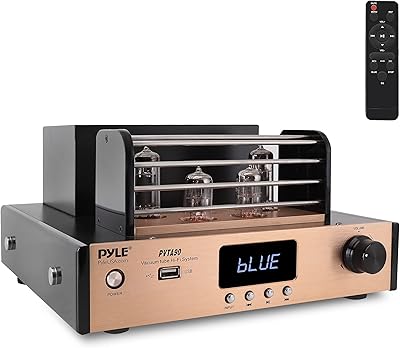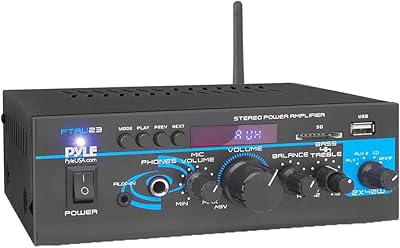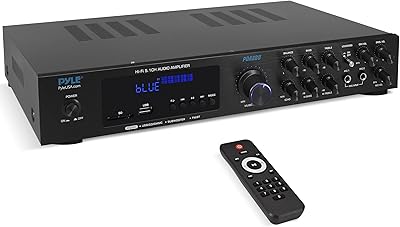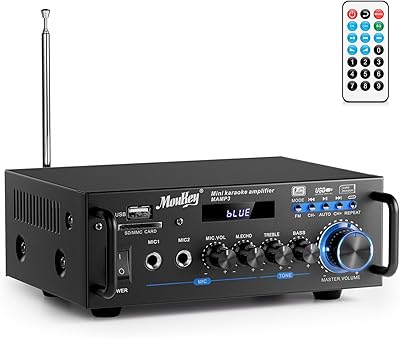


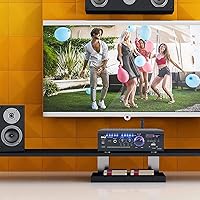
Overview

The Pyle PCAU46BA Bluetooth Stereo Amplifier is a compact, budget-conscious receiver that sits firmly at the accessible end of the home audio market. Pyle has long been the brand people turn to when they want real hardware without spending serious money, and this amp fits that pattern well — it is not competing with mid-range Denon or Yamaha gear, and it does not pretend to. The dual-voltage design supporting both 110V and 220V is a genuinely practical touch, especially for international buyers. With over 740 ratings averaging 4.0 stars, the response from owners is broadly positive, though far from unanimous. It is an honest entry-level option for casual listeners ready to move past a basic Bluetooth speaker.

Features & Benefits

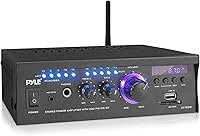
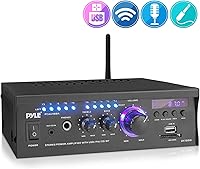
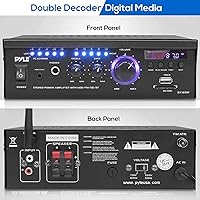
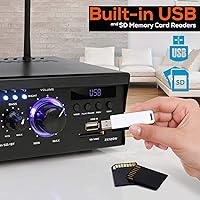
On paper, the PCAU46BA claims 2x120 watts of output, but it is worth being clear-eyed: budget amplifiers at this price rarely sustain that figure cleanly under real conditions. In practice, there is enough usable power to drive most bookshelf speakers at comfortable volumes in a small to mid-sized room. The Bluetooth connection holds up well at close range, and the variety of inputs — RCA, USB-A, SD card, and a front AUX jack — means most people can connect whatever they already own. The built-in AM/FM tuner adds standalone radio without extra hardware, and the physical rotary controls for bass, treble, and volume feel more intuitive day-to-day than any app-based alternative.

Best For

This Pyle amp makes the most sense for anyone wanting to power a pair of passive bookshelf speakers without a large outlay. Think dorm rooms, home workshops, bedrooms, or any space where filling the room with decent sound matters more than critical listening accuracy. It pairs naturally with a turntable or legacy CD player via RCA — scenarios where a modern Bluetooth speaker simply cannot help. The flexible voltage selector also makes it worth a look for international households or people splitting time between regions. If your goal is consolidating a phone, a USB music drive, and a radio tuner into one tidy box on a tight budget, this compact stereo receiver handles all of that without complication.

User Feedback

Buyers consistently highlight how quickly this Pyle amp gets up and running — most report it working straight out of the box with minimal fuss. Value for money is the dominant positive theme, with many owners noting it outperforms their expectations for the price paid. On the critical side, the plastic chassis draws frequent comments; it feels lightweight and a few buyers question its long-term durability. Bluetooth stability through walls gets flagged occasionally as inconsistent. The included remote is functional but basic, and the LED display is readable without being particularly sharp. Overall, the consensus leans positive for everyday casual use — just do not expect refined build quality or textbook wattage delivery at this price tier.

Pros

  • Extremely easy to set up — most buyers are listening within minutes of unboxing, no app required.
  • The PCAU46BA delivers genuinely broad input coverage: Bluetooth, RCA, USB, SD card, and AUX all in one unit.
  • Built-in AM/FM tuner removes the need for a separate radio receiver in the home.
  • Dual 110V/220V voltage support is a rare and practical feature at this price tier.
  • Physical bass, treble, and volume knobs make daily adjustments fast and intuitive.
  • Included remote is functional for basic control from across the room.
  • Compact footprint fits neatly on a shelf or inside a media cabinet without sacrificing desk space.
  • Short-circuit and surge protection provide a basic but meaningful layer of hardware safety.
  • Works reliably with a wide range of standard 6-ohm and 8-ohm bookshelf speakers.
  • For casual everyday listening, this compact stereo receiver punches above its weight in versatility.

Cons

  • Plastic chassis feels lightweight and does not inspire confidence in long-term durability.
  • Rated wattage is a peak figure — sustained clean output under real conditions falls noticeably short of the spec.
  • Bluetooth range degrades significantly through walls, making room-to-room coverage unreliable.
  • Switching the Bluetooth source between two devices is not always smooth or quick.
  • The infrared remote requires close line-of-sight and has a limited effective range.
  • Headphone output lacks the drive needed for higher-impedance headphones.
  • No optical or digital input limits compatibility with modern TVs and digital sources.
  • The unit runs warm during extended listening sessions, particularly in enclosed or poorly ventilated spaces.
  • FM reception depends heavily on antenna placement, and the included wire antenna is basic at best.
  • LED display washes out in bright ambient lighting and offers minimal information beyond active input status.

Ratings

The Pyle PCAU46BA Bluetooth Stereo Amplifier has been scored by our AI system after analyzing verified purchase reviews from buyers worldwide, with spam, bot-generated, and incentivized feedback actively filtered out. Scores reflect the genuine consensus across thousands of real ownership experiences — strengths and frustrations alike. Where buyers consistently praised usability and input variety, and where they pushed back on build quality or wattage transparency, both sides are honestly represented here.

Value for Money
83%
For the price paid, most buyers feel they received more functional hardware than expected. The combination of Bluetooth, multiple inputs, a tuner, and a remote in a single compact unit strikes many owners as genuinely strong value, especially those coming from basic Bluetooth speakers.
A small but vocal group of buyers feel the wattage marketing is misleading at this price tier, which can create a gap between expectations and real-world output. If you expected full rated power cleanly delivered, the price-to-performance relationship feels less generous.
Sound Quality
67%
33%
For casual listening in a small room — background music while cooking, a workshop playlist, or a bedroom setup — the audio output is more than adequate. Pairing it with decent bookshelf speakers produces a noticeably fuller sound than any Bluetooth speaker at this price.
Audiophiles and critical listeners will find the audio character flat and unrefined. The entry-level DAC and amplifier circuit show their limitations at higher volumes, introducing some distortion, and the tonal balance lacks the nuance that even modestly priced mid-range receivers deliver.
Ease of Setup
91%
This is one of the most consistently praised aspects across all reviews. Buyers report the unit is operational within minutes of unboxing — plug in speakers, power on, pair via Bluetooth, and it works. No app required, no firmware updates, no complicated menus.
A small number of users encountered initial Bluetooth pairing quirks, particularly when switching between devices. The manual is thin and not especially helpful if something does not connect as expected on the first attempt.
Bluetooth Performance
68%
32%
In open-plan spaces and small rooms, the Bluetooth connection holds steady and pairing is quick. Most users streaming music from a phone or laptop within the same room report a reliable, drop-free experience that covers everyday casual use well.
Walls and interference reduce the effective range noticeably below the advertised 30-plus feet. Several verified buyers flagged intermittent dropouts when moving between rooms, and switching the connected device — say, from a phone to a laptop — is not always smooth.
Build Quality
54%
46%
The unit feels solid enough when sitting stationary on a shelf, and the front-panel knobs have a reasonable amount of resistance. For a device that largely stays in one place, the construction is functional and does its job without immediately falling apart.
The plastic chassis is the most common criticism in user reviews. It feels lightweight in a way that signals budget origins, and the overall fit and finish does not inspire confidence in long-term durability. A few buyers reported knob wobble or cosmetic issues arriving from the box.
Input Variety
88%
The range of inputs available on a unit at this price point is genuinely broad. RCA for legacy players, USB-A for thumb drives, an SD card slot, and a front AUX jack mean most buyers can connect everything they already own without adapters or workarounds.
There is no optical or digital input, which limits compatibility with modern TVs or sound systems expecting a digital connection. The RCA input also handles phono signals passively, so turntable users without a built-in preamp will need an external phono stage.
AM/FM Tuner
74%
26%
Having a functional AM/FM tuner built in is a genuine convenience that buyers specifically mention as a deciding factor. For anyone who still listens to local radio — in a kitchen, garage, or small office — it removes the need for a separate device entirely.
Reception quality is average and heavily dependent on antenna positioning. The included wire antenna is basic, and in areas with weaker signals, some users report static or difficulty locking onto stations, especially on AM.
Remote Control
61%
39%
The included infrared remote covers the core functions — volume, input switching, and basic playback controls — which is appreciated for couch use or when the unit is mounted on a shelf out of easy reach. It is better than no remote at all.
The remote feels cheap and the button layout is not intuitive. Several buyers note that the infrared range is limited and requires fairly direct line-of-sight, which reduces its usefulness if the unit is tucked behind other objects or at an angle.
Power Output
58%
42%
For small to medium rooms with efficient bookshelf speakers, the amplifier delivers enough clean power to reach comfortable listening levels. Buyers using it with 8-ohm speakers in modest spaces tend to report satisfactory volume without obvious strain.
The 2x120W spec is a peak or maximum figure under ideal conditions, not a realistic continuous output number — and this distinction matters. Buyers who expected to drive larger or less efficient speakers at high volume found the amp running warm and the sound compressing earlier than anticipated.
Display & Interface
72%
28%
The blue LED display is visible from across a room in normal lighting and clearly shows the active input and basic status information. The front-panel layout is intuitive enough that most buyers figure it out without touching the manual.
In bright ambient light — near a window or under strong overhead lighting — the blue LED can wash out and become harder to read. The display also lacks any detail beyond basic mode indicators, so there is no frequency readout for the FM tuner or track info from USB playback.
Speaker Compatibility
76%
24%
The amp works well with a wide range of common bookshelf and small floor-standing passive speakers, and the 4-ohm load rating gives it reasonable flexibility. Most buyers using standard 6-ohm or 8-ohm consumer speakers report no compatibility issues.
Very low-impedance or high-power-demand speakers push the unit into thermal stress faster than expected. A handful of buyers using demanding speaker loads reported the unit shutting off via protection circuitry during extended listening sessions at high volume.
Dual Voltage Support
86%
The switchable 110V/220V input is a practical differentiator that international buyers and frequent movers specifically call out as a reason for choosing this unit. It works in North America and Europe without any additional hardware.
The voltage selector switch is a small physical toggle that sits on the rear panel and is easy to overlook. A few buyers have reported powering on with the wrong voltage setting, which is a user error but one a clearer label or default lock could help prevent.
Headphone Output
63%
37%
Having a 3.5mm headphone jack on the front panel is a convenient touch for late-night listening or private use. It works as expected and disables the speaker outputs when plugged in, which is the correct behavior.
The headphone amplification circuit is basic and shows its budget origins with higher-impedance headphones. Users with 250-ohm or higher cans will find the output thin and lacking drive. It works fine with standard earbuds or low-impedance headphones.
Size & Portability
81%
19%
The compact footprint — under 8.5 inches deep and under 3 inches tall — means it fits on a shelf, inside a media cabinet, or on a desk without dominating the space. Its light weight makes repositioning easy, and it travels reasonably well for a mains-powered device.
The compact size is partly a result of the lightweight internal components, which some buyers view as a double-edged trait. A few also noted that the ventilation is minimal, and the unit can run noticeably warm during extended use in confined spaces.

Suitable for:

The Pyle PCAU46BA Bluetooth Stereo Amplifier is a strong fit for casual home listeners who want to power a pair of passive bookshelf speakers without committing to a serious audio budget. If your setup involves a small bedroom, a dorm room, a home workshop, or a kitchen shelf — spaces where background music and everyday listening are the goal rather than critical audio evaluation — this compact stereo receiver does exactly what it needs to. Hobbyists with a turntable or a legacy CD player will appreciate the RCA input, which keeps older gear in the rotation without requiring additional hardware. The dual-voltage selector also makes it genuinely practical for international households or anyone splitting time between North America and Europe, removing an obstacle that many comparable units ignore entirely. Anyone who wants one box to handle Bluetooth streaming, a USB music drive, and local radio without juggling multiple devices will find the input variety here surprisingly well-matched to that exact use case.

Not suitable for:

The Pyle PCAU46BA Bluetooth Stereo Amplifier is not the right choice for buyers who prioritize audio fidelity, long-term durability, or high-power speaker driving. The plastic chassis and lightweight internal construction are honest reflections of the price point, but they do mean the unit is unlikely to hold up under heavy daily use for years the way a mid-range Yamaha or Denon receiver would. Listeners pairing this Pyle amp with demanding, low-efficiency speakers — or expecting to fill a large living room at high volumes — will likely find the amp struggling before reaching satisfying output levels, since the rated wattage figures reflect peak conditions rather than sustained real-world performance. Anyone who uses high-impedance headphones as a primary listening tool will also find the headphone output underpowered and underwhelming. Buyers wanting optical or digital inputs for a modern TV connection will need to look elsewhere, and anyone who has grown accustomed to stable whole-home Bluetooth coverage should temper their expectations, as the wireless performance behind walls is inconsistent.

Specifications

  • Model: The unit carries the model designation PCAU46BA, manufactured by PyleUSA.
  • Power Output: Rated at 2x120 watts into 4 ohms, reflecting peak output under ideal conditions rather than continuous RMS delivery.
  • Dimensions: The chassis measures 5.39″ wide by 2.87″ tall by 8.41″ deep, making it compact enough for most shelving or desktop setups.
  • Weight: The unit weighs 4.86 pounds, light enough to reposition easily without assistance.
  • Voltage Input: Supports selectable input voltage between 110V/60Hz (North America) and 220V/50Hz (Europe and other regions) via a rear-panel switch.
  • Bluetooth Range: Bluetooth wireless range is rated at over 30 feet under open-air conditions with no obstructions.
  • Wired Inputs: Equipped with one RCA stereo input, one front-panel AUX 3.5mm jack, one USB-A port, and one SD/MMC card slot.
  • Tuner: Built-in AM and FM radio tuner requires an antenna connection for reliable signal reception.
  • Headphone Output: A 3.5mm headphone jack on the front panel disables speaker outputs when a headphone is connected.
  • Display: Blue LED front-panel display shows active input mode and basic operational status.
  • Controls: Front panel features dedicated rotary knobs for bass, treble, and master volume adjustment.
  • Remote Control: An infrared remote control is included in the box for basic function control at a distance.
  • Speaker Impedance: Designed to drive speakers rated at 4 ohms, and also compatible with common 6-ohm and 8-ohm passive speakers.
  • Audio Encoding: Outputs stereo two-channel audio; the unit does not support multichannel or surround decoding.
  • Protection: Built-in short-circuit and power surge protection circuits are integrated to guard both the unit and connected speakers.
  • Chassis Color: Available in black with a plastic enclosure construction.
  • Connectivity Types: Supports Bluetooth, 3.5mm AUX, USB-A, SD/MMC, and RCA analog connectivity.
  • Manufacturer: Produced by PyleUSA, a US-based brand with a broad catalog of entry-level consumer audio hardware.

Related Reviews
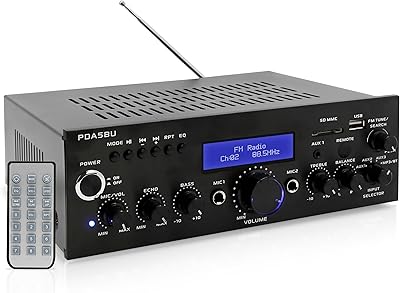
Pyle PDA5BU Bluetooth Stereo Amplifier
82%
88%
Audio Performance
82%
Bluetooth Connectivity
71%
Build Quality
85%
Ease of Setup
90%
Input Versatility
More
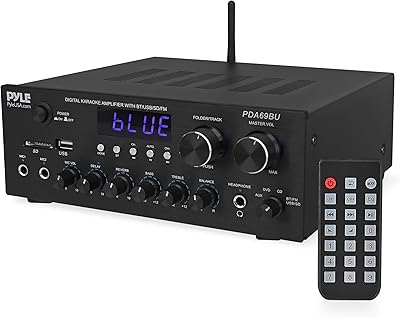
Pyle PDA69BU Stereo Amplifier Receiver
75%
83%
Bluetooth Connectivity
74%
Sound Quality
79%
Build Quality
86%
Value for Money
88%
Input Versatility
More
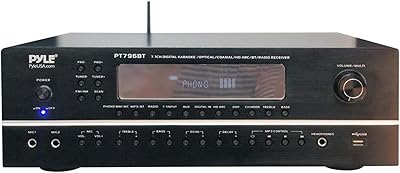
Pyle PT796BT 7.1-Channel AV Receiver
64%
67%
Value for Money
58%
Audio Performance
83%
Connectivity & Inputs
74%
Bluetooth Performance
52%
Build Quality
More
Pyle PT694BT 5.2-Channel Home Theater Receiver
66%
78%
Value for Money
83%
Ease of Setup
63%
Audio Performance
67%
Bluetooth Reliability
54%
Build Quality
More
Pyle PTAU23 Stereo Amplifier
74%
83%
Value for Money
89%
Input Versatility
91%
Ease of Setup
61%
Audio Quality
74%
Microphone Performance
More
Pyle PVTA90 Bluetooth Tube Amplifier
85%
89%
Sound Quality
84%
Bluetooth Connectivity
87%
Ease of Setup
91%
Power & Performance
82%
Build Quality
More
Pyle PVTA20 Bluetooth Tube Amplifier
81%
88%
Sound Quality
85%
Bluetooth Connectivity
90%
Build Quality
82%
Power Output
87%
Ease of Setup
More
Moukey MK0153 Karaoke Amplifier
73%
88%
Value for Money
91%
Ease of Setup
72%
Microphone Performance
78%
Bluetooth Connectivity
58%
Audio Output Power
More
AIYIMA T9
AIYIMA T9
77%
83%
Sound Quality
88%
Value for Money
91%
Connectivity & Input Variety
67%
Bluetooth Performance
74%
Build Quality & Materials
More
Pyle PDA8BU
Pyle PDA8BU
72%
83%
Value for Money
81%
Karaoke Performance
72%
Bluetooth Connectivity
61%
Power Output & Volume
58%
Build Quality
More

FAQ

Any passive speakers — meaning speakers without a built-in amplifier — will work here. The unit is designed for 4-ohm loads, but standard 6-ohm and 8-ohm bookshelf or floor-standing speakers are compatible too. Just avoid powered or active speakers, which have their own amplification and do not connect via bare wire terminals.

It has an RCA input, but no built-in phono preamp. If your turntable has a built-in preamp — which many modern entry-level models do — you can connect it directly via RCA and it will work fine. If your turntable outputs a raw phono-level signal, you will need an external phono preamp between the turntable and this compact stereo receiver.

That figure represents peak output under ideal test conditions, not the continuous clean power you will experience in a living room. In practice, the usable continuous output is considerably lower — which is standard for budget amplifiers in this category. For small rooms and efficient bookshelf speakers, it is more than enough, but do not expect to drive large or inefficient speakers at high volumes without some compression or distortion creeping in.

You can connect a TV that has an analog RCA audio output or a 3.5mm headphone jack using the appropriate cable. However, this Pyle amp does not have an optical (Toslink) or digital coaxial input, so TVs that only output digital audio will not work without an external digital-to-analog converter.

In the same room with a clear line of sight, the connection is generally stable for streaming music from a phone or laptop. Through walls or at longer distances, several buyers report occasional dropouts, so it is best thought of as a same-room wireless solution rather than a whole-home one. Switching between two paired devices can also require a manual re-pairing step in some cases.

Yes — there is a small voltage selector switch on the rear panel that you need to flip from 110V to 220V before plugging it into a European outlet. The switch is easy to overlook, so check it before powering on. Using the wrong voltage setting can damage the unit, so it is worth taking a moment to confirm the setting whenever you move between regions.

Yes, it is one of the more beginner-friendly units in its category. You connect your speaker wires to the binding posts on the rear, plug in the power, and turn it on. Bluetooth pairing follows the same process as any other Bluetooth device — hold the source button until it enters pairing mode, then select it on your phone. Most first-time buyers report being fully set up in under ten minutes.

The chassis does get noticeably warm during extended listening, particularly if the unit is enclosed or poorly ventilated. For normal use at moderate volumes in open air, it stays within a safe operating range. Avoid placing it inside a tightly enclosed cabinet without ventilation gaps, as heat buildup over long sessions can stress the internal components.

It works with standard earbuds and low-impedance headphones, and plugging in automatically cuts the speaker output, which is the expected behavior. If you use high-impedance headphones — 150 ohms or above — the output will likely sound thin and underpowered, since the headphone amplification circuit is basic. For serious headphone listening, a dedicated headphone amplifier would serve you better.

The USB-A port on this Pyle amp supports audio playback from a thumb drive containing music files — it is not a charging port. You can load MP3s or compatible audio files onto a USB drive, plug it in, and the unit will play them back directly. It does not stream from a connected phone via USB; for phone audio, use the Bluetooth or AUX input instead.