Overview

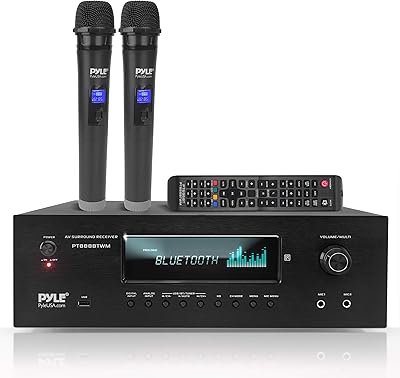
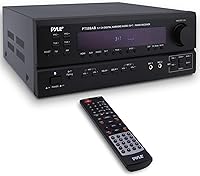
The Pyle PT588AB 5.1 Channel Home Theater Receiver is a budget-oriented AV receiver that has been on the market since 2012 — worth keeping in mind. That longevity cuts both ways: it proves the unit has staying power, but the technology hasn't evolved. The advertised 420W peak power sounds impressive until you understand that peak and RMS wattage are very different things; real-world output is considerably more modest. Physically, it fits comfortably on a standard entertainment center shelf and manages to bridge legacy RCA connections with Bluetooth and HDMI, which is genuinely useful for households that haven't fully retired their older gear.
Features & Benefits

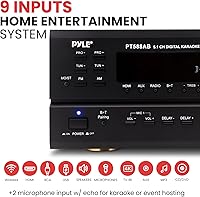
The connectivity lineup is where this home theater amp earns its keep. Four HDMI inputs with a single output handle most living room source setups, and the 4K and 3D pass-through keeps it compatible with modern displays without requiring an upgrade. Three quarter-inch microphone jacks with built-in echo control make karaoke nights easy to set up — no external mixer needed. Bluetooth pairing works with phones and tablets without complicated steps, and a built-in AM/FM tuner with 12 presets adds casual radio listening as a bonus. The LCD display panel does its job clearly, and the subwoofer output gives you room to add dedicated bass if your speakers call for it.

Best For

This surround sound receiver is a solid fit for a specific buyer: someone building a budget home theater or karaoke setup who doesn't want to manage multiple separate components. If you have a mix of older RCA-based devices and newer HDMI sources, the input variety here covers both without requiring adapters or extra switching boxes. It also suits smaller rooms well — the actual usable output won't fill a large open-plan space, but for a bedroom, basement, or modest living room it handles things comfortably. Anyone expecting audiophile-grade performance should look elsewhere; this unit is built around convenience and versatility, not sonic precision.

User Feedback

Among buyers who've lived with this home theater amp for a while, the setup experience and sheer number of inputs tend to get the most praise — people appreciate plugging everything in without needing extra hardware. On the flip side, long-term durability is a recurring concern, with several users reporting issues after a year or two of regular use. The remote control draws mixed reactions, some finding it reliable and others noting inconsistency. A handful of buyers also feel the wattage claims don't match what they actually hear at volume. Karaoke performance, though, consistently earns positive mentions, with the echo controls and multi-mic support standing out as genuine highlights.

Pros

  • Three mic inputs with echo control make this home theater amp one of the most karaoke-ready receivers at its price point.
  • Four HDMI inputs let you keep a game console, streaming stick, Blu-ray player, and cable box all connected simultaneously.
  • Bluetooth pairing is quick and reliable for most smartphones and tablets without needing to dig through menus.
  • The setup process is approachable enough for first-time receiver buyers to complete without technical help.
  • A built-in AM/FM tuner with 12 presets adds everyday radio use without requiring a separate device.
  • RCA and HDMI inputs coexist on the same unit, making it easy to connect both legacy and modern source devices.
  • The compact footprint fits standard AV shelving without dominating the entertainment center.
  • 4K and 3D pass-through support keeps it compatible with current TV setups without signal degradation.
  • The subwoofer output allows buyers to add a dedicated bass unit and meaningfully improve the audio experience.

Cons

  • The 420W power rating is a peak figure — real sustained output is significantly lower than the headline number implies.
  • Long-term durability is a documented concern, with multiple buyers reporting functional issues after one to two years of regular use.
  • The included remote becomes less reliable over time, and replacement units are not readily available through standard retail channels.
  • There are no per-channel level controls or auto-calibration, making accurate 5.1 surround tuning difficult.
  • The unit runs noticeably warm during extended sessions, which can be a risk in enclosed or poorly ventilated cabinet installations.
  • No optical or coaxial digital audio input limits compatibility with certain source components.
  • The USB port only charges devices and cannot be used as an audio input, which surprises some buyers.
  • Bluetooth codec support is basic, creating an audible quality ceiling for anyone streaming higher-resolution audio.

Ratings

The scores below for the Pyle PT588AB 5.1 Channel Home Theater Receiver were generated by our AI engine after analyzing verified buyer reviews from multiple global markets, with spam, incentivized, and bot-flagged submissions actively filtered out. The result is a balanced snapshot that reflects what real owners consistently praise and where they consistently run into trouble — no cherry-picking in either direction.
Value for Money
74%
26%
For buyers who want HDMI switching, Bluetooth, and karaoke capability in a single box without spending on separates, the price-to-feature ratio is hard to argue with. Many owners explicitly say they got more inputs and functionality than they expected at this tier.
If you factor in the longevity concerns reported by long-term owners, the value calculation shifts. A unit that needs replacing within two or three years starts looking less like a bargain and more like a recurring cost.
Build Quality
52%
48%
Out of the box, the chassis feels reasonably solid and the front panel buttons have a satisfying click. First impressions from unboxing reviews are generally positive, and the unit looks presentable in a standard entertainment setup.
Extended use tells a different story. Recurring buyer complaints point to components degrading over time — particularly the remote sensor and internal connections. Several owners reported failures after 12 to 18 months of regular use, which is a pattern hard to ignore.
Audio Performance
61%
39%
For casual listening in a small to mid-size room, this home theater amp produces a full enough sound with decent channel separation. Hooking up a dedicated subwoofer noticeably improves the overall experience, and the bass and treble controls give you some room to tune things.
The 420W peak power claim creates expectations the unit cannot meet in real-world use. Actual usable output is significantly lower, and at higher volumes some buyers notice compression and a lack of dynamic range that would frustrate anyone with a trained ear.
Karaoke Functionality
83%
Three quarter-inch mic inputs with adjustable echo is genuinely rare at this price point and arguably the unit's strongest selling feature. Families and small-venue hosts who use it regularly for karaoke nights consistently rate this aspect highly, noting the echo effect adds a polished feel without needing extra gear.
The echo control range is somewhat limited — users looking for professional-grade mic mixing will find the adjustment options a bit coarse. There is no individual mic volume control per input, which becomes noticeable when two mics are used simultaneously at different sensitivities.
HDMI Connectivity
78%
22%
Four HDMI inputs is a practical advantage for living rooms with multiple sources — a game console, a streaming stick, a Blu-ray player, and a cable box can all stay plugged in at once. The 4K and 3D pass-through works as advertised for most modern display setups.
Some buyers have reported intermittent handshake issues between certain 4K sources and their TVs when routed through this surround sound receiver. It is not a universal problem, but it surfaces often enough in reviews to be worth flagging before purchase.
Bluetooth Performance
72%
28%
Pairing is straightforward — most users describe connecting a phone or tablet as a quick, one-time process with reliable reconnection afterward. Streaming audio quality over Bluetooth is acceptable for background listening and casual use.
Bluetooth range is limited to close-proximity use, and a few buyers noted occasional dropouts when the connected device was on the other side of a room. The codec support is basic, so audiophiles streaming lossless audio will hear a noticeable quality ceiling.
Ease of Setup
81%
19%
Multiple buyers specifically call out how easy the initial setup was, even for those who had never installed an AV receiver before. The labeled inputs, included cables, and straightforward remote make the first-hour experience notably stress-free for a multi-input device.
The instruction manual is thin on detail for more advanced configurations like assigning specific audio delays per channel or optimizing the subwoofer crossover. Power users will likely need to experiment independently rather than rely on documentation.
Remote Control
57%
43%
The remote covers all the core functions — source switching, volume, tuner presets, and mute — and is responsive when used in direct line-of-sight within a reasonable distance. Button layout is logical enough that most users memorize the key functions quickly.
Reliability over time is a genuine weak point. A consistent thread in long-term reviews describes the remote becoming less responsive after several months, with the IR sensor on the unit itself suspected in some cases. Replacement remotes are not easy to source.
AM/FM Tuner
68%
32%
Having a built-in tuner with 12 preset stations is a feature many buyers in this category do not expect, and it adds real day-to-day convenience for households that still use over-the-air radio. Reception quality in urban areas with strong signal is reported as clean and stable.
In areas with weaker signal, the included antenna does not do enough to pull in reliable reception without repositioning. The tuner interface itself is functional but dated, and scanning through stations manually is slower than most standalone tuners.
Input Variety
79%
21%
The combination of HDMI, RCA, and a USB charging port means this home theater amp can serve as a hub for a wide range of devices — from vintage CD players and tape decks to modern streaming sticks and smartphones. That breadth is a genuine practical advantage.
The USB port charges devices but does not function as an audio input, which surprises some buyers who assume it does. There is also no optical or coaxial digital audio input, which limits compatibility with certain soundbars or older home theater components.
Display & Controls
71%
29%
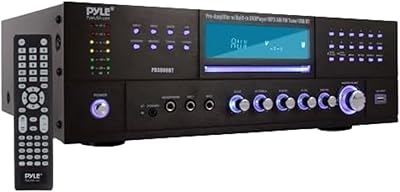
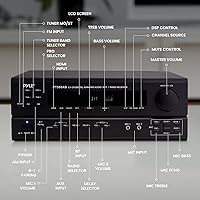
The front-panel LCD display is clear and informative — showing the active input, volume level, and tuner frequency at a glance. Physical knobs for volume and source selection feel more reliable than touch-based alternatives on competing units at this price.
The display has limited brightness adjustment, which makes it harder to read in very bright rooms. Button labels on the front panel are small, and a few buyers mention the text is difficult to read from across a typical living room without the remote.
Speaker Compatibility
66%
34%
The 4-ohm impedance support and dedicated subwoofer output give buyers reasonable flexibility when pairing speakers. Many users successfully run standard home theater speaker packages with this amp without any impedance mismatch issues.
The unit does not provide individual speaker level trim controls beyond basic bass and treble, which makes proper 5.1 channel calibration a rough approximation at best. Buyers coming from mid-range receivers will feel the absence of any auto-calibration feature.
Physical Design & Footprint
73%
27%
At roughly 13 by 17 inches, it slides into most standard AV furniture without the oversized footprint of higher-end receivers. The front panel has a clean, utilitarian look that does not clash with most entertainment center aesthetics.
At 19 pounds it is heavier than its size suggests, which can be a minor inconvenience during installation or repositioning. Ventilation slots are present but the unit does run noticeably warm after extended sessions, which a few buyers flag as a concern for enclosed cabinet placement.

Suitable for:

The Pyle PT588AB 5.1 Channel Home Theater Receiver is a practical pick for buyers who want a versatile, all-in-one hub without the cost or complexity of building a system from separate components. It fits especially well in homes where karaoke is a regular activity — three mic inputs with echo control is a combination that is genuinely hard to find at this price tier. Households that still own older RCA-based devices but want to add Bluetooth streaming and HDMI switching will find this home theater amp bridges that gap without requiring extra adapters or boxes. It also works well in smaller dedicated spaces like a basement entertainment room, a bedroom setup, or a modest living room where the real-world output levels are enough to fill the space comfortably. First-time AV receiver buyers who want a manageable setup experience will appreciate how straightforward the initial installation is.
Not suitable for:

Buyers who prioritize long-term reliability and audio fidelity should approach the Pyle PT588AB 5.1 Channel Home Theater Receiver with realistic expectations. The 420W power figure is a peak rating, not a continuous RMS measurement, and the actual sustained output is considerably lower — anyone planning to drive a full set of power-hungry floor-standing speakers in a large room will likely be underwhelmed. This surround sound receiver also lacks the channel-level calibration tools and auto-setup features found on receivers from more established audio brands, which makes it a poor fit for buyers who want accurate, tuned 5.1 surround sound for serious film or music listening. Those who have experienced mid-range or high-end AV equipment will notice the difference in build quality fairly quickly. If you are equipping a permanent, long-term home theater installation and expect the hardware to last five or more years under regular use, there are more durable options worth the additional investment.
Specifications

  • Peak Power: The unit is rated at 420W peak output across all channels combined, which is a maximum burst figure rather than a continuous RMS measurement.
  • Channel Config: Supports 5.1 surround sound channel configuration with dedicated outputs for front, center, surround, and subwoofer speakers.
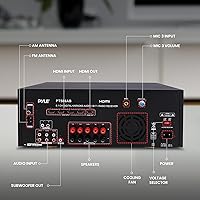
  • HDMI Ports: Equipped with 4 HDMI inputs and 1 HDMI output, supporting 4K ultra and 3D TV pass-through for compatible displays.
  • Mic Inputs: Features three 1/4-inch microphone inputs with a built-in echo effect control, enabling multi-mic karaoke use without an external mixer.
  • Audio Inputs: Includes 3 RCA stereo audio inputs for connecting legacy source devices such as CD players, tape decks, or older game consoles.
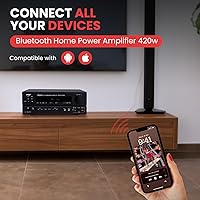
  • Bluetooth: Built-in Bluetooth allows wireless audio streaming from smartphones, tablets, laptops, and other compatible devices with a straightforward pairing process.
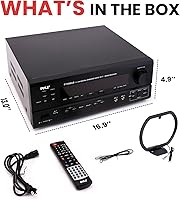
  • FM/AM Tuner: Integrated AM/FM radio tuner supports up to 12 saved presets and ships with an antenna for over-the-air signal reception.
  • Subwoofer Out: A dedicated subwoofer output and preamp output allow connection of a powered subwoofer or external amplifier for expanded bass response.
  • Display: A front-panel LCD display shows the active input source, volume level, and tuner frequency in real time.
  • Dimensions: The unit measures 13 x 16.9 x 4.9 inches, fitting comfortably on standard AV shelving within most entertainment centers.
  • Weight: Weighs 19 pounds, which is moderate for a 5.1 receiver but worth accounting for during installation or shelf load planning.
  • USB Port: A USB port on the front panel functions as a device charging port only and does not support audio playback from USB storage.
  • Remote Control: An infrared remote control is included in the package for adjusting volume, switching inputs, and accessing tuner presets from a distance.
  • Power Input: Compatible with both 115V 60Hz and 230V 50Hz power supplies, making it usable in North America and in many international markets.
  • Frequency Response: Audio frequency response spans 20Hz to 20kHz, covering the full range of human hearing under standard operating conditions.
  • Signal-to-Noise: Rated signal-to-noise ratio is 85dB, which is adequate for casual listening but below the threshold of higher-end AV receivers.
  • Speaker Impedance: Designed to work with speakers rated at 4 ohms impedance, which should be confirmed before pairing with any existing speaker setup.
  • First Available: This model was first listed for sale in January 2012 and has remained in active production and retail distribution since then.

Related Reviews

Pyle PT589BT
Pyle PT589BT
66%
74%
Value for Money
61%
Sound Quality
72%
Subwoofer Performance
83%
Ease of Setup
53%
Build Quality
More
Pyle PD3000BT.5 Home Theater Bluetooth Amplifier Receiver
82%
88%
Audio Performance
91%
Bluetooth Connectivity
85%
Ease of Setup
78%
Build Quality
80%
Microphone Inputs for Karaoke
More
Monoprice Premium 5.1 Channel Home Theater System 10565
83%
88%
Sound Quality
91%
Bass Performance
85%
Ease of Setup
82%
Build Quality
84%
Design/Appearance
More
Pyle PT888BTWM.5
Pyle PT888BTWM.5
68%
78%
Value for Money
82%
Karaoke Performance
47%
Build Quality
81%
Bluetooth Connectivity
63%
Sound Quality
More
Rockville HTS56 5.1 Home Theater System
71%
67%
Sound Quality
74%
Subwoofer Performance
88%
Setup & Installation
83%
Connectivity & Compatibility
62%
Karaoke Functionality
More
Monoprice Premium 5.1.2 Channel Immersive Home Theater System
82%
88%
Sound Quality
91%
Bass Performance
84%
Ease of Setup
79%
Build Quality
90%
Compatibility with Devices
More
Definitive Technology ProCinema 6D 5.1 Channel Home Theater Speaker System
84%
88%
Sound Quality
92%
Bass Performance
85%
Ease of Setup
90%
Design & Aesthetics
80%
Build Quality
More
LG S95TR Soundbar
LG S95TR Soundbar
81%
93%
Surround Sound Immersion
89%
Dialogue Clarity
88%
Wireless Setup & Cable Management
91%
LG Ecosystem Integration
76%
Subwoofer Performance
More
iLive IHTB159B 5.1 Home Theater System
78%
80%
Audio Quality
88%
Bluetooth Connectivity
85%
Ease of Setup
60%
Build Quality
70%
Bass Performance
More
Yamaha RX-V385
Yamaha RX-V385
75%
83%
Audio Quality
91%
Ease of Setup
88%
Build Quality
86%
Value for Money
79%
Connectivity & Inputs
More

FAQ

The 420W figure is a peak power rating, meaning it reflects a brief maximum burst under ideal conditions — not what the unit sustains during normal listening. The continuous RMS output per channel is considerably lower. For a small to mid-size room it performs fine, but do not expect it to drive large floor-standing speakers at high volume without strain.

Yes, the unit has three separate 1/4-inch microphone jacks, so you can have multiple mics plugged in and active simultaneously. Each input shares the same echo control rather than offering individual adjustment per mic, but for a home karaoke setup that works well in practice.

It supports 4K pass-through, so video signal from a 4K source like a streaming stick or Blu-ray player will pass through to your TV without being downscaled. Just make sure you use HDMI cables rated for 4K bandwidth to avoid any signal issues.

Most buyers find it straightforward — you press the Bluetooth button, put your phone or tablet into pairing mode, and the connection happens within a few seconds. Reconnection on subsequent uses is generally automatic once the initial pairing is saved.

Absolutely. The Pyle PT588AB 5.1 Channel Home Theater Receiver includes three RCA audio inputs specifically for legacy devices, so a DVD player, VCR, or older game console with red and white audio connectors will plug right in alongside your HDMI sources.
Unfortunately, no. The USB port on this unit is for charging phones and other devices only — it does not read audio files from USB storage. If you want to play music wirelessly, Bluetooth is the way to go with this amp.

The receiver does run noticeably warm after an hour or more of use, which is common for amplifiers in this class. If you plan to place it inside an enclosed entertainment center cabinet, make sure there is reasonable airflow above and around the unit to avoid heat buildup over long sessions.

The unit is designed for speakers with 4-ohm impedance, so check your speaker specs before connecting. Standard home theater speaker packages in this price range are typically 4 or 8 ohms — at 8 ohms the unit will still work but output power will be reduced compared to the rated spec.

This is one of the more commonly flagged issues in long-term owner reviews. Many buyers find the remote works well initially, but responsiveness can decline after several months of use. Keeping the IR sensor on the front panel unobstructed helps, but it is worth knowing that replacement remotes are not easy to find through standard retail channels.

It depends entirely on what you need it for. The core features — HDMI switching, Bluetooth, and karaoke mic inputs — still hold practical value for the right buyer. Where it shows its age is in the lack of modern room correction software, limited codec support, and build quality that does not match newer competitors. For a casual setup or a dedicated karaoke system, it still does the job; for a serious long-term home theater investment, newer options are worth the extra cost.