Overview

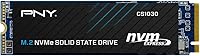
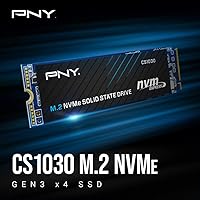
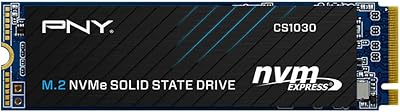
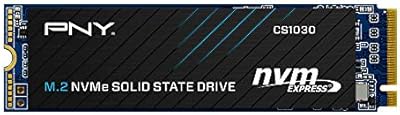
The PNY CS1030 1TB M.2 NVMe SSD is PNY's answer to the growing crowd of users who want a genuine NVMe speed boost without paying premium-tier prices. PNY doesn't always get the spotlight that Samsung or WD commands, but the brand has been in the storage game for years and backs its drives with a 5-year warranty and round-the-clock US-based support — something you rarely see at this price point. This is an M.2 2280 drive running on a PCIe Gen3 x4 interface, which puts it firmly in the mainstream NVMe category. Solid, capable, honest performance. Don't expect flagship numbers, but do expect a meaningful real-world difference over anything SATA.
Features & Benefits

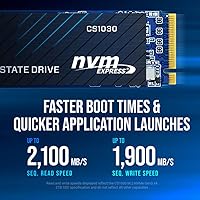
At its core, this NVMe drive moves data at up to 2,100 MB/s sequential read and 1,700 MB/s sequential write — numbers that sound abstract until you actually boot Windows in under ten seconds or watch a large file transfer finish in a fraction of the time a SATA drive would take. The M.2 2280 form factor means it slots directly into the vast majority of modern motherboards and laptop upgrade bays, no bracket or adapter needed. Power consumption is kept genuinely low, which translates to a tangible battery life improvement in laptops running everyday tasks. At 1TB, there is ample headroom for an OS installation, your core applications, and a healthy chunk of your media or game library.

Best For

The CS1030 1TB is a natural fit for anyone pulling a sluggish laptop back from the dead with an NVMe swap, or a student building their first desktop who wants solid performance without blowing the budget. Home office workers handling document editing, video calls, and browser-heavy workloads will notice a genuine day-to-day improvement. Budget-conscious gamers benefit too — load times drop noticeably compared to SATA, even if this drive won't match the raw throughput of a PCIe Gen4 option. Where it isn't the right call is for video editors or 3D artists pushing heavy sequential workloads regularly; those users would be better served by a higher-tier drive. For everyone else, it punches well above its weight class.

User Feedback

Across nearly 2,000 ratings, this M.2 upgrade holds a 4.7-star average — a score that reflects consistent real-world satisfaction rather than a spike of early reviews. Buyers frequently highlight the noticeable speed jump over their old SATA drives and how painless the physical installation is. The drive also sits at #177 in Internal SSDs on Amazon, which signals genuine sustained demand. On the critical side, a handful of users have raised questions about long-term endurance under heavy continuous write loads, and a few noted underwhelming packaging on arrival. Neither issue appears systemic, but if you plan to hammer the drive with sustained workloads day in, day out, it is worth factoring into your decision.

Pros

  • Boot times drop dramatically compared to SATA SSDs and hard drives — the difference is immediately noticeable.
  • Fits directly into M.2 2280 slots on most modern laptops and desktops without any adapter.
  • One of the better per-gigabyte NVMe values available at this price tier.
  • Five-year warranty with 24/7 US-based support is rare and reassuring at this price level.
  • Low power draw translates into real battery life gains on laptops during everyday tasks.
  • Installation is straightforward even for first-time builders or non-technical laptop upgraders.
  • The CS1030 1TB consistently delivers on its mainstream NVMe promise for typical daily workloads.
  • Nearly 2,000 verified buyer ratings averaging 4.7 stars reflects a broad and sustained user satisfaction.
  • Ranks #177 in Internal SSDs on Amazon, signaling genuine ongoing demand rather than a brief sales spike.

Cons

  • Sustained write speeds drop noticeably once the cache fills during large, prolonged file transfers.
  • No heatsink included, which can lead to thermal throttling inside compact, poorly ventilated laptops.
  • Packaging is minimal and a small number of buyers reported damage during shipping.
  • No mounting screw or installation hardware is included in the box.
  • Brand recognition lags behind Samsung and WD, which can make resale or trade-in less attractive.
  • The RMA and warranty claims process has been described as slower and more back-and-forth than expected.
  • Older M.2 slots that only support SATA signaling are incompatible, and the listing does not clearly warn buyers.
  • Random write IOPS under high queue depth lag behind higher-tier NVMe drives at only a slightly higher price.
  • A 2TB option in this same lineup is not consistently available at a competitive price point.

Ratings

The PNY CS1030 1TB M.2 NVMe SSD has been scored by our AI system after analyzing thousands of verified global buyer reviews, with spam, bot-submitted, and incentivized feedback actively filtered out. The scores below reflect both the genuine strengths and the honest shortcomings that real users encountered — nothing is glossed over. Whether this M.2 upgrade delivers on its budget-friendly promise is exactly what these ratings are designed to tell you.
Read & Write Performance
83%
For everyday computing tasks — booting Windows, launching browsers, loading games — users consistently reported a dramatic improvement over their previous SATA drives. The NVMe protocol keeps latency low, and that translates into a snappier, more responsive feel during normal use.
Sustained sequential write speeds under prolonged workloads show some drop-off once the SLC cache fills, which is typical at this tier but worth noting. Users moving large video libraries or doing frequent large-file transfers may find the performance less consistent than the peak specs suggest.
Value for Money
91%
At its price point, getting a genuine NVMe drive with 1TB of capacity and a five-year warranty is a compelling package. Students and budget builders repeatedly called it one of the best per-gigabyte deals they found without stepping down to a slower SATA option.
A small number of buyers noted that competing drives from brands like Kingston or Crucial occasionally match or undercut the price with comparable specs, so it pays to check the market before committing. The value proposition is strong but not always uncontested.
Installation Ease
94%
The M.2 2280 form factor slots directly into virtually every modern motherboard and laptop upgrade bay without needing brackets or adapters. First-time builders and laptop upgraders repeatedly praised how straightforward the physical swap was, even without technical experience.
A handful of users noted the drive ships without any installation guide or mounting screw, which caught a few beginners off guard. For most systems this is a non-issue, but those upgrading compact laptops should verify their chassis includes the necessary retention screw beforehand.
OS Boot & App Load Times
88%
Users coming from spinning hard drives or older SATA SSDs described the difference in boot times as immediately noticeable — cold boots finishing in under ten seconds was a commonly cited experience. Application launches, including heavier software like Adobe Reader and game launchers, also felt considerably faster.
The improvement over a high-end SATA SSD is real but more modest than marketing figures imply for typical workloads. Users with already-fast SATA drives may notice a smaller subjective difference in daily use compared to those upgrading from a mechanical hard drive.
Build & Reliability
79%
21%
The drive has maintained a strong reputation for day-to-day reliability in the years since its 2020 launch, with the large number of verified buyers reporting no failures during normal desktop and laptop use. PNY's five-year warranty provides meaningful peace of mind that many competing budget drives do not offer.
A recurring concern among more technically minded users involves long-term endurance under sustained write-heavy workloads, such as continuous large file transfers or frequent drive cloning. While failures are not common, the drive is clearly optimized for typical consumer use rather than near-server-level write demand.
Thermal Management
67%
33%
Under everyday workloads — web browsing, office applications, gaming sessions — the CS1030 1TB runs at comfortable temperatures without throttling. Users in well-ventilated desktop builds rarely reported any heat-related issues during standard use.
In compact laptops with restricted airflow, a small but consistent group of users observed performance throttling during prolonged intensive tasks. The drive lacks a heatsink, and in thermally constrained environments this can become a noticeable limitation over extended sessions.
Power Efficiency
82%
18%
Laptop users specifically highlighted improved battery endurance after swapping out older SATA drives or HDDs. The low idle power draw is a practical benefit for students and remote workers who rely on unplugged use throughout the day.
The efficiency gains are modest compared to newer, more advanced NVMe controllers designed with power optimization as a primary focus. Users with ultra-thin laptops where every milliwatt counts may not see the dramatic battery gains that the spec sheet implies.
Compatibility
89%
The standard M.2 2280 footprint means this drive works across a huge range of systems — from budget AMD builds to mainstream Intel laptops — without any modification. Users reported successful installations in a wide variety of laptop brands and desktop motherboards from multiple generations.
A small number of older systems with M.2 slots that only support SATA signaling — not NVMe — are incompatible, and a few buyers discovered this only after purchase. Verifying your motherboard or laptop supports NVMe over M.2 before buying is an important step that the product listing does not prominently flag.
Packaging & Unboxing
61%
39%
The drive itself arrives intact in the vast majority of cases, and buyers focused purely on the hardware rarely had complaints about the product condition on arrival.
Packaging is minimal and utilitarian, which drew criticism from buyers who expected more protective presentation at this price. Shipping damage complaints — dented boxes, loosely packed drives — appear more frequently here than with some competing brands, though actual drive damage remained uncommon.
Random Read/Write (IOPS)
74%
26%
For typical consumer tasks involving small random file access — loading game assets, reading system files, opening documents — the drive performs competently and well above any SATA alternative. Users doing light multitasking reported a fluid, responsive experience.
Random write performance under queue depth stress is where budget Gen3 drives like this one show their limits compared to higher-end NVMe options. Power users running virtual machines or database applications locally will find this a bottleneck over time.
Warranty & Support
86%
A five-year limited warranty with access to 24/7 US-based technical support is a genuinely competitive offering at this price tier, and buyers noted that PNY's support team was responsive when contacted. The warranty length compares favorably to several rival budget brands that cap coverage at three years.
Some users reported that the RMA process, while ultimately resolved, involved more back-and-forth communication than expected. The warranty is a meaningful safety net, but the claims process is not as frictionless as the support availability implies.
Gaming Performance
81%
19%
Gamers upgrading from HDDs or older SATA SSDs saw a real reduction in level load times across popular titles. For a budget gaming build, this NVMe drive delivers a tangible quality-of-life improvement without requiring a premium-tier investment.
Against PCIe Gen4 drives now available at similar or only slightly higher prices, the gap in game load times has narrowed enough that performance-focused gamers should weigh whether the extra spend is worth it. The drive is capable, but it is no longer the only budget-friendly option in its performance class.
Capacity Adequacy
87%
At 1TB, the drive comfortably handles a full Windows installation, a suite of productivity applications, and a reasonable game library simultaneously. Users setting this up as a primary drive for a laptop or mid-range desktop found it adequately roomy for their everyday needs.
Heavy media collectors and users with large Steam libraries found 1TB tighter than expected once the OS overhead and a few AAA game installs are factored in. For those users, the absence of a 2TB variant at a competitive price in this same lineup is a minor frustration.
Brand Reputation & Trust
77%
23%
PNY has been a consistent player in the consumer storage market for years, and buyers who had previous positive experiences with PNY USB drives or memory cards felt comfortable extending that trust to this drive. The brand's longevity adds a layer of confidence that newer no-name alternatives cannot offer.
PNY simply does not carry the same enthusiast-community recognition as Samsung or WD, which makes some buyers hesitant despite the comparable specs and warranty. This perception gap occasionally pushes fence-sitters toward better-known brands even when the technical case for this drive is sound.

Suitable for:

The PNY CS1030 1TB M.2 NVMe SSD was built for the kind of buyer who wants a meaningful, tangible upgrade without spending more than the situation demands. If you are a student dropping this into an aging laptop that still crawls through boot-up every morning, or a home office worker who wants snappier application response without commissioning a full system rebuild, this drive addresses both scenarios well. Budget-conscious DIY builders putting together a capable mid-range desktop will find it a reliable, no-fuss boot drive that keeps the overall build cost in check. Casual gamers upgrading from a hard drive or an older SATA SSD will notice real reductions in load times across most titles without needing to pay for PCIe Gen4 speeds they would barely exploit. The 1TB capacity also makes it practical as a single primary drive for most everyday users — there is enough room for the operating system, standard applications, and a rotating game library without constantly managing storage.
Not suitable for:

The PNY CS1030 1TB M.2 NVMe SSD is not the right call for users whose workflows genuinely stress storage hardware. Video editors regularly moving large raw footage files, photographers batch-processing high-resolution RAW images, or 3D artists working with dense asset libraries will likely hit the ceiling of what this drive can sustain under continuous heavy write loads. The SLC cache helps with short bursts, but prolonged sequential write sessions expose the drive's budget-tier controller roots. Similarly, if your motherboard only supports PCIe Gen4 and you plan to exploit that bandwidth, spending the modest premium on a Gen4 drive is the smarter long-term decision. Power users running local virtual machines, development environments with heavy disk I/O, or any near-professional workload would be better served by stepping up to a higher-endurance, higher-sustained-throughput option from the same or competing brands.

Specifications

  • Brand: Manufactured by PNY Technologies, a US-based company with a long history in consumer memory and storage products.
  • Model: The official model number is M280CS1030-1TB-RB, belonging to the CS1030 series of mainstream NVMe drives.
  • Capacity: Offers 1TB of usable flash storage, suitable for a primary OS drive alongside a substantial application and media library.
  • Form Factor: Uses the M.2 2280 form factor, measuring 3.15 x 0.87 x 0.16 inches, which fits the vast majority of modern laptop and desktop M.2 slots.
  • Interface: Connects via PCIe Gen3 x4 using the NVMe protocol, delivering significantly lower latency than any SATA-based storage solution.
  • Sequential Read: Rated for sequential read speeds of up to 2,100 MB/s under optimal conditions.
  • Sequential Write: Rated for sequential write speeds of up to 1,700 MB/s under optimal conditions.
  • Weight: Weighs just 0.352 ounces, making it one of the lightest internal storage upgrades available for portable systems.
  • Compatibility: Compatible with PCs and laptops that feature an M.2 slot with NVMe (PCIe) support; not compatible with M.2 slots limited to SATA signaling only.
  • Installation: Designed for internal installation and connects directly to the M.2 slot on the motherboard without requiring cables or adapters.
  • Power Draw: Engineered for low power consumption during both active use and idle states, which contributes to improved battery life in laptop applications.
  • Warranty: Backed by a 5-year limited warranty, which is above average for drives in the mainstream budget NVMe category.
  • Support: PNY provides 24/7 US-based technical support for warranty claims and installation assistance.
  • Color: The drive is black in color, consistent with standard M.2 SSD aesthetics for internal installation.
  • Release Date: First made available in October 2020, and has remained an active, non-discontinued product in PNY's lineup since launch.
  • Flash Type: Uses NAND flash memory with an SLC write cache layer to handle burst write workloads at higher speeds before falling back to native write rates.
  • OS Support: Compatible with Windows 10 and later versions, as well as Linux distributions that support NVMe block devices natively.
  • Heatsink: Ships without an integrated heatsink; users in thermally constrained builds may want to add a thin thermal pad for sustained workloads.

Related Reviews
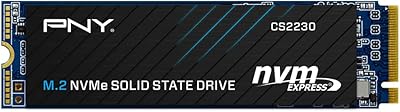
PNY CS2230 1TB M.2 NVMe SSD
82%
83%
Read & Write Performance
91%
Value for Money
94%
Installation Ease
86%
Boot & Load Times
78%
Build Quality & Reliability
More
PNY CS1030 2TB M.2 NVMe SSD
88%
92%
Performance Speed
88%
Ease of Installation
90%
Reliability
89%
Value for Money
85%
Power Efficiency
More
PNY CS1030 M.2 NVMe SSD 500GB
86%
89%
Performance
92%
Value for Money
84%
Installation Process
90%
Boot Time Improvement
87%
File Transfer Speed
More
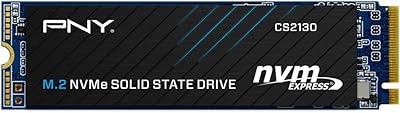
PNY CS2130 1TB M.2 PCIe NVMe SSD
87%
91%
Performance in Gaming
89%
File Transfer Speed
94%
Setup & Installation
68%
Thermal Management
85%
Build Quality & Durability
More
PNY CS2241 1TB M.2 NVMe Gen4 SSD
88%
94%
Performance
92%
Speed & Responsiveness
89%
Compatibility with Modern Systems
88%
Ease of Installation
91%
Reliability & Durability
More
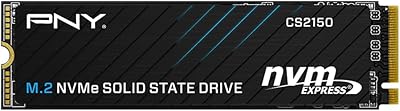
PNY CS2150 1TB Gen5 NVMe SSD
82%
93%
Sequential Read Speed
87%
Sequential Write Speed
62%
Thermal Management
88%
Gaming Performance
71%
Platform Compatibility
More
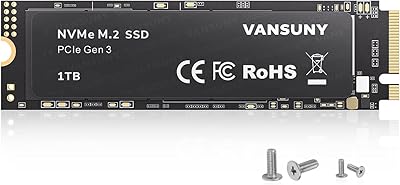
Vansuny 1TB NVMe M.2 SSD
87%
94%
Performance (Speed)
88%
Reliability
72%
Compatibility
91%
Value for Money
85%
Build Quality
More
GAMERKING 1TB M.2 NVMe SSD
87%
89%
Performance
92%
Speed (Read/Write)
80%
Durability (MTTF)
91%
Compatibility
94%
Ease of Installation
More
SanDisk Extreme M.2 1TB NVMe SSD
79%
88%
Read Performance
71%
Write Performance
94%
Installation Ease
86%
Value for Money
62%
Thermal Management
More
INLAND TN320 1TB NVMe M.2 SSD
87%
92%
Value for Money
88%
Performance Speed
94%
Ease of Installation
85%
Durability and Endurance
90%
Compatibility
More

FAQ

You need to confirm two things: that your system has an M.2 slot, and that the slot supports NVMe (PCIe) rather than SATA-only signaling. Most laptops and motherboards made after 2017 support NVMe, but a quick check of your system's manual or the manufacturer's spec page will confirm it. If your M.2 slot only supports SATA, this drive will not work in it.

For everyday tasks like booting Windows, opening applications, and general file access, you will notice a real improvement — especially in system responsiveness and boot times. That said, if you are already on a modern SATA SSD, the jump will be meaningful but not as dramatic as upgrading from a hard drive. The biggest gains come from the lower latency of the NVMe protocol, which makes the whole system feel more immediate.

At the price gap between NVMe and SATA options today, this drive makes a strong case for itself. You get lower latency, faster burst performance, and a drive that will remain relevant longer as software continues to take advantage of faster storage. Unless your system physically cannot support NVMe, it is hard to justify going the SATA route in a new build or upgrade right now.

Modestly, yes. The drive is designed with low power consumption in mind, and its idle power draw is lower than most SATA drives and essentially all spinning hard drives. In real-world laptop use, the difference is subtle rather than dramatic, but it is a genuine benefit alongside the speed improvements.

Absolutely. While many users install it as their primary OS drive for the speed benefits, it works perfectly well as a secondary storage drive for games, media, or project files. As long as your system has a second M.2 slot available, the setup is straightforward.

No — the drive ships without a retention screw or any additional hardware. For most desktop motherboards this is not a problem since many boards include a screw pre-installed at the M.2 slot. Laptop upgraders should check whether their chassis has the necessary M.2 retention screw before starting the swap, as it is easy to overlook.

Yes, noticeably so compared to SATA SSDs and dramatically so versus hard drives. Open-world games with large streaming assets see some of the biggest improvements. It will not close the gap entirely with a high-end PCIe Gen4 drive, but for most game titles the difference between this and a Gen4 option is marginal in practice.

It depends on the scale of your work. For occasional editing of 1080p or light 4K footage, the CS1030 1TB handles it without issue. If you are regularly moving large RAW video files, working with 4K or 6K multi-stream timelines, or doing continuous long renders, the sustained write speed can drop once the drive's cache is saturated. For heavy professional video workflows, a higher-endurance NVMe option would be a more reliable choice.

PNY covers the drive with a 5-year limited warranty and offers 24/7 US-based technical support, which is a strong offering at this price tier. The process involves contacting PNY support, verifying the failure, and initiating an RMA. Some users have noted the process involves a few back-and-forth steps, so keep your purchase receipt and model information handy to speed things along.

In a well-ventilated laptop or desktop, thermal throttling is rarely an issue during normal use. In very compact ultrabooks with restricted airflow — particularly during sustained read/write operations — temperatures can climb enough to trigger throttling. The drive does not include a heatsink. If you are installing it into a thin-and-light laptop and plan to push it with sustained workloads, a thin M.2 thermal pad is an inexpensive precaution worth considering.

Where to Buy

Newegg.com
In stock $189.99
PayMore West Valley
In stock $149.99
Grooves-Inc.com
In stock $161.06
MemoryC.com
In stock $206.43