Overview

The PNY CS2150 1TB Gen5 NVMe SSD arrived in late December 2024 as PNY's push into the competitive fifth-generation storage market. PCIe Gen5 is the current peak of consumer NVMe bandwidth, and boards supporting it — primarily Intel 13th/14th Gen and AMD Ryzen 7000 platforms — are now common enough that the upgrade makes practical sense for a growing number of builders. Early buyer ratings sit at 4.7 stars across roughly 126 reviews, which is a promising start, though the sample size remains modest. If you're on an older platform, this Gen5 drive won't unlock its potential; for those with the right hardware, however, the performance headroom is genuinely there.

Features & Benefits

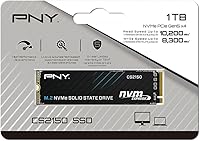
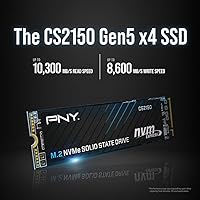
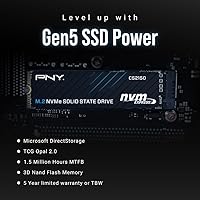
The CS2150 reaches sequential read speeds of up to 10,200 MB/s and write speeds of up to 8,300 MB/s over a PCIe Gen5 x4 interface — figures that translate to noticeably faster large-file transfers and snappier application loading in real use. The standard M.2 2280 form factor means installation is straightforward on any compatible desktop or laptop slot. For users handling sensitive data, TCG Opal 2.0 encryption operates at the hardware level, so there is no performance penalty compared to software-based alternatives. DirectStorage support lets compatible games stream assets directly to the GPU, cutting stutter during asset-heavy open-world traversal. A five-year warranty with a defined TBW rating and round-the-clock US-based support rounds out the package.

Best For

This Gen5 drive makes the most sense for builders already on a Gen5-compatible platform — Intel 13th or 14th Gen or AMD Ryzen 7000 — who want to actually reach that bandwidth ceiling. Gamers running DirectStorage-enabled titles will notice real reductions in load times and smoother asset streaming, particularly in expansive open-world environments. Video editors and photographers working with large RAW files or 4K and 6K multi-stream timelines will value the extra headroom during sustained read and write cycles. It also suits anyone running local AI models, where consistent high-bandwidth access to large model files makes a practical difference. Data-conscious users gain hardware-level encryption without any additional configuration overhead.

User Feedback

Across the roughly 126 ratings collected since launch, the CS2150 holds a solid 4.7-star average — encouraging for a drive this new, though the review pool is still limited enough to treat the score as directional rather than definitive. Most positive buyers highlight benchmark results that closely match advertised figures, along with a clean and fast installation experience. A common practical concern is thermal output: Gen5 drives run warmer than earlier generations, and several reviewers strongly suggest pairing the drive with a motherboard heatsink to prevent throttling under sustained loads. A few buyers note that extended write workloads can push speeds below peak figures, which is typical behavior for 3D NAND at this class. Warranty and support interactions are generally spoken of positively.

Pros

  • Sequential read speeds reaching 10,200 MB/s make large file transfers noticeably faster in real workloads.
  • DirectStorage support meaningfully cuts asset load times in compatible games, reducing in-game stutter.
  • Hardware-level TCG Opal 2.0 encryption secures sensitive data without any measurable speed trade-off.
  • The standard M.2 2280 form factor installs cleanly in virtually any compatible desktop or laptop slot.
  • Early buyers report benchmark results that closely align with advertised speed figures.
  • A five-year warranty with a defined TBW rating gives strong long-term confidence for the price tier.
  • 24/7 US-based technical support is a meaningful differentiator compared to many competing drives.
  • The CS2150 handles sustained high-bandwidth reads well, which matters for local AI model loading.
  • Released in late 2024, this NVMe SSD is positioned on current-generation technology rather than aging silicon.
  • Installation is straightforward, and early reviewers consistently describe the setup process as fast and uncomplicated.

Cons

  • Gen5 speeds are completely inaccessible on older platforms — compatibility is a hard requirement, not a suggestion.
  • The drive can run hot under sustained load, and a motherboard heatsink is strongly advisable rather than optional.
  • Sustained write speeds can dip below peak figures over extended write sessions, which is worth knowing for heavy workloads.
  • At 1TB, the capacity may feel limiting for users who store large game libraries or lengthy video project files locally.
  • The review pool of roughly 126 ratings is still small enough that long-term reliability data remains limited.
  • Buyers without a Gen5-capable slot are effectively paying for performance they will never unlock.
  • No heatsink is included in the box, adding a potential extra cost or compatibility consideration for some builds.
  • Users on tight budgets may find that a well-regarded Gen4 drive delivers 90% of practical performance at a lower price point.

Ratings

The PNY CS2150 1TB Gen5 NVMe SSD has been scored by our AI system after analyzing verified global buyer reviews, with spam, bot activity, and incentivized feedback actively filtered out to ensure the results reflect genuine user experience. Scores cover everything from raw speed performance to thermal behavior and long-term value, giving a transparent look at both where this Gen5 drive excels and where real buyers have run into friction. The overall picture is strongly positive for the right user, but a few practical caveats are worth understanding before buying.
Sequential Read Speed
93%
Buyers running benchmarks consistently report hitting figures very close to the advertised 10,200 MB/s ceiling, which is unusually honest for storage marketing. For tasks like loading large video project files or transferring RAW photo libraries, this translates into noticeably shorter wait times compared to Gen4 alternatives.
These peak figures are only achievable on a motherboard with a native PCIe Gen5 M.2 slot, which limits the audience considerably. Users who installed the CS2150 on a Gen4 board reported speeds capped at that interface limit, meaning the drive's headline number never materialized for them.
Sequential Write Speed
87%
Sustained write performance holds up well during moderate workloads like exporting edited video or moving large game install folders, with speeds that stay competitive within the Gen5 tier. Reviewers doing 4K timeline renders noted a clear improvement over their previous Gen4 drives in total export time.
During very long continuous writes — think full-drive transfers or repeated large backup operations — the drive's cache eventually saturates and speeds step down meaningfully below the rated 8,300 MB/s. This is a known behavior for 3D NAND drives at this class, but buyers expecting flat sustained performance throughout should calibrate expectations.
Thermal Management
62%
38%
Under light to moderate daily use, the CS2150 stays within manageable temperature ranges, and users with motherboards that include a good M.2 heatsink cover reported no throttling during standard workloads like game loading or file transfers.
Multiple reviewers flagged noticeable heat buildup during sustained high-bandwidth tasks when no heatsink was installed, with some reporting thermal throttling that cut real-world speeds substantially. For a drive in this performance class, not including even a basic heatsink in the box feels like a meaningful omission.
Gaming Performance
88%
In DirectStorage-enabled titles, buyers reported a tangible reduction in texture pop-in and asset loading delays compared to Gen4 drives, particularly in open-world games with large streaming assets. Even in non-DirectStorage games, level load times improved enough for users to notice the difference in a side-by-side switch.
For competitive or older titles that do not leverage DirectStorage, the practical improvement over a well-performing Gen4 NVMe drive is modest at best. Gamers on a tight budget may find the Gen5 premium hard to justify unless their library skews toward newer, asset-heavy open-world games.
Platform Compatibility
71%
29%
The standard M.2 2280 form factor means physical installation is compatible with nearly any modern desktop or laptop M.2 slot, and several reviewers praised the straightforward plug-in installation process requiring no special tools or adapters.
True Gen5 bandwidth is gated behind a relatively narrow set of compatible platforms, and this is where buyers have run into trouble — those on older systems or budget motherboards cannot access the speeds they paid for. The drive works as a functional NVMe SSD on older platforms, but that is a significant overpay for the performance delivered.
Value for Money
79%
21%
Positioned in the accessible mid-range of the Gen5 market, the CS2150 offers competitive flagship-tier speeds without the premium pricing of some rival Gen5 options, which buyers explicitly called out as a deciding factor in their purchase. For users on a Gen5 platform, the cost-per-gigabyte ratio is reasonable relative to what you get.
For anyone not on a fully Gen5-capable system, the value equation falls apart quickly since the performance advantage evaporates. Buyers who later realized their board only supported Gen4 expressed regret, feeling they had paid for a feature set their hardware could not use.
Installation Experience
91%
Reviewers across skill levels described installation as fast and uncomplicated, with the standard M.2 form factor slotting cleanly into motherboard slots without any compatibility issues on supported platforms. First-time builders specifically appreciated that no drivers or additional software were required to get the drive recognized and running.
The absence of any installation guide or quick-start documentation in the box was a minor frustration for a small number of less experienced buyers. While the process is genuinely simple, including a brief reference card would have cost very little and helped new builders feel more confident.
Data Security
88%
TCG Opal 2.0 hardware encryption was a meaningful selling point for reviewers who handle sensitive client data or work in professional environments where drive security is non-negotiable. The fact that encryption runs at the hardware level means there is no CPU overhead and no software to manage day-to-day.
Activating Opal 2.0 requires compatible encryption management software and some familiarity with BIOS security settings, which is not intuitive for average users. A small number of reviewers were unaware the feature existed or did not know how to enable it, meaning they bought a security capability they never used.
AI Workload Readiness
83%
Users running local large language models and image generation pipelines noted genuine improvements in model load times compared to Gen4 drives, particularly when repeatedly loading multi-gigabyte model weights during iterative testing sessions. The high sequential read bandwidth directly benefits this use case in a measurable way.
AI workloads involving smaller, frequently accessed model files benefit less from raw sequential speed and more from random read performance, which is less prominently specified for this drive. Buyers with mixed AI and general workflows may not see consistent gains across every task.
Build & Form Factor
85%
At just 0.352 ounces, the CS2150 is essentially weightless in a build, and its standard dimensions mean it fits without issue in both full-size desktop builds and slim laptop upgrade bays. Reviewers noted the drive felt solid and well-constructed for its size class.
As a bare M.2 module, there is no visual feedback of any kind during operation — no activity LED, no status indicator — which is purely cosmetic but occasionally mentioned by buyers who like to visually confirm a drive is active. For a NVMe SSD this is entirely standard, but worth noting.
Warranty & Support
86%
The five-year limited warranty backed by a defined TBW endurance rating gave buyers meaningful long-term confidence, particularly compared to competing drives that offer shorter coverage periods. Several reviewers specifically mentioned that US-based 24/7 support was a deciding factor, having been frustrated by overseas-only support options on other brands.
The specific TBW figure is not prominently surfaced in retail listings, requiring buyers to dig into documentation to understand the endurance ceiling. A small number of users also reported longer-than-expected response times when contacting support during peak periods, though the quality of assistance when reached was generally praised.
Real-World vs. Advertised Speeds
77%
23%
Under typical mixed workloads — gaming, browsing, file management — the CS2150 behaves consistently and responsively, with benchmark scores from early buyers lining up closely with advertised sequential figures in short-burst tests. This alignment between marketing and reality is something buyers genuinely appreciated.
Sustained workloads that push writes beyond the drive cache reveal a gap between peak and average throughput that is not clearly communicated in the product listing. A subset of reviewers felt the sustained write performance was undersold relative to the headline numbers, which set expectations that did not fully hold under heavy continuous use.
Long-Term Reliability
73%
27%
As a newer 3D NAND drive from an established brand with a five-year warranty and TBW rating, the foundational indicators for longevity are in place. Early buyers have not reported failures or degradation over the months since the December 2024 launch.
With fewer than 130 reviews collected over a short post-launch window, there simply is not enough long-term field data to draw confident conclusions about multi-year endurance. Buyers placing high importance on proven long-term reliability may prefer waiting for a larger real-world data pool before committing.

Suitable for:

The PNY CS2150 1TB Gen5 NVMe SSD is purpose-built for users who already own a Gen5-capable motherboard and want to fully leverage that investment. PC builders on Intel 13th or 14th Gen or AMD Ryzen 7000 platforms will get the most out of the raw bandwidth this drive offers. Gamers running DirectStorage-enabled titles stand to benefit noticeably, with faster asset streaming reducing the stutters that plague slower drives in large open-world games. Creative professionals who regularly move large RAW image batches or cut multi-stream 4K and 6K video will appreciate how sustained read and write performance holds up under real workloads. It is also a strong match for anyone running local AI inference, where repeatedly loading multi-gigabyte model files is the norm rather than the exception. Users with data security requirements get hardware-level encryption at no performance cost, which is a practical advantage over software-based alternatives.
Not suitable for:

The PNY CS2150 1TB Gen5 NVMe SSD is simply the wrong tool if your motherboard does not support PCIe Gen5 — you will pay a premium for speeds your system physically cannot deliver, and a quality Gen4 drive will serve you better at a lower cost. Casual PC users who primarily browse the web, stream video, or run office applications will not notice any difference between this and a mid-range Gen4 option in day-to-day tasks. Users on older Intel or AMD platforms, or those with budget B-series motherboards that lack Gen5 slots, should look elsewhere. Anyone sensitive to thermals in a compact or poorly ventilated case should also pause: this class of drive can run hot under load, and without an adequate heatsink, throttling is a real risk. Finally, buyers who need more than 1TB of fast storage for a single volume may find themselves needing an additional drive, since this capacity tier fills up quickly for heavy creative or AI workloads.

Specifications

  • Brand: Manufactured by PNY, a storage and memory brand with over three decades of consumer and professional hardware experience.
  • Series: Part of the CS2150 lineup, PNY's dedicated PCIe Gen5 NVMe product family released in late 2024.
  • Capacity: Available in this configuration at 1TB of usable NAND flash storage.
  • Interface: Uses a PCIe Gen5 x4 NVMe interface, the current top tier of consumer M.2 connectivity.
  • Form Factor: Standard M.2 2280 dimensions, meaning it is 22mm wide and 80mm long, compatible with the vast majority of modern desktop and laptop M.2 slots.
  • Sequential Read: Rated for sequential read performance of up to 10,200 MB/s under optimal conditions.
  • Sequential Write: Rated for sequential write performance of up to 8,300 MB/s under optimal conditions.
  • NAND Type: Built on 3D NAND flash memory, which stacks memory cells vertically to improve density and endurance compared to planar designs.
  • Encryption: Supports TCG Opal 2.0 hardware-based encryption, enabling drive-level data protection without relying on the host CPU.
  • DirectStorage: Fully compatible with Microsoft DirectStorage, allowing supported games to stream assets directly to the GPU, bypassing traditional CPU bottlenecks.
  • Platform Support: Compatible with PCIe Gen5-enabled desktops and laptops, including systems built on Intel 13th and 14th Gen and AMD Ryzen 7000 series platforms.
  • Installation: Internal installation type, inserted directly into an M.2 slot on a compatible motherboard without additional cables or adapters.
  • Weight: The drive weighs 0.352 ounces, making it one of the lightest storage upgrade options available for portable and desktop systems alike.
  • Warranty: Covered by a 5-year limited warranty with an endurance rating expressed as a defined TBW (terabytes written) value.
  • Support: PNY offers 24/7 technical support staffed by US-based agents for warranty and troubleshooting inquiries.
  • Release Date: First made available to consumers on December 27, 2024, positioning it as a current-generation product on the latest NVMe standard.

Related Reviews
PNY CS2150 2TB Gen5 PCIe NVMe M.2 SSD
89%
94%
Performance
96%
Speed
88%
Build Quality
91%
Ease of Installation
90%
Compatibility
More
Crucial P510 1TB Gen5 NVMe SSD
84%
93%
Raw Read & Write Performance
91%
Value for Money
61%
Thermal Management
94%
Installation & Compatibility
88%
Reliability & Endurance
More
PNY CS2230 1TB M.2 NVMe SSD
82%
83%
Read & Write Performance
91%
Value for Money
94%
Installation Ease
86%
Boot & Load Times
78%
Build Quality & Reliability
More
PNY CS1030 1TB M.2 NVMe SSD
81%
83%
Read & Write Performance
91%
Value for Money
94%
Installation Ease
88%
OS Boot & App Load Times
79%
Build & Reliability
More
PNY CS2241 1TB M.2 NVMe Gen4 SSD
88%
94%
Performance
92%
Speed & Responsiveness
89%
Compatibility with Modern Systems
88%
Ease of Installation
91%
Reliability & Durability
More
PNY CS2130 1TB M.2 PCIe NVMe SSD
87%
91%
Performance in Gaming
89%
File Transfer Speed
94%
Setup & Installation
68%
Thermal Management
85%
Build Quality & Durability
More
Crucial T700 1TB Gen5 NVMe M.2 SSD
89%
96%
Performance
94%
Speed (Read/Write)
92%
Gaming Performance
90%
Compatibility
80%
Thermal Management
More
Corsair MP700 PRO 1TB NVMe SSD
76%
94%
Raw Read Performance
88%
Write Performance
61%
Thermal Management
69%
Value for Money
91%
Installation & Setup
More
RONGSHU 1TB NVMe SSD
87%
91%
Performance
94%
Read Speed
89%
Write Speed
88%
Installation Ease
75%
Thermal Management
More
TEAMGROUP MP44L 1TB NVMe SSD
89%
94%
Performance
96%
Speed (Read/Write)
85%
Heat Management
91%
Installation Ease
92%
Compatibility
More

FAQ

You need a motherboard with a PCIe Gen5 M.2 slot to unlock the full performance of this drive. Intel 13th and 14th Gen and AMD Ryzen 7000 platforms are the primary compatible options. If your board only has Gen4 or Gen3 slots, the CS2150 will still function but will be throttled to the slot's maximum bandwidth, which means you would be paying for speeds you cannot actually use.

Gen5 drives as a category run noticeably warmer than their Gen4 predecessors, and the CS2150 is no exception. Using your motherboard's built-in M.2 heatsink is strongly recommended, especially under sustained workloads like large file transfers or video exports. Without thermal management, the drive may throttle to protect itself, which will reduce real-world speeds.

It is a strong pick for gamers on a Gen5 platform, particularly for titles that support Microsoft DirectStorage. Those games stream texture and asset data directly to the GPU, and a fast drive reduces the time spent waiting for that data to load. For standard non-DirectStorage games, the difference over a good Gen4 drive will be marginal in practice.

Like most high-performance 3D NAND drives, the CS2150 hits its peak write figures during shorter bursts but can step down during extended, sustained writes once the drive's cache is saturated. For typical home and office workloads this is rarely noticeable, but users doing very large single-session transfers should expect average write speeds to settle below the rated 8,300 MB/s ceiling.

No, the drive ships as a bare M.2 module without a heatsink. Most mid-range and higher motherboards include an M.2 heatsink cover, and using that is the easiest solution. If your board lacks one, third-party M.2 heatsinks are widely available and inexpensive.

Absolutely. The CS2150 works equally well as a secondary drive for game libraries, video project files, or AI model storage. You are not required to use it as your primary OS drive, and in many workflows storing large working files on a fast secondary drive is a common and practical setup.

It means the drive can encrypt all data stored on it using hardware-level processing rather than relying on your CPU to handle encryption in software. In practice, you enable it through compatible encryption management software or your system BIOS. The main advantage is that there is no performance hit, and the data on the drive is protected even if the physical drive is removed from your system.

The five-year limited warranty means PNY will cover manufacturing defects for up to five years from purchase. TBW, or terabytes written, is a separate endurance metric indicating the total amount of data you can write to the drive over its lifetime before the NAND is considered worn. Hitting the TBW limit does not automatically mean the drive stops working, but it does affect warranty eligibility in some cases.

It depends heavily on your habits. For a dedicated fast drive used alongside a larger secondary storage drive, 1TB is workable for most users. However, if you plan to store your full game library, large RAW photo archives, and video project files all on this single volume, you may find it fills up faster than expected. Many users pair a 1TB Gen5 drive with a larger, cheaper Gen4 drive for bulk storage.

Early buyer feedback suggests it benchmarks competitively within the Gen5 tier, with speeds that closely match advertised figures. It sits in an accessible price range for this class of drive, which makes it an attractive option compared to premium Gen5 alternatives that carry a significantly higher cost. As a newer release with a relatively small review pool so far, longer-term reliability comparisons with established competitors are still developing.

Where to Buy

Newegg.com
In stock $249.99
B&H Photo-Video-Audio
In stock $249.99
Beach Audio
In stock $285.18