Overview

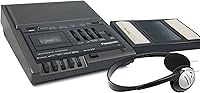
The Panasonic RR930 Microcassette Transcriber Recorder is a dedicated desktop unit built for professionals who live and die by accurate, efficient transcription — think medical offices, legal firms, and busy administrative environments. Panasonic has since discontinued it, but that has not stopped this transcriber from holding steady in active workflows across the country. Analog transcription is not going away quietly; many facilities run on legacy systems where switching to digital would mean overhauling infrastructure, retraining staff, and spending considerably more. For those environments, the RR930 remains a practical, proven option that does exactly what it promises without unnecessary complexity.
Features & Benefits

The feature working transcriptionists tend to appreciate most is the variable tape-speed control. When a physician dictates quickly or a deposition recording has audio inconsistencies, being able to slow playback without turning voices into a garbled mess is genuinely useful — not just a checkbox spec. The three-digit counter is quietly indispensable too; it lets you mark a spot and return to it precisely, saving real time across a long document. The included foot controller is the other standout — hands stay on the keyboard where they belong. A built-in condenser mic handles direct recording, and the 3.5mm headphone jack works with most standard headsets, including the one bundled in the box.

Best For

This microcassette unit makes the most sense for professionals already embedded in analog transcription workflows — people who are not switching systems anytime soon and just need a reliable workhorse. Medical transcriptionists dealing with physician dictation, legal assistants working through deposition recordings, and solo practitioners running lean offices are all natural fits. It also serves organizations that need a dependable backup unit when primary equipment goes down mid-project. If you are inheriting an existing microcassette setup or simply replacing an older machine in the same ecosystem, the transition here is minimal. This is not for someone testing the waters for the first time — it is for people who know exactly what they need.

User Feedback

With a 3.7-star average across 130 ratings, the RR930 draws genuinely mixed reactions — and the reasons are worth unpacking. Buyers who received new units consistently highlight the foot pedal responsiveness and speed adjustment as features that meaningfully improve daily output. The complaints tell a different story: sourcing replacement parts for a discontinued machine is frustrating, and some reviewers note that build quality shows wear after years of intensive use. A notable pattern in the lower ratings involves used or refurbished units sold through third-party sellers, which skews the overall picture. Professionals coming from older Panasonic transcribers adapt quickly. Realistic expectations matter here — this is mature analog hardware, not a product with a full warranty ecosystem behind it.

Pros

  • Variable speed playback lets you slow down fast or unclear audio without distorting the speaker voice.
  • The foot controller keeps both hands free for typing, which meaningfully speeds up transcription output.
  • Three-digit tape counter makes it easy to mark and return to specific points in long recordings.
  • Comes ready to work out of the box with both a headset and foot pedal included.
  • Built-in condenser mic handles direct dictation recording without any additional equipment needed.
  • Standard microcassette tape compatibility means media is easy to source from multiple suppliers.
  • Professionals upgrading from older Panasonic models report virtually no adjustment period.
  • At 4.25 pounds with a compact footprint, it sits comfortably on a crowded desk without dominating the workspace.
  • Widely regarded as a solid analog workhorse among medical and legal transcription professionals.

Cons

  • Discontinued by the manufacturer, meaning no official repairs, parts, or warranty support are available.
  • No digital output or computer connectivity of any kind — recordings stay analog throughout.
  • Replacement parts are increasingly scarce, which creates real risk for long-term heavy users.
  • Some units available on the market are used or refurbished, which affects reliability unpredictably.
  • The fixed desktop design offers zero portability for transcriptionists who work across multiple locations.
  • No USB, Bluetooth, or any modern interface makes integration with current office software impossible.
  • Build quality on heavily used units has shown wear over time according to a portion of long-term owners.
  • At this price tier, the lack of any active support network is a harder pill to swallow than it would be on a budget device.

Ratings

The scores below for the Panasonic RR930 Microcassette Transcriber Recorder were generated by our AI engine after systematically analyzing verified buyer reviews from multiple global sources, with spam, bot activity, and incentivized feedback actively filtered out. Both the genuine strengths that keep this unit in active professional use and the real frustrations buyers have encountered are transparently reflected in every score. No category has been softened or inflated — what you see is an honest composite of what working transcriptionists have reported in practice.

Transcription Performance
83%
Professionals consistently praise the unit for delivering clean, reliable playback that holds up through long transcription sessions. The ability to slow tape speed without significant audio degradation is particularly valued when working with fast dictators or recordings made in less-than-ideal acoustic conditions.
A small subset of users noted that older or worn tapes can introduce occasional playback artifacts that the unit cannot compensate for. Performance is ultimately bounded by the quality and condition of the microcassette media being used.
Variable Speed Control
88%
This feature draws consistent, specific praise from medical and legal transcriptionists who deal with rapid or accented speech daily. Slowing playback without turning voices into distorted audio is not a given on analog machines, and the RR930 handles it better than many competing units at similar price points.
The speed adjustment range, while functional, is not infinitely granular — some users working with very fast dictation wished for a slightly wider slow-down range. It handles most real-world scenarios well but has a ceiling that dedicated heavy users occasionally bump against.
Foot Controller
91%
The included foot pedal is frequently cited as one of the two features that justify the price on its own. Hands-free stop, start, and rewind control during typing genuinely reduces transcription time in a measurable way, and the pedal response is described as consistent and tactile rather than mushy or delayed.
A few users who bought units through third-party resellers received packages missing the foot pedal entirely, which is a fulfillment issue rather than a product flaw but is worth flagging. The pedal cable is also fixed-length, which can create minor desk setup constraints.
Build Quality
67%
33%
Out of the box on a new unit, the chassis feels solid and the controls operate with a satisfying firmness that signals professional-grade construction. Units used in low-to-moderate volume environments over several years have generally held up without mechanical failure according to a sizeable portion of reviewers.
Heavy daily use over extended periods reveals wear in the transport mechanism and control buttons on some units. The discontinued status means any hardware degradation is a dead end — there is no factory service path, and third-party repair availability is inconsistent depending on location.
Ease of Setup
86%
Most buyers report having the unit fully operational within minutes of unboxing, with no complex configuration or driver installation required. Professionals transitioning from older Panasonic transcribers in particular note that the layout is immediately intuitive.
The included documentation is minimal and assumes a baseline familiarity with transcription equipment. Buyers with no prior experience on similar hardware may need to spend extra time familiarizing themselves with tape loading and counter reset procedures.
Tape Counter Accuracy
82%
18%
The three-digit counter earns practical appreciation from users who work on long or multi-session documents. Being able to log a counter position, step away, and return precisely to a flagged passage without rewinding blindly saves genuine time over the course of a workday.
The counter is mechanical rather than electronic, so it does not reset automatically or sync to any external system. Users managing multiple tapes across different projects have to maintain their own counter logs manually, which adds a small administrative layer.
Audio Playback Clarity
79%
21%
For analog hardware, playback quality on well-maintained tapes is consistently described as clear enough for accurate transcription without fatigue-inducing strain. The bundled headset performs adequately, and users who swapped in a higher-quality 3.5mm headset reported a noticeable improvement in their overall listening experience.
Audio clarity is directly tied to tape condition and original recording quality — the unit cannot enhance or clean up poorly made source recordings. Background noise on original dictation recordings passes through without any filtering, which can slow transcription on difficult source material.
Microphone Quality
71%
29%
The built-in condenser mic handles direct dictation recording capably in quiet environments, making the unit genuinely self-contained for users who both record and transcribe. Office-based physicians or attorneys who occasionally dictate directly into the machine rather than a dedicated recorder find it more than adequate for routine use.
The built-in mic is not suited for recording in noisy environments or at any meaningful distance from the speaker. Users who primarily transcribe from pre-recorded tapes will likely never use it, making it a neutral feature rather than a selling point for that segment.
Included Accessories
77%
23%
Bundling both a headset and foot controller adds real tangible value compared to transcribers sold body-only at similar price points. Having everything in one package means a new user can start work immediately without sourcing compatible peripherals separately.
The bundled headset is functional but not exceptional — several reviewers replaced it relatively quickly with a higher-quality third-party option. Accessory quality feels like it was calibrated to meet a threshold rather than impress.
Parts & Repair Availability
31%
69%
For buyers who source a unit in good working condition and use it in moderate-volume environments, the practical impact of the discontinued status can be minimal for a number of years. Units that have been well maintained by previous owners represent reasonably low short-term risk.
This is the most significant systemic weakness of the RR930 at this stage of its lifecycle. Replacement belts, transport mechanisms, and electronic components are not available through any official channel, and third-party repair shops with the relevant expertise are rare. Buying this machine means accepting that a major failure is effectively irreparable.
Value for Money
62%
38%
For a professional who specifically needs an analog microcassette transcription setup and already has tapes and a workflow built around that format, the price represents fair compensation for a capable, complete unit. The foot pedal inclusion alone offsets a portion of the cost when measured against buying peripherals separately.
Measured against the full landscape of transcription tools available today — including digital dictation systems with active warranties and cloud connectivity — the price is difficult to defend for anyone without a specific analog requirement. The discontinued status compounds the value equation negatively over the long term.
Compatibility
84%
Standard microcassette tape compatibility is a practical strength — media is available from multiple brands at accessible price points, and the unit does not restrict you to a proprietary format that could become scarce. Third-party headsets with 3.5mm connections work reliably as well.
Compatibility ends firmly at the analog boundary. There is no pathway to integrate this transcriber with modern transcription software, voice recognition platforms, or any digital storage system without additional third-party hardware that introduces its own complexity.
Noise & Operational Sound
74%
26%
The tape transport mechanism operates at a sound level that experienced transcriptionists find unobtrusive during long sessions. It does not produce the loud mechanical clatter associated with some older or lower-end analog units.
Some users working in very quiet environments noted that the transport motor emits a low hum that becomes noticeable during pauses in playback. This is not a widespread complaint but surfaces enough in reviews to be worth noting for noise-sensitive users.

Suitable for:

The Panasonic RR930 Microcassette Transcriber Recorder is purpose-built for professionals who need a dependable, no-frills transcription station in environments where analog workflows are the norm rather than the exception. Medical transcriptionists handling high volumes of physician dictation will find the variable speed and foot pedal combination genuinely reduces daily fatigue and turnaround time. Legal secretaries and paralegals who regularly work through deposition recordings or client interview tapes will appreciate the precision the three-digit counter brings to long, complex documents. Solo practitioners and small office administrators who have not migrated to digital platforms — whether by budget, preference, or institutional requirement — get a complete, ready-to-use setup right out of the box. It also makes strong sense as a backup unit for any organization that cannot afford transcription downtime during peak workload periods.

Not suitable for:

The Panasonic RR930 Microcassette Transcriber Recorder is a poor fit for anyone expecting modern connectivity, digital file output, or long-term manufacturer support. If you need to share recordings via email, integrate with cloud-based transcription software, or connect to a computer directly, this unit simply cannot deliver — it is an analog device in every meaningful sense. Buyers who are just starting a transcription practice and have the flexibility to choose their own setup would be better served by exploring current digital dictation systems that come with active warranties and available service networks. The discontinued status is a real concern for anyone planning to rely on this as a primary machine for years ahead, since replacement parts and factory repairs are no longer accessible through official channels. Casual users who only occasionally transcribe a recording here and there will also find the price point and desk-bound form factor difficult to justify.

Specifications

  • Product Type: Desktop microcassette transcriber and recorder designed for professional office use.
  • Brand & Model: Manufactured by Panasonic under the model designation RR930.
  • Tape Format: Compatible with standard microcassette tapes, which remain widely available from multiple third-party suppliers.
  • Speed Control: Features variable tape-speed adjustment allowing playback to be slowed or accelerated without significant audio distortion.
  • Tape Counter: Equipped with a three-digit mechanical counter for precise position tracking and easy return to marked points.
  • Microphone: Includes a built-in condenser microphone suitable for direct voice recording without external equipment.
  • Headphone Jack: 3.5mm headphone output compatible with most standard mono or stereo headsets.
  • Included Accessories: Ships with a dedicated headset and a foot controller for hands-free transcription operation.
  • Dimensions: Unit measures 8.69 x 7.06 x 2 inches, designed to sit flat on a standard desktop workspace.
  • Weight: Unit weighs 4.25 pounds, making it a stable desktop fixture rather than a portable device.
  • Connectivity: Analog-only unit with no USB, Bluetooth, or digital output interfaces of any kind.
  • Headset Type: Bundled headset uses a 3.5mm connection; no proprietary connector is required for compatible third-party headsets.
  • Mfr. Status: Officially discontinued by Panasonic; no longer available through authorized retail channels as a new product.
  • Avg. Rating: Holds an average customer rating of 3.7 out of 5 stars based on 130 ratings on Amazon.
  • Sales Rank: Ranked #36 in the Portable Microcassette Recorders category on Amazon at time of data capture.
  • Recording Time: Supports up to 60 minutes of recording time dependent on tape length and speed setting used.
  • Power Source: Designed for AC power operation as a desktop unit; not intended for battery-powered portable use.
  • Foot Controller: Included foot pedal allows the transcriptionist to start, stop, and rewind tape without removing hands from the keyboard.

Related Reviews
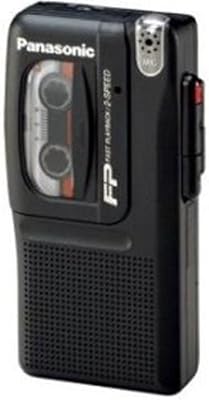
Panasonic RN302 Microcassette Recorder
75%
86%
Build Quality
71%
Recording Clarity
67%
Voice Activation (VAS)
93%
Ease of Use
79%
Battery Life
More
Sony M-450 Microcassette Recorder
73%
93%
Battery Life
88%
Build Quality
79%
Recording Clarity
91%
Ease of Use
89%
Portability
More
Sony M-470 Microcassette Voice Recorder
74%
93%
Ease of Use
78%
Audio Clarity
84%
Build Quality
91%
Portability
76%
Battery Life
More
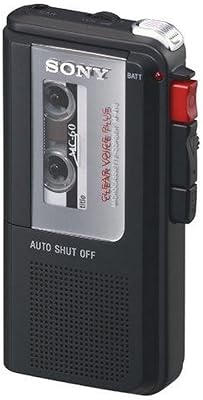
Sony M-670V Microcassette Voice Recorder
77%
88%
Audio Clarity
84%
Build Quality
71%
Voice-Operated Recording
91%
Battery Life
86%
Portability & Form Factor
More
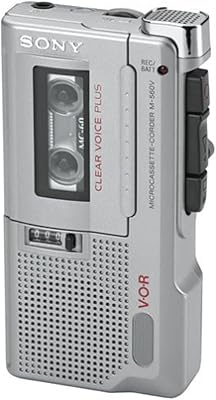
Sony M-560V Microcassette Recorder
76%
88%
Build Durability
92%
Battery Efficiency
79%
Speech Intelligibility
84%
User Interface
71%
VOR Reliability
More
Panasonic DMR-ES35VS DVD Recorder / VCR Combo
84%
88%
Ease of Use
85%
Build Quality
89%
VHS to DVD Dubbing Quality
90%
Compatibility with Formats
80%
Connectivity Options
More
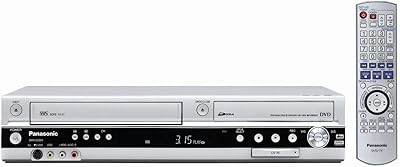
Panasonic DMR-EZ485VK DVD VCR Combo Recorder
71%
88%
VHS-to-DVD Dubbing Quality
84%
Build Quality
79%
Ease of Setup
61%
Menu & Interface Usability
76%
ATSC Tuner Performance
More
Panasonic DMR-E75VS DVD Recorder/VCR Combo
84%
88%
Ease of Use
90%
Recording Quality
85%
Build Quality
62%
Compatibility with Media Formats
91%
Time-Slip Feature
More
Panasonic DMR-ES15S DVD Recorder
71%
88%
FireWire Dubbing Performance
82%
Disc Format Compatibility
41%
Aspect Ratio Flexibility
76%
Video Output Quality
84%
Audio Output Quality
More
Panasonic DMR-E80H DVD Player/Recorder with 80GB Hard Drive
84%
88%
Ease of Use
91%
Video Quality (Progressive Scan)
87%
Recording Functionality
85%
Audio Quality
89%
Storage Capacity (80GB Hard Drive)
More

FAQ

It works with standard microcassette tapes regardless of brand, so you are not locked into anything proprietary. Tapes from Sony, Olympus, Maxell, and generic suppliers all fit without issue. Just confirm you are buying microcassette format and not standard cassette, as they are different sizes.

The foot controller is included in the box along with a headset, so you have everything needed to start transcribing right away. That said, if you are buying a used unit from a third-party seller, always confirm both accessories are part of the listing before purchasing.

No, this is a fully analog device with no USB port, no digital output, and no computer connectivity of any kind. Audio stays on the microcassette tape. If digital archiving or file sharing is a requirement for your workflow, you will need a different solution.

Official Panasonic service and parts are no longer available, which is the honest downside of buying discontinued hardware. Your best options are third-party electronics repair shops familiar with analog tape equipment, or sourcing a second unit as a parts donor. It is worth factoring that reality into your buying decision.

Most users who have worked with previous Panasonic transcription units report almost no adjustment period. The layout and control logic are familiar, and the foot pedal behavior is consistent with earlier models in the lineup.

It makes a real practical difference. Slowing playback on a fast talker or a muffled recording lets you catch words you would otherwise have to rewind and replay multiple times. The audio quality holds up well at reduced speeds, which is the part that matters most for transcription accuracy.

It can work, but it is better suited for professionals who are already operating in an analog environment or replacing existing equipment. If you are setting up a transcription workflow from scratch today, current digital dictation systems offer more flexibility, active support, and easier integration with modern software.

Any mono transcription headset with a 3.5mm plug will work. Standard transcription headsets from manufacturers like Koss or Starkey are common replacements. Just avoid stereo headsets designed for music listening, as they are not optimized for voice transcription clarity.

It lets you note the counter position of any point you need to return to — a word you missed, a section you want to verify, or a point your supervisor flagged for review. Instead of guessing where you are on the tape, you write down the number and rewind to it precisely. On a long document, that saves meaningful time.

That depends almost entirely on your situation. If you are maintaining an existing microcassette workflow, replacing a failed unit, or need a reliable backup machine and already have tapes and infrastructure in place, the value is straightforward. If you are starting fresh or need long-term manufacturer support, the discontinued status and analog-only design make it harder to justify compared to modern alternatives.

Where to Buy