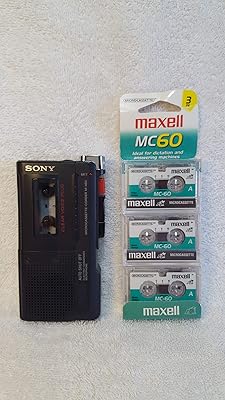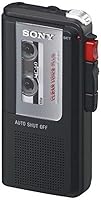
Overview

The Sony M-470 Microcassette Voice Recorder is a compact, no-nonsense analog recorder that has quietly held its ground in a market increasingly dominated by digital alternatives. That staying power says something. Sony has been making portable audio equipment for decades, and that history shows in the build quality and reliability you get from this microcassette recorder. But let's be clear about what it is: a tape-based device with all the practical trade-offs analog format brings. If you want instant file transfers or cloud syncing, look elsewhere. What you get instead is a straightforward, dependable tool built around one job — capturing spoken audio cleanly and consistently.

Features & Benefits

At its core, this voice recorder runs on simplicity. The dual recording speeds — 1.2 and 2.4 centimeters per second — let you choose between fitting more audio onto a tape or getting cleaner sound, which matters when you need to transcribe something accurately later. The Clear Voice function does a decent job reducing background noise so spoken words come through more distinctly, especially in quieter office environments. The built-in mic and speaker mean you can record and play back without plugging anything in, and the 3.5mm headphone jack is there when you want privacy. Two AAA batteries handle power, though an AC adapter works equally well at a desk.

Best For

This microcassette recorder makes the most sense for people with a specific, professional use case. Lawyers, doctors, and journalists who need physical tape records — whether for legal documentation or personal archives — will find it fits naturally into their workflow. It also appeals strongly to professionals already accustomed to the microcassette format who want a reliable replacement unit without learning new software. Students recording lectures without smartphone distractions will appreciate its stripped-back approach too. One practical note worth flagging before you buy: confirm that microcassette tapes are available in your area or online, because tape availability is a real consideration that catches some buyers off guard.

User Feedback

People who rely on this voice recorder regularly tend to highlight its ease of use — no app to configure, no settings menu to navigate, and spoken audio comes through clearly on playback. Battery life gets positive marks as well, with two AAA cells lasting a reasonable stretch under normal daily use. On the downside, buyers consistently flag the lack of any digital connectivity — no USB port and no direct way to transfer recordings to a computer. A few users note that the Clear Voice feature works well in calm environments but loses effectiveness against louder background noise. Physically, it tends to hold up well over extended use.

Pros

  • Physical tape format provides a tangible, archivable record that cannot be accidentally deleted or corrupted by software.
  • Dual recording speeds let you extend tape life when audio fidelity is less critical.
  • The Clear Voice function meaningfully improves speech clarity in quiet to moderately noisy settings.
  • No software installation, no account setup — you press record and it works.
  • Built-in speaker means you can play back recordings anywhere without headphones.
  • Runs on standard AAA batteries, so finding a replacement is never a problem.
  • Slim, pocket-sized build makes it easy to carry without adding noticeable bulk.
  • AC adapter compatibility makes it a practical desk dictation tool as well.
  • Sony hardware tends to hold up well under regular daily use over an extended period.
  • The 3.5mm headphone jack allows private, focused playback without disturbing others.

Cons

  • No USB port or digital output means transferring recordings to a computer requires an external analog-to-digital workaround.
  • Microcassette tapes are increasingly hard to find in physical retail stores.
  • Recording time is limited to what fits on a physical tape — no expandable storage option exists.
  • Clear Voice performance drops noticeably in louder or more complex acoustic environments.
  • Once a tape is full, you must have a spare on hand or risk missing something important.
  • No timestamp or indexing function makes locating a specific moment within a long recording tedious.
  • The analog format makes it impossible to search, tag, or organize recordings the way digital tools allow.
  • Playback speed cannot be adjusted, which slows down transcription compared to digital alternatives with variable playback.

Ratings

The scores below reflect an AI-driven analysis of verified global user reviews for the Sony M-470 Microcassette Voice Recorder, with spam, incentivized, and bot-generated feedback actively filtered out before processing. Every category captures both what buyers genuinely appreciated and where this voice recorder fell short in real-world use. The result is an honest, balanced snapshot of how this analog recorder performs across the full range of buyer experiences.

Ease of Use
93%
Users consistently describe the operating experience as refreshingly immediate — press a button, it records. There are no menus to navigate, no firmware updates to manage, and no pairing process to fumble through. Professionals who just need to capture audio quickly find this reliability genuinely valuable.
A small number of users note that the tape counter and speed selector can be ambiguous without the manual on hand. Those switching from digital recorders occasionally find the lack of any on-screen feedback during recording mildly disorienting at first.
Audio Clarity
78%
22%
For voice-focused recordings in calm environments — office dictation, one-on-one interviews, quiet meeting rooms — users report speech comes through clearly and is easy to transcribe afterward. The Clear Voice processing makes a tangible difference when background noise is moderate.
In louder or more complex acoustic settings, audio quality drops noticeably. Several reviewers mention that recordings made in busy public spaces, open offices, or outdoors can sound muffled or cluttered, with the Clear Voice feature unable to fully compensate.
Build Quality
84%
The physical construction earns consistent praise from long-term users who report the unit surviving years of daily professional handling without mechanical failure. Buttons feel deliberate and well-spaced, and the cassette door mechanism holds up reliably through repeated use.
The plastic housing, while solid for its weight class, does pick up scratches and scuffs over time. A few users noted the cassette door felt slightly loose on units used heavily for more than a year, though functional failures were rarely reported.
Portability
91%
At under 100 grams and slim enough to drop in a shirt pocket, this recorder genuinely disappears into a daily carry without adding bulk. Doctors and journalists frequently mention keeping it on their person throughout a full workday without noticing its weight.
Compared to ultra-thin digital voice pens now on the market, the M-470 is noticeably thicker. Users who prioritize absolute discretion or minimal pocket footprint may find newer digital alternatives more practical in that regard.
Battery Life
76%
24%
Most users get several solid hours of active recording from a pair of standard AAA batteries, which is adequate for a full professional workday of moderate use. The AC adapter option makes desk-based dictation essentially unlimited, which frequent users appreciate.
Heavy users — those recording continuously for extended stretches — find battery drain faster than expected. A recurring complaint is that the low-battery indicator does not give enough advance warning, catching some users mid-session without a spare set on hand.
Clear Voice Function
69%
31%
In the environments where it works well — quiet offices, small meeting rooms, controlled studio spaces — the Clear Voice function genuinely improves voice intelligibility on playback. Transcriptionists and legal professionals working in these settings rate it positively.
The feature's effectiveness is highly environment-dependent, and several users feel it was oversold for their use case. In anything beyond a quiet room, the processing does not reliably filter out ambient noise, and some users feel it can slightly flatten the natural sound of voices.
Tape Availability
47%
53%
For buyers who plan ahead and purchase tapes in bulk online, supply is currently manageable. Longtime microcassette users are already accustomed to sourcing tapes from specialist retailers and report this is a workable habit rather than a dealbreaker.
Physical retail availability of microcassette tapes has declined sharply, and this is one of the most frequently mentioned frustrations in buyer feedback. Running out of tape unexpectedly — and not being able to find replacements locally — has disrupted recording sessions for multiple users.
Value for Money
61%
39%
For buyers who specifically need an analog tape recorder and understand what they are purchasing, the M-470 delivers on its core promise reliably. The Sony brand backing and long production history provide some assurance that the unit will perform consistently over time.
At its current price point, the recorder sits uncomfortably against capable digital alternatives that offer far more functionality for similar or lower cost. Buyers who discover after purchase that they needed digital features feel the value proposition falls short of expectations.
Microphone Performance
74%
26%
The built-in microphone captures close-range voice clearly enough for dictation and one-on-one interviews, which covers the primary use case this recorder was designed for. Users recording in controlled indoor environments rarely feel the need for an external mic.
The microphone is front-facing and directional by nature, meaning recordings suffer if the speaker is not relatively close and facing the device. Group conversations or multi-directional audio capture produces noticeably uneven results across the table.
Playback Quality
79%
21%
Playback through the built-in speaker is clear enough for personal review in a quiet room, and the 3.5mm headphone output delivers noticeably improved fidelity for focused listening. Transcriptionists who use headphones for playback report the audio is clean and consistent.
The built-in speaker volume tops out at a level that is practical for individual listening only — it is not loud enough to comfortably share playback with a small group. There is also no speed adjustment for playback, which slows down transcription compared to digital tools.
Digital Connectivity
18%
82%
There is essentially nothing to praise in this category from a modern workflow perspective, though a small number of technically minded users have successfully routed audio via the headphone jack into a computer for manual digitization when needed.
The complete absence of USB, Bluetooth, or any native digital output is the single most cited limitation across all user feedback. For anyone whose workflow involves sharing, editing, or archiving recordings digitally, this recorder creates a significant and time-consuming workaround.
Size & Form Factor
88%
The compact rectangular shape fits naturally in hand during use and drops into almost any bag pocket without friction. Users who carry the recorder throughout a full shift — field reporters, medical staff — find its form factor genuinely unobtrusive over long periods.
The 2-inch display is functional but small, and users with reduced vision or those trying to read the tape counter in dim lighting occasionally find it harder to monitor than they would like. A backlit display would have improved usability in variable lighting conditions.
Durability
83%
Long-term owners frequently mention using the same unit for multiple years without needing repair or replacement, which speaks well of the mechanical reliability of the core recording and playback mechanism. Sony's component quality holds up in sustained daily professional use.
The external casing shows cosmetic wear faster than some users expect for the price. A handful of reviewers also noted that the tape drive mechanism can become inconsistent with very heavy use over multiple years, though outright mechanical failure appears to be uncommon.
Setup & Learning Curve
92%
There is almost no setup involved — insert batteries, load a tape, and the recorder is immediately ready to use. This zero-configuration experience is specifically mentioned by users who have gifted the unit to less tech-savvy family members or colleagues without any issues.
The instruction manual is minimal, and some users unfamiliar with analog recorders are unsure which speed setting to use for their specific needs. There is no guided setup or recommendation built into the device itself to help new users make informed choices out of the box.

Suitable for:

The Sony M-470 Microcassette Voice Recorder is genuinely well-matched for professionals whose work depends on physical, tangible recordings — think lawyers documenting client consultations, doctors dictating notes between appointments, or journalists capturing on-the-record interviews where a physical tape carries evidentiary weight. If you already have an established microcassette workflow and simply need a dependable replacement or backup unit, this recorder slots in without any learning curve whatsoever. It also suits people who operate in environments where smartphones or digital recorders draw unwanted attention or are outright prohibited. Students who want a focused, single-purpose tool for capturing lectures — without the temptation of notifications or apps — will find it refreshingly straightforward. Analog purists and older professionals who have never needed or wanted digital file management will feel right at home.

Not suitable for:

The Sony M-470 Microcassette Voice Recorder is a poor fit for anyone whose workflow depends on moving recordings quickly and conveniently into a computer, editing software, or cloud storage — there is simply no direct digital pathway built in. Buyers expecting to search through recordings by timestamp, bookmark moments, or organize files into folders will be frustrated by the linear, tape-based nature of the format. If you record in loud environments regularly — busy newsrooms, outdoor events, or crowded public spaces — the Clear Voice function will not compensate enough to give you reliably clean audio. Sourcing microcassette tapes is becoming less convenient over time, and that ongoing dependency on a shrinking consumable is a real logistical concern for heavy users. Anyone who values compactness purely for the purpose of discretion should also know this recorder is noticeably bulkier than a modern digital voice pen.

Specifications

  • Brand: Manufactured by Sony, a company with a long-established reputation in portable consumer audio equipment.
  • Model Number: The official model designation is M470, sometimes listed as M-470 across retail and support documentation.
  • Dimensions: The unit measures 4.36 x 2 x 0.85 inches, making it slim enough to fit in a shirt pocket or small bag compartment.
  • Weight: At 97 grams (3.42 oz), this voice recorder adds virtually no noticeable burden to a bag or jacket pocket.
  • Recording Format: Audio is recorded onto standard 4mm microcassette tape, a physical analog medium that requires separate tape purchases.
  • Recording Speeds: Two selectable speeds are available — 1.2 cm/s for extended recording time and 2.4 cm/s for improved audio clarity.
  • Recording Time: Up to 60 minutes of recording is supported per tape side, depending on tape length and selected speed.
  • Microphone: A built-in microphone is integrated directly into the unit, requiring no external mic for standard voice recording use.
  • Speaker: An internal speaker allows audio playback directly from the recorder without headphones or external audio equipment.
  • Headphone Jack: A 3.5mm headphone jack is included for private listening, compatible with standard wired headphones.
  • Clear Voice: The Clear Voice function applies audio processing to reduce ambient noise and enhance the clarity of recorded speech.
  • Power Source: The recorder operates on two AAA batteries or via an AC adapter, supporting both portable and stationary use scenarios.
  • Battery Count: Two AAA batteries are required for cordless operation; batteries are not included in the retail package.
  • Screen Size: A 2-inch display is built into the unit to provide basic operational feedback during recording and playback.
  • Connectivity: A 3.5mm audio jack is the only hardware interface; there is no USB port, Bluetooth, or digital output of any kind.
  • Compatibility: The unit is compatible with standard wired headphones via the 3.5mm jack; no wireless accessories are supported.
  • Availability: As of the most recent manufacturer information, the Sony M-470 has not been discontinued and remains in production.
  • First Available: This model was first made available for purchase on August 7, 2008, indicating a long and stable product lifespan.

Related Reviews
Sony M-560V Microcassette Recorder
76%
88%
Build Durability
92%
Battery Efficiency
79%
Speech Intelligibility
84%
User Interface
71%
VOR Reliability
More
Sony M-670V Microcassette Voice Recorder
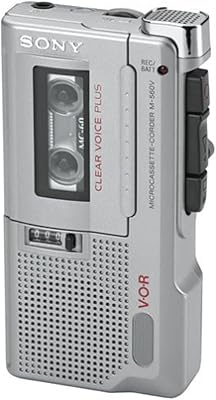
77%
88%
Audio Clarity
84%
Build Quality
71%
Voice-Operated Recording
91%
Battery Life
86%
Portability & Form Factor
More
Sony M-450 Microcassette Recorder
73%
93%
Battery Life
88%
Build Quality
79%
Recording Clarity
91%
Ease of Use
89%
Portability
More
Sony ICD-PX240 4GB
Sony ICD-PX240 4GB
81%
83%
Audio Clarity
91%
Ease of Use
94%
Portability & Form Factor
78%
Battery Performance
67%
Storage & File Management
More
Sony ICD-PX370 4GB
Sony ICD-PX370 4GB
83%
97%
Battery Longevity
89%
Portability & Form Factor
94%
File Transfer Convenience
78%
Recording Quality
91%
User Interface & Ease of Use
More
Sony TCM150 Standard Cassette Voice Recorder
82%
88%
Build Quality & Durability
91%
Battery Life
94%
Ease of Use
76%
Audio Clarity (Playback)
82%
Microphone Sensitivity
More
Sony ICD-UX560
Sony ICD-UX560
76%
88%
Audio Clarity
84%
Recording Modes
81%
Voice Activation
86%
Ease of Use
74%
Build Quality
More
Sony ICD-UX570
Sony ICD-UX570
79%
83%
Audio Clarity
76%
Noise Cancellation
91%
Built-In USB Convenience
88%
Battery Life
92%
Portability & Form Factor
More
Sony ICD-PX440 Digital Voice Recorder 4GB
87%
89%
Sound Quality
91%
Portability
87%
Battery Life
94%
Ease of Use
85%
Recording Time
More
Sony ICD-PX312 Voice Recorder
73%
91%
Ease of Use
88%
Battery Life
79%
Audio Clarity — Quiet Environments
48%
Audio Clarity — Noisy Environments
63%
Build Quality
More

FAQ

It uses standard 4mm microcassette tapes, the same format that has been around for decades. You can still find them online through major retailers, but physical store availability has become spotty in recent years. Stocking up when you find them is a smart move.

Not directly. There is no USB port or digital output on this unit. If you need to digitize your recordings, you would have to run an audio cable from the headphone jack into your computer's line-in port and record in real time using audio software — it works, but it is not a quick process.

Battery life depends on how often you are recording versus simply leaving the unit on standby, but most users find two AAA batteries last through several hours of active recording. If you use it heavily at a desk, plugging in the AC adapter will save you from burning through batteries.

In quiet to moderately calm environments, yes — speech comes through with noticeably less background hiss and ambient noise. In louder settings, like a busy cafe or an outdoor interview, it struggles to compensate effectively. It is a useful feature, but it is not a substitute for good microphone placement.

It can capture group conversations, but results will vary depending on room size and how far away speakers are from the recorder. The built-in mic picks up sound from the immediate vicinity best, so placing it centrally on a table gives you the best chance of capturing everyone clearly.

The recorder will simply stop when the tape runs out — there is no overflow, no cloud backup, and no warning system beyond what the tape counter shows. Carrying a spare cassette is strongly recommended if you are heading into an important session.

Yes, standard rechargeable AAA batteries work fine. Just keep in mind that rechargeable batteries typically run at a slightly lower voltage than alkaline ones, which can sometimes affect how long the recorder operates before it signals low battery.

It is adequate for personal listening in a quiet room — you can hear your recordings clearly enough to review them. It is not designed for broadcasting to a group, so if you need others to hear the playback, headphones or an external speaker via the 3.5mm jack would serve you better.

User feedback over the years suggests it holds up well under regular daily handling. The build feels solid for its size and weight class, and many professionals report using theirs for years without mechanical issues. Like any tape-based device, keeping it away from dust and extreme temperatures will extend its life.

It is a practical choice for students who want a dedicated, distraction-free recording tool. There are no apps to manage, no notifications to interrupt focus, and operation is about as simple as it gets. The main trade-off is that you will need to rewind and listen in real time rather than scrubbing through a digital file, which can slow down review sessions.

Where to Buy