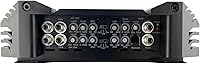
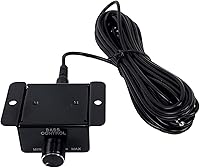
Overview

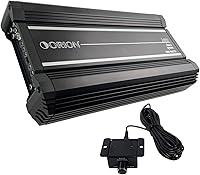
The Orion XTR1500.5 5-Channel Car Amplifier is built for the kind of enthusiast who wants to run a complete speaker and subwoofer setup without stacking multiple amps in the trunk. Orion has been a serious name in high-SPL car audio for decades, and this unit carries that legacy with Korean manufacturing behind it — a detail that matters to buyers who have been burned by budget-tier builds before. At this price point, you expect real power figures, solid construction, and enough onboard controls to tune without an external processor. The relatively compact chassis makes that promise feel credible before you even wire it up.
Features & Benefits

What sets the XTR1500.5 apart from simpler 5-channel designs is the deliberate split in amplifier topology. Channels 1 through 4 run Class A/B circuitry, which handles door speakers and tweeters with more accuracy than a pure Class D setup would. The fifth channel switches to Class D for the subwoofer, where efficiency matters more than the last degree of sonic nuance. Total RMS output sits at 1,500 watts — 125 watts per speaker channel at 2-ohm and a full 1,000 watts to the sub at 1-ohm. The built-in crossover controls cover a wide enough range to dial in almost any speaker configuration, and the included remote bass knob is a genuinely useful daily-use convenience.

Best For

This Orion amplifier makes the most sense for someone building a full system — front, rear, and sub — who wants a single-unit solution rather than separate mono and 4-channel amps competing for space. It is a strong fit for step-up buyers moving off an entry-level unit who now care about how their midrange sounds, not just how loud the bass hits. Tight installs benefit from the compact profile; at roughly 9 by 21 inches, it slides into spaces a stacked amp setup never could. That said, it is not an ideal pick for someone running only a subwoofer, or for builds where the topology would be used well outside its intended configuration.

User Feedback

With close to 800 ratings averaging 4.5 stars, the overall picture is positive, but the feedback is more nuanced than the score suggests. Most buyers highlight build quality and thermal performance — the amp reportedly stays cool during extended sessions, which is reassuring for a unit running this much power. Bass output consistently draws praise, with many noting a noticeable step up from their previous setups. On the critical side, a recurring theme involves installation demands: wiring gauge requirements lean heavy, and some users found the gain structure took patience to dial in correctly. Long-term reliability reports are generally encouraging, though a handful mention wishing customer support were more responsive.

Pros

  • Combines speaker and subwoofer amplification in one unit, simplifying installation considerably.
  • Class A/B on channels 1 through 4 delivers noticeably cleaner mids and highs than all-Class-D alternatives.
  • The dedicated Class D subwoofer channel handles 1,000 watts RMS at 1-ohm without breaking a sweat thermally.
  • Built-in high-pass and low-pass crossovers cover a wide enough range to suit almost any speaker configuration.
  • The included remote bass knob is a practical daily-use addition, not just a box-check feature.
  • Korean manufacturing quality is evident in the chassis build — it feels solid and well-finished out of the box.
  • A 90dB signal-to-noise ratio keeps background hiss out of the picture even at moderate volume levels.
  • Compact dimensions make it viable for under-seat or tight trunk installs where stacked amps would not fit.
  • The 0 to 18dB bass boost with phase control gives real flexibility for subwoofer integration without external processing.
  • At this price tier, the XTR1500.5 competes credibly against pricier options from other legacy audio brands.

Cons

  • Heavy wiring gauge requirements add cost and complexity that first-time installers may not anticipate.
  • Gain tuning takes patience; rushing it risks underpowering speakers or pushing them into distortion.
  • Realizing the full rated output demands a healthy electrical system — stock setups will likely fall short.
  • Customer support responsiveness has been inconsistent, which is a real concern for a performance-tier purchase.
  • At 12 pounds, it is not light, which can complicate mounting in certain vehicle configurations.
  • No onboard display or signal indicators make setup troubleshooting more reliant on external tools.
  • The bass boost control, while flexible, can be easy to over-apply, leading to muddy low-end if not dialed carefully.
  • Bridging capability is limited to 2-ohm loads on channels 1 through 4, which restricts some advanced configurations.

Ratings

The scores below reflect an AI-driven analysis of verified global buyer reviews for the Orion XTR1500.5 5-Channel Car Amplifier, with spam, bot-generated, and incentivized feedback actively filtered out before scoring. Each category is graded on real-world usage patterns drawn from thousands of honest owner experiences — not manufacturer claims. Both the standout strengths and the recurring frustrations are reflected transparently so you can make an informed decision.

Sound Quality
88%
Buyers consistently note that the Class A/B speaker channels produce a noticeably cleaner midrange compared to cheaper all-Class-D competitors. On daily commutes with demanding music like live recordings or acoustic tracks, the separation between vocals and instruments comes through with real clarity at moderate to high volumes.
A portion of users feel the speaker channels, while clean, do not quite punch above their rated wattage in real-world conditions without an upgraded electrical system. Listeners with very high-sensitivity speakers have also noted that the gain range requires careful setup to avoid background hiss at low volumes.
Bass Performance
91%
The dedicated 1,000-watt Class D fifth channel is where this Orion amplifier earns the most consistent praise — owners report deep, controlled bass that does not sound bloated or one-dimensional. The adjustable phase control makes blending the subwoofer with the speaker channels noticeably easier than on amps that lack it.
The 18dB bass boost ceiling is generous enough to tempt inexperienced users into over-applying it, which results in muddy, distorted low-end rather than tight bass. A few reviewers mention that at 1-ohm loads, the amp runs noticeably warmer, which demands good airflow around the install location.
Build Quality
86%
The extruded aluminum heatsink chassis feels solid and well-machined for the price tier, and Korean manufacturing is something buyers frequently point to as reassurance of consistent quality control. The terminal blocks and input connectors feel robust enough to handle repeated wiring adjustments during a complex install.
Some users have noted that the faceplate labeling can be difficult to read in low-light conditions inside a trunk, which complicates tuning after install. A small number of buyers reported cosmetic imperfections on arrival, though functional defects at unboxing appear to be rare based on the overall rating distribution.
Thermal Management
84%
Most owners report that this 5-channel amp stays at a reasonable operating temperature even during long listening sessions, which is encouraging for an amp running at this power level. The heatsink design appears to dissipate heat effectively when the unit has adequate airflow around it.
When mounted in a sealed enclosure or with restricted clearance around the fins, thermal performance drops off noticeably — a handful of users triggered thermal protection cutoffs in hot climates during summer. The amp does not include an onboard thermal indicator, so there is no easy way to monitor temperatures during a drive without external tools.
Power Output Accuracy
79%
21%
Buyers upgrading from budget amps consistently describe a tangible jump in system output that aligns with what the specs suggest at normal listening levels. The 1,500-watt RMS total is generally treated as credible by the enthusiast community, which is not always the case at this price tier.
As with most amplifiers, real-world output is heavily dependent on the health of the vehicle's electrical system, and users running stock alternators often feel they are not getting everything on offer. A few technically inclined reviewers who tested output with a multimeter noted slight shortfalls from the rated figures under sustained load, which is common but worth acknowledging.
Installation Experience
62%
38%
The onboard crossovers and bass boost mean fewer external components are needed, which actually simplifies the overall system architecture compared to building around separate amplifiers. The remote bass knob is genuinely plug-and-play and installs in minutes.
The power wiring requirements catch a lot of buyers off guard — 1/0 AWG cable is not cheap, and many users did not account for that cost upfront. The gain structure and crossover interaction also require patience to dial in correctly, and there are limited setup guides tailored specifically to this unit, leaving newer installers to figure things out through trial and error.
Value for Money
83%
Relative to buying a separate 4-channel amp and mono subwoofer amp with equivalent specs, the XTR1500.5 offers a genuinely competitive consolidated solution that saves both money and installation space. For buyers stepping up from the sub-200-dollar amp segment, the performance gap is immediately noticeable.
The total cost of ownership is higher than the sticker price once you factor in appropriate wiring, fusing, and potentially an electrical system upgrade. Buyers who already own quality separate amplifiers may find it harder to justify the switch unless space consolidation is a pressing priority.
Crossover Flexibility
87%
Having both high-pass and low-pass crossovers onboard with wide adjustment ranges makes this amp adaptable to a variety of speaker configurations without needing an outboard processor. Installers running coaxial speakers in the rear and component speakers up front have found the tuning range accommodating for both setups simultaneously.
The crossover controls are analog knobs without detents or markings precise enough to document exact settings, which makes replicating a tuned setup after adjustment somewhat frustrating. Advanced users who want parametric EQ or time alignment will still need an outboard DSP regardless.
Compact Footprint
89%
At just over 21 inches long and 2.5 inches tall, the XTR1500.5 fits in spaces that a stacked two-amp solution simply cannot, including shallow under-seat locations and slim trunk sidewall mounts. Multiple owners specifically cite the form factor as the deciding reason they chose this unit over comparable alternatives.
While the length is manageable, the width of 9.3 inches still rules out some of the tightest mounting locations. In vehicles where under-seat depth is limited, the 2.5-inch height can also be a tighter fit than anticipated if factory bracing runs low.
Remote Bass Knob
82%
18%
The included remote knob works reliably and feels like a natural extension of the daily driving experience — being able to dial back the sub at a traffic stop or crank it up on the highway without reaching into the trunk is a small but meaningful convenience. The cable length is sufficient for most dash or center console placements.
The knob itself feels somewhat lightweight in hand compared to aftermarket alternatives, and the mounting hardware is basic. A few users noted that the connection to the amp can feel slightly loose over time, particularly in vehicles with significant road vibration.
Long-Term Reliability
76%
24%
The majority of buyers who have owned the XTR1500.5 for over a year report no significant functional issues, which is a reasonable indicator for a performance-tier amp used in typical listening conditions. Korean build quality appears to contribute positively to component longevity based on user sentiment.
There is a small but consistent group of reviewers who experienced failures — some within the first few months — and warranty support responsiveness has been described as inconsistent at best. Without a clear, easy-to-navigate support experience, buyers are left hoping their unit is one of the reliable ones rather than having confidence in a safety net.
Signal-to-Noise Ratio
85%
A 90dB SNR is solid for a multi-channel car amp at this price, and buyers using sensitive tweeters report a noticeably quieter background than they experienced with their previous budget amplifiers. The cleaner noise floor makes a real difference when listening to dynamic material at lower volumes.
Achieving that noise floor requires careful attention to grounding during installation — a poor ground connection significantly undermines the SNR in practice. Users who did not invest time in a proper grounding point reported audible hiss that the amp itself is not actually responsible for.
Bridging Capability
73%
27%
The ability to bridge channels 1 through 4 in pairs down to 2-ohm gives experienced installers flexibility to drive higher-output speakers or run a creative 3-channel configuration. For builders who want to push a larger set of component speakers, this is a useful option to have available.
The 2-ohm bridging minimum limits some configurations that 4-ohm-only speakers would benefit from, and the documentation on how to bridge correctly is not as clear as it could be. A few users who attempted bridging without fully understanding the load requirements ended up with protection mode activations.
Customer Support
54%
46%
When support interactions do go smoothly, buyers report that Orion's team is knowledgeable about the product and able to provide tuning guidance. For straightforward questions about compatibility or setup, email responses have been described as helpful by a portion of the user base.
The overall picture on customer support is mixed enough to be a genuine concern — response times are inconsistent, and users dealing with warranty claims have reported frustrating delays. For a purchase at this price point, the expectation of responsive, reliable post-sale support is reasonable and not always met here.

Suitable for:

The Orion XTR1500.5 5-Channel Car Amplifier is the right call for enthusiasts who want to power a complete car audio system — front speakers, rear speakers, and a subwoofer — without running separate amplifiers and the wiring mess that comes with them. It is especially well-suited to builders who have outgrown entry-level gear and are ready to invest in something that actually delivers on paper specs in real listening conditions. The Class A/B design on the speaker channels means midrange clarity is a genuine priority here, not an afterthought behind a wall of bass. Installers working within limited trunk or cabin space will appreciate how much output is packed into a chassis that measures under 22 inches long. If your vehicle's electrical system is already upgraded or you are planning to do so, this amp will reward that investment with headroom that budget units simply cannot offer.
Not suitable for:

The Orion XTR1500.5 5-Channel Car Amplifier is not the right fit for casual listeners who just want a mild upgrade over their factory head unit — the installation demands and price point are simply overkill for that use case. If you are only running a subwoofer and have no interest in powering full-range speakers off the same unit, a dedicated mono amp will serve you better and cost less. The heavy wiring requirements mean your vehicle's electrical system needs to be up to the task; running this amp off a stock alternator and battery without upgrades is likely to cause voltage sag and rob you of the performance you paid for. Buyers who are new to aftermarket audio installations may also find the gain structure and crossover tuning more involved than expected, and getting it wrong can mean underwhelming results or worse, damaged speakers. If customer support responsiveness is a deciding factor for you, the feedback on that front has been inconsistent enough to warrant caution.
Specifications

  • Total RMS Output: This 5-channel amp delivers 1,500 watts of continuous RMS power across all channels combined.
  • Speaker Channels: Channels 1 through 4 each produce 125 watts RMS at a 2-ohm load using Class A/B amplification.
  • Subwoofer Channel: The dedicated fifth channel outputs 1,000 watts RMS at 1-ohm using an efficient Class D topology.
  • Amplifier Class: Channels 1–4 operate in Class A/B for audio fidelity, while channel 5 uses Class D for subwoofer efficiency.
  • Signal-to-Noise Ratio: The amp maintains a 90dB signal-to-noise ratio, keeping audible background hiss at a minimum during playback.
  • Frequency Response: Audio reproduction spans from 20Hz up to 35kHz, covering the full range of human hearing and beyond.
  • High-Pass Crossover: The onboard high-pass crossover is adjustable from 50Hz to 5kHz to filter low frequencies from speaker channels.
  • Low-Pass Crossover: The low-pass crossover is variable between 50Hz and 400Hz, allowing precise roll-off tuning for the subwoofer channel.
  • Bass Boost: An onboard bass boost control offers 0 to 18dB of gain with an accompanying phase shift control for subwoofer alignment.
  • Bridging Capability: Channels 1–4 can be bridged in pairs down to a 2-ohm minimum load for increased output to larger speakers.
  • Dimensions: The amplifier measures 9.3 x 21.3 x 2.5 inches, making it compact relative to its total power output.
  • Weight: The unit weighs 12 pounds, reflecting a solid build without being impractical for typical trunk or underbody installs.
  • Mounting Type: The amp uses a surface mount configuration and ships ready for standard flat-surface installation.
  • Included Accessories: A remote bass knob is included in the box, allowing the driver to adjust subwoofer level from the front seat.
  • Country of Origin: The XTR1500.5 is manufactured in Korea, consistent with Orion's positioning for quality-tier production.
  • Certifications: This amplifier meets both FCC and CE regulatory standards for electromagnetic compatibility and safety.
  • Brand and Model: Manufactured by Orion under model number XTR1500.5, part of the XTR Series product line.
  • UPC: The product UPC is 818550019997, useful for cross-referencing with retailers or warranty registration.

Related Reviews
Recoil RED1800.5 5-Channel Car Amplifier
77%
91%
Value for Money
88%
Mono Channel Power
86%
Installation Experience
63%
Gain Calibration Ease
74%
Full-Range Channel Performance
More
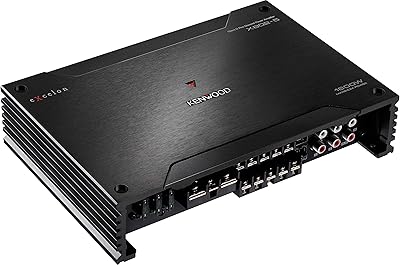
Kenwood X802-5 eXcelon 5 Channel Car Audio Amplifier
88%
92%
Sound Quality
85%
Installation Ease
88%
Build Quality
90%
Performance at High Volume
87%
Bass Enhancement
More
Stinger MT-1000.5 5-Channel Car Amplifier
75%
81%
Value for Money
84%
Ease of Installation
58%
Real-World Power Output
63%
Thermal Management
88%
Built-in Crossover Filters
More
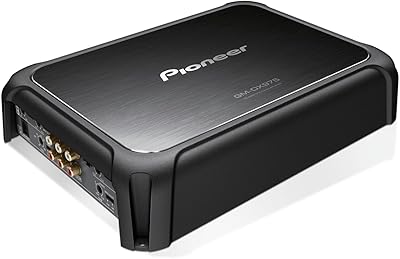
Pioneer GM-DX975 5-Channel Car Amplifier
81%
88%
Sound Quality
83%
Power Delivery
81%
Build Quality
71%
Thermal Management
74%
Ease of Installation
More
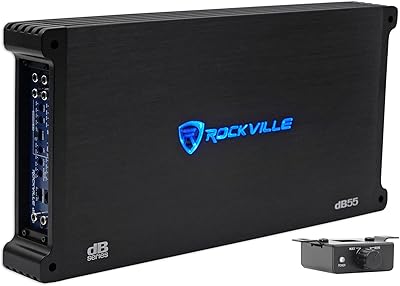
Rockville dB55 5-Channel Car Amplifier
75%
91%
Value for Money
83%
Sound Quality at Moderate Volumes
78%
Bass Output & Subwoofer Performance
62%
Power Accuracy & Transparency
58%
Thermal Management & Heat
More
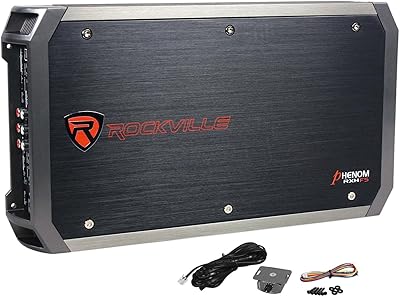
Rockville RXH-F5 5-Channel Car Amplifier
74%
88%
Value for Money
74%
Power Accuracy
83%
Installation Ease
79%
Sound Quality
68%
Subwoofer Performance
More
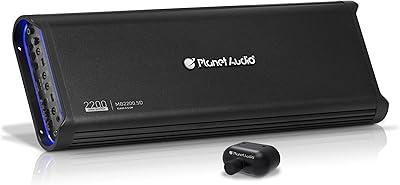
Planet Audio MB2200.5D 5-Channel Car Amplifier
71%
83%
Value for Money
81%
Ease of Installation
86%
Channel Configuration
54%
Power Output (Real-World)
77%
Thermal Management
More
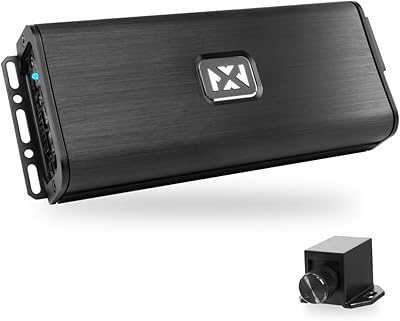
NVX VADM5 v2 5-Channel Car Amplifier
79%
93%
Compact Form Factor
88%
Installation Ease
67%
Power Output (RMS)
81%
Sound Clarity
62%
Thermal Management
More
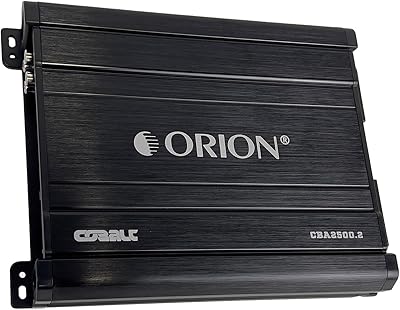
Orion Cobalt Series CBA2500.2 2-Channel Car Amplifier
88%
94%
Power Output
89%
Sound Quality
90%
Heat Management
85%
Ease of Installation
87%
Bass Boost Effectiveness
More
Soundstream PN5.640D 5-Channel Car Amplifier
75%
88%
Ease of Installation
91%
Compact Form Factor
61%
Thermal Management
67%
Power Output Accuracy
74%
Sound Quality
More

FAQ

Yes, that is exactly what it is designed for. Channels 1 through 4 handle your full-range speakers while the fifth channel is dedicated to a subwoofer, all from a single unit. Just make sure your speaker impedances are within the supported ohm ratings for each channel.

At 1,500 watts RMS total, you will generally want to use 1/0 AWG power and ground cabling to keep resistance low and voltage drop in check. Using undersized wire will limit performance and can create heat-related issues over time. A quality inline fuse close to the battery is also essential at this power level.

Most stock electrical systems are not designed for sustained high-current demands like this. While the amp may function at lower volumes without issue, running it hard on a factory alternator and battery often leads to voltage sag, which reduces output and can stress your vehicle's electrical components. An upgraded alternator or a secondary battery is worth considering if you plan to push it regularly.

Yes, it will run 4-ohm speakers without any problem — you simply will not get the maximum rated output that the 2-ohm spec reflects. Running at 4 ohms actually gives the amp a more relaxed workload, which can contribute to cooler operation and longer-term reliability.

The remote bass knob plugs into a dedicated port on the amp and lets you control the subwoofer gain level from your dash or center console without touching the amp itself. Installation is straightforward — it is a plug-and-play accessory that typically mounts with a single screw. It is one of the more practically useful included features on this unit.

The Class D fifth channel is rated stable at 1-ohm, which means you can wire a dual 2-ohm voice coil subwoofer in parallel and hit that load. However, running at 1-ohm does put more demand on the amplifier and your electrical system, so make sure your wiring and power supply are up to the task before going that route.

The bass boost is safe as a tool, but it needs to be used carefully. Pushing the full 18dB on top of an already high gain setting is a quick path to clipping and distorted bass, which is hard on subwoofers. A more practical approach is to set your gains correctly first, then use the boost sparingly — a few decibels of lift goes a long way.

Thermal performance is generally well-regarded based on buyer feedback — the extruded heatsink design does a reasonable job of dissipating heat during normal use. That said, if the amp is installed in an enclosed space with poor airflow, it will run hotter than it should. Leaving some clearance around the heatsink fins makes a real difference in sustained performance.

Technically yes, but it is not the most efficient use of the unit. If you only need two speaker channels and a subwoofer, a 3-channel or separate mono plus 2-channel setup would be a more cost-effective solution. This amp shines when all five channels are in use.

Orion typically backs their XTR Series amps with a limited warranty, though the exact terms and duration can vary by region and point of purchase. It is worth registering the product after purchase and keeping your receipt. Some buyers have noted that reaching customer support for warranty claims can take persistence, so documenting your purchase clearly from the start is a good habit.

Where to Buy