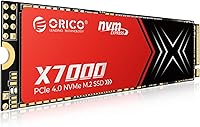

Overview

The ORICO X7000 2TB NVMe SSD enters a crowded PCIe Gen 4 market with specs that punch well above its price point — which is exactly why it deserves a closer look. ORICO isn't a newcomer to storage; the Shenzhen-based brand has built a solid reputation across USB hubs, enclosures, and drives over the past decade. This drive launched in December 2024, so it's still finding its footing in terms of long-term owner data. On paper, the numbers are impressive. In practice, whether those figures translate consistently to real-world gains depends on your system, your workload, and how honestly you read the fine print.

Features & Benefits

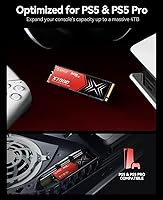
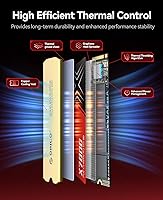
The headline figures here are real, not inflated. At peak sequential speeds, this NVMe drive handles workloads — large file transfers, game asset streaming, OS boot cycles — where a slower drive creates noticeable bottlenecks. The PCIe 4.0 x4 interface also works in older PCIe 3.0 slots, though throughput scales down accordingly. PS5 owners should know upfront: Sony's hardware caps internal drive speeds regardless, so you're not losing anything the console could actually use. The tri-layer cooling system — copper heatsink, graphene heat spreader, and thermal management firmware — is a genuine differentiator at this price tier, where most competitors ship a basic aluminum slug. The 1,200TBW endurance rating is also strong for a 2TB capacity.

Best For

The X7000 is a natural fit for PS5 owners who've maxed out their console's factory storage and don't want to overpay for brand-name alternatives with comparable specs. PC gamers playing open-world titles or anything with heavy asset loading will notice a real difference, particularly coming from a SATA or older NVMe drive. Content creators working with 4K footage or large RAW photo batches also benefit from the sustained write performance. On the laptop side, any M.2-compatible machine gets a meaningful upgrade — just verify PCIe generation before purchasing. If your build runs hot or has restricted airflow, the included heatsink takes one thermal variable off your plate entirely.

User Feedback

With a 4.6-star average across just over 100 ratings, early buyer sentiment is positive but not yet definitive. Reviewers consistently highlight how straightforward installation is and report noticeable improvements when upgrading from older drives — PS5 users in particular seem satisfied with load time reductions. Heatsink build quality also draws repeated praise. On the critical side, a handful of buyers note that real-world speeds under sustained workloads don't always hit peak advertised figures, which is honest and typical for any high-performance NVMe. The bigger open question is long-term reliability; this gaming SSD simply hasn't been on the market long enough for meaningful durability patterns to surface.

Pros

  • Heatsink is included out of the box — no separate purchase needed for PS5 or compact PC builds.
  • The copper and graphene cooling stack genuinely outpaces the basic aluminum heatsinks bundled with many competitors at this price.
  • At 2TB capacity, it offers real breathing room for large game libraries or video project archives.
  • PCIe 3.0 backward compatibility means the X7000 works in older systems, not just the latest platforms.
  • Early buyers consistently report smooth, straightforward installation with no driver headaches.
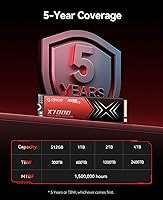
  • The 1,200TBW endurance rating is reassuringly high for heavy daily workloads at this capacity tier.
  • Broad device compatibility — PS5, desktop, and laptop — makes it a flexible one-drive solution.
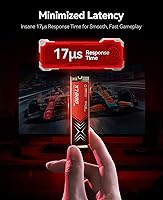
  • Low response time translates to snappier system behavior during multitasking and app switching, not just sequential transfers.
  • Available in multiple capacities, so buyers can right-size to their actual needs and budget.

Cons

  • With just over 100 ratings since its late-2024 launch, long-term reliability is still an open question.
  • Real-world sustained speeds under continuous heavy workloads often fall short of the peak figures on the packaging.
  • ORICO is a less familiar name in drives specifically, which may give cautious buyers pause compared to established SSD brands.
  • PS5 users will never actually hit the top-end read speed due to Sony hardware limitations — that bandwidth is effectively wasted on console.
  • No companion software is offered for drive health monitoring or performance diagnostics.
  • PCIe 3.0 users get noticeably reduced throughput, which undermines the drive's core speed advantage.
  • Packaging and unboxing experience has drawn minor criticism from some buyers — not a dealbreaker, but worth noting.
  • The review pool is too small to draw firm conclusions about failure rates or consistency across production batches.

Ratings

The scores below for the ORICO X7000 2TB NVMe SSD were generated by our AI engine after analyzing verified global buyer reviews, actively filtering out incentivized, duplicate, and bot-flagged feedback to surface what real owners actually experienced. Both the genuine strengths and the recurring frustrations are reflected here — nothing has been softened to favor the product.

Read & Write Performance
88%
Buyers consistently report a tangible difference when loading large open-world games or booting into Windows compared to their previous SATA or older NVMe drives. The sequential throughput holds up well for the kinds of real-world tasks most users throw at it — moving large video projects, installing hefty game updates, or running multiple applications simultaneously.
A portion of users note that sustained write speeds under heavy continuous workloads — long encoding sessions, for example — drop noticeably once the cache buffer saturates. Peak numbers on the box reflect ideal benchmark conditions, and not every real-world scenario will reproduce them.
PS5 Compatibility
84%
PS5 owners report a smooth plug-and-play experience with no formatting headaches — the console recognizes the drive immediately and walks you through setup. The heatsink ships pre-attached, which satisfies Sony's installation requirement without any extra shopping.
Sony's own hardware ceiling means the drive's top-end PCIe 4.0 speed rating is largely irrelevant in a console context, and some buyers feel misled by the marketing emphasis on those figures. The real-world console performance gain over other PS5-compatible drives in the same class is modest rather than dramatic.
Thermal Management
91%
The copper-and-graphene heatsink combination genuinely outperforms the basic aluminum fins bundled with many competing drives at this price point, and users in compact cases or restricted-airflow builds specifically call this out as a deciding factor. During extended gaming sessions, temperatures stay controlled without the drive pulling back its speeds to protect itself.
In systems where the motherboard ships with its own M.2 heatsink cover, the pre-attached cooler can create a clearance conflict that requires a small workaround. A small number of users found the heatsink slightly awkward to work around during installation in tight laptop bays.
Installation Ease
93%
This is one of the most consistently praised aspects across all buyer groups — whether installing in a PS5, a desktop, or a laptop, users describe the process as quick and uncomplicated. No drivers, no setup software, no formatting prompts beyond what the operating system handles automatically.
The included documentation is minimal, which is fine for experienced builders but can leave first-time upgraders uncertain about specifics like screw size or slot orientation. Laptop users in particular have noted that some models require confirming M.2 slot clearance beforehand, which the packaging does not flag proactively.
Value for Money
82%
18%
For the combination of PCIe 4.0 speeds, 2TB capacity, a quality heatsink, and strong endurance ratings, the X7000 delivers a genuinely competitive package relative to what similar-spec drives from bigger-name brands cost. Buyers upgrading from SATA SSDs or older NVMe drives tend to feel the performance-per-dollar ratio is hard to argue with.
Buyers specifically comparing this gaming SSD against newer budget entrants from established storage brands have found the gap narrowing, which makes the price feel slightly less compelling than it did at launch. Those who primarily need the drive for light everyday tasks may find they are paying for headroom they will never realistically use.
Build Quality
79%
21%
The drive itself feels solid and the heatsink assembly has a premium look compared to the flimsy plastic clips seen on cheaper thermal solutions. Users who have handled multiple NVMe drives report that the overall construction feels appropriately robust for the price tier.
A handful of reviewers took issue with the packaging, describing it as underwhelming for a product at this price point — minor, but it shapes the out-of-box impression. No major structural complaints have surfaced, though the limited review timeline makes it premature to draw firm conclusions about long-term physical durability.
Long-Term Reliability
67%
33%
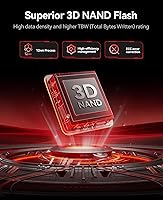
On paper, the endurance and MTBF ratings are strong and indicate the underlying NAND flash is not a budget-grade component. The few buyers who have been using the drive since its December 2024 launch report no failures or unexpected behavior so far.
The drive simply has not been on the market long enough to assess real-world failure rates or multi-year consistency — a review pool of around 100 ratings over a few months cannot answer the durability questions that only time reveals. Buyers who prioritize proven long-term reliability from drives with years of tracked owner data may want to wait.
Response Latency
86%
The low access latency is perceptible during system multitasking and application switching, where the NVMe drive keeps up with rapid, scattered read requests without the micro-hesitations associated with slower storage. Users who moved from HDDs or entry-level SSDs describe the system feeling noticeably more reactive during everyday use.
For the majority of casual gaming and productivity workloads, the latency advantage over other well-rated PCIe 4.0 drives in this class is marginal rather than transformative. Users expecting dramatic improvements on already-fast NVMe systems may not perceive a meaningful difference day to day.
Compatibility Range
83%
The combination of M.2 2280 form factor, PCIe 4.0 with PCIe 3.0 backward support, and PS5 certification gives this NVMe drive one of the widest compatibility profiles at its price point. Buyers appreciate not having to worry about whether it will fit or function across their different devices.
PCIe 3.0 users get noticeably reduced throughput, and a few buyers on older platforms felt the product was marketed toward a hardware generation their system cannot fully utilize. Compatibility with ultra-slim laptops using shorter M.2 slot formats like 2242 is also not supported.
Software & Ecosystem
54%
46%
The drive works immediately with standard third-party monitoring tools like CrystalDiskInfo, so health tracking and temperature data are accessible without relying on proprietary software. For buyers who prefer managing their hardware with existing tools, the lack of bundled software is a non-issue.
ORICO offers no companion utility for drive health dashboards, firmware updates, or performance diagnostics, which competing brands at this tier increasingly provide. Users who prefer a managed, brand-integrated experience will feel the absence, and there is no clear channel for firmware updates if one becomes necessary.
Packaging & Unboxing
61%
39%
The product arrives securely packaged with the heatsink assembly already in place, which at minimum means there is no fiddly pre-installation hardware work before getting started. Most buyers focused on functionality rather than presentation report this is a perfectly adequate unboxing experience.
Multiple reviewers specifically flag the retail packaging as looking generic and inconsistent with the drive's positioning as a premium-tier product. No installation guide, mounting screw, or accessory is included, which other brands in this price range typically bundle as a basic courtesy.
Brand Trust & Support
69%
31%
ORICO has a credible track record in storage accessories and peripheral hardware, and its products are widely stocked across major retail channels, which signals a level of institutional stability beyond a fly-by-night manufacturer. Buyers familiar with the brand from USB hubs and enclosures tend to approach this drive with existing confidence.
For buyers new to ORICO specifically as an SSD manufacturer rather than an accessories brand, the name carries less weight than established storage specialists. Post-sale customer support responsiveness is underrepresented in current reviews, leaving questions about warranty claim experiences largely unanswered at this stage.
Endurance Rating
89%
A 1,200TBW rating on a 2TB drive is genuinely strong and compares favorably against many name-brand competitors at this capacity tier. For content creators writing large files daily or gamers who constantly install and uninstall large titles, the headroom before the drive approaches its rated write limit is measured in years of practical use.
Rated endurance is a manufacturer-declared figure, and independent verification of NAND quality takes time and third-party testing to confirm — something still lacking for a drive this new. The MTBF figure similarly reflects theoretical reliability rather than observed field performance across a large installed base.

Suitable for:

The ORICO X7000 2TB NVMe SSD is a strong pick for PS5 owners who have burned through their console's built-in storage and want a high-capacity expansion drive without paying a premium for brand recognition alone. PC gamers running open-world titles or multiplayer games with large map files will appreciate the low-latency access and fast load times, especially when upgrading from an older SATA or entry-level NVMe drive. Content creators who regularly move large video or RAW photo files between storage and working directories will benefit from the sustained throughput, particularly during longer transfer sessions where thermal throttling on cheaper drives becomes a real problem. The included copper-and-graphene heatsink also makes this NVMe drive a smart choice for users with tight cases or limited airflow, since it handles its own thermal management rather than relying on your chassis to do the work. Laptop users with an open M.2 slot looking for a meaningful performance jump will find good value here as well.

Not suitable for:

The ORICO X7000 2TB NVMe SSD is not the right call for buyers who need ironclad long-term reliability data before committing — the drive only launched in late 2024 and has a limited review footprint, so multi-year durability is simply unproven at this point. Anyone exclusively using a PCIe 3.0 system should also recalibrate expectations: the drive will work, but it won't come close to the speeds advertised on the box. PS5 owners specifically chasing every last megabyte-per-second should know that Sony's hardware architecture imposes its own speed ceiling regardless of what any drive is rated for, so the top-end sequential figures are largely irrelevant in a console context. Budget-focused buyers who only need light storage for documents and casual browsing will find the performance headroom completely unnecessary, and there are more affordable options at lower capacities that would serve those workloads just as well. Users who prefer drives backed by decades of consumer data from established storage-only brands may also want to weigh that familiarity against the value proposition here.

Specifications

  • Capacity: This drive is available in a 2TB configuration, with the full product family spanning from 512GB up to 4TB to suit different storage needs.
  • Form Factor: Uses the standard M.2 2280 form factor, meaning it fits the most common M.2 slot found in modern desktops, laptops, and the PS5.
  • Interface: Connects via PCIe 4.0 x4, the current mainstream high-performance standard, with backward compatibility for PCIe 3.0 systems.
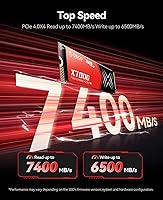
  • Read Speed: Rated for up to 7,400MB/s sequential read, which benefits large file transfers and fast game asset loading on compatible systems.
  • Write Speed: Sequential write is rated at up to 6,500MB/s, supporting fast saves, exports, and write-intensive workflows like video editing.
  • Response Time: Access latency is rated as low as 17 microseconds, contributing to snappier system responsiveness during multitasking and application switching.
  • Endurance: Rated at 1,200TBW (terabytes written), which represents strong longevity headroom for heavy daily workloads over several years.
  • Reliability: Mean time between failures is rated at 1.5 million hours, reflecting the manufacturer's confidence in the NAND flash used in this drive.
  • Cooling System: Ships with a copper heatsink and graphene heat spreader pre-installed, supplemented by intelligent thermal management firmware baked into the drive controller.
  • PS5 Compatibility: Officially compatible with the PlayStation 5 expansion slot, though the console's hardware architecture limits usable speeds to approximately 6,500MB/s regardless of the drive's peak rating.
  • Install Type: Designed as an internal drive requiring physical installation into an M.2 slot; no external enclosure or USB adapter is included or required.
  • Compatible Devices: Verified compatible with PS5 consoles, M.2-equipped desktops, and laptops that support the M.2 2280 form factor.
  • Weight: The drive with heatsink weighs approximately 2.46 ounces, which is typical for an M.2 SSD with an attached thermal solution.
  • Package Contents: The retail package includes the 2TB SSD with the heatsink assembly pre-attached; no additional installation accessories are listed as included.
  • Brand Origin: Manufactured by Shenzhen ORICO Technologies Co., Ltd., a China-based hardware company with an established product line spanning USB hubs, enclosures, and storage devices.
  • Launch Date: First made available in December 2024, making it a relatively recent release with a still-developing owner review history.

Related Reviews
ORICO J10 256GB M.2 NVMe Internal SSD
76%
83%
Read Speed Performance
61%
Write Speed & Cache Behavior
88%
Heatsink Quality
74%
Compatibility
79%
Value for Money
More
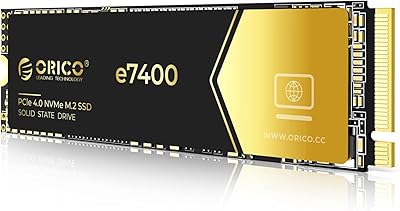
ORICO e7400 2TB M.2 NVMe SSD
81%
91%
Sequential Speed
78%
Random Read/Write
86%
Thermal Management
83%
PS5 Compatibility
88%
Value for Money
More
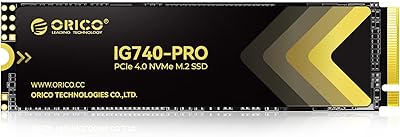
ORICO IG740PRO 2TB NVMe SSD
83%
93%
Read & Write Speed
91%
Endurance & Longevity
84%
Thermal Management
88%
Data Security & Protection
92%
PS5 Compatibility & Installation
More
ORICO O7000 2TB NVMe SSD
78%
88%
Read Performance
74%
Write Performance
91%
Thermal Management
73%
PS5 Compatibility
86%
Value for Money
More
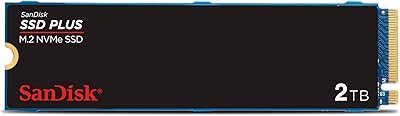
SanDisk 2TB SSD Plus M.2 NVMe SSD
86%
89%
Performance
92%
Ease of Installation
88%
Reliability
91%
Value for Money
90%
Capacity
More
PHIXERO P5000 2TB NVMe SSD
88%
93%
Performance (Speed)
88%
Build Quality
90%
Heat Management
85%
Ease of Installation
92%
Compatibility
More
Fikwot FN955 2TB M.2 NVMe SSD
81%
88%
Read Performance
74%
Write Performance
92%
Value for Money
93%
PS5 Compatibility
67%
Thermal Management
More
RONGSHU RP7000 2TB NVMe SSD
78%
88%
Read/Write Performance
91%
Value for Money
93%
PS5 Compatibility
74%
Thermal Management
67%
Endurance & Longevity
More
TEAMGROUP MP44L 2TB NVMe M.2 SSD
79%
88%
Sequential Read Performance
83%
Sequential Write Performance
74%
Thermal Management
91%
Installation Experience
89%
Value for Money
More
ORICO Y20 2TB SATA SSD
75%
91%
Value for Money
78%
Read & Write Speed
74%
Installation Ease
76%
Build Quality
63%
Long-Term Reliability
More

FAQ

Yes, it fits the PS5 expansion slot natively since it uses the standard M.2 2280 form factor. The heatsink is already attached, which Sony requires for PS5 installation. Just remove the expansion bay cover, slot it in, and the console will format it automatically on next boot.

Realistically, no — and that is not a flaw specific to this drive. Sony's PS5 hardware caps internal SSD throughput at around 5,500 to 6,500MB/s regardless of what any drive is rated for. You will still see a clear improvement over the console's base storage, but the top-end PCIe 4.0 figure on the box reflects PC benchmark conditions, not console performance.

It will work, but it will run at PCIe 3.0 speeds rather than the full PCIe 4.0 rated performance. In practice that means roughly half the peak sequential throughput. For everyday tasks and even most gaming scenarios that is still a solid performer, but if maximizing speed is your priority you would want a PCIe 4.0 compatible system.

No, the heatsink comes pre-attached. It uses a copper and graphene layered design rather than a basic aluminum slab, which is notably better than what many similarly priced drives bundle in. If your motherboard has its own M.2 heatsink cover, you may need to choose one or the other depending on clearance.

On raw specs it is competitive with drives from more recognized names — the endurance rating, speed class, and included heatsink all hold up to comparison. The honest tradeoff is brand track record: ORICO has history in storage accessories, but long-term SSD failure data for this specific model is limited given its late-2024 launch. If that uncertainty matters to you, a drive from a brand with a longer SSD track record might offer more peace of mind.

ORICO does not bundle proprietary drive management software with the X7000. You can monitor health, temperature, and wear levels using free third-party tools like CrystalDiskInfo on Windows, which reads standard NVMe SMART data and works fine with this drive.

After formatting and system overhead, you can expect around 1.85 to 1.9TB of usable space. This is standard across all 2TB drives and is not unique to this NVMe drive — storage manufacturers measure capacity in decimal terabytes while operating systems report in binary, which accounts for the small difference.

It is a capable option for creative workloads, particularly for editors working with 4K footage or large RAW photo libraries. The write speed holds up well for export and cache tasks. That said, for very long sustained writes — think multi-hour 4K renders — any SSD will eventually throttle once the cache fills, and this gaming SSD is no exception.

If your laptop has an accessible M.2 slot, the physical installation is straightforward — remove the back panel, unscrew the existing drive or slot clip, and insert the new one at an angle before pressing it down. The trickier part is checking your laptop's M.2 slot length and PCIe generation beforehand, since not all laptops support M.2 2280 or PCIe 4.0. A quick spec check before buying will prevent any surprises.

It is a fair concern worth raising. The current review base is positive and the specifications are backed by credible ratings, but roughly 100 reviews over a few months is not enough to draw firm conclusions about production consistency or failure rates over time. If you are risk-averse, waiting six to twelve months for a larger review pool to develop is reasonable. If the specs and price make sense for your needs now, the early buyer feedback is encouraging — just keep that warranty information handy.