Overview

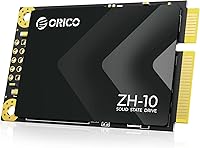
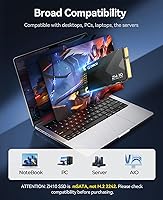
The ORICO ZH10 2TB mSATA Internal SSD is aimed squarely at people trying to squeeze more life out of older hardware — think 2012–2016 era laptops, compact mini PCs, and embedded industrial machines that ship with an mSATA slot rather than the newer M.2 connector. That distinction matters enormously. mSATA and M.2 are not interchangeable, so checking your motherboard or laptop manual before ordering is non-negotiable. ORICO, a Shenzhen-based peripheral maker, has built a steady following for affordable storage accessories, and this drive — launched in late 2024 — extends that catalog into higher-capacity mSATA territory where options from major brands are increasingly scarce.

Features & Benefits

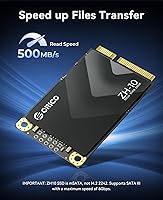
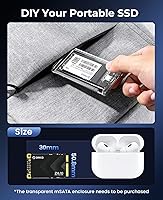
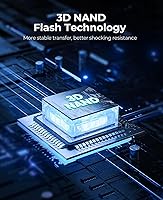
Running on a SATA III interface, this mSATA drive tops out at 500MB/s read and 490MB/s write — respectable figures that will feel like a genuine transformation if you're replacing a spinning hard drive, though anyone coming from a modern NVMe SSD shouldn't expect a speed revelation. The underlying 3D NAND flash construction offers practical durability advantages: better resistance to drops and vibration, and noticeably lower power draw compared to older planar NAND designs. The 50mm x 30mm footprint fits standard mSATA slots cleanly, and backward compatibility with SATA II systems means it works in even older machines, though speeds will be capped. Pairing it with ORICO's TC10 enclosure turns it into a compact portable drive — a genuinely useful second life for the hardware.

Best For

This internal SSD makes the most sense for anyone whose laptop or ultrabook has an mSATA slot — common in machines from roughly 2011 through 2016 — and wants a high-capacity replacement for an aging hard drive without buying a whole new computer. It's equally well-suited to DIY desktop or industrial builds where mSATA is the only internal storage option available. If peak sequential speed is your main concern, faster drives exist, but the ORICO ZH10 delivers where it counts: generous capacity at a price that's hard to argue with. Tinkerers who plan to use it alongside the TC10 enclosure get a useful dual-purpose solution out of a single purchase.

User Feedback

With a 4.5-star average across more than 360 ratings — solid for a drive that only reached the market in late 2024 — buyer sentiment around the ORICO ZH10 skews positive, and its #203 ranking in Internal Solid State Drives on Amazon points to genuine traction rather than a handful of early reviews. Most buyers report a noticeable improvement in boot and load times after replacing an old spinning drive. The recurring criticism involves compatibility confusion: some purchasers expect M.2 support, which is simply a different form factor. Independent speed benchmarks from reviewers remain sparse, so treating the rated figures as independently verified would be premature. Satisfaction runs high when the drive lands in the right machine.

Pros

  • Fitting a full 2TB into an mSATA form factor is genuinely rare and solves a real capacity problem for legacy hardware owners.
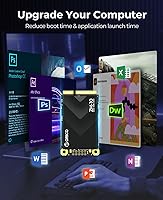
  • The switch from a spinning hard drive to this mSATA drive delivers a noticeable improvement in boot times and application loading.
  • 3D NAND construction makes the drive more resistant to physical shock and vibration than older storage technologies.
  • Lower power draw compared to HDDs helps extend battery life on older laptops that are already energy-constrained.
  • Backward compatibility with SATA II systems means it works in even older machines, not just SATA III hosts.
  • Five capacity options from 128GB to 2TB let buyers right-size the purchase without switching to a different product line.
  • The TC10 enclosure pairing gives buyers a genuine second use case as a portable external drive.
  • Early Amazon ratings skew strongly positive, with buyers frequently citing easy installation as a highlight.
  • The 50mm x 30mm standard footprint means no adapter or modification is needed for compatible slots.

Cons

  • Compatibility confusion between mSATA and M.2 is common and has led to preventable returns — research your slot type before buying.
  • Independently verified speed benchmarks from third-party reviewers are scarce, making it hard to confirm rated performance figures.
  • SATA III throughput is a hard ceiling, so the drive will feel limiting on any workflow that demands fast large-file transfers.
  • ORICO does not have the same warranty infrastructure or long-term support track record as established Western brands.
  • Users with SATA II systems will see speeds capped well below the advertised figures, which may disappoint without prior research.
  • As a relatively new listing from late 2024, the long-term reliability data simply does not exist yet.
  • There is no included installation hardware in the box beyond the drive itself, so a compatible screw may need to be sourced separately.

Ratings

The scores below for the ORICO ZH10 2TB mSATA Internal SSD were generated by our AI after analyzing verified buyer reviews from multiple global markets, with spam, bot-submitted, and incentivized feedback actively filtered out. Each category reflects honest aggregate sentiment — where buyers were consistently happy, the scores show it, and where real frustrations surfaced, those are reflected just as transparently. This is not a promotional summary; it's a ground-level picture of what actual users experienced after installing this drive.

Value for Money
88%
For buyers upgrading an older laptop on a budget, the capacity-to-cost ratio here is difficult to argue with — 2TB in an mSATA form factor is genuinely rare at this price tier. Users frequently noted that getting this much storage into a legacy machine without spending on a full system replacement felt like a smart financial decision.
A small segment of buyers felt the price was harder to justify once they discovered that independent benchmark results were not readily available to confirm the advertised speeds, introducing some uncertainty about what they were actually paying for.
Installation Ease
91%
The physical installation process earned consistent praise across reviews — buyers described the drive slotting directly into the mSATA connector with no adapter, bracket, or special tooling required. Even users with limited hardware experience reported completing the swap in under ten minutes.
The main friction point was not the hardware itself but the lack of any included mounting screw, which some users discovered mid-installation. A handful also noted that no cloning software or migration guide is bundled, leaving first-timers to figure out data transfer independently.
Read/Write Performance
74%
26%
Against a mechanical hard drive, the performance jump is immediately tangible — boot times that previously stretched past a minute can drop to well under 20 seconds, and application loading feels noticeably sharper in daily use. For the workloads this drive is realistically targeting, the SATA III throughput holds up well.
Independent third-party benchmarks are sparse, making it difficult to verify whether the drive consistently hits its rated 500MB/s read ceiling in real systems. Users coming from modern NVMe storage will find the throughput unimpressive, and SATA II hosts cap performance further still.
Compatibility Accuracy
63%
37%
When buyers did their homework and confirmed their machine had a genuine mSATA slot, the drive fitted and was recognized without issue across a range of laptop brands and mini PC platforms. No driver installation is required — the host system simply detects it as a standard SATA device.
Compatibility confusion between mSATA and M.2 is the single most recurring complaint in the review pool, and it has led to a meaningful number of returns. The product listing does include a warning, but buyers routinely overlook it, suggesting the distinction needs to be communicated more prominently at the point of sale.
Build Quality
82%
18%
The drive feels solid in hand for its size and weight class — the PCB is clean, component placement looks tidy, and the 3D NAND construction provides inherent structural advantages over older flash designs in terms of shock and vibration resistance during daily laptop use.
There is no external casing or protective cover on the drive, leaving the PCB exposed once installed, which is standard for the form factor but may unsettle buyers unfamiliar with bare-board internal components. Long-term reliability data simply does not yet exist for a drive that launched in late 2024.
Thermal Management
83%
Users running this internal SSD as an OS drive in everyday laptop use — web browsing, document editing, light media — reported no noticeable heat buildup near the drive bay. The low power draw of 3D NAND is a genuine practical benefit in thin chassis machines with limited airflow.
Under sustained heavy sequential writes, some slight warmth was noted by users running extended file transfers, though no reports of thermal throttling have emerged in the review pool. The absence of any heatspreader means heat management relies entirely on the host chassis design.
Capacity Options
87%
Offering the same ZH10 family in five sizes — 128GB through 2TB — means buyers can match storage to their actual needs without switching to a completely different product line. This is particularly useful for industrial or embedded use cases where the right capacity matters as much as the right form factor.
The very smallest tiers in the range, particularly 128GB, feel difficult to justify given how affordable higher capacities have become across the SSD market broadly. Buyers would be better served stepping up to at least 512GB regardless of budget.
Brand Reliability
69%
31%
ORICO has built a recognizable reputation in the storage accessories space, and buyers familiar with the brand's enclosures and hubs came to this drive with a reasonable baseline of trust. Early review sentiment has been broadly positive, which is an encouraging signal for a new product entry.
ORICO does not carry the same track record or warranty infrastructure as established Western storage brands, and with the ZH10 only a few months old, there is simply no long-term reliability data to draw on. Buyers who prioritize peace of mind over price may prefer a more established name.
Packaging & Presentation
72%
28%
The drive arrives securely packaged and protected from static, which buyers appreciated. The no-frills presentation is consistent with the product's practical, upgrade-focused positioning rather than premium retail branding.
Several users noted the packaging includes very little documentation — no quick-start guide, no compatibility checklist, and no installation tips. For non-technical buyers who are doing their first SSD upgrade, a simple included reference card would meaningfully reduce confusion.
Portability Versatility
78%
22%
The option to pair this mSATA drive with ORICO's TC10 enclosure and use it as a compact portable SSD adds genuine second-life value that competing mSATA drives don't always advertise. Buyers who pursued this route described the resulting form factor as impressively small and practical for carrying personal data.
The TC10 enclosure is not included and must be purchased separately, which means this use case carries an additional cost that buyers need to factor in upfront. The combined setup also cannot match the transfer speeds of a purpose-built USB 3.2 or Thunderbolt portable drive.
OS Boot Performance
86%
Replacing a mechanical hard drive with this internal SSD as the primary OS volume was the most commonly praised use case in buyer reviews, with multiple users specifically calling out how dramatically Windows startup times improved on machines that had previously been frustratingly slow to reach the desktop.
A few users noted that performance gains felt more modest on machines with SATA II controllers or older CPUs, suggesting the bottleneck shifts from storage to other aging components once the hard drive is removed from the equation.
Seller & Support Experience
66%
34%
Buyers who had straightforward transactions reported quick delivery and a product that matched its description. ORICO's Amazon storefront presence appears active, which provides some reassurance for initial purchase support inquiries.
Post-sale support experiences were more mixed — warranty claim processes were described as slower and less clear than those offered by major Western storage brands, and there is limited community or technical documentation available outside the product listing itself.

Suitable for:

The ORICO ZH10 2TB mSATA Internal SSD is the right call for anyone whose older laptop, ultrabook, or mini PC has an mSATA slot and is still limping along on a mechanical hard drive. If your machine dates from roughly 2011 to 2016, there's a reasonable chance it has exactly the connector this drive needs, and swapping in a 2TB SSD will make that computer feel dramatically more responsive for everyday tasks like booting, opening apps, and handling files. It's also a smart pick for DIY enthusiasts building compact desktop setups or working with embedded and industrial hardware where mSATA remains the standard form factor. Buyers who care more about getting a large, reliable storage capacity at a fair price — rather than chasing the absolute fastest transfer speeds on the market — will find the value proposition here genuinely strong. And if you want to double its usefulness, pairing it with ORICO's TC10 enclosure turns it into a portable drive you can carry around, which is a nice bonus for the price of a single purchase.

Not suitable for:

The ORICO ZH10 2TB mSATA Internal SSD is not the right drive if your machine uses an M.2 slot — even the compact M.2 2242 size — because mSATA and M.2 are physically and electrically different standards that are not interchangeable. Buyers upgrading a modern laptop or desktop should look at M.2 SATA or NVMe options instead, as this drive simply will not fit. Performance-focused users should also look elsewhere: with sequential reads topping out near 500MB/s over SATA III, this internal SSD cannot compete with NVMe drives that routinely hit three to seven times those speeds, so it's not suited for heavy video editing workstations, gaming rigs, or any setup where storage throughput is a bottleneck. There is also limited third-party benchmark data publicly available to independently verify the advertised speed figures, which may give data-driven buyers pause. If long-term brand support and warranty infrastructure are priorities for you, a more established storage label might offer greater peace of mind.

Specifications

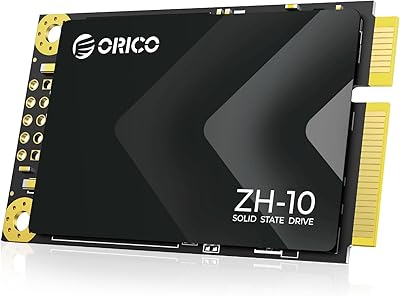
  • Form Factor: This drive uses the mSATA form factor, measuring 50mm x 30mm, which fits the dedicated mSATA slots found in many laptops and mini PCs produced between 2011 and 2016.
  • Interface: It connects via a SATA III 6Gbps (Serial ATA-600) interface and is backward compatible with older SATA II hosts, though speeds will be limited by the host controller in those cases.
  • Sequential Read: Rated sequential read speed reaches up to 500MB/s under optimal SATA III conditions, representing a substantial throughput improvement over mechanical hard drives.
  • Sequential Write: Rated sequential write speed tops out at up to 490MB/s, keeping read and write performance closely matched for balanced everyday workloads.
  • Storage Capacity: This specific variant offers 2TB of usable storage capacity, with the ZH10 family also available in 128GB, 256GB, 512GB, and 1TB configurations.
  • Flash Type: The drive uses 3D NAND flash memory, which stacks memory cells vertically to improve density, endurance, and resistance to physical shock compared to planar NAND designs.
  • Installation Type: Designed for internal installation only, the drive slots directly into a compatible mSATA connector on the host motherboard without requiring any adapter bracket.
  • Weight: The drive weighs 2.08 ounces, making it light enough to have negligible impact on the overall weight of a laptop or compact desktop build.
  • Dimensions: Physical dimensions are 3.94 x 3.15 x 0.39 inches, consistent with the standard full-size mSATA specification.
  • Compatible Devices: Officially listed compatible device types include laptops, ultrabooks, desktop computers, and mini PCs that expose a physical mSATA connector.
  • Brand & Manufacturer: The ZH10 is manufactured by Shenzhen ORICO Technologies Co., Ltd., a Chinese peripheral brand known primarily for storage enclosures and accessories.
  • Model Series: This drive belongs to ORICO's ZH10 series, which is dedicated to the mSATA form factor and should not be confused with ORICO's M.2-based product lines.
  • Enclosure Compatibility: The drive is compatible with ORICO's TC10 transparent mSATA enclosure, allowing it to be repurposed as a compact portable external SSD when not used internally.
  • Power Consumption: 3D NAND technology enables lower operating power draw compared to older planar NAND or spinning hard drives, which is particularly relevant for battery-powered laptops.
  • Availability Date: The ZH10 series became available on Amazon in September 2024, making it a relatively recent addition to the mSATA storage market.
  • Market Ranking: As of available data, the drive holds a Best Sellers Rank of #203 in the Internal Solid State Drives category on Amazon, indicating meaningful sales volume for a new listing.
  • Included Contents: The package includes only the mSATA SSD itself; no mounting screws, cables, cloning software, or enclosure accessories are included in the box.
  • Backward Compatibility: The drive is backward compatible with SATA II host controllers, though actual transfer speeds in SATA II systems will be limited to that interface's maximum bandwidth of approximately 300MB/s.

Related Reviews
ORICO ZH10 1TB mSATA Internal SSD
80%
88%
Value for Money
79%
Read Speed Performance
76%
Write Speed Performance
91%
Installation Ease
62%
Compatibility Accuracy
More
SanDisk SSD Plus 2TB Internal SSD
82%
88%
Read Speed Performance
74%
Write Speed Performance
94%
Installation & Compatibility
91%
Value for Money
86%
Long-Term Durability & Reliability
More
ORICO ZH10 128GB mSATA SSD
76%
88%
Value for Money
82%
Read Performance
67%
Write Performance
71%
Compatibility
86%
Installation Ease
More
ORICO C10 2TB External SSD
78%
88%
Transfer Speed
84%
Build Quality
91%
Portability & Size
79%
Value for Money
76%
Cross-Platform Compatibility
More
ORICO Y20 2TB SATA SSD
75%
91%
Value for Money
78%
Read & Write Speed
74%
Installation Ease
76%
Build Quality
63%
Long-Term Reliability
More
ORICO X7000 2TB NVMe SSD
79%
88%
Read & Write Performance
84%
PS5 Compatibility
91%
Thermal Management
93%
Installation Ease
82%
Value for Money
More
ORICO J10 256GB M.2 NVMe Internal SSD
76%
83%
Read Speed Performance
61%
Write Speed & Cache Behavior
88%
Heatsink Quality
74%
Compatibility
79%
Value for Money
More
ORICO e7400 2TB M.2 NVMe SSD
81%
91%
Sequential Speed
78%
Random Read/Write
86%
Thermal Management
83%
PS5 Compatibility
88%
Value for Money
More
Patriot P210 2TB Internal SATA SSD
80%
93%
Value for Money
76%
Read & Write Speed
91%
Installation Ease
78%
Compatibility
67%
Long-term Reliability
More
ORICO B5PLUS 2TB Portable External SSD
74%
94%
Portability
78%
Transfer Speed
73%
Build Quality
81%
Value for Money
91%
Plug-and-Play Ease
More

FAQ

The easiest way is to check your laptop's service manual or the manufacturer's support page — search your exact model number plus the word 'specifications.' mSATA slots have a distinct edge connector that looks similar to a Mini PCI-e slot, while M.2 slots are typically labeled as such and come in different key configurations. If you open the bottom panel and see a small card roughly the size of a stick of gum with no notch labeling, double-check before assuming it's mSATA.

Yes, it will work. The ORICO ZH10 2TB mSATA Internal SSD is backward compatible with SATA II, so it will fit and function normally in older systems. The trade-off is that your actual transfer speeds will be capped by the SATA II ceiling of around 300MB/s rather than the drive's rated 500MB/s — still a major improvement over a mechanical hard drive, but worth knowing upfront.

Absolutely — that's one of its most common use cases. As long as your BIOS or UEFI recognizes the mSATA slot as a bootable device (most systems that have one do), you can install your OS directly onto this internal SSD and experience noticeably faster startup times.

It's sold separately. The drive ships on its own, so if you want to use it as a portable external drive via the TC10 enclosure, you'll need to purchase that accessory independently. It's a useful option, but it adds to the total cost.

In terms of raw sequential throughput, they're roughly equivalent — both are limited by the SATA III interface to around 500-550MB/s reads. The difference is purely physical form factor. This mSATA drive is designed for the compact mSATA slot, while a 2.5-inch SSD goes into a traditional drive bay. Choose based on which slot your machine actually has, not on speed expectations.

No, and this is the most important thing to confirm before buying. mSATA and M.2 are different standards with different connectors, even though some drives look similar in size. Physically inserting one into the other's slot is not possible without damage. Always verify which slot type your system has before ordering.

No software is included in the box. You'll need to handle data migration yourself using a third-party tool. Free options like Macrium Reflect or Clonezilla work well for this, and there are plenty of step-by-step guides online for migrating an OS to a new SSD.

For everyday tasks — booting into Windows, opening a browser, launching Office apps — the difference is dramatic. A typical mechanical hard drive might take 60 to 90 seconds to boot; an SSD in the same machine often cuts that to under 15 seconds. File transfers and application loading will also feel much snappier. It's one of the highest-impact upgrades you can make to an older machine.

ORICO typically offers a limited warranty on its drives, but the specific terms should be confirmed at the time of purchase through the Amazon listing or ORICO's official support channels. As a Chinese brand without a broad Western retail presence, warranty claims may involve shipping the unit back, so it's worth reading the fine print before buying if after-sales support is a priority for you.

SSDs in general run much cooler than hard drives, and 3D NAND designs are particularly efficient. Under typical workloads — browsing, document editing, light media playback — thermal output from this mSATA drive should be minimal. In sustained heavy transfer scenarios it may warm slightly, but it's unlikely to cause thermal issues in a well-ventilated laptop chassis.