Overview

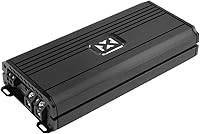
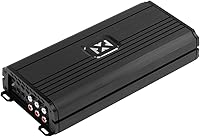
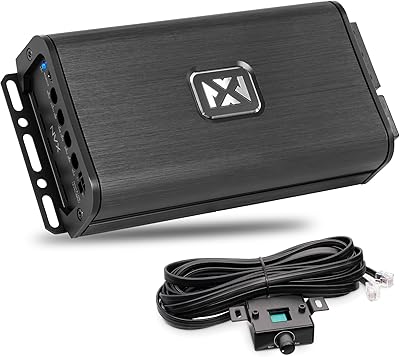
The NVX NDA11005 5-Channel Class-D Car Amplifier is a compact, practical solution for anyone wanting to power their entire car audio system from a single unit. It handles four full-range speakers plus a dedicated subwoofer channel, which means one amp replaces what used to require two separate installs. At its price point, it sits comfortably in mid-range territory, competing with brands like Rockford Fosgate and Kenwood without trying to match boutique-level builds. Physically, it measures just over 10 inches long, making it easy to slide under a seat or tuck into a compact trunk. Solid value, but go in with realistic expectations.
Features & Benefits

One of the stronger selling points of this 5-channel amp is its flexibility across impedance loads — you can run it at 4 ohms, drop to 2 ohms for more headroom, or bridge channels depending on your speaker setup. The variable high-pass filter spans 40 to 400 Hz, and a subsonic filter handles the low end down to 10 Hz, giving you genuine crossover control without an external processor. Speaker-level inputs with signal-sensing turn-on make wiring into a factory head unit genuinely straightforward. The included wired bass remote lets you dial the sub up or down from the driver seat. Budget for a proper 4 AWG wiring kit — it is required and not included in the box.

Best For

This Class-D car amp is purpose-built for the driver who wants to upgrade from a flat factory system without the complexity of a multi-amp setup. If you are keeping your OEM head unit, the high-level inputs make integration straightforward — no aftermarket receiver required. It also shines in smaller vehicles like hatchbacks and compact SUVs, where space under the seat or in a shallow trunk is tight. Buyers who want basic tuning without investing in a separate DSP will appreciate having filters built right in. If you are running a large, power-hungry subwoofer alongside high-end component speakers, you may outgrow it — but for an everyday upgrade, it hits a practical sweet spot.

User Feedback

Buyers consistently highlight clean output at moderate listening levels and praise how painlessly the install goes when using speaker-level inputs. The remote bass knob earns positive marks for being responsive and easy to reach while driving. On the flip side, some users note the amp runs noticeably warm during extended high-volume sessions, so where you mount it matters. There is also the familiar frustration around peak versus RMS figures — 2200W peak sounds bold, but the 1100W RMS is what reflects real-world output. Long-term reliability appears solid based on early ownership reports, though the product is still relatively new. At this price tier, competing options from Rockford Fosgate or Alpine may edge it out on thermal management, but most buyers consider the overall trade-off worthwhile.

Pros

  • Powers all five channels from a single, compact unit — no second amp needed
  • High-level inputs make it genuinely painless to integrate with a stock factory head unit
  • Built-in high-pass and subsonic filters eliminate the need for a separate crossover or DSP
  • The included wired bass remote is a practical touch that many similarly priced amps skip
  • Four-way protection circuitry reduces the risk of damage during daily driving conditions
  • Slim dimensions make under-seat or shallow trunk installs realistic in smaller vehicles
  • Flexible impedance options let installers tune output to match a range of speaker setups
  • Clean, distortion-free output at moderate listening levels is a recurring praise point from buyers
  • At its price point, the feature set is hard to beat for an all-in-one car audio solution

Cons

  • Runs noticeably warm under sustained high-volume use — mount location and airflow matter
  • A 4 AWG wiring kit is required but not included, adding cost that is easy to overlook upfront
  • The 2200W peak figure is marketing math; real continuous output is the 1100W RMS number
  • Subwoofer channel power may not satisfy buyers running larger, more demanding woofers
  • NVX is a lesser-known brand, and long-term reliability data is still limited given its recent release
  • Competing amps from Alpine or Rockford Fosgate likely offer better thermal management at a higher price
  • Signal-sensing turn-on can be inconsistent in some vehicle electrical environments
  • Chassis build quality feels functional rather than robust compared to higher-tier options
  • Limited installer community and third-party tuning guides compared to more established brands

Ratings

Our AI rating engine analyzed verified global buyer reviews for the NVX NDA11005 5-Channel Class-D Car Amplifier, actively filtering out incentivized, duplicate, and bot-generated submissions to surface what real installers and daily drivers actually experienced. Scores reflect a candid synthesis of both the genuine strengths and the frustrations that surfaced consistently across ownership reports. Nothing is glossed over — where this 5-channel amp earns its praise and where it falls short are both represented transparently below.

Value for Money
88%
For buyers who want to power four speakers and a subwoofer without splitting budget across two separate amplifiers, the pricing of this Class-D car amp is hard to argue with. Most owners felt they received considerably more usable hardware than the price tag would suggest, especially given the built-in filters and included bass remote.
A small but vocal group felt the value perception was undercut once they factored in the separately purchased 4 AWG wiring kit, which adds meaningful cost to the total install. Buyers comparing against occasional sales pricing from Rockford Fosgate or Alpine also noted the gap closes faster than expected at the premium tier.
Installation Ease
91%
The high-level speaker inputs with signal-sensing turn-on are the standout feature for installation convenience — owners consistently praised how this eliminated the need for RCA outputs from the head unit entirely. First-time installers reported completing the full wiring job in a single afternoon without professional help.
A few users noted the terminal labeling on the unit is small and cramped, requiring close attention during wiring. Those installing in tight spaces also mentioned the 4 AWG power wire requirement made routing through factory grommets more difficult than expected.
Sound Quality
79%
21%
At moderate listening volumes, buyers described the output as clean and well-controlled, with good channel separation across the front and rear speakers during everyday commutes. The built-in crossover filters noticeably reduced muddiness between the sub and full-range channels without requiring an external processor.
At higher volume levels, some listeners detected a slight softening in clarity compared to more expensive competitors. Audiophiles accustomed to premium amplification found the noise floor acceptable but not exceptional, particularly on the full-range channels when pushed toward their rated limits.
Thermal Management
63%
37%
During typical daily driving at moderate output levels, the NVX five-channel amplifier stays at a manageable temperature, and the 4-way protection circuitry does appear to function reliably as a safety net when things get warm. Owners who mounted it in open, ventilated locations reported no shutdowns during normal use.
Extended high-volume sessions — long highway drives with bass-heavy music — produced consistent reports of the amp running noticeably hot. Several buyers experienced thermal protection triggering a shutdown during demanding use, suggesting the chassis dissipates heat adequately for casual listening but struggles under sustained stress.
Power Accuracy
67%
33%
The 1100W RMS continuous figure holds up reasonably well under real-world conditions, and buyers who set up their system around the RMS spec rather than the peak number came away satisfied with the output levels. At 2 ohms the subwoofer channel delivers a perceptible bump in bass authority.
The 2200W peak figure frustrates buyers who treat it as a usable power rating — it is not, and some owners felt misled before understanding the distinction. Real-world headroom at 4 ohms is modest for the full-range channels, and demanding speaker setups will expose the ceiling quickly.
Build Quality
72%
28%
The chassis feels solid and purposeful for its weight class, and the terminal blocks accept wiring cleanly without the loose tolerances sometimes found on budget amplifiers. The overall fit and finish is functional and professional-looking enough for visible installs in trunk builds.
The casing does not inspire the same confidence as heavier, thicker-walled competitors from JL Audio or Hertz at higher price points. A handful of buyers noted the gain and filter knobs feel slightly loose compared to what they expected, though none reported functional failures from this.
Compact Form Factor
93%
Measuring just over 10 inches long and under 2 inches tall, this is one of the more genuinely compact 5-channel options available, and owners of hatchbacks, compact SUVs, and sedans praised how cleanly it disappeared under rear seats or into shallow trunk panels. The low profile opens up install locations that a bulkier amp simply cannot access.
The compact size does come with a trade-off in terminal spacing — four channels of speaker wire plus power and ground leads in a tight area can feel crowded during initial wiring. Installers with larger hands or thicker wire gauge reported the process requiring patience.
Bass Remote Knob
82%
18%
The included wired remote knob is a genuine convenience that many similarly priced amps skip or charge extra for, and buyers appreciated being able to reduce subwoofer output at a traffic stop without adjusting the head unit. The control feels responsive with no noticeable lag or jump in level adjustment.
The knob itself has a somewhat basic plastic construction, and a few long-term owners reported the pot developing minor channel inconsistency after repeated use over several months. The cable length is adequate for most installs but tight if the amp is mounted far from the dashboard.
Filter Versatility
84%
Having both a variable high-pass filter and a subsonic filter built into a single amplifier at this price point gives installers a meaningful degree of tuning control that usually requires a separate processor. Buyers who took time to dial in the crossover points reported a noticeably cleaner integration between sub and door speakers.
The filter adjustment controls are small rotary pots with no detents or marked positions, making precise, repeatable tuning difficult without a test tone or measurement tool. Casual users often set them by ear, which works but leaves measurable room for optimization on the table.
Channel Flexibility
86%
The ability to run the amp at 4 ohms, 2 ohms, or in bridged configuration gives installers real options when matching the unit to different speaker impedances and layouts. Buyers who bridged the front channels for a two-way high-power stage reported solid results without introducing distortion.
Bridging reduces the number of usable full-range channels from four to two, which limits flexibility for buyers who later want to add rear fill speakers. The subwoofer channel power does not change across configurations, which is a minor limitation for users hoping to see a bump in sub output from bridging.
Factory Integration
89%
Signal-sensing turn-on worked reliably across a wide range of factory head units in user reports, including vehicles where traditional remote wire access is buried or nonexistent. This feature alone makes the NVX five-channel amplifier considerably more accessible for OEM-integration installs than most competitors at the same price.
In a small number of vehicles with complex factory amplifier systems or DSP-equipped OEM audio setups, the signal-sensing turn-on triggered unreliably or caused minor pop noise on startup. These cases appear to be edge cases rather than systematic failures, but worth researching for your specific vehicle.
Reliability & Longevity
71%
29%
Short to medium-term reliability reports are generally positive, with most owners experiencing no functional issues during the first six to twelve months of use. The 4-way protection system appears to do its job in preventing damage during installation errors or brief overload events.
Because this model only launched in mid-2024, multi-year reliability data simply does not exist yet, which introduces some uncertainty for buyers prioritizing long-term durability. The brand also has a smaller service and support network than established competitors, which could complicate warranty claims depending on where you purchased.
Noise Floor
74%
26%
At typical listening levels in a daily driver, background hiss and alternator whine were not commonly reported issues, suggesting the amp handles grounding and shielding adequately for its class. Owners who followed standard grounding best practices found the output clean enough for everyday music enjoyment.
In quieter musical passages at higher gain settings, a small number of users noticed low-level hiss that more expensive amplifiers do not exhibit. Sensitivity to install quality is relatively high — a poor ground connection will surface noise artifacts faster on this unit than on more forgiving premium designs.

Suitable for:

The NVX NDA11005 5-Channel Class-D Car Amplifier is an excellent fit for everyday drivers who want to meaningfully upgrade their sound system without building a complicated multi-amp install. It is especially well-suited to owners who are keeping their factory head unit, since the high-level speaker inputs remove the need for an aftermarket receiver entirely. Compact vehicle owners — think hatchbacks, small SUVs, and sedans with limited trunk space — will appreciate how easily this amp tucks away given its slim profile. If your goal is powering four door speakers and a subwoofer from one unit while staying within a reasonable budget, this 5-channel amp covers that scenario cleanly. It also works well for first-time installers who want built-in filtering tools without the added cost and complexity of a standalone DSP or equalizer.

Not suitable for:

The NVX NDA11005 5-Channel Class-D Car Amplifier is not the right choice for serious enthusiasts chasing high headroom with power-hungry, competition-grade speakers or large subwoofers. If you plan to run a 12-inch or 15-inch sub that demands 600W RMS or more on its own, the subwoofer channel here will leave you wanting. Buyers who intend to push the system at high volumes for extended periods should be aware that thermal performance at the limits has drawn some concern — proper mounting with adequate airflow is not optional, it is essential. Audiophiles expecting the tighter channel separation and lower noise floor of premium brands like JL Audio or Hertz will likely find this Class-D car amp falls short at that reference level. Finally, if you are not prepared to budget for a 4 AWG wiring kit separately, factor that into the total cost before purchasing.
Specifications

  • Brand: This amplifier is manufactured by NVX, a car audio brand focused on value-driven performance products.
  • Model Number: The official model designation is NDA11005, part of NVX's N-Series amplifier lineup.
  • Amplifier Class: This unit operates as a Class-D amplifier, which prioritizes energy efficiency and reduced heat output compared to Class-AB designs.
  • Channels: The amplifier provides five discrete output channels: four full-range channels and one dedicated subwoofer channel.
  • RMS Power: Continuous RMS output is rated at 1100W total across all five channels under standard operating conditions.
  • Peak Power: Peak power is rated at 2200W, a figure representing momentary burst capacity rather than sustained output.
  • 4-Ohm Output: At 4 ohms, the amplifier delivers 100W RMS per full-range channel and 315W RMS on the subwoofer channel.
  • 2-Ohm Output: At 2 ohms, output increases to 150W RMS per full-range channel and 500W RMS on the subwoofer channel.
  • Bridged Output: In bridged mode, the full-range channels produce 300W RMS per pair, with the subwoofer channel maintaining 500W RMS.
  • High-Pass Filter: A variable high-pass filter is built in, adjustable between 40 Hz and 400 Hz to protect full-range speakers from low-frequency distortion.
  • Subsonic Filter: An integrated subsonic filter is adjustable from 10 Hz to 55 Hz, preventing the subwoofer from reproducing inaudible frequencies that can cause damage.
  • Protection: Four-way protection circuitry guards against thermal overload, electrical overload, speaker short circuits, and DC offset conditions.
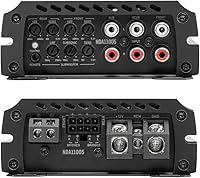
  • Signal Inputs: The amplifier accepts speaker-level (high-level) inputs with automatic signal-sensing remote turn-on, enabling direct connection to factory head units.
  • Bass Remote: A wired remote bass level control is included in the box, allowing the driver to adjust subwoofer output without reaching the amp.
  • Dimensions: The amplifier measures 10.15″ in length, 4.42″ in width, and 1.73″ in height, making it suitable for under-seat or shallow trunk installations.
  • Weight: The unit weighs 3.92 lbs, light enough for flexible mounting in a variety of vehicle locations.
  • Wiring Requirement: Optimal installation requires a 4 AWG gauge amplifier wiring kit, which is not included and must be purchased separately.
  • Mounting Type: The amplifier is designed for freestanding or surface-mounted installation and does not require a dedicated rack enclosure.
  • First Available: The NDA11005 became available for purchase in August 2024, making it a relatively recent addition to the NVX lineup.
  • Package Weight: The complete retail package, including accessories, weighs approximately 3.92 lbs and ships in an 11.61″ x 6.65″ x 2.72″ box.

Related Reviews
NVX VADM4 v2 4-Channel Amplifier
84%
93%
Power Accuracy
91%
Compact Form Factor
89%
Marine & Weather Durability
88%
Thermal Management
84%
Crossover Flexibility
More
Soundstream RSM4.1200D 4-Channel Car Amplifier
71%
91%
Ease of Installation
83%
Value for Money
71%
Sound Quality
67%
Build Quality
58%
Thermal Management
More
NVX VADM5 v2 5-Channel Car Amplifier
79%
93%
Compact Form Factor
88%
Installation Ease
67%
Power Output (RMS)
81%
Sound Clarity
62%
Thermal Management
More
Plinius PHF100.4D 4-Channel Car Amplifier
74%
88%
Value for Money
76%
Sound Quality
63%
Power Output
54%
Thermal Management
84%
Ease of Installation
More
Cerwin-Vega Mobile CVP2500.5D 2,500-Watt 5-Channel Class D Amplifier
84%
94%
Performance & Power Output
88%
Sound Clarity & Bass
85%
Ease of Installation
72%
Thermal Management
90%
Build Quality & Durability
More
Recoil RED1800.5 5-Channel Car Amplifier
77%
91%
Value for Money
88%
Mono Channel Power
86%
Installation Experience
63%
Gain Calibration Ease
74%
Full-Range Channel Performance
More
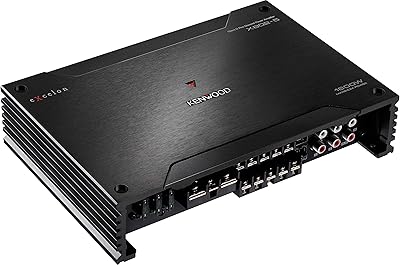
Kenwood X802-5 eXcelon 5 Channel Car Audio Amplifier
88%
92%
Sound Quality
85%
Installation Ease
88%
Build Quality
90%
Performance at High Volume
87%
Bass Enhancement
More
Stinger MT-1000.5 5-Channel Car Amplifier
75%
81%
Value for Money
84%
Ease of Installation
58%
Real-World Power Output
63%
Thermal Management
88%
Built-in Crossover Filters
More
NVX VADM1v2 Monoblock Amplifier
82%
88%
Power Output
93%
Compact Form Factor
71%
Thermal Management
86%
Tuning Controls
74%
High-Level Input Usability
More
Rockville dB55 5-Channel Car Amplifier
75%
91%
Value for Money
83%
Sound Quality at Moderate Volumes
78%
Bass Output & Subwoofer Performance
62%
Power Accuracy & Transparency
58%
Thermal Management & Heat
More

FAQ

You can absolutely use it with a factory head unit. The high-level speaker inputs let you tap directly into existing speaker wiring, and the signal-sensing turn-on means the amp wakes up automatically when the stereo does. No aftermarket receiver required.

Peak power is the absolute maximum the amp can handle for a very brief moment under ideal conditions — it is not what you get continuously. RMS is the honest number: 1100W total across all five channels, sustained during normal use. When comparing amplifiers, always use RMS figures.

It has a good chance of fitting, given its slim 1.73-inch height and 10.15-inch length. That said, measure your available clearance before mounting, since seat rails and floor channels vary significantly between vehicles. Sedans and compact SUVs with flat under-seat areas tend to work well.

You will need to purchase a 4 AWG gauge wiring kit separately — it is not included. Budget for this before you buy, since skipping the correct gauge wire will limit performance and could create safety issues.

Yes, the subwoofer channel is stable at 2 ohms and will output 500W RMS at that load, which is the highest output this amp offers on any single channel. Just make sure your subwoofer's impedance and power handling actually match before wiring it up.

Class-D amps run cooler than older Class-AB designs, but this one does generate noticeable heat during extended high-volume listening. Mount it somewhere with reasonable airflow — avoid enclosing it completely in carpet or sealing it behind panels with no ventilation.

The remote knob plugs into a dedicated port on the amp and lets you raise or lower the subwoofer level from the driver seat without adjusting the head unit. NVX does not publish an exact cable length, so if your install requires a longer run, check before mounting the amp too far from the dash.

Yes, bridging is supported. In bridged mode the four full-range channels combine into two outputs at 300W RMS each, which works well if you are running a two-speaker front stage and want more power per channel than the standard configuration provides.

It is one of the more approachable options at this price point. The high-level inputs remove the need for RCA cables from the head unit, the signal-sensing turn-on handles remote wiring automatically, and the built-in filters mean you do not need a separate crossover. Just follow a wiring guide carefully and take your time.

A two-amp setup gives you more flexibility and typically better channel separation, but it also means more wiring, more space used, and a higher total cost. This Class-D car amp trades some of that ceiling for simplicity and a single compact footprint, which is the right call for most everyday upgrade installs.