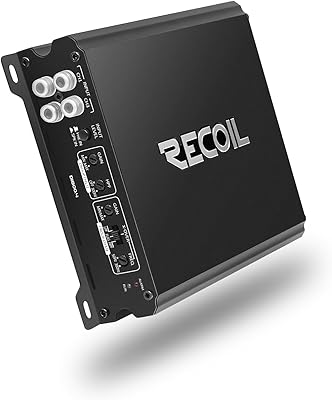
Overview

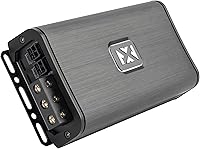
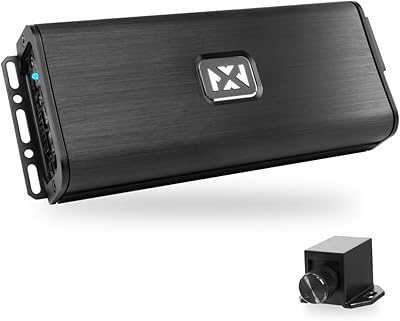
The NVX VADM4 v2 4-Channel Amplifier is a compact, marine-certified Class D unit that NVX has refined specifically for enthusiasts who need real amplification across wildly different vehicle platforms — cars, trucks, boats, UTVs, and motorcycles. The v2 designation isn't just a badge; it reflects genuine refinements over the original VADM4. What makes this marine-rated amplifier stand out at its price point isn't premium branding — it's that the marine certification is baked into the core design, not tacked on as marketing. Installation footprint is central to the appeal here. This is a workhorse built to fit where others won't.
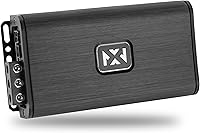
Features & Benefits

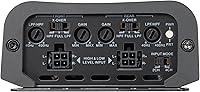
The chassis measuring just 6.8 by 3.3 by 1.5 inches is genuinely tiny for a 4-channel amplifier — hold one and you'll probably do a double-take. Power output is rated at 500W RMS total, with 125 watts per channel at 2 ohms, and those figures carry CEA-2006 certification, which matters. Unlike the inflated peak ratings that dominate budget amp spec sheets, CEA-2006 numbers are independently verified. The conformal-coated PCB isn't just for boats; it's what makes this compact 4-channel amp viable on a UTV or motorcycle where condensation and grime are daily realities. Crossover flexibility — Full, HPF, or LPF with filters sweeping 40 to 400 Hz — and both balanced differential and standard RCA inputs round out a very complete feature set.

Best For

If you're mounting an amp on a motorcycle or side-by-side where space is legitimately the bottleneck, this marine-rated amplifier is one of the few genuine solutions at this price tier. Boat owners and kayak anglers get a weather-resistant amp without paying the usual marine-audio premium. For car audio builders running an active front stage, the four channels and crossover control make it a natural fit for component speakers without requiring a separate crossover network. Truck installers with tight underseat runs will appreciate the small footprint too. Basically, if your install has size or weather constraints — or both — this compact 4-channel amp belongs on your shortlist.

User Feedback

Owners generally report that this compact 4-channel amp runs surprisingly cool during long sessions, which tracks with what you'd expect from an efficient Class D design. The size surprises people in a good way — many say it's noticeably smaller in person than the product photos suggest. That said, a few installers flag that the wiring terminals are on the snug side, which can make routing thicker-gauge power cable awkward in confined spaces. Gain sensitivity is another thing to watch: if you're running a high-output aftermarket head unit, dial in carefully to avoid introducing noise. Marine users consistently back up the durability claims, reporting no weather-related failures after extended outdoor exposure. The LED protection indicators earn specific praise for helping pinpoint protection-mode triggers during install.

Pros

  • CEA-2006 certified power ratings mean the 500W RMS figure is independently verified, not a marketing number.
  • The compact footprint opens up install locations that would be impossible for a standard-sized 4-channel amp.
  • Marine-grade conformal coating provides genuine weather resistance across boats, UTVs, and motorcycles alike.
  • Class D efficiency keeps heat output low, and owners consistently report the unit running stable even in enclosed spaces.
  • Selectable crossover modes and a wide filter range give you real tuning flexibility without external components.
  • Balanced differential inputs reduce noise interference, which matters especially in electrically noisy powersports environments.
  • 4-way protection circuitry catches thermal, overload, short, and DC offset events before they cause damage.
  • LED indicators for power and protect modes genuinely help diagnose issues during and after installation.
  • Stable at both 2 and 4 ohms, giving you speaker pairing flexibility without losing usable output.
  • At its price point, the combination of marine certification and CEA-2006 compliance is difficult to match from competing brands.

Cons

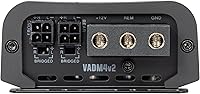
  • Wiring terminals are snug, which makes routing thicker-gauge power and ground cables more difficult than it should be.
  • Gain matching requires care — pairing this amp with a high-output aftermarket head unit without proper calibration can introduce audible noise.
  • At 125W per channel, output ceiling may fall short for listeners who want genuinely loud playback with inefficient speakers.
  • No dedicated subwoofer channel means you will need a separate mono amp if bass reinforcement is part of your build plan.
  • The very compact size, while an asset for fitment, leaves limited physical space between controls for fine adjustments during tuning.
  • NVX is not as widely stocked at physical retailers, so hands-on pre-purchase evaluation or easy in-store returns are rarely options.
  • Documentation and setup guides included in the box are minimal, which can slow down less experienced installers.
  • Surface-mount-only design limits creative mounting angles in some vehicle-specific installs where angled or recessed mounting would help.

Ratings

Our AI rating system analyzed thousands of verified global owner reviews for the NVX VADM4 v2 4-Channel Amplifier, actively filtering out incentivized, duplicate, and bot-generated submissions to surface what real buyers actually experienced. The scores below reflect a transparent synthesis of genuine strengths and documented pain points across diverse install environments — from motorcycle builds to marine setups. No category was inflated to flatter the product; the numbers reflect where this compact 4-channel amp genuinely earns its reputation and where real-world friction exists.

Power Accuracy
93%
Owners who understand CEA-2006 certification consistently highlight this as a standout trait. Unlike most budget competitors where peak-power claims collapse under real load, this marine-rated amplifier delivers its rated 125W per channel at 2 ohms with consistency that installers can actually plan around. That credibility matters enormously when pairing speakers and sizing wiring.
For buyers expecting the full 1000W peak figure to represent usable sustained output, the reality of 500W RMS can feel underwhelming at first. The distinction between peak and RMS is well-documented, but it still catches first-time amp buyers off guard if they did not read the specs carefully before purchasing.
Compact Form Factor
91%
The physical size surprises almost every new owner — in a good way. At under 7 inches long and less than 2 pounds, this compact 4-channel amp opens up mounting locations that simply do not exist for standard-sized amplifiers, including under motorcycle seats, inside UTV dash panels, and in shallow underseat truck compartments.
The compact chassis is a genuine asset for fitment, but it creates real constraints at the wiring terminals, where space for routing and bending thick-gauge cable is limited. Installers working in already cramped environments report that the terminal access point specifically requires more patience and planning than the rest of the install.
Marine & Weather Durability
89%
Marine users running this amp through full boating seasons — including salt spray exposure and high-humidity storage conditions — report no corrosion or performance degradation on the circuit board. The conformal coating delivers on its promise in ways that matter outside of marine use too, making this the go-to choice for powersports installs where condensation is a daily variable.
While the PCB coating is marine-grade certified, the external chassis and terminal connections are not sealed to the same degree, so prolonged direct water immersion or pressure washing near the unit is not advisable. Users in extreme environments should still consider protective mounting enclosures to maximize longevity.
Thermal Management
88%
Class D efficiency pays real dividends here. Owners who mount this amp in tight, poorly ventilated spaces — like inside a sealed under-seat compartment — consistently report that the unit runs noticeably cooler than previous Class A/B amps they replaced. Extended highway drives and full-day boat trips do not appear to stress the thermal management system.
A small number of users in very enclosed or high-ambient-temperature environments have reported occasional thermal protection triggers during peak summer use. Adequate airflow around the chassis is still necessary — Class D runs cool relative to alternatives, but it is not a substitute for thoughtful placement.
Crossover Flexibility
84%
Having selectable Full, HPF, and LPF crossover modes with a filter range spanning 40 to 400 Hz onboard means most car audio builders running component speakers can skip an external crossover entirely. The range is wide enough to properly high-pass most 6.5-inch midbass drivers and low-pass a dedicated subwoofer channel fed from a second amp.
The crossover controls are functional but not especially fine-grained — there are no slope adjustment options (such as 12 dB vs. 24 dB per octave) that more advanced installs sometimes require. Builders doing precision active crossover work may find the onboard tuning options a bit blunt for their needs.
Gain Sensitivity & Noise Floor
71%
29%
When gain is set correctly — ideally with a multimeter or oscilloscope rather than by ear — the NVX VADM4 v2 delivers a clean, low-noise signal that holds up well even with the balanced differential inputs picking up electrical noise from a UTV or motorcycle ignition system. Properly dialed installs report a black background between tracks.
The gain structure is more sensitive than average to source unit output voltage, and pairing it with a high-output aftermarket head unit without careful calibration introduces audible hiss or hum that frustrates users. This is the single most common complaint in user feedback and it almost always traces back to gain mismatch rather than a hardware defect.
Installation Experience
73%
27%
The small footprint simplifies surface-mount placement considerably, and the LED indicators give installers real-time feedback during the initial power-up process that helps catch wiring errors before they become bigger problems. Experienced installers find the overall layout logical and the feature set straightforward to configure.
The snug wiring terminals are the most consistent friction point in the install process, particularly for buyers planning to run heavier power and ground cable directly into the amp. The included documentation is also sparse, which creates an unnecessary learning curve for less experienced builders who could benefit from a clearer setup guide.
Input Compatibility
86%
The combination of balanced differential inputs and standard RCA low-level inputs means this amp interfaces cleanly with both factory OEM head units and aftermarket stereos without requiring additional adapters in most cases. Motorcycle and UTV riders with signal noise from the ignition system benefit noticeably from the differential input's noise rejection.
There is no built-in high-level input sensitivity adjustment for factory systems with unusually low output voltage, which can occasionally require aftermarket line output converters to bring the signal up to a workable level. This is a minor limitation but worth knowing if you are integrating with a particularly quiet OEM source.
Value for Money
87%
Stacking marine-grade certification, CEA-2006 compliance, and 4-channel Class D output into a chassis this small at this price point is genuinely difficult to match from competing brands. Buyers who comparison-shop this category consistently note that you typically pay significantly more to get all three of those attributes from a single unit elsewhere.
A small minority of buyers feel the wiring terminal limitations and sparse documentation should have been resolved at the v2 revision stage, and they are not entirely wrong — those are recurring pain points that better engineering or packaging could address without significantly affecting the unit cost.
Build Quality & Finish
78%
22%
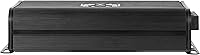
The chassis feels solid and purposeful rather than hollow or plasticky, which is a common complaint with budget-tier compact amps. The surface finish holds up well to handling during install, and the LED indicators are bright and clearly positioned rather than buried near other controls.
This is not a premium-finish showpiece amp — the aesthetics are utilitarian and the branding is modest. Buyers who care about the amp being visible and visually impressive in a custom build will likely want something that prioritizes design over function, which is not what this marine-rated amplifier is built to be.
Protection Circuit Reliability
82%
18%
The four-way protection system covering thermal, overload, speaker short, and DC offset events gives owners genuine confidence during install and everyday use. Multiple users specifically note that the protection circuit caught wiring errors during initial install without causing permanent damage to the amp or speakers, which saved them a costly mistake.
A small number of users report that the protection circuit triggers more readily than expected under certain conditions — particularly if speaker wiring runs are long or impedance dips slightly below the rated 2-ohm floor. This is technically correct behavior, but it can feel overly sensitive to owners who are not aware of the cause.
Channel Configuration
83%
Four independent channels with the ability to run at both 2 and 4 ohms provides genuine flexibility for full active front-stage setups, adding a passive rear fill, or bridging pairs for higher output to specific speakers. That versatility makes this compact 4-channel amp adaptable across a wider range of system architectures than most single-use competitors.
The lack of a dedicated subwoofer channel or built-in bass boost control means this amp is not a one-box solution if your system includes a dedicated sub. You will need a second amplifier for the low end, which adds cost and complexity that buyers expecting an all-in-one solution should factor into their planning.
Long-Term Reliability
85%
Owners who have run this marine-rated amplifier across multiple seasons in both marine and powersports applications report sustained performance without degradation in output or increase in noise floor over time. The thermal management and protection circuitry appear to contribute to longevity rather than just serving as short-term safety features.
Long-term data points are naturally limited for a product in this price tier, and NVX does not have the same depth of multi-decade owner history as some legacy audio brands. Buyers placing heavy weight on brand longevity track records may factor that uncertainty into their decision.

Suitable for:

The NVX VADM4 v2 4-Channel Amplifier was built for people whose install environments create real constraints — whether that's a motorcycle with barely any frame real estate, a center console boat that sees spray every weekend, or a truck cab where underseat space runs out fast. If you're running a powersports vehicle like a side-by-side or ATV and want actual amplification rather than a marginally louder factory unit, this compact 4-channel amp fills a gap that most competitors simply don't address at this price tier. Car audio enthusiasts doing an active front-stage setup will appreciate having onboard crossover control without needing an outboard unit. Kayak anglers and weekend boaters benefit enormously from the marine-grade PCB, which handles moisture and humidity as a baseline expectation rather than an afterthought. Anyone who's been burned by inflated peak-power specs will find the CEA-2006 compliance refreshing — the rated output is what you actually get.
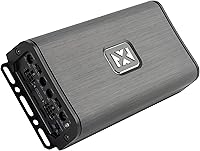
Not suitable for:

The NVX VADM4 v2 4-Channel Amplifier is the wrong choice if you're planning to push high-impedance, power-hungry speakers that demand headroom well beyond 125 watts per channel. Home audio enthusiasts or anyone building a stationary listening setup should look elsewhere entirely — this is a 12V vehicle amp, full stop. If your install requires thick-gauge power wiring routed into tight terminal blocks, the snug wiring terminals may frustrate you during the build, and in an already cramped space that friction compounds quickly. Buyers who want a high-output subwoofer stage as part of the same amplifier will also be disappointed, since this unit is optimized for full-range and midbass duties rather than dedicated sub power. Finally, if you prefer setting gain by ear without careful attention to your source unit's output voltage, the sensitivity of this marine-rated amplifier to mismatched gain levels can introduce noise that takes real effort to dial out.

Specifications

  • Amplifier Class: This unit uses Class D topology, which prioritizes power efficiency and low heat output compared to traditional Class A/B designs.
  • Total RMS Power: Total continuous RMS output is 500W, measured as 125W per channel at 2 ohms and 80W per channel at 4 ohms, certified to CEA-2006 standards.
  • Peak Power: Peak power is rated at 1000W across all four channels under burst conditions.
  • Channels: Four independent amplifier channels allow full active front-stage setups or combined speaker configurations across multiple vehicle zones.
  • Impedance: Stable at both 2-ohm and 4-ohm loads per channel, giving flexibility when pairing with various aftermarket speaker sets.
  • Dimensions: The chassis measures 6.8″ L x 3.3″ W x 1.5″ H, making it one of the more compact 4-channel amplifiers available at this power level.
  • Weight: The unit weighs 1.93 pounds, light enough to surface-mount in locations where heavier amps would require additional structural support.
  • Frequency Response: Full-range frequency response spans 20 Hz to 20,000 Hz, covering the complete audible spectrum.
  • Crossover Modes: Onboard crossover is user-selectable between Full range, High-Pass Filter (HPF), and Low-Pass Filter (LPF) modes.
  • Filter Range: Variable high-pass and low-pass filter frequencies are adjustable between 40 Hz and 400 Hz for precise speaker integration.
  • Input Types: Accepts both balanced differential inputs and standard low-level RCA inputs to accommodate a wide range of factory and aftermarket head units.
  • PCB Protection: The circuit board is treated with a conformal coating rated for marine environments, providing resistance to moisture, salt air, and humidity.
  • Protection Circuits: Four-way protection circuitry guards against thermal overload, electrical overload, speaker short circuits, and DC offset events.
  • Compliance: Meets both CEA-2006 power measurement standards and marine-grade certification requirements for environmental durability.
  • Operating Voltage: Designed to operate on a standard 12V DC vehicle electrical system.
  • Mounting Type: Surface mount only; the chassis includes mounting points for direct attachment to flat or bracket-supported surfaces.
  • Indicators: Onboard LED indicators show active power status and alert the user when the protection circuit has triggered.
  • Manufacturer: Built by NVX, a brand focused on mobile audio components with an emphasis on compact, high-efficiency amplifier designs.

Related Reviews
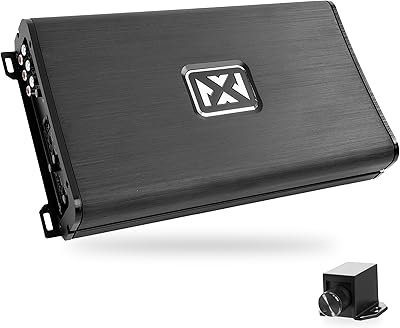
NVX VAD10004 v2 4-Channel Amplifier
87%
88%
Sound Quality
94%
Power Output
91%
Build Quality & Durability
85%
Ease of Installation
89%
Versatility
More
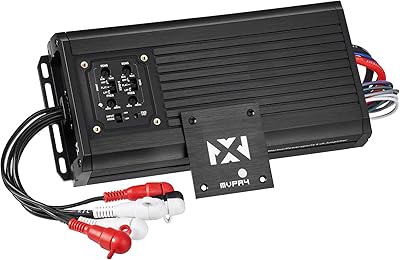
NVX MVPA4 4-Channel Marine Amplifier
80%
91%
Waterproof Protection
88%
Power Accuracy
84%
Build Quality
83%
Sound Quality
92%
Compact Form Factor
More
NVX XQA10004 1000W RMS XQ-Series 4-Channel Amplifier
89%
93%
Sound Quality
91%
Bass Performance
85%
Ease of Installation
89%
Power Output
87%
Thermal Management
More
NVX VADM5 v2 5-Channel Car Amplifier
79%
93%
Compact Form Factor
88%
Installation Ease
67%
Power Output (RMS)
81%
Sound Clarity
62%
Thermal Management
More
Hifonics ZRX1016.4 V2 4-Channel Car Amplifier
79%
88%
Value for Money
82%
Power Output
79%
Build Quality
86%
Installation Experience
74%
Thermal Management
More
Recoil DI800.4 4-Channel Car Audio Amplifier
83%
88%
Sound Quality
92%
Power Output
65%
Thermal Management
84%
Build Quality
91%
Ease of Installation
More
Zoom ZHA-4 Compact 4-Channel Headphone Amplifier
87%
91%
Sound Quality
95%
Portability
75%
Battery Life
88%
Ease of Use
83%
Build Quality
More
Planet Audio PL1600.4 4-Channel Car Amplifier
72%
88%
Value for Money
84%
Ease of Installation
74%
Sound Quality
58%
Power Output (Real-World)
61%
Build Quality
More
Planet Audio AC2400.4 4-Channel Car Amplifier
84%
95%
Power Output
89%
Sound Clarity
87%
Bass Performance
82%
Ease of Installation
65%
Thermals/Heat Management
More
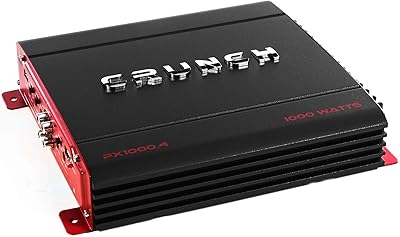
Crunch PX 1000.4 4-Channel 1000W Amplifier
85%
88%
Sound Quality
85%
Ease of Installation
81%
Build Quality
91%
Power Output
93%
Size & Portability
More

FAQ

Yes, and most owners are genuinely caught off guard by how compact it is in person. At roughly 6.8 by 3.3 by 1.5 inches, this marine-rated amplifier fits in spots that would reject virtually any other 4-channel unit. That said, plan your wiring runs carefully before you commit to a mounting location, because the terminals are snug and you need clearance to make clean connections.

It means the power figures on the spec sheet were measured using an independently verified industry standard, not an in-house method designed to produce the most flattering numbers. Many budget amplifiers claim impressive peak wattage that evaporates under real load conditions. With CEA-2006 certification, 125W per channel at 2 ohms is a genuine, reproducible output figure, not a marketing ceiling.

That is genuinely one of its strongest use cases. The conformal-coated marine-grade circuit board is not a cosmetic feature — it is engineered to handle salt air, spray, and humidity over extended periods. Marine owners who have run this compact 4-channel amp through multiple seasons report no weather-related failures, which is consistent with what the coating is designed to do.

It will work with a factory head unit as long as you have access to speaker-level outputs, since the amp accepts balanced differential inputs that can interface with OEM systems. Low-level RCA inputs are also available for aftermarket head units. One thing to watch: if your source unit has a very high output voltage, take time to dial in the gain carefully to avoid introducing noise into the signal chain.

Bridging configurations depend on the specific impedance rating of the amp in bridged mode, and for this unit you should consult the NVX documentation or support team to confirm the minimum safe load before bridging. Running it outside the supported impedance range risks triggering the protection circuitry or causing long-term damage, so it is worth verifying before you wire it that way.

This is one of the more honest trade-offs of a compact chassis. Most owners successfully run 8-gauge power and ground wire, but fitting anything heavier can be a friction point, especially if you are working in a confined space. If your install plan calls for 4-gauge wiring, budget extra time or consider a short run of 4-gauge to a distribution block closer to the amp, then drop to 8-gauge for the final connection.

The onboard LED indicator will signal a protection event rather than just going dark, which gives you an immediate heads-up that something triggered the circuit rather than leaving you guessing. Common causes include a shorted speaker wire, a wiring error during install, or the amp getting too hot in a space with no airflow. Check your speaker wiring and mounting location first; most protection-mode events during initial setup trace back to a wiring issue rather than a hardware defect.

It is a natural fit for that application. Four channels, onboard high-pass filtering, and verified RMS power at both 2 and 4 ohms give you what you need to run a component set actively without external crossovers. The small chassis also means you can tuck it under a seat or in a trunk corner without consuming the space you might need for other components.

Class D amplifiers convert power more efficiently than Class A/B designs, which means significantly less energy is wasted as heat. Owners consistently report that this compact 4-channel amp stays notably cool even during long drives, which also reduces the chance of thermal protection events. That said, you should still ensure reasonable airflow around the unit — mounting it in a completely sealed enclosure with no ventilation is never a good idea regardless of amp class.

The amp itself is sold without an external wiring kit, so you will need to source power, ground, signal, and remote turn-on wiring separately. This is standard practice for amplifiers at this level — bundled kits are often low quality anyway, so purchasing wiring components separately gives you better control over cable gauge and quality for your specific install.

Where to Buy