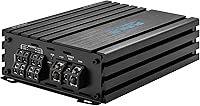
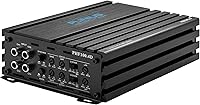
Overview

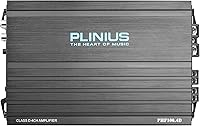
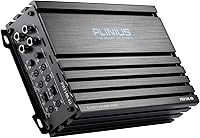
The Plinius PHF100.4D 4-Channel Car Amplifier is a straightforward entry into car audio amplification, built for everyday drivers who want noticeably better sound without spending a fortune. Plinius occupies the affordable end of the market, and this 4-channel amp reflects that honestly — it is not trying to compete with boutique brands, and it does not pretend to. What makes it worth a look is the compact 8.5 x 5.1-inch chassis, which fits where larger amps simply cannot. It also handles full-range audio — speakers and subwoofers — from a single unit, which is a genuine advantage for a first-time builder working with a limited budget and tight space.

Features & Benefits

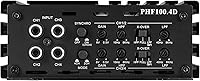
Class D amplification is the right call for in-car use — it runs cooler and draws less current than older Class AB designs, meaning less stress on your vehicle's electrical system during long drives. The MOSFET power supply helps keep voltage regulation stable, translating to cleaner output even when the music gets loud. A signal-to-noise ratio at or above 95dB is genuinely respectable at this price, keeping background hiss out of the picture. This Class D amplifier's crossover flexibility — high-pass from 10Hz to 8KHz, low-pass from 40Hz to 8KHz — lets you tune speaker and subwoofer output without needing an external processor. That is a lot of control packed into a compact footprint.

Best For

This 4-channel amp is a natural fit for anyone replacing a factory stereo for the first time and wanting real improvement without a complicated multi-amp setup. If you are powering a standard four-speaker configuration — two front, two rear — it handles that cleanly from a single unit. Bridging it down to mono also delivers a workable subwoofer channel, handy for a casual bass upgrade without buying additional gear. Compact vehicle owners will especially appreciate the small chassis; it tucks under seats or into tight trunk corners without drama. The internal fusing also simplifies wiring for DIY installers who would rather not source external fuse holders separately.

User Feedback

With 76 reviews and a 4.1-star average, the PHF100.4D draws a fairly consistent picture: buyers are generally pleased with what it delivers for the money, most praising easy installation and clear, punchy sound at moderate volumes. On the flip side, some users flag concerns about thermal performance — the amp runs noticeably warm under sustained loud use — and a few mention the included documentation could be more thorough. There is also a recurring thread around real-world power output; the rated figures feel optimistic relative to the chassis size, so calibrating expectations is wise. Seventy-six reviews is a reasonable starting point, not an exhaustive verdict.

Pros

  • Full-range capability means one amp handles both speakers and a modest subwoofer, reducing total system complexity.
  • Class D efficiency keeps heat output low, which matters a lot in the confined heat-prone environment of a car.
  • The compact chassis fits under seats and in tight trunk corners where most 4-channel amps will not.
  • Internal fusing simplifies wiring for DIY installs — no need to source or mount a separate fuse holder.
  • A signal-to-noise ratio of 95dB or better keeps background hiss out of everyday listening at normal volumes.
  • Flexible crossover controls let you tune speaker and sub output without adding an external processor.
  • At its price point, the PHF100.4D delivers genuinely cleaner sound than most factory head unit outputs alone.
  • Buyers consistently praise the straightforward installation process, even for first-timers with basic wiring experience.
  • The MOSFET power supply contributes to stable output rather than the voltage sag you get with cheaper designs.

Cons

  • Thermal performance under sustained loud use is a real concern — the amp runs hot and needs adequate ventilation.
  • Rated power figures appear optimistic relative to the physical chassis size; real-world headroom is more modest.
  • Included documentation is sparse, leaving first-time installers to rely on outside resources for setup guidance.
  • Bridged mono output is usable for light subwoofer duty only — not a substitute for a dedicated high-power mono amp.
  • Build materials feel entry-level in hand, which raises reasonable questions about longevity over several years.
  • The review pool of 76 ratings is helpful but not large enough to draw firm long-term reliability conclusions.
  • Input sensitivity range may require careful adjustment to avoid noise when paired with certain head unit outputs.

Ratings

The scores below for the Plinius PHF100.4D 4-Channel Car Amplifier were generated by our AI engine after analyzing verified global buyer reviews, actively filtering out incentivized, bot-generated, and outlier feedback to surface what real owners consistently experienced. Both the genuine strengths and recurring frustrations are reflected transparently — no score has been inflated to flatter the product.

Value for Money
88%
For drivers who want a meaningful upgrade from a factory setup without a significant outlay, this 4-channel amp consistently delivers more than buyers expect at its price tier. Reviewers frequently describe it as punching above its weight for everyday commuting and casual weekend listening, where the improvement over stock audio is immediately obvious.
Buyers who push the system hard or compare it to mid-range competitors will notice the gap. At near-maximum volume, the perceived value diminishes because output quality starts trailing off before you reach the limits you might expect on paper.
Sound Quality
76%
24%
At moderate listening volumes — the kind most drivers actually use during daily commutes — the PHF100.4D produces clean, balanced audio with a noticeably lower noise floor than a head unit running speakers directly. The 95dB signal-to-noise ratio holds up well in real-world conditions, keeping background hiss minimal across a standard 4-speaker setup.
Audiophiles and critical listeners will find the sound staging relatively flat, and stereo separation lacks the definition you get from pricier amplification. High-frequency detail in particular feels slightly compressed when the amp is pushed into the upper third of its volume range.
Power Output
63%
37%
For running four standard aftermarket coaxial or component speakers at everyday volumes, the real-world output is genuinely adequate. Drivers with modest speaker sets — particularly those in the 50 to 80 watt RMS range — report that the amp drives them confidently without strain at moderate playback levels.
The advertised power figures draw consistent skepticism from experienced installers, and for good reason — a chassis this compact physically cannot sustain 140 watts RMS per channel under continuous load without thermal intervention. Buyers who wire up higher-sensitivity subwoofers via the bridged output frequently report underwhelming bass headroom compared to what the spec sheet implies.
Thermal Management
54%
46%
During short listening sessions and moderate volume use, the amp stays within an acceptable temperature range without triggering any protection circuits. For drivers doing 20 to 30 minute urban commutes with the music at two-thirds volume or below, heat is rarely a practical issue.
Extended highway drives at higher volumes expose a real weakness — the chassis runs hot, and several reviewers report the amp entering thermal protection and cutting out during sustained loud playback. Under-seat mounting, which this amp is often marketed toward, makes the problem worse by restricting airflow around the unit.
Ease of Installation
84%
The wiring terminals are clearly labeled, and the inclusion of two internal 30-amp fuses removes one of the more fiddly steps from a typical amplifier install. First-timers consistently report getting the amp wired and operational within a couple of hours, even without prior car audio experience.
The included documentation is thin at best — some buyers describe it as little more than a basic diagram — and there are no detailed instructions for bridged mode wiring or crossover configuration. Without supplementary video guides, certain setup steps can lead to wiring mistakes that take time to troubleshoot.
Build Quality
61%
39%
The physical footprint is well-suited to tight installs, and the chassis feels reasonably solid for the price bracket when first handled. Mounting flanges are properly positioned and hold up during installation without flexing excessively.
The overall construction feels noticeably entry-level up close — the casing material, connector finish, and internal component feel all reflect the price point honestly. Long-term durability in high-vibration environments like truck beds or hatchbacks with significant road noise is a legitimate concern for buyers planning a multi-year install.
Compact Form Factor
87%
At 8.5 x 5.1 x 2.0 inches, this Class D amplifier fits comfortably under most passenger or rear seats, which is a genuine practical advantage in smaller vehicles where trunk space is limited or used for other purposes. Hatchback and sedan owners in particular appreciate not having to dedicate cargo space to amplification hardware.
The slim profile does limit internal component density, which likely contributes to the thermal and sustained-power limitations noted elsewhere. Buyers who have experience with similarly priced but physically larger competitors sometimes note that the extra bulk in those units translates to better heat dissipation and more headroom.
Crossover Flexibility
79%
21%
Having both high-pass and low-pass crossover controls built in — spanning 10Hz to 8KHz and 40Hz to 8KHz respectively — means you can shape the frequency split between speakers and a bridged subwoofer without adding an external line output converter or signal processor. That level of onboard tuning is uncommon at this price tier.
The crossover adjustment knobs lack detents or clear calibration markings, which makes precise tuning a bit of a trial-and-error process. Buyers trying to dial in a specific crossover point for a two-way component speaker setup will need a multimeter or a tuning app to confirm they are hitting the frequency they intend.
Channel Configuration
82%
18%
Four discrete channels give installers the flexibility to run a traditional front-rear speaker layout or experiment with a front-stage-only setup bridged to a sub, all from one unit. The full-range capability means this 4-channel amp can serve multiple system layouts without requiring additional hardware at the entry level.
Bridging the amp to mono for subwoofer duty ties up two of the four channels, which limits your ability to simultaneously run a full 4-speaker plus sub setup from this single amplifier. Buyers who want true 4-speaker plus subwoofer coverage will need to add a separate mono amp as the system grows.
Input Sensitivity Range
81%
19%
The 0.5V to 8V input sensitivity range covers virtually every head unit output level on the market, from high-voltage aftermarket preamp outputs down to low-voltage factory head unit signals. In practice, this means the amp pairs with almost any source without needing an additional line driver or signal booster.
At the high end of the sensitivity range, some reviewers note a slight increase in background noise, particularly when using factory head units with noisy ground planes. Getting a truly clean signal in older vehicles occasionally requires additional attention to grounding, which adds setup time for less experienced installers.
Documentation & Support
44%
56%
The product is straightforward enough in concept that experienced installers can set it up without any documentation at all, relying on standard car audio wiring conventions they already know. For those users, the sparse manual is simply a non-issue.
For first-time buyers — arguably the primary audience for this amp — the lack of detailed setup guidance is a recurring frustration in reviews. Brand support responsiveness has not been widely praised either, leaving buyers who run into crossover or bridging questions to figure things out via third-party forums and YouTube tutorials rather than official resources.
Noise Floor
77%
23%
Under normal conditions with a well-grounded install, the PHF100.4D keeps audible hiss out of the picture during quiet passages and between tracks. The 95dB signal-to-noise ratio proves its worth in everyday listening scenarios where silence between songs is a good indicator of amplifier cleanliness.
Grounding sensitivity is higher than ideal — a slightly imperfect ground connection introduces an audible hum that takes some effort to eliminate. Buyers installing in older vehicles or those with complex factory electronics report spending extra time chasing ground loops that a more robust power supply design might have suppressed.
Compatibility
83%
The wide input sensitivity range combined with full-range signal handling makes this Class D amplifier compatible with the vast majority of aftermarket head units sold today. Running standard 4-ohm aftermarket speakers across all four channels is entirely plug-and-play from a compatibility standpoint.
Running 2-ohm loads across all four channels simultaneously is technically supported but pushes the amp harder than most users anticipate, leading to thermal complaints from those who chose low-impedance speakers without accounting for the additional current draw and heat generation involved.

Suitable for:

The Plinius PHF100.4D 4-Channel Car Amplifier is a strong match for drivers who are taking their first real step beyond a factory stereo and want meaningful sound improvement without committing to a complex, multi-component install. If your goal is powering a standard four-speaker setup — front and rear door speakers — from a single, easy-to-wire unit, this 4-channel amp does that job competently. It is especially practical for compact car owners — think hatchbacks, small sedans, or vehicles where trunk or under-seat real estate is genuinely tight — since the small chassis fits where many rivals simply will not. Budget-conscious DIY installers will also appreciate the internal fusing, which removes one more external component from the equation. And if you want to add a modest subwoofer down the road, bridging two channels into a mono output gives you a usable bass channel without purchasing a separate mono amp.

Not suitable for:

The Plinius PHF100.4D 4-Channel Car Amplifier is not the right tool for enthusiasts who demand high output, audiophile-grade fidelity, or plan to run power-hungry subwoofers at sustained high volumes. The rated power figures look appealing on paper, but the compact chassis makes it physically unlikely that this amp sustains peak output for extended periods without thermal stress — experienced builders will recognize that gap. If you are planning a dedicated subwoofer channel with real headroom, a purpose-built mono amp will serve you far better than bridging this unit. Buyers who expect thorough installation documentation may also find themselves doing extra research, as the included materials have drawn complaints for being sparse. And if long-term build quality and component durability are priorities over upfront savings, stepping up to a more established brand at a higher price point is genuinely worth considering.

Specifications

  • Model Number: The unit is officially designated PHF100.4D by the manufacturer Plinius.
  • Amplifier Class: This amplifier uses Class D topology, which prioritizes electrical efficiency and reduced heat output compared to Class AB designs.
  • Channels: The amplifier provides 4 independent output channels, each capable of driving a separate speaker or driver.
  • RMS Power (2 Ohm): Each channel delivers 140 watts RMS when connected to a 2-ohm speaker load.
  • RMS Power (4 Ohm): Each channel delivers 100 watts RMS when connected to a 4-ohm speaker load, the most common impedance for aftermarket car speakers.
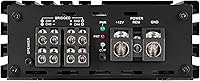
  • Bridged Output: Two channels can be bridged to produce a maximum of 300 watts into a single 4-ohm load, suitable for a modest subwoofer.
  • Power Supply: The amplifier uses a MOSFET-based power supply for stable voltage regulation and cleaner signal output under varying load conditions.
  • Signal-to-Noise Ratio: The rated signal-to-noise ratio is 95dB or greater, indicating low background noise relative to the audio signal during normal playback.
  • Input Sensitivity: Input sensitivity is adjustable between 0.5V and 8V, allowing compatibility with a wide range of head unit output levels.
  • High-Pass Crossover: The built-in high-pass crossover is adjustable from 10Hz to 8KHz, enabling precise control over which frequencies reach full-range speakers.
  • Low-Pass Crossover: The built-in low-pass crossover is adjustable from 40Hz to 8KHz, allowing the amp to direct bass frequencies to a subwoofer when bridged.
  • Internal Fusing: The unit includes two internal 30-amp fuses, eliminating the need for a separately mounted external fuse holder in most installs.
  • Full-Range Support: The amplifier is full-range capable, meaning it can power both traditional speakers and subwoofers from the same unit without an outboard crossover.
  • Dimensions: The chassis measures 8.5 x 5.1 x 2.0 inches, making it compact enough for under-seat or restricted-space mounting in most vehicles.
  • Weight: The amplifier weighs 4.96 lbs, keeping it light enough for single-person installation without additional support hardware.
  • Manufacturer: The product is manufactured and sold under the Plinius brand, which focuses on the affordable segment of the car audio amplifier market.

Related Reviews
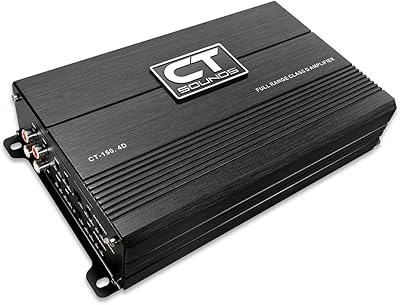
CT Sounds CT-80.4D 4-Channel Car Amplifier
74%
91%
Value for Money
78%
Power Output Accuracy
84%
Installation Ease
61%
Heat Management
67%
Build Quality
More
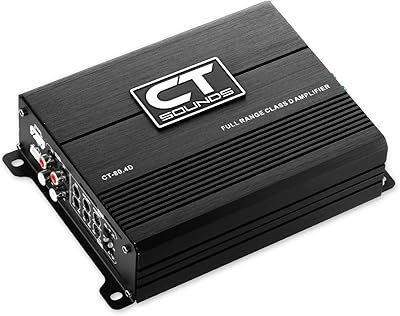
CT Sounds CT-150.4D 4-Channel Car Amplifier
75%
83%
Value for Money
78%
Sound Quality
61%
Build Quality
86%
Ease of Installation
77%
Thermal Management
More
Hifonics Zeus Delta ZD-750.4D 750 Watt 4-Channel Car Audio Amplifier
86%
92%
Power Output
90%
Sound Quality
88%
Heat Dissipation
89%
Ease of Installation
86%
Build Quality
More
Planet Audio AC2400.4 4-Channel Car Amplifier
84%
95%
Power Output
89%
Sound Clarity
87%
Bass Performance
82%
Ease of Installation
65%
Thermals/Heat Management
More
Recoil DI800.4 4-Channel Car Audio Amplifier
83%
88%
Sound Quality
92%
Power Output
65%
Thermal Management
84%
Build Quality
91%
Ease of Installation
More
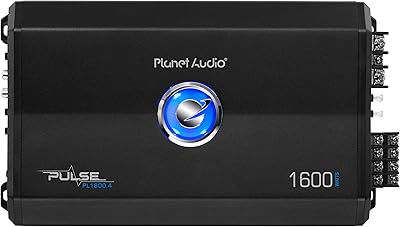
Planet Audio PL1600.4 4-Channel Car Amplifier
72%
88%
Value for Money
84%
Ease of Installation
74%
Sound Quality
58%
Power Output (Real-World)
61%
Build Quality
More
Recoil DI550.4 4-Channel Car Audio Amplifier
74%
91%
Value for Money
78%
Power Output
86%
Ease of Installation
74%
Sound Quality
67%
Build Quality
More
Recoil REA600.4 4-Channel Car Audio Amplifier
84%
89%
Audio Performance
91%
Ease of Installation
85%
Sound Quality at High Volumes
62%
Heat Management
90%
Power Output
More
Planet Audio AC1200.4 4-Channel Car Amplifier
73%
88%
Value for Money
67%
Power Output
83%
Installation Ease
74%
Sound Quality
61%
Build Quality
More
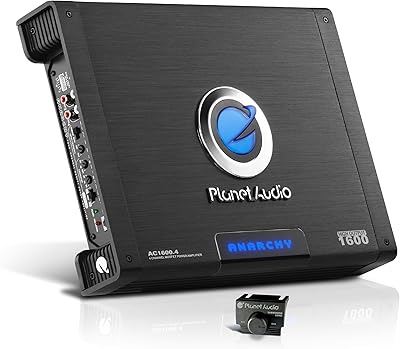
Planet Audio AC1600.4 Anarchy Series 4-Channel Car Amplifier
82%
94%
Power Output
88%
Sound Quality
70%
Ease of Installation
92%
Value for Money
85%
Build Quality
More

FAQ

Yes, that is actually one of the more practical things about this 4-channel amp. You can run your four main speakers across all four channels, then bridge two of those channels together to drive a single subwoofer. Just keep in mind that bridged output works best with a modest sub — do not expect it to push a high-power woofer to its limits.

Bridging combines two amplifier channels into one, effectively doubling the voltage swing and increasing power output to a single speaker or subwoofer. On most 4-channel amps like this one, you connect the positive terminal of your sub to the positive output of channel 1 and the negative terminal to the positive output of channel 2, then set the amp to bridged mode if a switch is provided. Check the included wiring diagram before doing this, and make sure your subwoofer is rated for a 4-ohm bridged load.

Heat is a genuine consideration with this Class D amplifier. While Class D runs cooler than Class AB by design, under-seat mounting restricts airflow, and several users have reported the unit running noticeably warm at higher volume levels. If you plan to listen loud for extended periods, try to leave some clearance around the amp or position it where air can circulate. Avoid mounting it in a fully enclosed compartment with no ventilation.

Treat the rated figures as a ceiling, not a guarantee of sustained real-world output. The 140W RMS per channel at 2 ohms is ambitious for an amp this size, and the consensus among experienced builders is that actual continuous output will fall somewhere below the stated peak. For everyday listening through a standard door speaker setup, it will have more than enough headroom — just do not plan your system around maxing out those rated numbers.

With two internal 30-amp fuses, this amp draws up to 60 amps total at peak, so you should use at minimum 4-gauge power and ground wiring for a proper install. Using undersized wire can cause voltage drop, overheating, or blown fuses under load. Run the power wire from the battery with an inline fuse holder within 18 inches of the battery itself, and keep the ground wire as short as possible to a clean, bare metal chassis point.

Yes, it is designed to work with virtually any aftermarket head unit. The input sensitivity range of 0.5V to 8V covers the output levels of most standard head units on the market. If you are using a factory head unit with low-voltage preamp outputs, dial the sensitivity up accordingly and watch for any increase in background noise at the extremes.

Technically yes, since the amp is rated for 2-ohm operation per channel. That said, running all four channels at 2 ohms simultaneously pushes the power supply harder and will generate more heat than a 4-ohm load. If you go this route, make sure the amp has good ventilation and monitor it for thermal issues during your first few listening sessions.

Most first-timers find this 4-channel amp relatively approachable. The wiring connections are clearly labeled, and the internal fusing removes one common stumbling block. The included documentation is on the thin side, so it is worth watching a general car amplifier installation video beforehand to understand the signal wiring and power routing before you start pulling panels.

For everyday use, 4-ohm speakers are the most practical match. The amp produces 100 watts RMS per channel at 4 ohms, which is a stable and honest operating point for this unit. Most aftermarket car speakers are rated at 4 ohms, so compatibility is rarely an issue with standard component or coaxial sets.

It works fine as a starting point, but plan around its limitations if you expect to grow the system later. The bridged sub output is enough for a small subwoofer now, but if you anticipate adding a dedicated high-power sub stage, you will likely outgrow what this amp can deliver and end up adding a separate mono block anyway. Think of this Class D amplifier as a solid entry-level foundation, not a long-term anchor for a serious build.